The words of the mantra suddenly materialized in my mind and spilled out of my mouth as I drove home, exhausted from the days chores. Simultaneously a sharp pain lodged itself in my lower back. Astonished by hearing myself repeat the familiar words as the pain intensified it took a moment for me to connect the two. I was experiencing family anguish and it was coming through my words and through my body. Although I am not a catholic I repeated Mary’s prayer opening my heart to the person that needed deep comfort. I could sense a door opening…a threshold being crossed.
I had already dreamed that my aunt had died the night she did. “The Queen is Dead”, the dream said. My aunt Terry, a very simple, religious, and loving woman lived her life surrounded by a light that was palpable. Calling her Queen was appropriate. I sent Billy, my cousin, six pure white roses attaching the words “Roses in the Snow” to the card after the phrase appeared out of thin air while I was sitting on the porch at twilight.
This post started as a comment to Annie Finch’s part 1 of Abortion As A Sacrament post. Realizing it was a story that was getting too long, I’m sharing it here as a reiteration of the practical significance of ritual, and finding our way through the no-longer-charted territories of being a female human — in the sense that if we were a female of any other animal form, we would still know exactly how to navigate all the challenges.
I had a years-long pregnancy-related experience in which ritual was the only thing to finally bringing closure, though the real issue was more the other being’s feelings or intent than mine. About a year after the birth of my only child, still nursing full time and using what should have been sufficient birth control, I became pregnant and aborted at Planned Parenthood. I had been well along, not having suspected anything because my menses hadn’t yet returned.
At the time, there was no debate in my mind, if I had added another responsibility to my already excessive load, I would have failed at everything, the most important being my daughter.
No matter which or how many gods we believe in, thinking about what we’ve done wrong and how we can set it straight is useful. The Day of Atonement, the Talmud says, “absolves from sins against God, but not from sins against a fellow man unless the pardon of the offended person is secured.”
Back in the Stone Age, otherwise known as the early 1980s, I had jobs as a technical writer and editor in five different industries, including aerospace and computer development. Hey, I was trained as a Shakespearean scholar, but in those days—pretty much like today—there were almost no jobs in the academy for newly-hatched Ph.D’s. So I tried technical writing. At one of the aerospace jobs, I sat in the “bullpen”—me and nineteen middle-aged white guys—whereas all the other women slaved—on typewriters in that pre-computer age—in the typing pool. There was a major class distinction in that aerospace firm, and I was glad to be with the guys. (Yes, shame on me.) Those were the days of 9 to 5. As far as I’m concerned, that movie is nonfiction.
One of my tech-writing buddies at the aerospace company was a former Jehovah’s Witness who had been disfellowshipped because his beard was the wrong shape and he’d refused to correct it. Another was an older man who had studied with Earnest Holmes himself and had also known Manly P. Hall in earlier days. A third friend, the project librarian, was a Conservative Jew. All three of these guys soon noticed the books I was bringing to read at lunch. These included the works of Dion Fortune and Gerald B. Gardner, and numerous metaphysical authors, plus every book I could find on alchemy, the tarot, New Thought, reincarnation, trance channeling…well, you get the idea. I was exploring occult worlds and ideas. When we weren’t talking about how to help the engineers write gooder English and I wasn’t trying to figure out how a FLIR (Forward-Looking InfraRed) helmet works, my three buds and I had some majorly interesting conversations on comparative religion and the occult (the word means “secret, hidden”) aspects of religions in general.
One day the Jewish librarian brought me a book to add to my library. This was the 1973 edition of The Jewish Catalog. What a wonderful book! I still have it. It’s sitting next to my keyboard as I type this.
Back in those innocent days, I still believed the pagan myth of the nine million witches burned by the inquisition during the Middle Ages. Yes, it’s a myth—there were never that many witches on the face of the earth at the same time; such a holocaust would have nearly depopulated medieval Europe. I have since learned that it is shameful to compare a mythological holocaust with the real Holocaust of World War II. I read The Jewish Catalog from cover to cover and learned a great deal.
Now flash forward to 2002 when the owner of RedWheel/Weiser phoned to ask me to write a book for them. I immediately said yes. The book, which they titled Pagan Every Day, is not, however, a pagan tome. It’s a daybook, a year and a day of short essays on topics that include goddesses, gods, and old pagan festivals and philosophy, and also saints and holy days from Christianity, Judaism, Islam, Hinduism, and Buddhism, plus less well known religions, plus interesting historical events…and then I also named Miss Piggy as The Goddess Of Everything. I get fan emails from people saying they reread the book, a day at a time, every year and still enjoy every page.
For September 24, I wrote about Judy Chicago’s Dinner Party, which was the most amazing exhibition I’d ever seen. The next day that year was Yom Kippur. I turned to my copy of The Jewish Catalog, where I learned about an obscure custom called kapparot. Here is what I wrote. Yes, I believe that we can borrow—but not pirate!—other people’s customs, acknowledge and express our gratitude to those other people and their religions, and then adapt what we borrow to a pagan perspective. After all, we’re all kin.
September 25: Yom Kippur
The Jewish Catalog describes custom called kapparot, which “entails swinging a chicken around one’s head as a…symbol of expiating sins. The chicken is then slaughtered and given to the poor….” Most people these days tie money in a handkerchief and swing that around their head, saying, This is my change, this is my compensation, this is my redemption.
Yom Kippur, the last of the ten days of Yamim Noraim, occurs at nightfall on the ninth day of Tishri. The rites for Yom Kippur are set forth in Leviticus 16.
No matter which or how many gods we believe in, thinking about what we’ve done wrong and how we can set it straight is useful. The Day of Atonement, the Talmud says, “absolves from sins against God, but not from sins against a fellow man unless the pardon of the offended person is secured.” People seeking recovery in Twelve-Step programs likewise turn their lives over to the care of “God as they understand him” (Step 3), make a list of people they have harmed and become “willing to make amends” (Step 8), and then actually make amends (Step 9).
Pagans can make amends before Samhain. We want to have a clean emotional field in which to rest over the winter and plant fresh seeds in when spring comes. Let’s revive that old Jewish custom. But not swinging the chicken! That’s cruelty to swinger and swingee. Tie crystals or red corn or other symbolic items in a clean white handkerchief and swing it around your head, reciting the blessing quoted above. Then go around and see the people you need to see. Speak heart to heart with them. Give them something blessed from your handkerchief. Get on with your lives, as friends or no longer as friends, but not as enemies.
BIO: Barbara Ardinger, Ph.D. (www.barbaraardinger.com), is a published author and freelance editor. Her newest book is Secret Lives, a novel about grandmothers who do magic. Her earlier nonfiction books include the daybook Pagan Every Day, Finding New Goddesses (a pun-filled parody of goddess encyclopedias), and Goddess Meditations. When she can get away from the computer, she goes to the theater as often as possible—she loves musical theater and movies in which people sing and dance. She is also an active CERT (Community Emergency Rescue Team) volunteer and a member (and occasional secretary pro-tem) of a neighborhood organization that focuses on code enforcement and safety for citizens. She has been an AIDS emotional support volunteer and a literacy volunteer. She is an active member of the Neopagan community and is well known for the rituals she creates and leads.
I contend therefore that we have allowed these chemicals to be used with little or no advanced investigation of their effect on soil, water, wildlife and man himself. Future generations are unlikely to condone our lack of prudent concern for the integrity of the natural world that supports all life. Rachel Carson, Silent Spring
Today we are faced with a challenge that calls for a shift in our thinking, so that humanity stops threatening its life-support system. We are called to assist the Earth to heal her wounds and in the process heal our own – indeed to embrace the whole of creation in all its diversity, beauty and wonder. Wangari Maathai
I want you to feel the fear I feel every day. And then I want you to act. Greta Thunberg
We are calling all women and our allies to come together to save the earth that sustains us all. Is it any wonder that from Rachel Carson to Wangari Maathai to the emerging young leader Greta Thunberg, women have been in the forefront of environmental movements for a century? As daughters, sisters, mothers, grandmothers, and aunts, we have long cared and advocated for the most vulnerable among us, the very young, the very old, the disabled, those who are the first to suffer the consequences of climate catastrophe and the many kinds of pollution that are poisoning the earth we share.
“Are you the store manager?” the liquor vendor asks.
“No, I’m just part time. Started this week.”
I am working at a local convenience store on the poor side of town where I now live.
“I’m just doing this part time to pay my basic bills so that I can do what I want.”
“And what is that?,” he asks.
“I have a computer app that is my passion. I host Sacred Circles. I do webinars and events. I just bought ten acres of land, and I want to do things on there.”
Heal. Help.
It rather feels as if I might be able to do that there as well. Because it is not the side of town with all the fancy subdivisions, it feels as if there is more community. These are Alabama locals. And compared to the plastic world that I am more familiar with, 85% of their customers pay in cash. Blue collar work trucks, construction crews, concrete workers, dump truck drivers, electricians and poor people. Women wearing chemo scarves. Another tells me, “I keep losing weight each week. Don’t know why.” Bony. Stumbling. Hobbling. But I watch all of them keep going.
Part 1 was posted yesterday. You can read it here.
Though becoming a witch has been a lifelong, gradual process during which I have enacted and developed many rituals, if I had to choose one moment to mark the time I entered my full witchy power, this would be it. This ritual was the first time in my life that I had been thrown entirely on my own resources as a witch, to craft a ritual that was necessary for my survival and that I had no idea how to obtain in any other way. With this ritual I saved my own life, both in a spiritual sense and on a more literal level, since living with such misery and anger would surely have debilitated my physical health.
A friend who is a therapist tells me that she feels many of the women in her practice who are most troubled carry unresolved grief from abortions, and that therapy doesn’t seem to be addressing it. I used to wonder why, as a person who has successfully used many kinds of therapy, I didn’t seek out therapy after my abortion (although a fabulous book by a therapist, Peace After Abortion, truly was helpful). My sense of it now is that I was suffering, not from a wound within my separate self, but instead, from a more raw and basic need that had to be satisfied outside myself, with others: the simple hunger for the spiritual nurturing of communal ritual at one of the most profound moments of my life, the moment when I encountered not only the blood mystery of birth, not only the blood mystery of death, but both of them combined, together, at once.
There is great insight in this feminist truism from the 1970s: “if men could get pregnant, abortion would be a sacrament.” According to Faye Wattleton’s memoir, this pithy remark was first spoken by a female cab driver as she drove Wattleton and Gloria Steinem to a feminist rally in New York City. We might think of the sacrament part of the quote as an ironic joke, an over-exaggeration for comedic effect. But I began to take the remark much more seriously after I had an abortion myself, as a 42-year old witch and a mother of two, and encountered a profound spiritual depth in the experience. It was then that I finally came to understand the complex web of will, mind, body, heart, and spirit, of family, self, and society, of future and past, that may be summoned and considered and experienced in the choice to end a pregnancy.
By the time I had the abortion, I had considered the decision deeply and—for reasons I needn’t go into here— was sure it was absolutely the right one for myself and our family. The procedure itself was smooth and painless, even beautiful. The doctor was experienced, gentle, and sensitive. The clinic was so aware of the spiritual and psychological dimensions of abortion that I was invited me to choose a lovely smooth small stone to hold during the operation and bury afterwards to create closure. It would be hard to imagine a better abortion clinic experience.
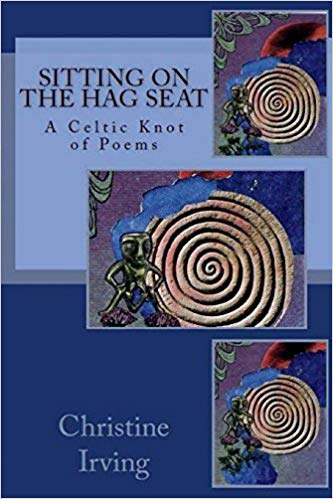
My book Sitting on the Hag Seat carries the blue cover I designed. Buried in the blue, riding the spiral Wheel of Return, stands a small Sheela-na-gig. The Sheela’ s origins remain unknown and controversial. It sometimes seem to me that the less explanation exists for a mysterious object or occasion, the more emotional attachment accrues to the opinions of diverging theorists. However, no matter what symbolism is ascribed to Sheela-na gig, her frequent placement above church doors or in the walls of cities, castles and watch towers, does seem to support a protective aspect not necessarily at odds with other attributions.
We have just passed another marker in the cycle of the seasons – Fall Equinox – the second moment in the circle of the year in which day and night are of equal length. It is a time to begin our quiet reflections on the growth experienced during the previous periods of the year; a time when a greater understanding of balance is sought; a time when our hearts are filled with appreciation for the bounty offered by Mother Earth while at the same time feeling trepidation about the approaching winter.
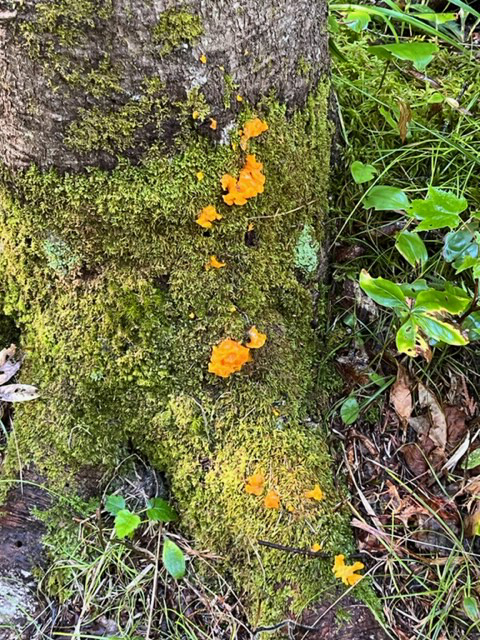
The other day I found the most beautiful fungus on an aging white pine set against deep green moss that was almost arcing over the brook. When I looked up Dacrymyces palmatis I discovered that it’s common name was “Witches Butter.” That figures I thought – this must mean that this plant has medicinal qualities, and of course it does along with the fact that the fungus is edible.
Any time I see the word witch associated with a plant if I am not familiar with it I start digging into research inevitably coming up with the same kind of information – the plant/ tree/ fungus/slime mold is edible and has medicinal value.
The word witch as many of us know has at its root to bend or shape. Shape -shifting by non –ordinary means.