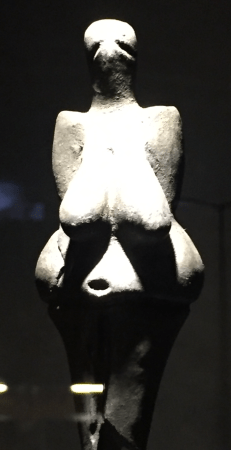
Marija Gimbutas, in her book Language of the Goddess, mentions only one goddess figurine from what was, at the time of her writing, Czechoslovakia (pages 31-32). That figurine comes from Předmosti, in the very eastern part of what is now the Czech Republic. However, there are more, and I would like to introduce you to the one that I encountered during a visit to another part of the Czech Republic several weeks ago.
Meet what Czechs refer to as the Venus of Dolní Věstonice. There is not a lot of information about her, so I have pieced together what I can find. Said to be the oldest known fired terracotta figurine (some 29,000 years old), she was first unearthed in 1925. She was found broken into two pieces at the site of the Stone Age settlement known as Dolní Věstonice, in the southeastern part of the Czech Republic. This settlement, according to Archeo Park Pavlov, was part of the Pavlovian culture, a Stone Age culture local to the area.
Author’s photograph of a replica of the Venus on display at Archeo Park Pavlov.
“Rest is resistance,” journalist Cassady Rosenblum wrote in her recent essay in the New York Times , entitled “Work is a False Idol.”
This statement completely undermines our American work ethic that elevates productivity to the highest altar. Rosenblum, a journalist who left a high stress job, wrote lyrically of the happiness she discovered just sitting on her parents’ porch in West Virginia. Some of her readers were up in arms—how dare she hang out on a porch when she could be working? Who does she think she is? Rosenblum received such a bashing in the comments section, you’d think she was Marie Antoinette torturing puppies.
Rest is a four-letter word, as un-American as Communists were in the 1950s. If you want to provoke the rage of strangers on the internet, publicly praise the joys of taking a sabbatical.
No one knows why Celtic Crosses have a circle. Guesses include pragmatic utilitarianism (to hold the arms up),1 the sun, Greek laurel wreath, Egyptian ankh, circle of creation,2 the Chi-Ro Greek monogram for Christ,3 the divine light that imbues all creation,4 the “Celestial Sphere” found in earlier Eastern Christianity,5 and a range of fanciful inventions based on modern imagination and pseudo-scholarship about Celtic “paganism.” [Leading scholars of pagan history agree that almost nothing is known about pre-Christian beliefs in Britain and Ireland. The few, conflicting descriptions we have, all come from highly tendentious, frequently incorrect foreigners (such as Julius Caesar, who also claimed that German forests were full of unicorns) or from Christian writers of later periods with strong agendas of their own (such as creating a native pagan history and mythology to rival their snobby Greek and Roman “Classical” neighbors).6] The circles on Celtic crosses remain a mystery.
With that in mind, I do not suggest an historical hypothesis here; rather, I offer a theological insight from a modern Feminist Christian perspective. I ask the invitational question: “What happens when modern Christians allow Celtic Crosses to symbolize the Compassing of the Divine Womb?”
When I think about the burning trees I think about women because we are so closely related through myth and story as well as sharing DNA. What is happening to these trees once happened to us… I note that women who normally are not keyed into trees in general seem to be deeply moved by the burning of these ‘elders’. Is that because we feel the threat to the Tree of Life and all that entails manifesting as uncontrolled fire?
The Burning Times
I gaze out my window into the swamp maples that ‘normally’ would have caught fire by the end of September. Not crimson red but bittersweet orange. I note a brownish tinge on the edges of dying leaves. Some have let go, fluttering to the ground. I must find a way to emulate them. Yesterday in the woods I am straining to see brilliance that isn’t there except for an occasional flicker. I don’t realize until I get home that this lack of color is literally depressing a life force that I have identified with my entire life. Accepting these seasonal disruptions is so hard for me – so much harder than I ever imagined.
Dedicated to Kohenet Andrea Jacobson of blessed memory, a deep practitioner of priestess presence
I have always loved obscure biblical women. My wife, who was educated in a yeshiva, marvels at the names and tales I mention to her; she’s never heard of them. Telling their stories, for me, is a form of resistance. They may be minor to the text, but to me they are main characters. As a feminist midrashist, I love digging into a text to find out more, to discover a radical take, to imagine a first-person perspective. As a contemporary spiritual teacher on the trail of the ancient priestesses, I find priestess role models in these hints of story. As the Jewish holiday season ends and we return to finding the sacred in the mundane, I want to share about a character I love, who doesn’t even have a name, but who, to me, teaches about being present, and meeting the mystery wherever we go.
“Manoah’s Sacrifice” by Rembrandt Harmensz. van Rijn 1641.( Source: Wikimedia Commons, public domain, PD-1923)
Judges 13 begins with a traditional biblical scene of annunciation. The wife of Manoah does not have a child. An angel appears to her to say that she will bear a son. He must be a nazir or nazirite and will be a hero, delivering his people from their enemies. A nazir is a kind of self-appointed priest, who has taken a vow not to drink wine or cut one’s hair, and who, like the high priest of the Temple, is forbidden to be near dead human bodies. Such a person’s hair is holy and, at the end of the nazirite service, will be offered on an altar. Both men and women could be nazirites; indeed, the nazirite vow seems to be an avenue where women can become holy. We can see there is patriarchal anxiety about this avenue to priestesshood; Numbers 30 is full of laws about how fathers and husbands can annul the vows of daughters and wives, which likely is partly concerned about women becoming nezirot (sing. nezirah) of their own volition.
I have just spent a week watching four productions of Mozart and Schikaneder’s 1791 opera. Four in a row! Now we all know that I adore musical theater more than almost anything else in the world. Operetta. Nelson and Jeanette. Fred and Ginger. Broadway musicals (but not the movies made from them that rewrote them completely). But opera?? Certainly not Italian opera seria. It’s just too loud. Besides, why isn’t La Boheme sung in French? Carmen in Spanish? Madame Butterfly in Japanese? Aida in Egyptian? Turandot in Chinese?
All right—yes, these are ridiculous questions. I’ve seen La Boheme and Turandot live. I’ve seen The Magic Flute live two or three times. Mozart is my favorite classical composer. Born in Salzburg (which was then part of the Holy Roman Empire and now is the site of an annual Mozart festival), he began composing at age five, and he and his sister Nannerl toured the courts of 18th-century Europe and performed before Louis XVI and Marie Antoinette. (BTW, while much of his story is told in the play and film Amadeus, Mozart was not murdered by Salieri. He died from a highly contagious miliary fever.)
I have been so angry about the Texas law that functionally bans abortion, I have not even been able to find the words to write about it. But alas . . . being angry without taking action is too often what we women do. So, I am forcing myself to focus and write this blogpost. I think the worst part of this law (although there are so many it is truly hard to choose), is how it isolates a vulnerable, pregnant woman. Can you imagine having an unwanted pregnancy and not being able to talk to anyone about it? This law puts a whole women’s support system into legal and financial jeopardy; a mother, sister, friend, doctor, staff at the doctor’s office, therapist, random neighbor and on and on. A woman’s only “legal” option is to talk to a crisis pregnancy center which comes with a hefty dose of political agenda. This is manipulation at this most virulent, cruel, and controlling.
The other night I had a dream about a strange green hooded figure that was guarding a green gate underground. She wasn’t human; she had a hooked bird’s beak (like many of Marija Gimbutas’s goddess figures). Something about the strange face reminded me of an American Indian. This creature was not friendly but she was not hostile either. Just really intent upon making it clear that you did not pass through the gate without her permission. The word Root kept reverberating out loud in this place… Root Woman? Strange that she was also a bird. Anyway, thinking about bird women prompted the following poem and brief reflection on my relationship with one kind of bird…
Tell me, what is it you plan to do with your one wild and precious life?
-Mary Oliver, “The Summer Day”
What did I do, the famous poet asks? Well, I survived, first of all, because that’s first.
Then, I got to ask the question and give an answer.
Then, I wanted to do so much– be a famous poet, too. But, really, so, few get to be that.
And after all, I needed money, so I was a waitress–breakfast, dinner, cocktails, diner, a short order cook, fry cook, prep cook, a janitor, a secretary, a saleswoman…and all that time I was a student. I did theater and one woman shows, and poetry slams and plays and I went to school and got degrees like other people get winter coats—just in case.