
I’ve always been troubled by the story of Boaz found in the Book of Ruth. While there are plenty of biblical narratives that horrify me–Hagar, Tamar, and other “texts of terror” as Phyllis Trible called them–the story of Boaz is uniquely problematic in how it has been interpreted and applied by some Christian traditions, particularly among evangelicals. What is so insidious about this biblical re-telling is how the relationship between Boaz, a wealthy landowner, and Ruth, a foreign widow, is idealized as some kind of romantic love story.
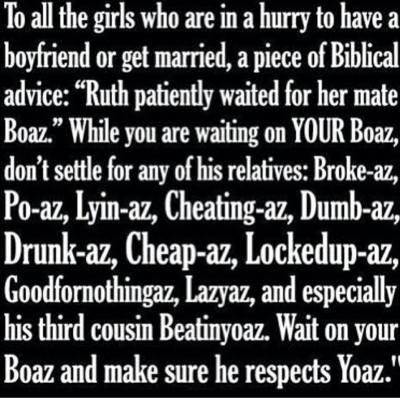
Waiting for your Boaz is a popular blogging platform among single white evangelical women who desire a husband. Their Facebook page alone has nearly 300,000 likes. For purchase on the main site is a book entitled 31 Days of Prayer for your Future Husband: Becoming a Wife Before the Wedding Day. The premise of Waiting for your Boaz is that if single women quit searching for a husband (i.e. dating) and pray for one instead, God will “write your love story” and like a matchmaker, will bring them one eventually.
While there are many troubling theological issues at play in this framework, for this particular piece I will focus on the cooption of the biblical narrative to uphold a worldview in which the fate of women is left to the whims of men and a male God.
In the biblical narrative Boaz is the distant relative of Naomi, Ruth’s mother-in-law. When the women are widowed suddenly and thus left destitute, they return to Naomi’s homeland in Bethlehem. (Orpah, Naomi’s other daughter-in-law who is also a widow, remains in Moab.) With no other known male relatives available to help them, Boaz is the women’s only hope for sustenance. He permits Ruth to glean the leftover crops after his fields have been harvested and instructs the workers not to bother her while she gathers food. While I acknowledge that Boaz acts kindly–or at least neutrally–toward Ruth, we ought not forget the immense power dynamics at play: Boaz is a native, wealthy, land-owning man while Ruth is a foreign, widowed woman with no rights.
At no other point in the narrative is this difference in power more evident than when Naomi insists that Ruth put herself at even greater risk–again for their collective well-being–by offering herself sexually to a drunk Boaz in the hopes that doing so might result in their continued protection.
This is not a fairytale. This is a story of survival.
In the end Boaz does offer Ruth and thus Naomi his protection through marriage. For two widows with no rights whatsoever, this is the best possible outcome, but it comes at great cost: namely Ruth’s bodily safety and autonomy which are threatened not only by her being a foreign woman working in the field, but also by her own mother-in-law’s admonition that Ruth offer herself as sexual collateral.
Single women ought to be praying for this? I think not.
Ruth does not wait. She cannot wait. Like many women, both ancient and contemporary, she uses what little power she has to do what is necessary in order to stay alive at great risk to her personal safety. Instead of admiring Boaz and his benevolent paternalism, our focus ought to be on removing the restrictions and confronting the injustices that leave women like Ruth and Naomi in such desperate circumstances in the first place.
 Katey Zeh, M.Div is a strategist, writer, and speaker who inspires communities to create a more just, compassionate world. She has written for outlets including Huffington Post, Sojourners, Religion Dispatches, Response magazine, the Good Mother Project, the Journal for Feminist Studies in Religion, and the United Methodist News Service. She is the co-host of Kindreds, a podcast for soul sisters. Her book Women Rise Up will be published by the FAR Press in March of 2018. Find her on Twitter at @kateyzeh or on her website kateyzeh.com.


 In the wake of Charlottesville, and following Xochitl Alvizo’s recent post on the topic, I review the May 2017 speech from New Orleans Mayor Mitch Landrieu who made a compelling case for the removal of confederate statues from public view in his southern city. In his argument, he poses a simple question related to how an African American mother or father explains to their 5th grade daughter the reason why a statue of Robert E. Lee holds a prominent visual position on the New Orleans landscape. He asks, pointing to the audience, “Can you do it? Can you do it? Can you look into her eyes and tell her why Robert E. Lee is there to encourage her?” The implication of course is, “No,” because Robert E. Lee is not placed upon high in this stronghold of southern history to inspire her.
  My idleness has been cured as I take a new job teaching college English to high school students at a charter school for eight hours a day. At exactly my 80th and last job application since January 2017, I received the offer just a few hours after my interview and had just a few days to pack up my life and leave. Traveling through desolate flatlands, relieved tornado season was quelled at late summer, I would finally embark on a full-time job, my last one having been almost a decade ago.
 Since patriarchy is atrocious, and capitalism is currently driving the earth to a very real catastrophe, we can get passionate about these issues. We can get angry. We can get self-righteous.
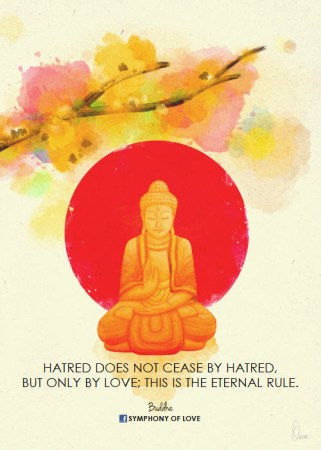 However, as one of the most famous verses of Dhammapada goes:
 Despite having thought
  During this time, I came across the Greek Orthodox prayer rope (komboskini) that had been spontaneously removed from her person and given to me by the Mother Superior of the
  It is in our hearts –one’s sense of superiority exists within. We are all and each capable of hate and bigotry.
 It is quite common, I think, for Jewish feminists to gravitate to the first creation story of Genesis/Bereshit as an example of human equality but struggle to claim this same passage as an example of the goodness of embodiment. Genesis/Bereshit 1:27 reads, “So G-d created humankind in the divine image, in the image of G-d, the Holy One created them; male and female G-d created them.” In this passage, we have not only equality between men and women, in direct contrast to the second creation story, but also a description of human nature.