

 During my ancestor research, I have seen the word “tenement”—with the implication of poverty, filth, and disease–handwritten onto more than one death certificate. Last month, I visited the Lower East Side where my Irish 2x great-grandmother Annie Corliss lived in the tenements near the docks with her husband the Scottish seaman James Inglis and their nine children.
Though the tenements where they lived in the vicinity of Cherry Street a block from the East River have been torn down to build public housing, my newly discovered third cousin Hattie Murphy still lives in the area. She arranged for me to visit the “Irish Outsiders” house in the Tenement Museum on nearby Orchard Street in order to gain an understanding the conditions of life in the tenements in the middle of the nineteenth century.
Tenement housing, which was a euphemism for apartment living in crowded and impoverished conditions, was often built on 25 x 100 foot lots that had been intended for single family homes. These several story buildings with four windows on the front of each floor were divided into small three-room apartments eight to a floor, each with one window facing the street or the back alley.

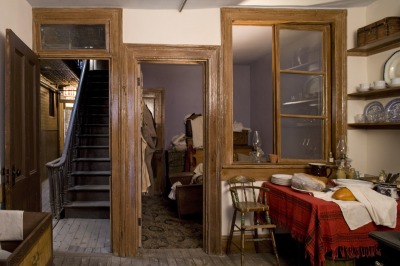
In the apartment we visited, the window was in the sitting room in the front, the bedroom was in the back, and the kitchen was in the center. The kitchen included a coal stove that was the only heating for the house. Laundry hung above the stove, and, as our guide explained, dirty diapers with only “number one” were simply pinned up to dry. Coal dust hung in the air and fell upon everything. Even in the summer when the windows were open, fresh air rarely reached to the kitchen, let alone to the bedroom in the back. Our guide remarked that the smells of cooking, coal, babies, and unwashed bodies would have been overpowering. Despite their poverty, the women purchased pretty dishes, often chipped, at second hand stores, and proudly displayed them.
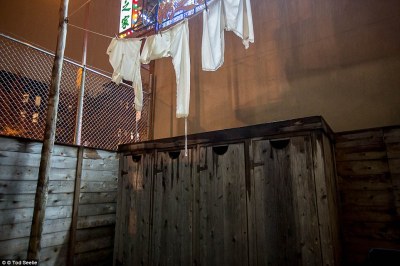
Our visit began in the back “garden” where there were four toilets for twenty-two families. I shuddered to imagine trying to clean them or to run down to use them in the middle of the night. There was a pump for fresh water. The guide handed around a bucket filled with pebbles to give us an idea of the weight the housewives and their children had to lug up flights of stairs numerous times each day. No wonder baths were infrequent. I remember an older Greek friend telling me how they used to wash with a cloth from the waist up one day and from the waist down the next. Annie’s family may not even have managed that.
Our tour included a description of a sick and dying baby and a funeral with the baby’s body laid out in the sitting room. My 2x great-grandmother gave birth to nine children of whom, unusually, the first eight lived to adulthood. Annie must have understood that hygiene is heath. Her days would have been spent fighting to keep her house and her children as clean as she could.
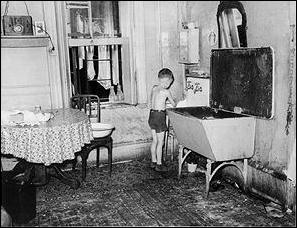
The bedroom in the apartment we visited had a small double bed pushed up against two walls, with just enough room to walk past it to get to a small closet and a few trunks crammed in the space against the back wall. When James the seaman was home, this would have been the marital bed, but when he was gone, the younger children slept with their mother, while the older ones wrapped themselves in sheets and blankets near the stove or in the sitting room.

Anne, age 20, and James “Ingles,” mariner, age 25, husband and wife, living in the area of the docks, appear on the 1855 New York State census. In fact, Annie was perhaps 15, while James was 17. I suspected this was an unusually young age to marry, and research proved me right. The average age for Irish marriages at the time was 20 for the bride and 25 for the groom. Annie would have had every reason to lie about her age for reasons of propriety.
Documents I have only recently found show that Ann “Carless,” age 13 arrived in New York with her mother Mary on January 16, 1854. Her two younger brothers, one 7 and the other an infant, died on the ship. As I could not find Ann’s mother Mary after that, I assume she died soon after arriving, leaving her young daughter on her own.
Annie lived her whole life in America in tenements in the the unsavory area near the docks—filled with bars, drunken sailors, prostitution, and crime. She died at the age of forty-five of a stroke, leaving her husband and eight children. Because of her, I am here.
Also see “The Careless Spirit of Annie Corliss.”
***
 Be among the first to order A Serpentine Path, Carol P. Christ’s moving memoir of transformation. Carol’s other new book written with Judith Plaskow is Goddess and God in the World: Conversations in Embodied Theology. Carol also wrote the first Goddess feminist theology, Rebirth of the Goddess.
Join Carol on a Goddess Pilgrimage to Crete in 2017. Save $200.
Read two of the chapters in the book: Mysteries and Dionysian Rites.
Thanks to Judith Shaw for the cover art “Downward Serpent.”

 I’m back in Las Cruces, New Mexico, spending the break between semesters in the spot where I plan to eventually retire. When I was here last summer (2016), I visited the Unitarian Universalist Church so decided to join the people gathered there on Christmas Day. Not many showed up—about twenty or so. The service was abbreviated. The emphasis was on singing Christmas carols from the hymnal. Unitarian Universalists, it appears, love to sing.
 Even though I encountered wisdom literature when specializing in Hinduism during my Religious Studies doctoral program, through reading the works of Christian female mystics and the liberation theologies of feminist spiritual guides, it took a book I never encountered in my academic studies to give me a spiritual foundation that feels complete after my departure from Christianity: Eckhart Tolle’s
  This is a great day for me as I announce the publication of
  Journeying into the worlds of young adult fantasy enters another dimension with the second series I will be looking at: Laini Taylor’s series Daughter of Smoke and Bone. The series premiered in 2011 and contains three books. Both Daughter of Smoke and Bone and the second book, Days of Blood and Starlight (2012) were on the lists of “Best Teen Book” for Amazon and the New York Times. The first book has already been sent into movie production. This series explores ideas surrounding good versus evil, tolerance, fear, grief, violence, and redemption.
  There is a Greek myth that tells there were fourteen “halcyon days” in every year, seven of which fell before the winter solstice, seven after; peaceful days when the sea was smooth as a pond and the hen-halcyon built a floating nest and hatched out for her young.
 For my dear Feminism and Religion family:
  Marie Cartier
