After being nailed as a witch I separated myself from the word and witch power in general. The word witch had a very dark side and could be used in the same frightening manner as it had been during medieval times to label and to expel any woman who lived on the edge (source of my original sense of unease). Especially one who lived alone in the woods and loved animals like I did.
Why had I been singled out? I was an outsider whose crime was to animate nature. Anything associated with nature was suspect if not ‘evil’.
Feminists beware. If you claim to be a witch – recall that the word is loaded. Personally, I think the label has backfired reducing our overall power as women. Perhaps making us more suspect than we already are.
This post was originally published on Aug. 26th, 2011
Carol P. Christ earned her BA from Stanford University and her Ph.D. from Yale University. She is a founding mother in the study of women and religion, feminist theology, women’s spirituality, and the Goddess movement and work has revolutionized the field of feminism and religion.She has been active in anti-racist, anti-war, feminist, and anti-nuclear causes for many years. Since 2001 she has been working with Friends of Green Lesbos to save the wetlands of her home island. She drafted a massive complaint to the European Commission charging failure to protect Natura wetlands in Lesbos. In 2010 she ran for office in Lesbos and helped to elect the first Green Party representative to the Regional Council of the North Aegean. She helped to organize Lesbos Go Green, which is working on recycling in Lesbos.
My hope for the new blog on Feminism and Religion is that it can become a place for real discussion with mutual respect of feminist issues in religion and spirituality.
I agree with Rosemary Radford Ruether who argued in a recent blog “The Biblical Vision of Ecojustice” that the prophets viewed the covenant with Israel and Judah as inclusive of nature. Indeed in my senior thesis at Stanford University on “Nature Imagery in Hosea and Second Isaiah,” in which I worked with the Hebrew texts, I argued that too. I also agree that the dualism Rosemary has so accurately diagnosed as one of the main sources of sexism and other forms of domination comes from the Greeks not the Hebrews. I agree that Carolyn Merchant is right that nature was viewed as a living being in Christian thought up until the modern scientific revolution. I agree with Rosemary that it is a good thing for Christians to use sources within tradition to create an ecojustice ethic. I am happy that there are Christians like Rosemary who are working to transform Christianity. Finally, I am pleased to admit that I have learned a great deal from her.
Will Catholics be “salt” and “light” in the 2024 election? Cardinal Dolan fails to show the way.
Donald Trump’s parade of vulgarity, racism, misogyny and grift is always on display. He is proud of it. His outrageous lies are his version of “truth,” or as his running mate JD Vance would say, they come “from the heart.” It’s easy to condemn Donald Trump but the more urgent question is how will our vote stack up against our professed values, and for believers, how does it square with our faith?
I am deeply ashamed that Catholics were enablers of Trump’s rise to power. And that Catholics, by a slim but crucial margin, still support Trump over Kamala Harris in seven battleground states, according to a National Catholic Reporter survey of self-identified Catholics.
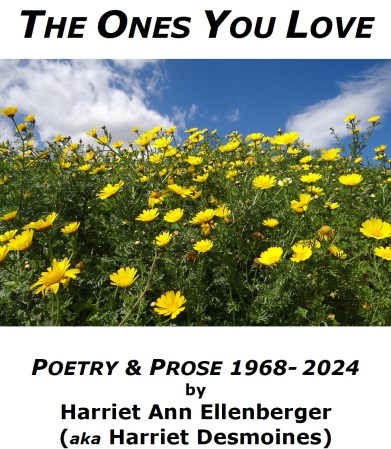
The Ones You Love, Poetry and Prose 1968-2024 is a half-century retrospective love letter from Harriet Ann Ellenberger to friends, family, and lovers; lesbian and overall feminism; lesbian feminist literature and theater; Nature; and those who have been victimized by war. Infusing the book is her overarching love of freedom, not only for herself, but for women, for humanity, and for the Earth. Harriet has been using her authorial and editorial gifts for her entire adult life to move our planet away from extinction into new ways of being, and has now collected her best writings, both prose and poetry, into a single volume. The book is both a brilliant, truthful, unglossed portrait of herself as well as a glimpse into feminism, and lesbian feminism in particular, over decades through one woman’s experience. She often notes in introductions to various pieces that she no longer completely agrees with what she wrote so long ago, but she does not edit out these views, (speaking of her “younger fiery-feminist self,” she says “I’m proud of her courage and proud of the work she undertook” (11)) which offers us a better understanding of both her own progression of thoughts and ideas as well as what issues and points of view were of concern at the time.
Of her most well-known achievement, she writes, “On July 4, 1976, the 200th anniversary of the American Revolution, Catherine Nicholson and I published the first issue of Sinister Wisdom, which has since become the longest-lived lesbian literature and arts journal in the world” (11). She explains the journal’s expansive perspective: “We exist in the interface between a death culture and the faint beginnings of a culture of — not humans — but life-lovers, a culture that embraces animals, plants, stars and those women who choose the future at the risk of their ‘sanity’ and security” (17). This is a vision she has carried with her ever since.
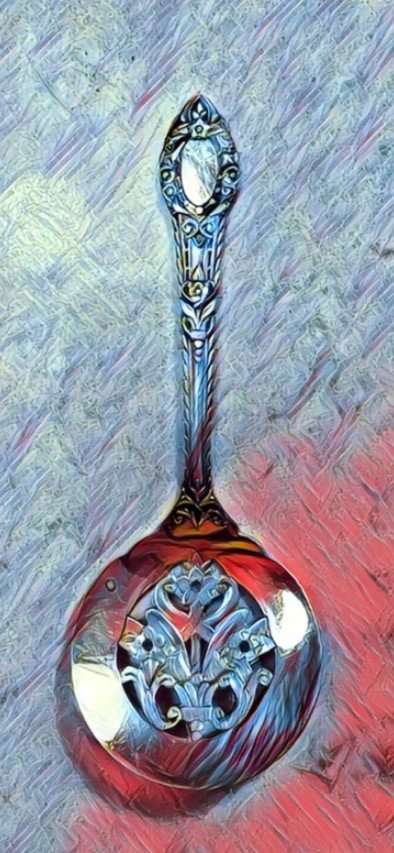
Dressed in filigreed art deco daffodils, dainty and tucked among tailored leaves held proudly — almost defensively. Elegant and demure; your shapely neck flares with grace.
You are such a small and lovely thing: light as a feather and yet you carry the weight of an American woman’s silver-plated dreams.
Like her, you were designed to be admired – fashioned to be lifted lightly. Pretty and proper at the table and placed just so.
Comfortable in your simple life of service. Polished until your delicate silver skin wore thin and the truth within your copper heart could be revealed.
First, understand without doubt: I agree with the anti-genocide protesters (and the progressives who are frustrated about our rigged economy). I couldn’t agree more that we need an arms embargo against Israel. I support the progressives who are protesting at Harris rallies, saying they refuse to vote for any candidate who does not commit to an arms embargo, so that no more US arms will be sent to wage ethnic cleansing against the civilians (mostly women and children) of Palestine. Harris has advocated for a ceasefire, she has met with the protesters, and she has responded politely to their protests against the genocide. But when they continue to chant that they won’t vote for her, she responds, “You know what? If you want Donald Trump to win, then say that. Otherwise, I’m speaking.”
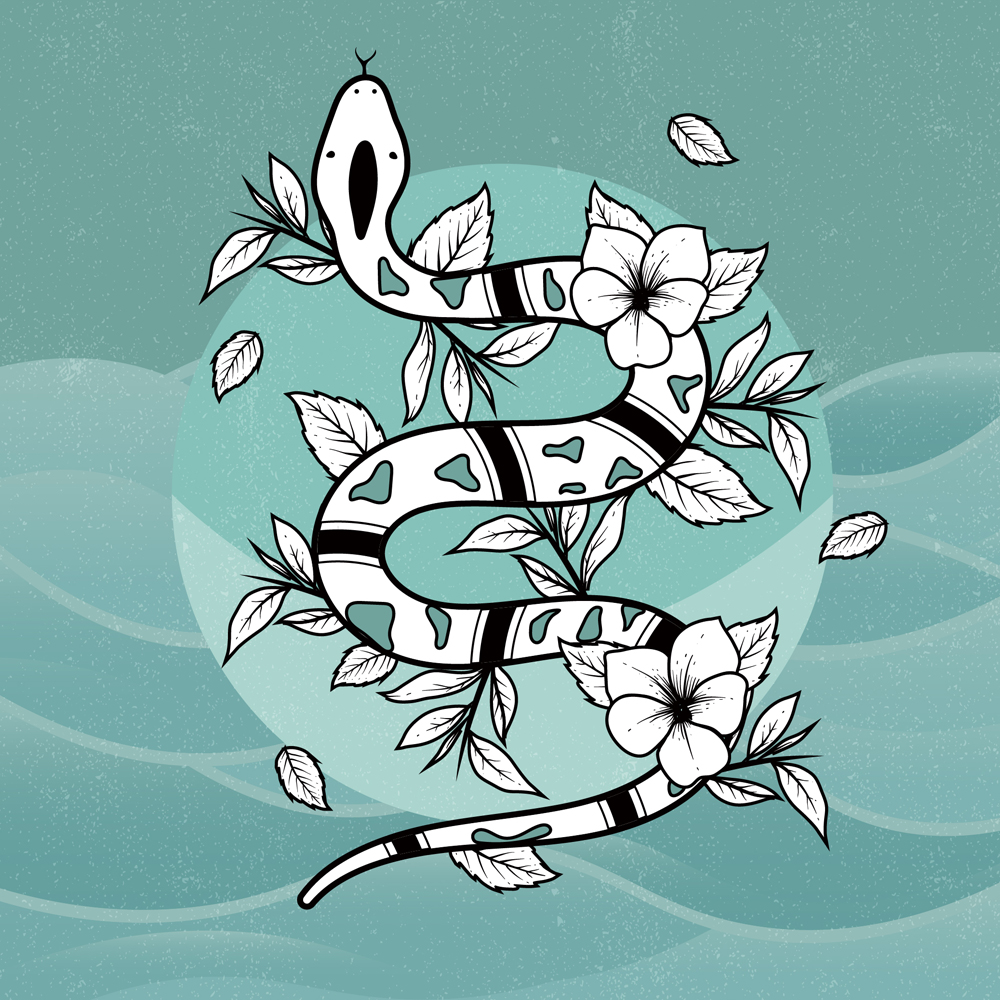
As I write this, water has slowly leaked in my front yard for a day. It has already turned what was dry and brown to moist and green. It seems fitting on the day of Nāga Pañcamī (worship on this particular 5th day of the half moon). It’s fitting that water—apaḥ—has gently made its way to the surface. It has wound around pipes, rocks and roots like a cobra—nāga—to come up to show itself. Though, there are financial challenges in fixing the leak, I can’t help celebrate it as a blessed omen of goodness to come.
After all, it’s arrived for this extra auspicious day in the most favourable month of the vedic calendar. I admit some of my frivolity may be from feeling better on my 5th day of covid. (The significance of the number 5 is not going unnoticed: linked to Patañjali and the great Yoga Sutras.) My mind too feels like it’s been making its way back to the surface. The seepage also keeps bringing me back to thoughts about the watery world of emotions, and new depths of emotions seem to be rising up in me. They feel deeply personal and universal at the same time. The celebration is devotional, the auspiciousness of having this extra time off of work to bring roses to the Mother.
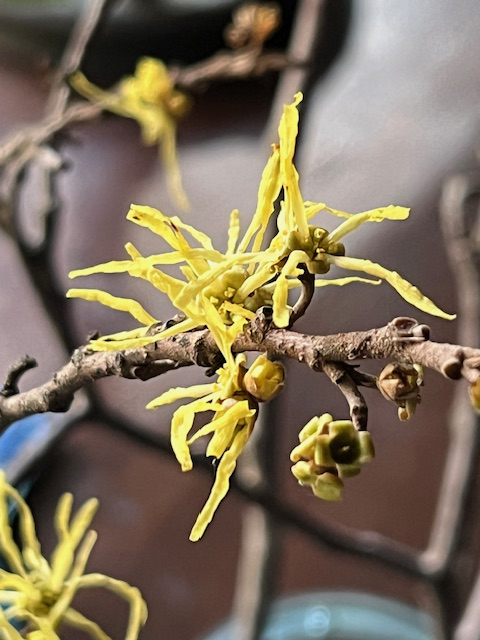
On my grandparent’s farm witch hazel trees were common, sprouting up around old fieldstone walls at the edges of the forest. I loved these trees that bloomed in the fall after all the leaves had fallen. Masses of buttery yellow spindles covered bare twigs. Clusters of blossoms stood out starkly against the trunks of most of the hardwoods – hickory, beech, maple and oak.
As a child I carefully inspected each clump of blossoms. On some branches I found empty seed capsules which I learned much later expelled their seeds all at once the year before. Even these bird beaked pods looked to me like a kind of flower. I also saw little round balls that I later learned were next year’s buds already formed and that the identical looking flowers were either male or female. If I stood beneath a tree, the tangled shapes of the branches wove a loose string -like tapestry above me, one that was often mirrored by a cobalt blue sky.
Some years ago when I was speaking on ecofeminism, womanist theologian Karen Baker-Fletcher posed a question that went something like this: What I am missing in your presentation is reference to ancestors. For black women, this issue is critical.
Baker-Fletcher’s question provoked a process of thinking that continues to this day. For example, I began to notice that when black women spoke at the American Academy of Religion, they often began by thanking their foremothers Delores Williams and Katie Cannon for beginning the womanist dialogue. It is far rarer to hear a white woman thank Valerie Saiving, Mary Daly, Rosemary Radford Ruether, or Marija Gimbutas before her talk.
To the contrary, many white women take great pains to distance themselves from feminist foresisters. I once heard a white woman Biblical scholar tell women students to do work on women in the Bible or other areas of religion without using the word feminist or placing their work in a female or feminist train of thought– if they wanted to get it published. She was very proud that she had used this method and succeeded. In other words, she was following in the footsteps of Mary Daly, Phyllis Trible, and Elisabeth Schüssler Fiorenza but acting as if she had invented the study of women and the Bible herself. The reason for this, she freely admitted, was that male scholars who held power in her field would not respect her work if she used the “f” word. Continue reading “Legacy of Carol P. Christ: Do White Feminists Have Ancestors?”
Throughout the modern ages there have been stories, legends, myths, and historical accounts of threatening people, mainly women, who have been linked with the supernatural, with containing powers, engaging with elements that go beyond the natural world, and who decentralize, shake up, and counter mainstream patriarchal systems and groups. And the predominate word which can be translated and transcend languages is that of WITCH. And since we are in the month of October, when it becomes somewhat acceptable for people to deck their houses with items long been associated with witchcraft, this month’s herstory profiles is diving into all things witchy.
So, lets deconstruct what witches do and how they function in history and in modern times. When we look at the origins of magic – at the very core- is the manipulation of the natural world for supernatural outcomings. Those outcomes can be a range – from conversing with supernatural beings, healings, prophecy, alchemy, transformation, and to even holding secret knowledge. The word magic has origins in Ancient Persian and Proto-Indo-European languages with concepts of “being able to” and to “have power.” If we look at ancient cultures, civilizations, and religions we found multiple variations of people and roles being able to contain, control, and weld magic.



 Feminism and Religion