From the Archives: “Be the Donkey: On Parshah Balak” by Ivy Helman

Author’s note: This post was originally published on this website on July, 10, 2022. This year, Balak was read in synagogues yesterday.

The Torah portion for July 16, 2022 is Balak (Numbers 22:2 -25:9).  Some of what happens in Balak is familiar: idolatry, divinely-sanctioned death penalties, and a plague.  But, did you know that this parshah has a talking female donkey who stands up to abusive behavior?  Perhaps not.  That talking donkey and the larger story of Balak’s attempt to curse the Israelites raises questions about gender, how we treat animals, choices, free will, violence, courage, and having one’s eyes open to what is really happening around one’s self. All of which is what we will be looking at today.

Balak begins with this story about Balaam.  The Moabite king, Balak, wishes to curse the Israelites because he is worried about their size and their impact on the land and its current inhabitants (22:3-4).  He sends representatives to bring  Balaam, a powerful man whose curses and blessings have tangible effects on their recipients (22:6), to him.  Balaam meets with those representatives and tells them to wait; he has to talk to the deity in order to know what to do.  The deity commands Balaam to stay put and to not curse the Israelites, for they are blessed (22:12). Indeed, a first in quite a while. 

Continue reading “From the Archives: “Be the Donkey: On Parshah Balak” by Ivy Helman”

Three poems by Rebecca Rogerson

Don’t Take Me to Church

He never let me eat communion because I wasn’t a catholic, but it was okay for me to eat his dick. My tiny palms forced to stroke him, the same dextrous hands that coloured in the lines. 

I knew his God wasn’t my God. I knew she saw everything there was to see and that he wouldn’t reach salvation; no matter how many Hail Marys he said at mass in Ireland.

The Virgin Mary knew what he stole from me, what they steal from all of us.

I couldn’t fall apart on Sundays at noon when he took me to church—before he took me home after he did what he did—to the little Jewish girl who didn’t know she was Jewish.

I couldn’t remember it because I buried it in Survive, until, it was resurrected by nightmares and demons who professed caring and brought me to altars of despair to vomit up all the darkness, and when there was no more left to cleanse or tear out; light ripped in.


No one talks about the embarrassment that goes along with the telling, sharing and surfacing of sexual violence. How it comes up, how it comes back. How we’re always haunted by the deadbeat dead and grabby grandfathers who try to reach from there into here, pretending they are made of heaven.

I fled a friend’s choir concert because perpetrators keep stealing time, moments, sleep, joy, and friendship, in churches and baths. On my flight, I hunted for nature, soil and anything else that felt most alive in the hilly town of Nelson. Pretending I was like everyone else, I hid the panic that strikes broken hearts.

Continue reading “Three poems by Rebecca Rogerson”

Two Poems by Rebecca Rogerson

ROSE WATER

I am the holy place somewhere in the stars of eternity,
 someone’s daughter who seeks reprieve somewhere.

Yetta changed her name to Mary. She tried to erase her past, not as a Jew, well maybe some of that, but more as a Jew molested by her father—a frum[1], “Monster”, his daughters called him.

On my altar sits my tallit alongside a Menorah with seven brass holders. No stars of David—before or after the decimation of Gaza. Can rose water sweeten our hearts? We pour it graciously in our hands, hoping the lost petals heal our guts and brighten our thoughts. She searches hungrily for hope in glass bottles adorned with Farsi, that cost $4.29 each.

Continue reading “Two Poems by Rebecca Rogerson”

Memorializing Grief and Trauma by Stephanie Arel

On Monday, March 18th, I joined a webinar developed by Dr. John Seitz and Sonia de Silva Monteiro at Fordham University. The panel included myself, Dr. Layla Karst, Assistant Professor of Theological Studies from Loyola Marymount, and Dr. Alana Harris, Reader in Modern British Social, Cultural and Gender History at King’s College London. All offered valuable insights to the topic: “Memorializing Clergy Sexual Abuse: An Interdisciplinary Conversation about the Ethics, Means, and Meanings of Sex Abuse Memorials.” The panel represented one of a series you can follow here.

My presentation featured some things I learned from researching my last book Bearing Witness: The Wounds of Trauma at Memorial Museums. The text focuses on memorial museums, illuminating methods of memorializing human suffering, suffering that penetrates workers’ personal lives. In fact, people preserving painful memories and histories often labor (physically and emotionally) from a place of personal wounding. From nine sites across the globe, 82 interviews revealed that 35% of the people engaged in memorializing mass trauma in a museum setting are survivors of the event they commemorate; 35% are family members of those who suffered or died; and the remaining signify community members, who are not impacted directly by the event or events commemorated but care deeply about those who were.

Continue reading “Memorializing Grief and Trauma by Stephanie Arel”

The Dark Tunnel by Sara Wright

Recently I had a very strange experience. I had fallen and was dumped into a nursing home to ‘recover’.

Since I have written about other aspects of this terrifying experience on this blog and published some pieces elsewhere, I am turning my attention to what happened to me after being drugged senseless, and then being stripped of every aspect of personal autonomy.

After I refused the 17 drugs, I incurred hostility from some nurses and aides who blamed me for having diarrhea and many other infractions none worth mentioning (one of the consequences of stopping the drugs was loose bowels).

 The one medication I needed was routinely withheld. Each time this happened I became more frightened and anxious. Shaky. These same caregivers either ignored me or intoned “all you have to do is relax, breathe”. They dismissed my PTSD/Anxiety disorder as some kind of psychological problem or were too ignorant or indifferent to care.

Continue reading “The Dark Tunnel by Sara Wright”

Emerging from the Underworld: a book review by Eline Kieft

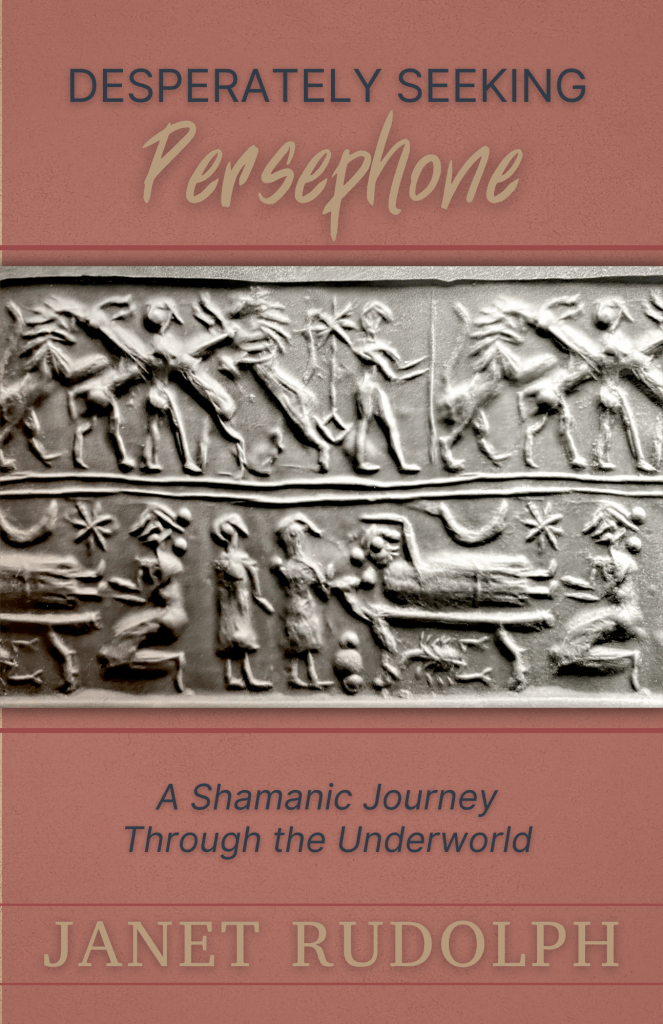
Desperately Seeking Persephone: A Shamanic Journey Through the Underworld by Janet Rudolph weaves together a healing journey from abuse and rape, a deep personal connection with the goddesses Inanna and Persephone, and the ups and downs of a long-term shamanic apprenticeship. These strands could have easily filled three separate books, but Janet masterfully crafts an integrated tapestry of personal and mythical strands. She integrates everyday life experiences, liminal space and the archetypal realms until something new emerges that is more than personal story, more than myth, and more than a description of discovering a shamanic path.

Continue reading “Emerging from the Underworld: a book review by Eline Kieft”

Hear Me! Redux by Winifred Nathan

She Said; He Said 
And How 
She won! He lost!

On May 9, 2023, in New York Supreme Court, “she said,” won. E. Jean Carroll was awarded a judgment of five million dollars in compensatory damages in her defamation and sexual abuse case against former President Donald Trump. YES, she won! He lost!  

How did this happen?

The starting point is looking to a New York state change in its law regarding sexual assault. The assault took place in early 1969. Like many women, Ms. Carroll didn’t seek immediate legal help. She waited until 2019 to file a suit. Her explanation: at her trial, she opined, “I was born in 1943. Women like me were taught and trained to keep our chins up and not to complain.”

In November 2019, E. Jean Carroll did bring her first lawsuit against Donald Trump, which grew from his remarks when she accused him of sexual abuse. The suit was, however, limited to defamation. (Applicable statutes of limitation precluded any potential criminal action for sexual assault.) The Justice Department appealed the case. 

Continue reading “Hear Me! Redux by Winifred Nathan”

From the Archives: Recognizing Abuse by Karen Tate

This was originally posted on March 8, 2019

I’ve been thinking a lot about abuse. Of course, most of us know about the domination, exploitation and  need for control meted out by patriarchy, but I wonder if we have actually normalized many abuses? Abuse in the home, in the workplace, in our culture. Perhaps  we accepted it unconsciously because so many of us are conditioned by religions that tell us to make noble sacrifice and tolerate suffering silently. I wonder if we’re calling it out when we see it – often and loudly – or if we’ve become conditioned to quietly accept the abuse with little push back.

My intent is not to offend anyone with this. I want to find common ground and defeat the polarization we find around us, but our President is the poster child for abusive behavior.  Do we recognize his lies and fear-mongering and so many of the ideas he gives credence and license to as abuse?  Not only is he eroding our democratic institutions but he poisons the political, social and cultural arena with negativity, fear and hate, rather than uplifting us and encouraging us to evolve and be the best version of ourselves. I equate him to poison in a well from which we must all drink.

Continue reading “From the Archives: Recognizing Abuse by Karen Tate”

Marketing in the New World and Karen Tate’s New Book on Normalizing Abuse by Caryn MacGrandle

Marketing was my thing in college.  And my first professional job out of college was in Marketing at the Regional Headquarters of Canon in Dallas.  And then my life took me out into the weeds: a marriage to an Airforce pilot following him to the snow filled tundra of North Dakota, the swamps of Mississippi, two divorces, four children, twists and turns and ups and downs all landing smack dab to where I sit in front of my computer at the moment outside of Huntsville, Alabama at 53 finally feeling like I’ve got somewhat of a handle on this crazy ride called Life or at least a better idea of how to buckle in and enjoy the ups and get through the downs.

Continue reading “Marketing in the New World and Karen Tate’s New Book on Normalizing Abuse by Caryn MacGrandle”

Legacy of Carol P. Christ: FORGIVENESS or TRUTH: WHICH IS THE BEST REMEDY?

This was originally posted on March 5, 2012

What happened to you really was bad. This should not happen to any child. It should not have happened to you.

In our culture there is often a rush to forgiveness that precedes acknowledging the harm that has been done. When I was a child and my father yelled at me or withheld love, I was told by mother, “He really does love you. He just does not know how to show it.” She sometimes added, “Even though he will never say he is sorry, you should forgive your father, because he did not really mean what he said.”

Continue reading “Legacy of Carol P. Christ: FORGIVENESS or TRUTH: WHICH IS THE BEST REMEDY?”