Keyvermestn by Janet Madden

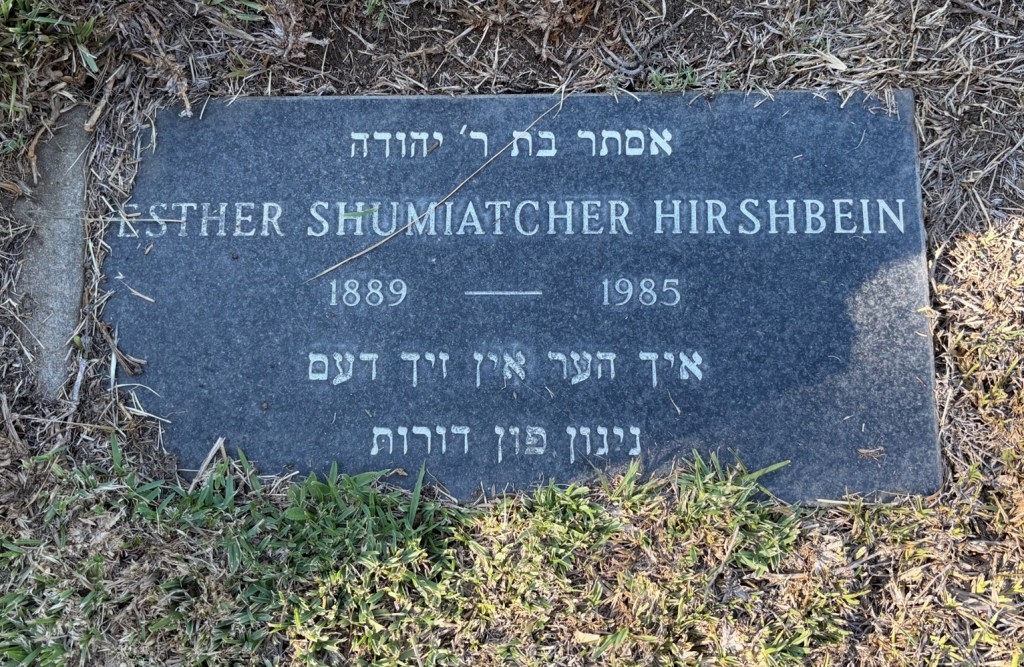
in memory of Esther Shumiatcher-Hirschbein

1.
On a sunny Elul afternoon
I kneel at your grave
a sprig of rue in my pocket.
I recite a tkhine for visiting the graveyard
and imagine that you know this ritual–
stretching string to calculate
the space your body inhabits.
The unspooling wick rests gentle
on rough-cut grass, touching
the edges of mortality,
its twists separating and connecting worlds:
the dead and the living
the past and the now
mine and yours,
a woman I never met,
a writer dead these 40 years.

Continue reading “Keyvermestn by Janet Madden”

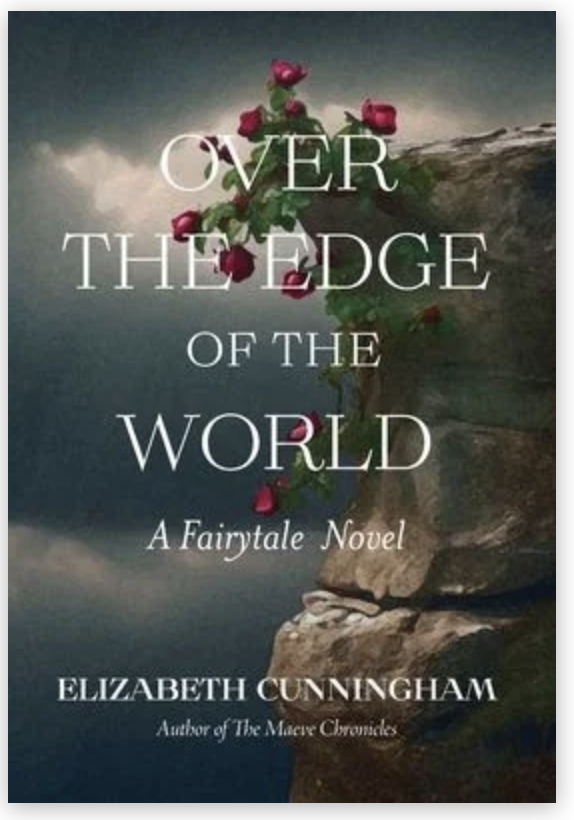
Elemental Grannies: Snippets from Over the Edge of the World, A Fairytale Novel by Elizabeth Cunningham

Introduction: An old woman, Rose begins spinning the tale the children never tire of hearing. Grannies Sweep, Spark, Dirt, and Brine, were old, so old, they forgot who they were and how they came to live where they did: a sheer pinnacle, a walking forest, an old shoe, a ship moored off a hidden shore.

But Rose has never told the whole story—to anyone. The story of a world these children have never seen, where the rich lived inside a vast dome, protected from heat and cold, rain, wind—and hunger. Nor do the children know about madness or cruelty. She has never told them about Noone, the power behind the dome, his obsession with immortality.

If she never tells these stories, who will remember the bravery of the beauty singers who daily risked the ultimate penalty—being thrown over the edge of world. Who will remember the intrepid children who danced defiantly on the dung heaps. If Rose does not tell her own story, who could imagine her birth deep inside the dome, the dangerous secret of her existence. A secret guarded her two huge aunties, once ragged outside boys, who became outrageous bodyguards in towering wigs and heels. To protect the new world and the people she loves, it is time for Rose to tell…

Continue reading “Elemental Grannies: Snippets from Over the Edge of the World, A Fairytale Novel by Elizabeth Cunningham”

From the Archives: Forgive Me My Ancestor(s) by Elizabeth Cunningham

This was originally posted on January 19. 2020. An ‘Update Note’ has been added at the end of the post.

Elizabeth Cunningham

When I was a child in the 1950s we often played cowboys and Indians. There is a photograph of my brother and me in no doubt inauthentic costume complete with feathered headdress. In kindergarten I named myself Morning Star. (I just googled and see that I must have gotten the name from the 50s television series Brave Eagle, the first with an indigenous main character. Morning Star is the female lead.)

When I was a teenager, my aunt came across a privately printed book The Gentleman on the Plains about second sons of English aristocracy hunting buffalo in western Iowa. My great grandfather accompanied them as their clergyman. I wish I could find that book now to see how this enterprise was presented. In my adolescent mind these “gentlemen” looked like the local foxhunters in full regalia. On opening morning of foxhunt season an Episcopal clergyman (like my father) was on hand in ecclesiastical dress to bless the hunt and then invited to a boozy breakfast.

Continue reading “From the Archives: Forgive Me My Ancestor(s) by Elizabeth Cunningham”

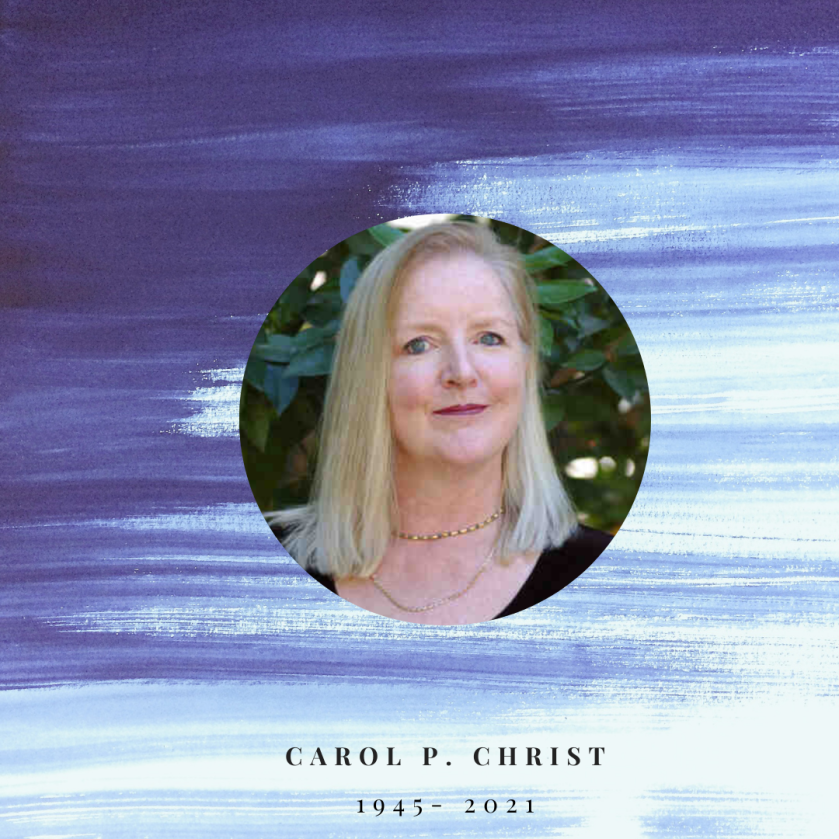
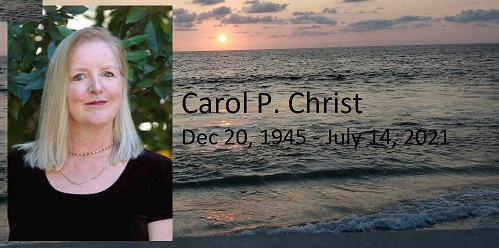
Legacy of Carol P. Christ: Connection to Ancestors in Earth-based Theology

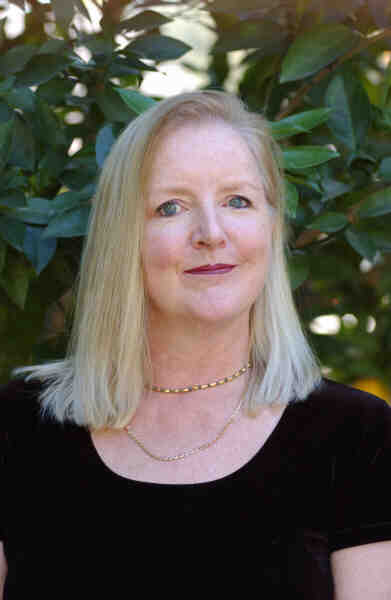
carol p. christ 2002 color

This post was originally published on Jan. 14th, 2013

“I am Carol Patrice Christ, daughter of Jane Claire Bergman, daughter of Lena Marie Searing, daughter of Dora Sofia Bahlke, daughter of Mary Hundt who came to Michigan from Mecklenburg, Germany in 1854.  I come from a long line of women, known and unknown, stretching back to Africa.”

Like many Americans, my ancestral history was lost and fragmented due to emigration, religious and ethnic intermarriage, and movement within the United States.  Though one of my grandmothers spoke proudly of her Irish Catholic heritage and one of my grandfathers acknowledged his Swedish ancestry, I was raised to think of myself simply as “American,” “Christian” and “middle class.”  Ethnic and religious differences were erased, and few stories were told.

Over the past two years, I have begun to discover details of my ancestral journey, which began in Africa, continued in the clan of Tara, and was marked by the Indo-European invasions.  In more recent times, my roots are in France, Holland, England, Germany, Ireland, Scotland, and Sweden.  In the United States, my family has lived in tenements in New York City and Brooklyn, in poverty in Kansas City, and on farms in Long Island, Connecticut, upstate New York, Michigan, and Pennsylvania.  My parents and grandparents settled in northern and southern California during the 1930s.  I have lived in southern and northern California, Italy, Connecticut, New York, Boston, and now Greece.

Learning details about family journeys has created a shift in my sense of who I am.  Continue reading “Legacy of Carol P. Christ: Connection to Ancestors in Earth-based Theology”

Legacy of Carol P. Christ: A Daughter of the American Revolution and a Daughter of Quaker Slave Owners in Long Island, New York

This post was originally published on June 4th, 2012

I did not ever think that genealogical research would reveal that I am descended from slave owners.

My family’s early American roots are in New York and the upper Midwest—not in the American South. While watching genealogy programs that reveal slave-holding ancestors in the lines of white and black Americans with roots in the South, I have breathed a sigh of relief accompanied by the thought–not me!

I have not expended a great deal of energy researching Searing ancestors who settled in Hempstead, Long Island in the 1640s, because my Uncle Emery had already traced the family line. Bored one afternoon and wondering if my ancestor Samuel Searing had left the Hempstead Quaker community because he fought in the Revolutionary War, I entered the Searing family surname into a general internet search.

I found that my 4x great-grandfather Nathaniel Pearsall–whose daughter Sarah and her husband Samuel Searing are my 3x great-grandparents–is indeed listed for “patriotic service” in the Daughters of the American Revolution database.  As an anti-war activist, I wish there had never been a revolutionary war–we could all have been Canadians!  I would have been pleased to learn that my ancestors were all Quaker pacifists. Still, I must admit that I felt a twinge of pride to be able to trace my ancestry back to our country’s beginnings.

Continuing to follow up links to Searing ancestors, I stumbled upon the wills John and Elizabeth Searing. John was a brother of my 5x great-grandfather, Jonathan Searing.

In the name of God, Amen, April 22, 1746. I, John Searing, of Hempstead, in Queens County, being very sick. My executors are to pay all my debts. I order all my negroes to be sold, except the oldest negro boy; Also my wheat, except enough for family use. I leave to my wife Elizabeth, one bed and furniture and a side saddle, and the use of 1/2 my farm, until my children are brought up…

In the name of God, Amen, November 27, 1760. I,Elizabeth Searing, of Hempstead, of Queens County, being sick. I leave to my son, John Searing, my negro man and a bed and three blankets, etc. To my daughter, Mary Searing, a negro girl, and she is to have clothing and linen of mine so much as my other two daughters have had. …  I leave my granddaughter, Mary Searing, daughter of my son Jacob, a negro girl, and to my daughter Anne long cloak, and the rest of my apparell to my daughters.

If I am a daughter of the American revolution, I am also a daughter of Quaker slave-holders. It is well-known that the Quakers were among the most vociferous abolitionist voices in America.  Who would have thought that Quakers had also owned “negroes.” How did this come about? Continue reading “Legacy of Carol P. Christ: A Daughter of the American Revolution and a Daughter of Quaker Slave Owners in Long Island, New York”

Legacy of Carol P. Christ: Touching Roots: An Incredible Lightness Of Being

This was originally posted on Jan. 7, 2o13

A few days ago, a German-speaking friend spoke with an Eiloff relative of mine who lives in St. Nikolaus, Saarland.  My relative remembered hearing the story that Heinrich Eiloff, my 2x great-grandfather, emigrated to the United States in the mid-1800s.  Since we connected, I am experiencing an incredible lightness of being.

This is the first time my two years of genealogical research have led to a “Kunta Kinte” moment, a connection with a relative in “the old country.”  I have been unable to trace most of my ancestors back to the places of their birth. 

My relative in St. Nikolaus was perplexed by a call from Greece from a woman claiming to represent his American relative. But when she explained that I only want to find my roots and perhaps visit relatives in St. Nikolaus, he said, “that would be very nice.”  He promised to speak with other living relatives and said we should call in a month or two and he would tell us what he found.

Continue reading “Legacy of Carol P. Christ: Touching Roots: An Incredible Lightness Of Being”

Legacy of Carol P. Christ: THE CARELESS SPIRIT OF ANNIE CORLISS: TRUMPING DESPAIR IN THE NEW WORLD

This was originally posted on April 2, 2012 and updated on December 30, 2016

Annie Corliss was my great-great-grandmother. The Corliss name, also spelled Corlis, Corless, Corlies, Corlers, and Carlis, is derived from “careless” meaning someone who is “carefree” or “happy-go-lucky.”

Annie Corliss was the daughter of James and Mary Corliss, both born in Ireland. Her parents may have been tenant farmers, but given that their surname could refer to someone who doesn’t settle or own property, they may have been Irish Travellers– itinerant craft persons and traders, sometimes called tinkers because they mended cooking pots and farm implements.  “Irish Travellers are a traditionally nomadic people of ethnic Irish origin, who maintain a separate language and set of traditions. … Irish Travellers have their roots in a Celtic (and possibly pre Celtic) nomadic population in Ireland.”

Continue reading “Legacy of Carol P. Christ: THE CARELESS SPIRIT OF ANNIE CORLISS: TRUMPING DESPAIR IN THE NEW WORLD”

Legacy of Carol P. Christ: A CLASH OF CULTURES IN OUR GENES

This was originally posted on February 27, 2012

I carry the exact replica of MDNA handed down from mother to daughter since the depths of the last Ice Age 17,000 years ago.  My father carries  the YDNA of the Indo-Europeans handed down from father to son since the time when his male ancestors invaded Europe about 5000 years ago.   

My female ancestors moved with the seasons as they gathered fruits and nuts, roots and greens to feed their families. Some of them may have blown red ochre around their hands to leave their marks in ritual cave-wombs.

Mitochondrial DNA is passed down exclusively from mothers to their children. My MDNA “T2b” was given the name “the clan of Tara” by Bryan Sykes in The Seven Daughters of Eve.  According to Sykes the earliest female ancestor with this gene lived about 17,000 years ago, perhaps in Tuscany.

Most Europeans–male and female–are related to only eight or ten female ancestors. Going further back, all Europeans, Asians, and Aboriginal Australians are related to the women among the San “bushmen” who left Africa 100,000 years ago. The San are one of 13 lineages in Africa that can be traced back to a single African foremother. We really are one big family.

Continue reading “Legacy of Carol P. Christ: A CLASH OF CULTURES IN OUR GENES”

Legacy of Carol P. Christ: I am Beginning to Understand

This was originally posted on Feb. 13, 2012

Elizabeth Kelly Inglis died in 1927 at age 62 from complications of a stroke. Secondary causes were malnutrition and exhaustion.

When I was a child, my father, though he was very close to his own parents and sister, spoke very little about his ancestors. I knew that both of his parents lost their fathers when they were small children. I was told that the Christs were German and the Inglises were Scottish and Irish. My grandmother Mary Inglis Christ was as Irish as the day is long. She prayed to the blessed Virgin and took me to church with her in the early mornings where she lit candles and whispered the rosary while fingering faceted lavender beads. She voted for Kennedy because he was Irish and Catholic—to the horror of my father and his father who had no use for the Democrats. My grandmother sometimes cried when she showed us photographs of her family, especially when she pointed to her sister Veronica, called Very. I sensed that my grandmother felt sad to have left her family in New York when she moved with her husband and children to California during the depression, but I was too young to understand fully. As far as I know, I never met any of the relatives from her side of the family, even when I moved to “back east.”

Continue reading “Legacy of Carol P. Christ: I am Beginning to Understand”

Legacy of Carol P. Christ: Body, Nature, Ancestors

This was originally posted on January 23, 2012

Some years ago, womanist theologian Karen Baker–Fletcher asked about ancestors following a lecture I gave on the body and nature.  I have since come to realize that ancestors are a missing link between the two:  we cannot speak adequately of embodiment and interdependence in the web of life without recognizing the ancestors whose lives made ours possible.  Our mothers quite literally gave us our bodies.  All of our ancestors gave us their genes.  Care and callousness with origins going back longer than conscious memory was imprinted on the psyches of our parents and grandparents and transmitted to us.  All of our ancestors give us connections to place.  While many black people in America can recite oral histories that begin with slavery in the United States, I come from a family where stories of origin for the most part were not valued or told.  Both of my father’s parents lost their fathers when they were very young, and my father, who was raised Catholic at a time when Catholics were discriminated against, preferred to think of our family as “American now.”  Like the hero of the film Lost in America, most members of my family dreamed of “melting right into that pot.” In the process we lost stories we need to help us to understand ourselves and the complex realities that “becoming American” involved.

Continue reading “Legacy of Carol P. Christ: Body, Nature, Ancestors”