A New Glossary for Crete: The Power of Naming and the Study of History by Carol P. Christ

carol-christThe words we use affect our thinking. In the case of ancient Crete the repetition of the terms “Palace,” “Palace of Knossos,” “King Minos,” “Minoan,” “Priest-King,” and “Prince of the Lilies” shape the way we understand history–even when we ourselves know these terms are incorrect. We must engage in “new naming.”

Ariadne. May have been a name of the Goddess of pre-patriarchal Crete. The ending “ne” signifies that Ariadne is not of Greek or Indo-European origin and thus predates the later Greek myths.

Ariadnian. The name I have given to the Old European pre-patriarchal culture of Crete, from arrival of the Neolithic settlers from Anatolia c.7000 BCE to the Mycenaean invasion c.1450 BCE. Arthur Evans named the Bronze Age (c.3000-1450 BCE) culture of Crete “Minoan” after King Minos of Greek mythology, son of Zeus and Europa, husband of Pasiphae, father of Ariadne, whose gift of the secret of the labyrinth to Theseus led to the downfall of her culture. Evans assumed that Minoan Crete was ruled by a King.

This image I call “Ariadne Dancing” could become the new “icon” of Ariadnian Crete.

minoan woman dancing

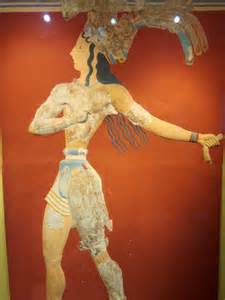
It could and should replace the “icon” of  the “Priest-King” Arthur Evans’ “imaginatively” reconstructed and named the “Prince of the Lilies.”

 prince of the lilies

Once we remove the crown which probably belonged to a Sphinx, the figure’s white color and athletic body suggests it was intended to portray a young female bull-leaper leading a bull. Continue reading “A New Glossary for Crete: The Power of Naming and the Study of History by Carol P. Christ”

THE LABRYS: A RIVER OF BIRDS IN MIGRATION by Carol P. Christ

carol-christ“There’s a river of birds in migration, a nation of women with wings.” Goddess chant, Libanalabrys seal ring

On the Goddess Pilgrimage to Crete, I explain that many of the names given to “Minoan” (c. 3000-1450 BCE) Cretan artifacts and architecture are products of patriarchal and Eurocentric imaginations, and as such, are misleading.  For example the name “Minoan” was given to the culture of Bronze Age Crete in honor of “King Minos,” who was said to have ruled in Crete a few generations before the Trojan War–several hundred years after the end of the culture to which his name was attached.  In fact, despite his eagerness to find evidence that King Minos ruled at Knossos, the excavator Sir Arthur Evans finally had to concede that the best he could do was to produce a fresco of a “Prince of the Lilies” which he identifed as the image of the male ruler of the culture he called “Minoan.”  Evans’ Prince had white skin, a fact that Evans conveniently overlooked–because according to his own interpretation of “Minoan” iconography, white skin would mark the figure as female.  Mark Cameron, who reviewed Evans’ reconstruction of the fresco, suggested that the Prince is more likely to be a young woman who is perhaps leading a bull to take part in the bull-leaping games.  He also stated that the “crown” belonged to another fresco altogether.

Evans’ failure to find evidence of a King or for that matter a Queen at the complex of buildings he called “The Palace of Knossos” calls into question his idea that these structures were palaces.  Nanno Marinatos argued that the “palace” was instead a ritual center for the surrounding village, as well as a community gathering place, a place for storing grain, wine, and oil in a sacred way, and a place where ritual objects were fashioned of clay, bronze, stone, and gold.  Following her lead, I renamed the “Palaces” “Sacred Centers.” In this blog I will experiment with renaming the “Minoan” culture “Ariadnian,” after the pre-Greek name Ariadne, which may be one of the names of the Goddess of Bronze Age Crete.

One of the most pervasive–and many would say–most enigmatic symbols of the Ariadnian culture is the labrys.  Continue reading “THE LABRYS: A RIVER OF BIRDS IN MIGRATION by Carol P. Christ”