3 Taoist Secrets for Embodying your Life

Taoism is an ancient Chinese philosophy and spiritual tradition that offers a unique perspective on life, existence, and human experience. Where many religious practices aim to transcend and sometimes even punish the body, Taoism cultivates a deep connection with our physical self in ongoing relationship with nature around us. 

This resonates with my own experience, in which I see the body as starting point and place of return for everything we do in life. Leaving the body in order to meet spirit or the divine has never made any sense to me. 

In this article I’ll highlight a few elements of Taoism as an embodied philosophy, specifically zooming in on principles and practices that promote holistic wellbeing and inner peace.

Continue reading “3 Taoist Secrets for Embodying your Life”

Paradigm Shifts: Playing the long game

You’re probably tired of hearing it… We live in a time of major change. But hardly anyone acknowledges that change doesn’t happen overnight. 

In anthropology and ritual studies, the state of change between the old and the new, is called liminal or threshold space. It is the in-between time. I believe we are living in such a time now. Our familiar frames of reference are crumbling, yet there are no clear new ones in place yet. 

In this post I reflect on a few aspects of this long-dance with the unknown.

Continue reading “Paradigm Shifts: Playing the long game”

Activate your Body to Navigate Overwhelm

We live in a time of radical change, in a steam cooker of accelerated alchemy. No wonder most of us struggle with chronic overwhelm.

Beliefs, habits, thought patterns and organisational structures don’t change overnight, and we need ways to boost our resilience in the long arc of paradigm shifts. How can we look after ourselves during this personal and collective dance of change?

In this post I reflect on the connection between movement and health, breathing, and the role of our nervous system. I propose 5 simple steps to minimise and transform overwhelm when it happens.

Continue reading “Activate your Body to Navigate Overwhelm”

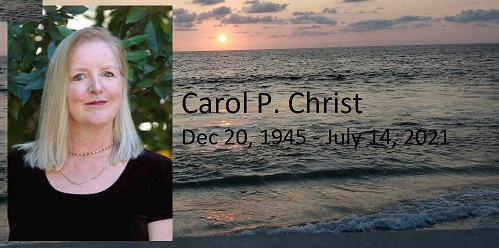
The Legacy of Carol P. Christ: GOD AND WOMAN AT YALE*

This was originally posted on June 25, 2012

As a graduate student, I was told in every way possible that I could not be a woman and a theologian.

When I was studying for my Ph.D. at Yale in theology in the late 1960s and early 1970s, my skirts were short as was the fashion of the day.  The male faculty and students and their wives dressed in ways that would not call attention to themselves or their sexuality.  I was also over 6’ tall.  When I walked into a room, I was consciously and unconsciously perceived as a threat to a world which these men had simply assumed was “theirs.”  Their response was to categorize me as a sexual being (I was once introduced as “our department bunny”) and to erase my mind.  I was to discover that the male graduate students were making bets in the dining hall about “where she will sit today.”  One of my friends frequently fell down and feigned to “worship” me when I passed him in the hallways.  I had never received so much attention from men before and it was flattering.

Continue reading “The Legacy of Carol P. Christ: GOD AND WOMAN AT YALE*”

Intellectual Curiosity as Holy Devotion by Chris Ash

IMG_0754A significant part of my spiritual practice involves exploring the tension of opposites  – learning to create and grow in the space between polarities without feeling obligated to choose one over the other as my truth. Immanent or transcendent? Both. Embodied or abstract? Depends on the context. Intellectual or spiritual? Yes, please.

My panentheistic view of divinity means that I find truth, wisdom, and spiritual insight in the manifest universe, how it works, and the principles that underlie its transformation. This makes my spiritual worldview embodied, in the sense that the divine is found in my body, in the bodies of those I meet, and in the cosmos as the body of God. It also brings sacred meaning to intellectual pursuit and development. Continue reading “Intellectual Curiosity as Holy Devotion by Chris Ash”

GOD AND WOMAN AT YALE* by Carol P. Christ

As a graduate student, I was told in every way possible that I could not be a woman and a theologian.

When I was studying for my Ph.D. at Yale in theology in the late 1960s and early 1970s, my skirts were short as was the fashion of the day.  The male faculty and students and their wives dressed in ways that would not call attention to themselves or their sexuality.  I was also over 6’ tall.  When I walked into a room, I was consciously and unconsciously perceived as a threat to a world which these men had simply assumed was “theirs.”  Their response was to categorize me as a sexual being (I was once introduced as “our department bunny”) and to erase my mind.  I was to discover that the male graduate students were making bets in the dining hall about “where she will sit today.”  One of my friends frequently fell down and feigned to “worship” me when I passed him in the hallways.  I had never received so much attention from men before and it was flattering.

At the same time, I was being told by these men that of course “no one expected me to finish my degree because I would marry and have children” and that “all of the jobs should go to men who have families to support.”  The “generic male,” as in “when a man finishes his PhD,” was the common language of both faculty and students.  If I protested, I was reminded that I probably would not finish my degree anyway.  I dated two of the other students in my first year, fell in love with one of them and lost my virginity to the other.  They both dumped me.  I was being told in every way possible that I could not be a woman and a theologian.  There was such a disconnect between the way I was perceived and the way I perceived myself that I came close to suffering a mental breakdown. Continue reading “GOD AND WOMAN AT YALE* by Carol P. Christ”