What’s Your Feminism I.Q.? by Barbara Ardinger

Let’s begin a new year by finding out what we know about feminist history and goddess scholarship. Take this little quiz and find out where you stand as a Feminism/Goddess Scholar. (It’s okay to laugh at some of the choices. Laughing shows you’re paying attention.)

1. Who wrote When God Was a Woman?

            a. Ernest Hemingway                         b. Merlin Stone

            c. Sharyn McCrumb                           d. Isabel Allende

Continue reading “What’s Your Feminism I.Q.? by Barbara Ardinger”

My Grandmother’s Clocks

Four hands
are spiraling
around a circle
breaking time
into increments.
 Resonate bells
 call up dark nights,
independently
ushering in a season
without need
 to harmonize.
Percussive voices
soothe an aching
heart overflowing
with grief.
Chimes intoning
the inside out.

Recently I gave myself an expensive gift. I had my two beloved clocks cleaned and oiled, and now both are ticking and chiming again.

Today they circle time.

Continue reading “My Grandmother’s Clocks”

Carol Christ Symposium ~ Call for Papers by Mara Lynn Keller ~ Deadline for Proposals this Week!

Carol P. Christ
A Symposium in Celebration of Her Spiritual-Feminist Activism and Women’s Spirituality Scholarship

“The Goddess is the intelligent embodied love that is in all being.”
~ Carol P. Christ

Free Symposium via Zoom hosted by
Women’s Spirituality Graduate Studies Program California Institute of Integral Studies
October 22, 2021. 10:00 am to 4:00 pm

Call for papers focusing on Carol P. Christ’s scholarship and activism in the key areas of Women’s Spirituality, Goddess Studies, Ecofeminism, and Women and Religion.*

Please speak to what you think and feel are Carol P. Christ’s most important contributions to one of the academic fields listed below, and then also, to how her writings are important to you personally. We will arrange papers into the following six panels of 3-4 presenters.

  1. Ecofeminist Philosophy and Activism 
  2. Goddess Studies and Egalitarian Matriarchal Studies 
  3. Spiritual Feminism and Peace Activism 
  4. Spiritual Feminist Literary Criticism  
  5. Women and Religion
  6. Women’s Spiritual Pilgrimage 

Please send an abstract of your proposed paper (in 300 words or less) to Mara Lynn Keller at mkeller@ciis.edu, by Wednesday, September 16, 2021. Acceptances will be sent out Friday-Monday, 9/24-27/2021. Papers are to be 12 minutes in length.  

*Primary Sources include:

  1. Diving Deep and Surfacing: Women Writers on Spiritual Quest (1986)
  2. Woman Spirit Rising: A Feminist Reader in Religion, anthology co-edited with Judith Plaskow (1992)
  3. Odyssey with the Goddess: A Spiritual Quest in Crete (1995) 
  4. Weaving the Visions: New Patterns in Feminist Spirituality. Anthology co-edited with Judith Plaskow (1989) 
  5. Laughter of Aphrodite: Reflections on a Journey to the Goddess (1987)
  6. Rebirth of the Goddess: Finding Meaning in Feminist Spirituality (1998)
  7. She Who Changes: Re-imaging the Divine in the World (2004)
  8. Goddess and God in the World: Conversations in Embodied Theology. Co-authored with Judith Plaskow (2016) 
  9. Carol’s blogs on Feminism and Religion can be found at: Carol P. Christ (feminismandreligion.com)

In addition to the panels, the Symposium will include:        
In Memoriam: Ritual Honoring Carol’s Life and Death (1946-2021)
Circle of Remembrance: Personal reminiscences and reflections on Carol’s life and work.


Talking about Death with my Daughter & Remembering Carol Christ

Recently, facing the reality that I do not have definitive or perhaps, static “answers” for my little one when she asks me about death, I find comfort in Carol’s words—in the idea that I don’t have to “answer” my daughter with one, forever “truth.” Because I have to ability to give her “enough,” at least for now.

As I sit down to write, I am reminded of a post I wrote many years ago entitled “Where Do Cat’s Go,” about my mother’s cat, Mimi, who passed away at the age of twenty-four. At that time, I was struggling with what death meant outside of an Evangelical Christian ideology. I had rejected the doctrine of heaven (and hell) itself; but doubt lingered. Fear still held sway over my emotions. I wanted to “believe in,” something else. Whether to regain control or simply for comfort, I hoped for new belief.

Carol Christ, who has touched so many of us, who was my teacher and whom I miss, replied to that post (paraphrasing here), “Why does [Mimi] have to go anywhere? Isn’t it enough that she is a loved and remembered part of life?”

At the time it was not enough. But recently, facing the reality that I do not have definitive or perhaps, static “answers” for my little one when she asks me about death, I find comfort in Carol’s words—in the idea that I don’t have to “answer” my daughter with one, forever “truth.” Because I have to ability to give her “enough,” at least for now.

 As a feminist mom, I frequently think about what will give my daughter strength and a sense of her value outside of hetero-patriarchal standards. I am also an ex-vangelical agnostic married to an atheist. He and I want our daughter to have choice in her spirituality and freedom to explore her own directions. I think this is a good commitment, though it is frequently a little more difficult in practice. My partner wants to protect our daughter from all religion and Christianity in particular. I tend to take an educational approach, answering her questions about spiritual matters with, “well, people believe all sorts of things about that,” then listing several beliefs or mythologies that might give her some information on the matter.

Continue reading “Talking about Death with my Daughter & Remembering Carol Christ”

Remembering Karolina by Judith Shaw

judith shaw photo


Early in the morning of July 15, 2021, I was sitting amid the chaos of boxes in my new home which I had just closed on a week earlier. I had woken at 5 am to a leak in the new roof and was feeling very tired and somewhat dazed by all the work to be done. Then I got a text with the news that Carol Christ had passed away the previous day.  It took a few minutes for that reality to sink in past my state of overwhelm and exhaustion and then the tears and the memories flooded through me. 

Carol and I became friends in 1987 when we both had begun living on the Greek island, Lesvos, in the village of Molyvos. At that time Carol was mainly using her Greek name, so for many years I called her Karolina. As the months wore on we discovered our mutual interests –  in Goddess, in social justice, in living a life more connected to nature and in the desires of younger women to kick up their heels and have some fun. We became constant “parea” (company) for each other. 

Continue reading “Remembering Karolina by Judith Shaw”

Beltane and Greek Easter: Mary and the Goddess by Laura Shannon

Today, May 1, we celebrate Beltane, the Celtic festival between the Spring Equinox and the Summer Solstice. Starting tonight, we also celebrate Greek Easter, with its ritual drama of life and death. 

In the Western Church, Easter never falls as late as May, but in the Orthodox calendar, Easter and Beltane more or less co-incide every few years. It’s a reminder of connections between Christian and pre-Christian traditions, both in the archetypal cycle of life, death, and regeneration, and in links between the Christian Mary and the pre-Christian Goddess in her various names and forms.

Continue reading “Beltane and Greek Easter: Mary and the Goddess by Laura Shannon”

God’s Womb by Joyce Zonana

The first time I came across the phrase, I thought I must be making a mistake. “Que Dieu l’enveloppe dans sa matrice,” the passage read in French, “May God’s womb enfold her.” or possibly, “May God enfold her in His womb.” His womb?

Joyce Zonana
The first time I came across the phrase, I thought I must be making a mistake. “Que Dieu l’enveloppe dans sa matrice,” the passage read in French, “May God’s womb enfold her,” or possibly, “May God enfold her in His womb.” His womb?

I’d just started translating Ce pays qui te ressemble [A Land Like You], Tobie Nathan’s remarkable novel of Egypt’s Jews in the first half of the twentieth-century, and I couldn’t be sure I was correct in thinking that “womb” was the proper rendering for “matrice.” But a quick search confirmed my hunch. Matrice (from the Latin matrix < mater) might be translated as “matrix” or “mould,” but that made no sense here. “Uterus or womb” was the anatomical meaning, and it was the first meaning listed in my French dictionary.

The phrase, or something very like it, kept turning up, always after a dead person was named:  

Que Dieu accueille son âme en sa matrice.

Que Dieu l’enveloppe dans sa matrice.

Que Dieu la berce dans sa matrice. 

May God’s womb welcome his soul.

May God’s womb enfold him.

May God’s womb cradle her.

In all, “God’s womb” is mentioned seven times in this novel set in Cairo’s ancient Jewish quarter, Haret al-Yahud. Each time, it’s part of a ritual prayer, a formulaic wish for the wellbeing of a departed soul. But what extraordinary wellbeing is wished for here, what a remarkable envisioning of God as the possessor of a welcoming, warm womb. Continue reading “God’s Womb by Joyce Zonana”

Forty Days After Childbirth, Mary Returns to the World by Laura Shannon

All week we have been warming our spirits at the sacred fire of Candlemas / Imbolc, the Celtic holiday in honour of Brighde, Irish saint and Goddess of poetry, smithcraft and healing. Imbolc falls approximately 6 weeks between the winter solstice and the spring equinox, one of the 8 festivals of the Celtic year.
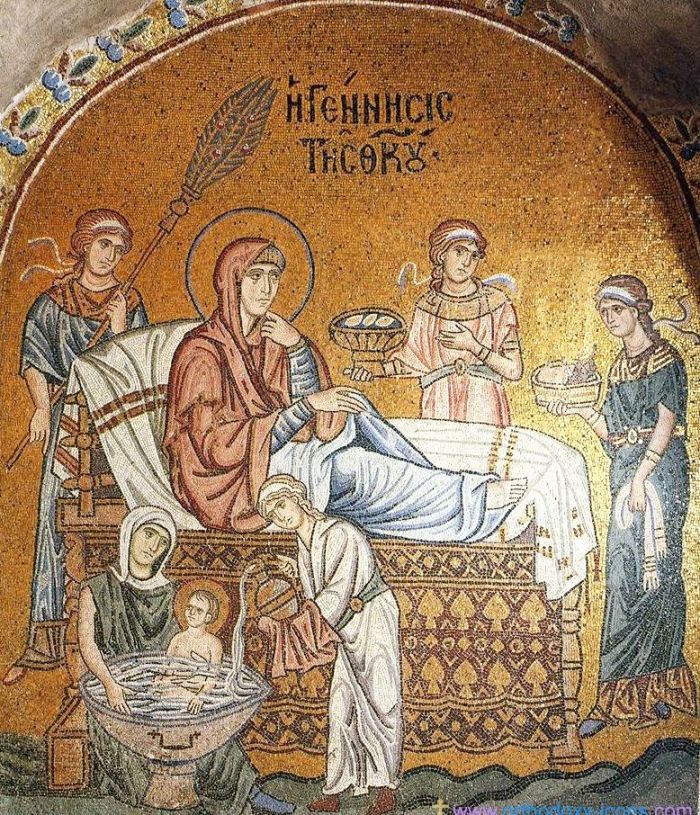
In the Greek Orthodox Church, February 2 is celebrated as Ypopantis, the presentation of Jesus at the Temple, 40 days after his birth, in accordance with Mosaic law. This day also marks Mary’s ritual return to the world after forty days of postpartum seclusion. This practice was known in the Western Church as ‘churching’ or blessing a new mother after 40 days; Hindu tradition also recommends women spend up to 40 days in rest and isolation after childbirth.

image of Mosaic of the Nativity
Mosaic of the Nativity

In the west, the customs of confinement and churching have dwindled since the 1960s, but in Greek Orthodox tradition until very recently, these forty days of isolation for mother and child were routine. A special word, lechóna (λεχώνα), from the ancient Greek for ‘bed’ or ‘couch’, denotes a woman in this special time. Continue reading “Forty Days After Childbirth, Mary Returns to the World by Laura Shannon”

The Navajo Mountain: A Feminist Perspective Chant by Sarah Wright

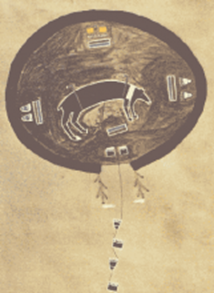
Mountain Chant image
Frighten Him On It – Sand painting used in the Mountain Chant, circa 1907″ by E.S. Curtis

Like the Navajo Night Chant celebrated at winter solstice the Navajo Mountain Chant is the last important winter ceremony, one that marks the shift in seasons and the return of the light. The Mountain Chant was once nine days in duration; today it has apparently been shortened to a four – day ceremony. It is celebrated in early February and each night different holy songs are sung.

The Mountain Chant is also a very complex healing series of ceremonies. Elaborate sand paintings are created and then destroyed after each healing. Disease may be diagnosed by either a woman or a man, but a Medicine man always leads the ceremonies. The intention is to cure a person of the disharmony that is creating the illness. The ceremonies are also enacted to pray to the holy people (Yei) for rain, and to receive assistance with the crops, and most importantly they are done to restore balance and harmony between the People and nature. Continue reading “The Navajo Mountain: A Feminist Perspective Chant by Sarah Wright”

Living with Uncertainty by Sara Wright

I was deeply moved by Carol’s willingness to share deeply personal feelings about how her visit to the hospital , enough so that I decided to write about how the Covid virus has impacted my life and the lives of those around me.

Here in my corner of the world summer is a time to be outdoors, and so returning to Maine in the early spring has allowed me to be emotionally present in a joyful way for Nature’s turnings, first from winter to spring, and then from spring to summer. But I am a naturalist and only too aware that my love for the wild is not shared by everyone.

Because I have no family, the longing to be with loved ones does not pierce my heart in the same way it does for others. Continue reading “Living with Uncertainty by Sara Wright”