God’s Womb by Joyce Zonana

The first time I came across the phrase, I thought I must be making a mistake. “Que Dieu l’enveloppe dans sa matrice,” the passage read in French, “May God’s womb enfold her.” or possibly, “May God enfold her in His womb.” His womb?
Joyce Zonana
The first time I came across the phrase, I thought I must be making a mistake. “Que Dieu l’enveloppe dans sa matrice,” the passage read in French, “May God’s womb enfold her,” or possibly, “May God enfold her in His womb.” His womb?

I’d just started translating Ce pays qui te ressemble [A Land Like You], Tobie Nathan’s remarkable novel of Egypt’s Jews in the first half of the twentieth-century, and I couldn’t be sure I was correct in thinking that “womb” was the proper rendering for “matrice.” But a quick search confirmed my hunch. Matrice (from the Latin matrix < mater) might be translated as “matrix” or “mould,” but that made no sense here. “Uterus or womb” was the anatomical meaning, and it was the first meaning listed in my French dictionary.

The phrase, or something very like it, kept turning up, always after a dead person was named:  

Que Dieu accueille son âme en sa matrice.

Que Dieu l’enveloppe dans sa matrice.

Que Dieu la berce dans sa matrice. 

May God’s womb welcome his soul.

May God’s womb enfold him.

May God’s womb cradle her.

In all, “God’s womb” is mentioned seven times in this novel set in Cairo’s ancient Jewish quarter, Haret al-Yahud. Each time, it’s part of a ritual prayer, a formulaic wish for the wellbeing of a departed soul. But what extraordinary wellbeing is wished for here, what a remarkable envisioning of God as the possessor of a welcoming, warm womb. Continue reading “God’s Womb by Joyce Zonana”

Forty Days After Childbirth, Mary Returns to the World by Laura Shannon

All week we have been warming our spirits at the sacred fire of Candlemas / Imbolc, the Celtic holiday in honour of Brighde, Irish saint and Goddess of poetry, smithcraft and healing. Imbolc falls approximately 6 weeks between the winter solstice and the spring equinox, one of the 8 festivals of the Celtic year.
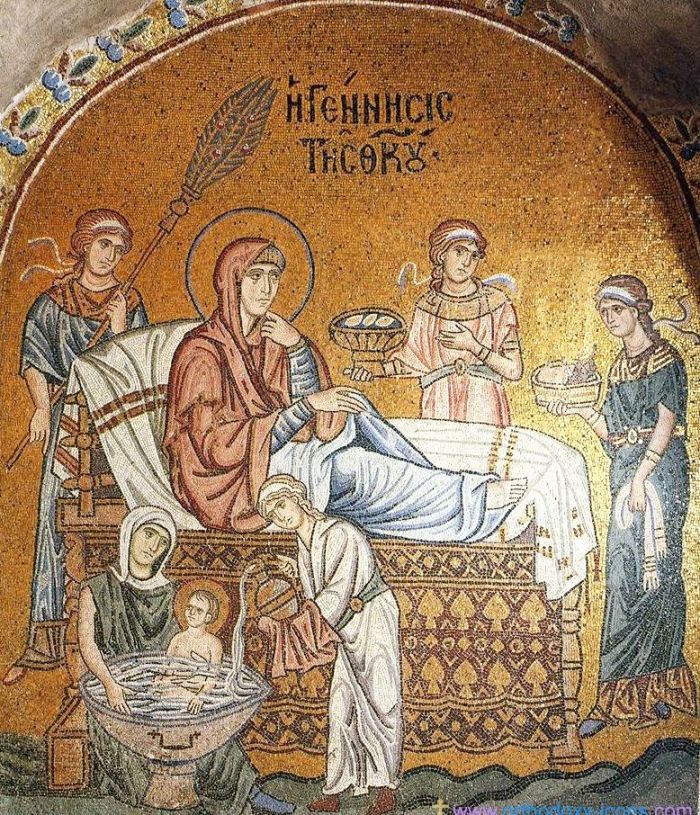
In the Greek Orthodox Church, February 2 is celebrated as Ypopantis, the presentation of Jesus at the Temple, 40 days after his birth, in accordance with Mosaic law. This day also marks Mary’s ritual return to the world after forty days of postpartum seclusion. This practice was known in the Western Church as ‘churching’ or blessing a new mother after 40 days; Hindu tradition also recommends women spend up to 40 days in rest and isolation after childbirth.

image of Mosaic of the Nativity
Mosaic of the Nativity

In the west, the customs of confinement and churching have dwindled since the 1960s, but in Greek Orthodox tradition until very recently, these forty days of isolation for mother and child were routine. A special word, lechóna (λεχώνα), from the ancient Greek for ‘bed’ or ‘couch’, denotes a woman in this special time. Continue reading “Forty Days After Childbirth, Mary Returns to the World by Laura Shannon”

The Navajo Mountain: A Feminist Perspective Chant by Sarah Wright

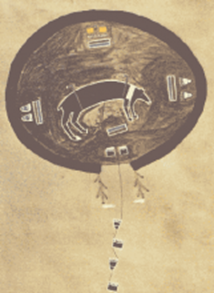
Mountain Chant image
Frighten Him On It – Sand painting used in the Mountain Chant, circa 1907″ by E.S. Curtis

Like the Navajo Night Chant celebrated at winter solstice the Navajo Mountain Chant is the last important winter ceremony, one that marks the shift in seasons and the return of the light. The Mountain Chant was once nine days in duration; today it has apparently been shortened to a four – day ceremony. It is celebrated in early February and each night different holy songs are sung.

The Mountain Chant is also a very complex healing series of ceremonies. Elaborate sand paintings are created and then destroyed after each healing. Disease may be diagnosed by either a woman or a man, but a Medicine man always leads the ceremonies. The intention is to cure a person of the disharmony that is creating the illness. The ceremonies are also enacted to pray to the holy people (Yei) for rain, and to receive assistance with the crops, and most importantly they are done to restore balance and harmony between the People and nature. Continue reading “The Navajo Mountain: A Feminist Perspective Chant by Sarah Wright”

Living with Uncertainty by Sara Wright

I was deeply moved by Carol’s willingness to share deeply personal feelings about how her visit to the hospital , enough so that I decided to write about how the Covid virus has impacted my life and the lives of those around me.

Here in my corner of the world summer is a time to be outdoors, and so returning to Maine in the early spring has allowed me to be emotionally present in a joyful way for Nature’s turnings, first from winter to spring, and then from spring to summer. But I am a naturalist and only too aware that my love for the wild is not shared by everyone.

Because I have no family, the longing to be with loved ones does not pierce my heart in the same way it does for others. Continue reading “Living with Uncertainty by Sara Wright”

Lammas after Lockdown by Laura Shannon


Today, August 1, 2020, is Lammas, the Celtic festival of late summer, the ‘feast of bread’, time of harvest and of golden grain. Here in the UK, Lammas arrives just as we are emerging from our coronavirus lockdown. It’s hard to feel a personal sense of ‘harvest’ when most people’s lives have been on hold since the spring.

Confined to our homes, many people could throw themselves into tending their own gardens (if they had one), but most of us could not cultivate the symbolic gardens of our lives and work in the way that we wanted. Many have faced deep loss, the withering of seeds planted in the past which could not now come to fruition.

Despite the tragic times, the earth continues to dance to the sacred rhythms of sun and moon. The trees are full of fruit, the fields are full of grain. Although I too have had my share of sorrow and grief in recent months, today I feel moved by the season to look at what we can harvest from our experience of the coronavirus pandemic.

Continue reading “Lammas after Lockdown by Laura Shannon”

Canada Goose by Sara Wright

Canadian Geese have been on my mind a lot lately. This past winter I have missed the skeins of geese that fly back and forth up and down the river appearing every single morning like clockwork. In Abiquiu when winter turned to spring I noted that the geese were behaving in much the same way the Sandhill cranes did before they migrated, splitting into pairs or groups of three and flying erratically. I was puzzled. I didn’t recall witnessing such behavior before this year. I wondered about migration patterns. Were the geese shifting their flight patterns too? Or perhaps the small groups I saw were staying year round? Some days it almost seemed as if these water birds were confused by something.
I saw three Canadian geese on the last predawn walk I took to the river/Bosque in New Mexico – just an hour or two before leaving for Maine. I knew that a perilous journey was ahead because we were driving cross-country from NM to ME. The C/virus was a frightening threat even though I brought all food, and planned to camp/use woods as bathroom. The first morning after my arrival at home I saw and heard three geese honking over my head. I was struck by the odd synchronicity remembering the mother goose tales of my childhood – and later as a graduate student when I learned about their mythology. Continue reading “Canada Goose by Sara Wright”

Navajo Night Chant and the Sacred Dark by Sara Wright

With Winter Moon’s passage and the approach of the winter solstice just a little less than a week away I am much aware of the (potential healing) dwelling place that I inhabit that also characterizes these dark months of the year.

Unfortunately, even those who acknowledge our seasonal turnings rarely honor the dark as sacred. At the winter solstice the emphasis is still on light.

As Carol Christ writes so succinctly we manage to celebrate light at both solstices – at its apex and at its return.

This attitude reveals to me an inability to be present to dark, in both its generative and non-generative aspects. The original inhabitants of this country honored the dark months of the year very differently than westerners do. Their most important ceremonies occurred during the winter months. Both aspects of the dark were acknowledged and explicated through ceremony. What follows is a history of one of the Navajo healing ceremonies that occur only during the winter months of the year. Continue reading “Navajo Night Chant and the Sacred Dark by Sara Wright”

Ritual Dances for Greek Easter by Laura Shannon

In a previous post on FAR I wrote about some of the Easter customs in Greece in which pre-Christian and Christian practices intertwine, and I would like to pick up this thread again here.

Today is ‘Bright Saturday’, the Saturday after Greek Easter (one week after Western Easter in 2019). This week is known as ‘Bright Week’, and is the joyful culmination of the Orthodox calendar cycle which began with carnival back in February. During Bright Week, people come together in celebration and feasting. Fasting is not permitted, a welcome relief after the seven weeks of Lent.

While Carnival and Twelfth Night customs are mainly performed by men, spring rituals and dances are almost exclusively in the hands of the women. Many of the dance songs are sung a cappella by the women themselves, typically in unison, emphasising group unity and solidarity. Continue reading “Ritual Dances for Greek Easter by Laura Shannon”

Longing to Heal Family in our Differences and Distances by Elisabeth Schilling

I can’t even save myself. I make bad decisions just like the ones in the world – bombs and wars and the industrial revolution with chains of greed. But then I go on and, without even knowing any part of the story, want to save others. Carol Christ’s post yesterday on family brought me to tears and I instantly had to write a poem. First, it made me think of the memory of my own mother telling me to wait for my dad to get a belt and him saying it will hurt him more than it does me.

Except when I told my mom this, she said it never happened, so I don’t understand the vivid visions in my head that I have being little and hearing the words and being afraid, and why the sight of men’s work belts make me nauseous. I believe my mother. It doesn’t matter either way, I guess, now, in my opinion about my own experience. What I mean by that is I don’t want to do the work of being suspicious or thinking about what is at stake at the moment. I’m okay with shelving it. Let’s just say I believe and don’t feel like trying to explain those visions. I suppose everyone will have an opinion about my decision and perspective on this. Feel free to voice it if it makes you feel better. Continue reading “Longing to Heal Family in our Differences and Distances by Elisabeth Schilling”

Women’s Ritual Dances and the Nine Touchstones of Goddess Spirituality – Part Four by Laura Shannon

In Rebirth of the Goddess, Carol P Christ offered Nine Touchstones of Goddess Spirituality as an alternative to the Ten Commandments. The Nine Touchstones are intended to inform all our relationships, whether personal, communal, social, or political.[1] In this four-part blog (here are parts 1-3 Part 1, Part 2, Part 3) I am exploring ways in which these Nine Touchstones are inherently embodied in traditional women’s ritual dances of the Balkans, which has been my spiritual practice for over thirty years.

Carol’s Fourth Touchstone is: ‘Speak the truth about conflict, pain, and suffering.’ Many women’s dance songs which allow the women to speak and sing their grief and pain. When we bring that pain into the healing container of the circle, sharing simple steps, Dancers in the circle simultaneously give and receive support for their own and others’ sorrow. Ultimately, the sense of community  and solidarity in the circle transforms our grief so that the burden becomes manageable. Many historical songs, too, tell stories of women being abducted or abused, and how they fought back or got away – or not – so that they are remembered and honoured by future generations.

Continue reading “Women’s Ritual Dances and the Nine Touchstones of Goddess Spirituality – Part Four by Laura Shannon”