The third day dawns under a cloud. Mourning doves spread their wings across leaden skies. I am walking on air. Two restless nights – a huge truck in the yard – Blocked, my stomach lurches. I read Tributes in a daze. Fierce Little Flower Warrior Woman fights a torrent of waves. She is bridging raging waters forging a New Story.
“Weaving the Visions.” Oh, now I remember where it all began.
She hugged a tree. I plant a seed. Listening to rounds of “light and darkness” I let my body lead.
A serpentine path guides me back to Her Garden. Cradled by Ancestors Rooted in Body I shed another patriarchal skin.
When I was 17, I left the US to live and study in Europe for a year, with Womanspirit Rising crammed into my backpack. This book, edited by Carol P. Christ and Judith Plaskow, gave me the solid ground of a feminist worldview which honoured women, the body, and the earth. My favourite chapter was the last one: Carol’s foundational essay ‘Why Women Need the Goddess’, where she writes, ‘The simplest and most basic meaning of the symbol of Goddess is the acknowledgement of the legitimacy of female power as a beneficent and independent power’. These words, indeed that whole essay, became the pole star for my journey through the world, helping me name what was missing in both the academic world and the world of dance.
This year, more than ever before, I note a very subtle shift that is occurring as we approach the middle of July. Lots of humidity – and I confess – I love the sweet summer scent as long as it isn’t hot. The days are losing a minute or two of light. Instead of slamming out of bed in the pre-dawn hour I find myself sleeping until 6AM and my dogs want to sleep in until 9 on gray foggy mornings like today. The birds are quieter, their songs less intense although my feeder is visited by hoards of youngsters, many of which are still being fed by their parents.
The Wood thrush has moved deeper into the forest, so it is the Mourning doves who begin my day with song. Most of all, I notice the richness, the vibrancy of deep summer green. Even though my flower garden is on fire with primary colors, I can’t seem to soak in enough greening to satisfy my hungry heart..
Subtle changes like this probably go unnoticed by most but for me they are signs of the goddess coming into her own…I am curious if anyone else senses this shift of energy.
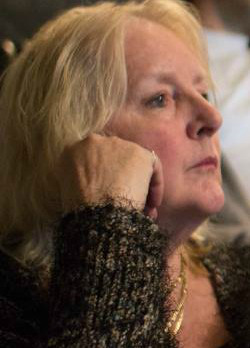
I wrote the prose and poem this morning July 14th for Carol’s blog not knowing at that time that this most compassionate woman, feminist scholar, mentor, friend had died shortly after midnight. When I saw the notice on the Internet I was stunned. It seemed so impersonal to receive such heartbreaking news in this manner. When I came back to read this piece I realized that indeed, Midsummer had given birth to a Goddess and her name was Carol Christ.
Our sister friend, Laura Shannon, emailed us early in the morning to share the news that “Carol passed peacefully in her sleep last night at 12.11 am on July 14th. Alexis (Masters) was with her.” Carol died in the company of friends.
The community of Feminism and Religion (FAR) grieves the death of Carol P. Christ.
Our sister friend, Laura Shannon, emailed us early in the morning to share the news that “Carol passed peacefully in her sleep last night at 12.11 am on July 14th. Alexis (Masters) was with her.” Carol died in the company of friends.
Her writings here on FAR have been a gift to countless many of us for years. She recently emailed me to let me know that she would need to step back from writing her weekly FAR post for the foreseeable future, and, that if she could pull it off, she would send in her swan song soon. That moment didn’t come and that’s ok. There is no finale for a person such as Carol. We are changed and blessed because of her presence in our lives. Her legacy will be long and enduring.
I invite you all who would like to share a short tribute in honor of Carol Christ to send it here to FAR so it can be published as part of this post. This will serve as a running tribute that we can keep adding to. It will be a space to share, to grieve, and to celebrate her life. Send in your reflections to feminismandreligionblog@gmail.com. You may also share in comments below as well.
No single one of us can capture all that Carol has meant to us and to the world –– it is only right to hear from the many voices as we celebrate this most brilliant friend and teacher of ours.
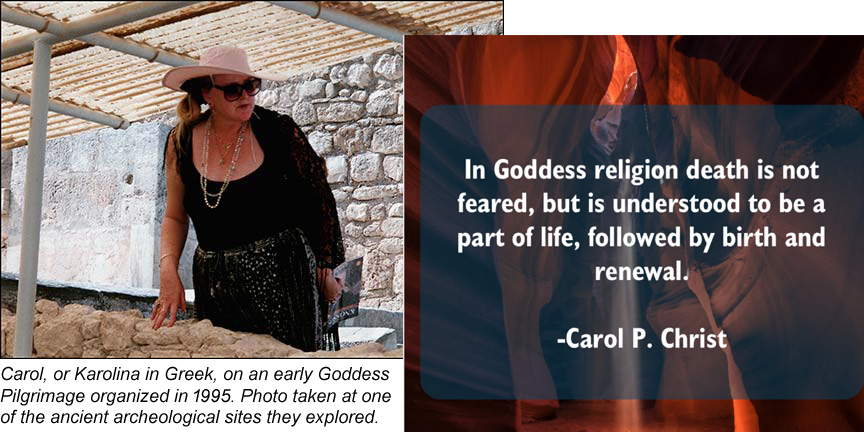
“In Goddess religion death is not feared, but is understood to be a part of life, followed by birth and renewal.” — Carol P. Christ
Carol married intellect with heart centering –– she had a formidable intellect but always spoke from her heart.
In view of learning of Carol’s death I find these words from Janet’s post today inspiring:
“Who is she that shines through like the morning star, beautiful as the moon, radiant as the sun awe-inspiring as a cascade of starlight?”
On a personal level, Carol’s words were essential on my journey away from god by way of the Goddess. Her courage required me to dig deep to embrace my own version of the “hubris” exhibited by male “god makers” and “system builders.” Carol’s quote below inspired many us to take on the two-fold task of unearthing the patriarchal symbol system woven into the fabric of our socialization and of replacing it with words of truth, communities of support, ceremonies of meaning, and images of the goddess, all inspired by stories of the very beginning when the divine was imagined as female.
The reason for the continuing effects of religious symbols is that the mind is uncomfortable with a vacuum. Symbol systems cannot simply be rejected, they must be replaced. Where there is no replacement, the mind will revert to familiar structures at times of crisis, bafflement, or defeat. (Carol Christ, Womanspirit Rising)
–– Patricia Lynn Reilly, Author of A God Who Looks Like Me
Carol was a wonderful friend and colleague. She loved to read my work in progress (brilliantly, often several times in a row before she wrote back to me) and I hers.
Her essay on patriarchy was the best I have ever read. I asked her to contribute it to the anthology, Foremothers of the Women’s Spirituality Movement: Elders and Visionaries. The day after she sent it to me, I found that the essays fir the book had to be personal. I felt terrible. I emailed her to tell her, and she said it wasn’t a problem. The next day she had a new, wonderful, perfect essay for me.
Although I knew she didn’t have many months to live, I am still stunned by this loss.
–– Miriam Robbins Dexter
Carol was and will remain one of the foremothers and most brilliant voices of the Women’s Spirituality movement. At the conference on “The Great Goddess Re-Emerging” at the University of California at Santa Cruz in the spring of 1978, Carol delivered the keynote address, “Why Women Need the Goddess: Phenomenological, Psychological, and Political Reflections.” Christ proposed four compelling reasons why women might turn to the Goddess: the affirmation and legitimation of female power as beneficent; affirmation of the female body and its life cycles; affirmation of women’s will; and affirmation of women’s bonds with one another and their positive female heritage (Christ 1979).
In her most recent article, for the Encyclopedia of Women in World Religion: Faith and Culture, Christ wrote about the Goddess religion and culture of her beloved island of Crete, and the roles women played in that “egalitarian matriarchal” civilization. Her eloquent words speak not only to the Goddess religion of ancient Crete, but also to the spirituality and ethical values she also cherished, which are much needed in our own culture today.
As discerners and guardians of the mysteries, women created rituals to celebrate the Source of Life and to pass the secrets of agriculture, pottery, and weaving down through the generations. The major rituals of the agricultural cycle involved blessing the seeds before planting, offering the first fruits of the harvest to the Goddess, and sharing the bounty of the harvest in communal feasts. These rituals establish that life is a gift of the Goddess and institute gift-giving as a cultural practice. As women controlled the secrets of agriculture, it makes sense that land was held by maternal clans, that kinship and inheritance passed through the maternal line, and that governance and decision-making for the group were in the hands of the elders of the maternal clan. In this context, the intelligence, love, and generosity of mothers and clan mothers would have been understood to reflect the intelligence, love, and generosity of the Goddess.*
Honor, blessing, and gratitude to you for your life, Carol. You told us many times you did not fear death. You did not speculate on what comes after. Whatever goddess is, surely you reman in her embrace.
A wise woman committed to the spiritual freedom of women and a teacher of life and struggle has set out to meet the infinite. I thank life for giving me the joy of walking part of the way in this world, in the company and wisdom of women like her.
Thanks for everything my dear Carol. For the ideas and enthusiasm with which you always supported my work. For creating community and safe spaces For lovingly and intensely vindicating the transcendence of the humanity of women
Blessed journey our woman, teacher and guide. May the divine that you found in all women receive you today in her loving arms.
That was Karolina’s last message to me, on June 18th, 2021. I like to think it was also her last message to the universe, as she climbed back into the lap of the Goddess early on the morning of July 14th.
I’d sent her a selfie of me with a new haircut, a few inches shorter, as she’d suggested some time earlier. “Yessssss” was her immediate, characteristic reply. Two days later I forwarded an even better photo. It was surprising not to hear back from her, and I should have been concerned. Instead, I let two weeks go by before reaching out again. And then it was too late.
“Yessssss” was Karolina’s full-hearted response to life, and part of how she nurtured her friends and acquaintances. I will carry that “yessssss” with me till the end of my days, always grateful to have known and been nurtured so generously, so unfailingly by her. Her soft voice, her gentle laugh, her quiet glamor, her deep engagement with all the details of life … I could talk with her about my cats, my husband, my writing, my childhood, my haircut. Nothing was too small or too large, nothing too complex or too simple.
“Intelligent embodied love” is how Karolina described the ground of being, and intelligent embodied love was what she herself embodied and radiated, even as she suffered through her cancer and its treatment. For this past year, she devoted herself to making her new home as beautiful as possible. The last room she finished was the “guest room study,” and how I would have liked to have joined her there. Instead I will simply carry her “yessssss” in my heart.
Rabena yer’hamou – Que Dieu la berce dans sa matrice – “May she be cradled in the womb of the Goddess.” Blessed be.
Carol was my second cousin. In 2016, we spent about 10 days in France and Germany tracking down places where our ancestors lived. Like her Feminism and Religion research and writings she was a meticulous in her ancestry research and fearless about meeting strangers and asking questions. One of the places where are relatives came from was Saarland St Nikolaus-Rosbruk. We were having lunch by the river when she saw this tree that she wanted to embrace. Here is a picture of her by the tree. I love her expression.
Best to all, Bill Christ
I’ve been so honored to blog with Carol here at FAR over the last seven or so years and doubly honored that she wrote an endorsement for my new book just last month.
Carol was a tremendous role model and influence for me and she will be deeply missed. She impacted so many lives with her work and her depth of purpose and strength of character were so palaple, even across many miles. When I first read “Why Women Need the Goddess” it touched a chord within me that continues to reverberate through this day. Her work and writing shaped my own thealogy profoundly. In her honor, I chose one of her books off my shelf—She Who Changes—and randomly opened to a page, which, fittingly, was about how death is a part of life:
“For process philosophy, the whole universe is alive and changing, continually co-creating new possibilities of life. Every living individual is born, grows, and then dies. The world is a web of changing individuals interacting with, affecting, and changing each other. The body is the locus of changing life. Not to be embodied, not to change, is not to be alive…” –Carol P. Christ. (She Who Changes: Re-imagining the Divine in the World, p. 45)
I read this quote aloud during a small women’s circle the same day Carol died, a circle that, in some way, may not have existed without the gift of her presence in this world.
–– Molly Remer
Remembering Carol P. Christ
I am so grateful and glad that a circle of Carol’s friends and colleagues champion her accomplishments and celebrate her life.
I might be her oldest friend in this group, definitely more a personal friend than a professional colleague. We were in the same freshman dormitory on the same dorm corridor that was made into a social group at Stanford. Both of us felt a bit out of place, she—at the time–a political conservative from Orange County California, and I one of 17 Asians in a class of 1,200 from the small town of Gilroy, California.
Never her academic peer, we still spent time together studying, finding our way, and hanging on to our independent thinking. And we stayed in touch when we both relocated to the East Coast, she to Yale and I to New York City. I have attached a photo of Carol at her wedding in 1979 when she was living in northern California. Much later I met her family when her mother died and I knew of the family static that she worked to understand and make peace with. We stayed in touch through all these decades. I visited twice in Lesbos with my mother, sister and best friend, and she visited here in Oakland.
I saw Carol not through her scholarly achievements but from what I saw as her kind of priestess bearing. Always her forthright sense of what would make the world a better place, calling out the wrongs but being understanding, always with her oar in the water. I also saw her as a warm friend who could laugh about the foibles, not worry about binging on good television, enjoy a good meal with friends, and tend to her garden and pets.
Carol should not have suffered the pain of conflicts, even if those experiences sharpened her mind. She should not have suffered from debilitating illness. . .and she died too young. She told me once that she stayed in Greece because it was the most beautiful place she had ever been. Though I never liked having good friends so far away, it seemed that gave her joy and solace.
We will miss her.
–– Gail Kong
I was profoundly influenced by the keynote address Carol gave in 1978 at the Great Goddess Re-Emerging Conference in Santa Cruz, CA. I was one of the 500 women listening to her words “Why Women Need the Goddess”. The impact of her observation about the power of symbol systems on each of us individually and the influence symbol systems have on all of us collectively, helped guide my own life.
We met in the fall of 2017 when I was one of ten women on the Goddess Pilgrimage. Carol described herself as a “feminist and ecofeminist writer, activist, and educator”. Please view this eighteen minute video of Carol speaking at the Harvard Divinity School where she spoke about her life. This was the 2014 Religion and the Feminist Movement Conference: https://www.youtube.com/watch?v=YwYygffNCAg.
I’m always moved by women speaking on their own behalf about their lives with no intermediary to interpret their life from afar. You will certainly gain a sense of who Carol was in her world.
My lesbian partner, Jeanne Neath, and I had reservations to join the 2021 Pilgrimage. To ease my grief at Carol’s death, I’ve gathered ten more candid photos of Karolina on some of the earlier Pilgrimages. You can see those photos on my blog http://paulamariedaughter.com/. Carol put incredible energy into each day of those two weeks she escorted us around the various sites that linked us to the ancestors.
Carol dared to examine the deeply embedded beliefs of our patriarchal institutions including academia and religion. She invented a new life for herself. She ‘shed the skin’ of an academic. Karolina was determined to reach other women like herself willing to look beyond the familiar goddesses of the patriarchy to discover the much more ancient Earth Goddess of our Neolithic and Paleolithic ancestors.
Many of us now acknowledge Carol/Karolina as a beloved ancestor.
Blessed Be, Paula Mariedaughter
One of Carol Christ’s books early on, in 1980, that impressed me deeply was Diving Deep and Surfacing – Women Writers on Spiritual Quest, published by Beacon Press. It helped me rediscover my spiritual path. I actually incorporated the phrase “diving deep and surfacing” in a process of self-understanding and awareness. — feeling grateful.
When I first learnt how patriarchy plotted and schemed to write the Goddess out of existence and by extension, the history of all women; not stopping at the written word, using violence and the threat of violence too; I was furious. This was the first time I experienced rage. Not fully knowing our history means we exist in a world of numb. To discover is to feel. To feel is to be alive. This is why Carol’s work is so important – because it links women to their collective past and to their collective future. The anger has subsided and now I ride a wave of certainty, connected to an international movement of powerful women. Understanding our story is empowering. Empowerment is Carol’s legacy.” – Claire Dorey
I met Karolina in 2018, when I was in Lesvos working as a volunteer with refugee organisations, so ours was a very short friendship by comparison with most of her other friends. We kept in touch when I went back to Sydney, and then picked up again where we had left off when I returned to Lesvos in early 2020 for another few months of volunteer work, before the Covid pandemic intervened. After that we kept in touch via Skype.
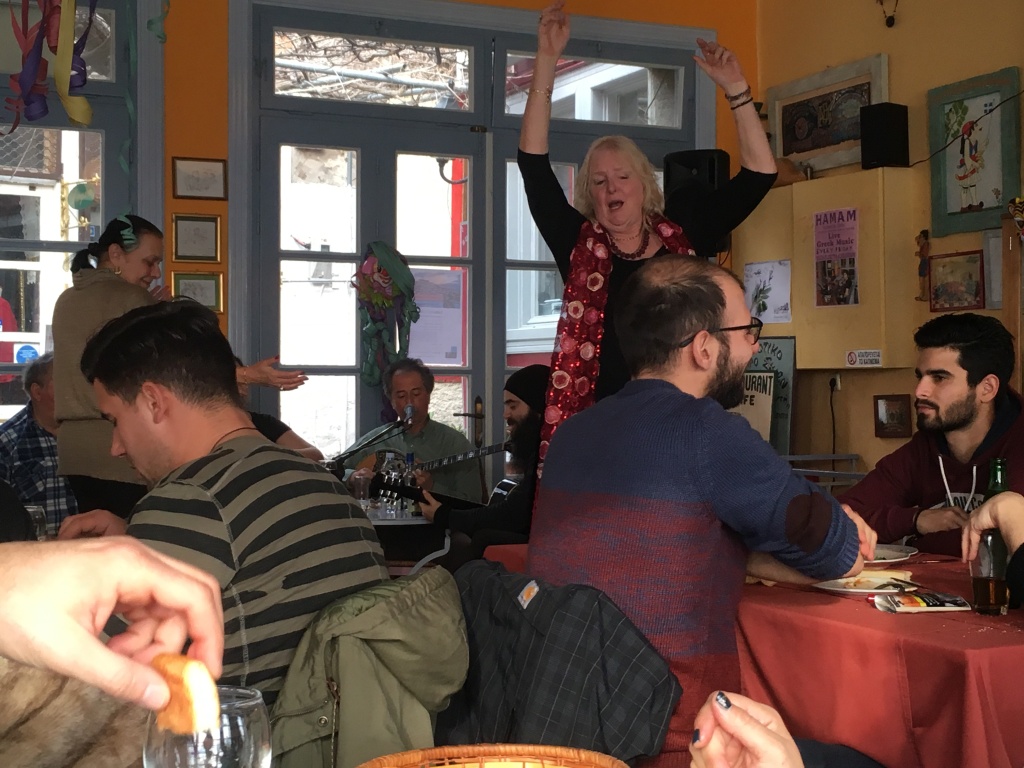
I was a bit younger than Karolina, but we shared the same feminist background and had a broadly similar outlook on life. In the short time that we spent together we shared a lot of long lunches with copious amounts of red wine. It was great for me, because Karolina could order meals in Greek, so we always ate interesting local food. She loved to dance, so if there was music she would be on the dance floor! Karolina knew a lot about Greek Orthodoxy and local customs. I spent a memorable “Clean Monday” with her in 2018, when she donned a tutu as part of a dance troupe, and then danced the afternoon away in Maria’s Taverna… (Clean Monday is the start of the 40 days of Lent in the Greek Orthodox Church).
Even though we didn’t know each other for very long, I think that we both valued our friendship, perhaps for different reasons. From my perspective, I loved staying in Karolina’s beautiful old house in Molyvos at weekends, bird watching in the salt marshes at Kalloni, and going to out-of-the-way places to eat. As well as intellectual stimulation she also provided some relief from the intensity of my refugee work, which was very welcome!
I thought it was incredibly brave of Karolina to leave Lesvos and move to Crete, and I’m glad that she got to enjoy her new apartment in Heraklion, however briefly. I would love to have visited her there, but Covid and her illness meant that was not to be. I will miss her.
Yesterday was Greek Easter and as Greece was still on lockdown, friends brought a lovely meal of roast chicken and vegetables, scalloped potatoes, green salad, and pineapple upside down cake, which we ate together on my balcony. Still I could not help remembering Easters past.This blog was originally published in 2013.
Though I am not a Christian any more, I don’t want to sit home alone on Easter Day. Besides being a Christian ritual, Greek Easter is a time to eat lamb with family and friends, and to celebrate the coming of spring by feasting out-of-doors in flowering fields or in a garden filled with flowers, bees, butterflies, and birds. Such rituals have been celebrated from time immemorial.
Greek Easter came late this year, only yesterday, May 5. I prepared for an Easter party in my garden for weeks. My garden is planted with herbs and aromatics—lavender, thyme, oregano, rosemary, curry plant, rue, sage, cistus, rose-scented geranium, sweet william, cat mint and several other kinds of mint, bee balm, and roses and fruit trees, including lemon, bitter orange, pomegranate, olive, quince, and cherry. Everything blossoms in spring, attracting bees and butterflies.
I began weeding and pruning about 6 weeks ago. This year I had to remove many overgrown lavender plants. For the last 3 weeks in addition to ongoing weeding and pruning, I have been replanting lavender which I have promised myself to prune “way back” in the fall, along with purple sage, blue daisies, and thyme. Though there is bare ground in some parts of the garden, in other parts mature plants and trees are in full flower.
I have my breakfast in the early morning on a terrace from which I can see the garden and the sea. I love to” just sit” in the garden at this time of year. My thoughts cease as I enjoy the flowers, new ones every few days, and watch birds, butterflies, bees, and my two tortoises. Then my eyes come to rest on a task that needs doing, and I work for an hour or more as the sun comes into the garden.
There is a flowing fountain in the center of my garden that attracts birds. This year as in other years, there is a nest of great tits in a hole in an old locust tree. This tree is an import from America favored by the Ottomans, planted decades ago by someone whose name I do not know. One morning in early spring a migrating hoopoe landed above my head in the other locust tree. A hoopoe is a magnificent rust-colored bird with a black and white wings, a crown that can be opened or closed like a fan, and a long down-curved bill. Its arrival–a garden first– felt like a blessing. This spring I have seen blue tits, sparrows, collared doves, chaffinches, goldfinches, and for the first time a pair of black-eared wheatears drinking and cavorting in the fountain.
With the old lavender bushes gone, I have been able to see the tortoises with whom I share the garden more clearly. They wake up about ten as the sun begins to shine on the stone paths in the garden. They warm themselves for a while, and then start searching for food. Last year they “weeded” the garden for me—though they didn’t care for the bermuda and other invasive grasses. This year I feed them greens and vegetables. When the first rose petals fell to the ground, I remembered that, like us, they have a “sweet tooth”—besides flower petals, they like tomatoes and other fruit. They don’t actually have teeth, but rather hard gums, which are quite effective for munching and sometimes gobbling down food. After eating, they wander around the garden and usually have sex at least once (they are both boys), before they crawl under the bushes to wait out the hottest part of the day. They wake up again in the late afternoon.
I find it amazing to be sharing my garden with two reptiles whose ancestors perfected their evolution 200 million years ago when Pangaea was a single continent. I marvel at the agility they have despite their heavy shells. They push themselves up low steps and slide back down. They can get from one side of the garden to the other quite quickly when they want to.
All of my garden preparation culminates at Easter when I make a party for my friends. I order the lamb early in the week and make a pilgrimage with one or two others to a mountain village to pick it up. Along the way we stop to admire migrating birds in the wetlands of Kalloni and the wildflowers in the fields and on the hillsides. In the village we also buy braided sweet Easter bread called tsoureki, cooked with a red Easter egg in its center, and tiny Greek sweets called baklava and kataiifi, made of thin pastry, nuts, and honey. We lunch at a favorite taverna in the village, before returning home.
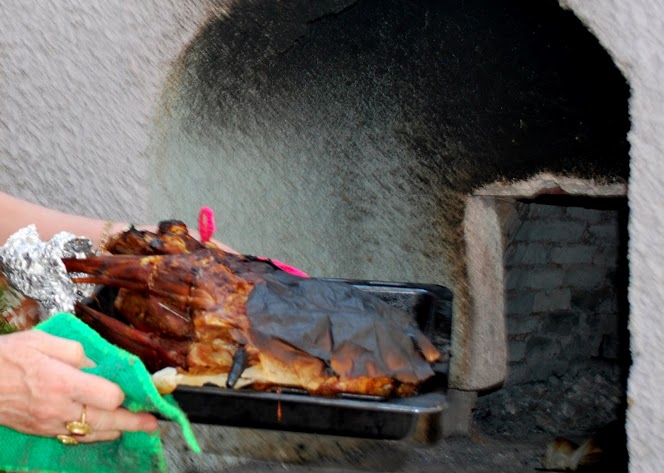
My house, which is over a hundred years old, originally had its kitchen in the garden: the old brick oven and an open fireplace remain. I use the oven only on Easter to roast a lamb that cooks all night long and into the morning. I save tree prunings, rosemary and lavender clippings, and collect driftwood for the fire. It must burn fast and hot. I wait until midnight to light it.
In the evening, I prepare the rice as the Greeks once did in Smyrna with orange and lemon juice, black currants, golden raisins, pine nuts, mint, parsley, and onions. I use it to stuff the lamb. I make tzatziki with yogurt, cucumber, and garlic, garnishing it with mint from the garden. The next day friends will bring potato salad (as my Grandma made it) and a green salad to which I will add mint, dill, and bee balm from the garden.
At midnight the church bells peal announcing “Christos anesti,” “Christ is risen.” The village rings with the sounds of firecrackers and the sky is lit by fireworks. This is the moment I choose to light my fire. I revel in the feeling of danger within and without. The fire burns wildly for at least an hour “until the bricks turn white.” Then I push the flaming wood to the sides of the oven, watch the embers burn down until they are small glowing coals, insert the lamb, shut the oven door, and go inside. I am always too excited to fall asleep immediately.
When I wake, I check to be sure the lamb is cooked, but don’t open the oven door again until my guests arrive. I take my time setting up folding tables next to the marble table with stone seats in the secluded area that used to be a kitchen. I think of the generations of women and girls who used the oven where the lamb awaits, as I bring the taverna chairs and cushions out storage. I spread out tablecloths from Crete and set out ceramic dishes from Skyros–painted with birds, flowers, mermaids, sailing ships, and people in traditional dress–pink wine glasses, pink and blue cloth napkins. Like the garden, my table is a feast of color.
Before the guests arrive, I sit in the garden and wait. A song of thanksgiving reverberates in my mind:
This is my Mother’s world,
And to my listening ears,
All Nature sings,
And ‘round me rings,
The m-u-s-i-c of the spheres.
Easter lamb stuffing Smyrna style
2 cups white long grain rice
2 T black currants
2 T golden raisins
2 T pine nuts
2 T olive oil
1/4 cup chopped fresh mint
1/2 cup chopped parsley
2 onions chopped
juice of one orange (and/or lemon)
salt and pepper to taste
(you can also add the liver, cooked and chopped)
Cook the onions in the olive oil, add the rice and orange juice, cook lightly, add the other ingredients stir.
Spoon into the cavity of a cleaned lamb carcass with the legs but without the head.
Can also be used for chicken. If not used as stuffing, add enough water to cook rice. Amounts of ingredients can be varied.
*Smyrna is the Greek name for Izmir, a city where Greeks lived for many centuries, until 1922, the year of the “great catastrophe” when many of them fled to Lesbos, Chios, and Samos, while others ended up in Athens.
Like many of you, I was anxious and angry during most of the Trump administration years. I watched MSNBC avidly, hoping against hope that a) he could be stopped or b) he would be impeached. Now that he is gone, it would be nice to be able to take a “breather” (I wasn’t breathing regularly during the Trump years), a break from thinking about US politics all the time, but sadly, the political situation in the United States continues to require attention.
President Biden has pleasantly surprised me with his progressive domestic agenda and his decision to remove troops from the heretofore endless war in Afghanistan. Nonetheless, he has proposed an increase in the military budget. Dwight David Eisenhower, who warned of the increasing power of “the military-industrial complex” as he left office, must be turning over in his grave.
Most worrying of all is the fact that so many Americans voted for Donald Trump, believe that the election was stolen from him, and support white supremacy, while the Republican party refuses to deviate from the Trumpian worldview.
As if it could not be any worse, police killings of innocent black men by white officers and mass killings by young white men with easy access to automatic weapons are proliferating. Moreover, Republican-inspired voting restriction legislation is once again threatening the foundations of our democracy. Continue reading “Feeling Weary about US Politics by Carol P. Christ”
In Greece the liturgies of lent and especially of the week before Easter are known as the “divine drama,” in Greek theodrama. This may refer to the “drama” of the capture, crucifixion, and resurrection of Jesus and to the suffering of God the Father and Mary.
However, it is important to recall that the drama in ancient Greece referred to both the tragedies and comedies, most specifically, those that were performed in the theater of Dionysios in Athens. While we have been taught that the Greek tragedies celebrated “downfall of the hero” due to his “tragic flaw,” it is important to remember that Dionysios was the original protagonist of the Greek tragedy: it was his death and rebirth that was first celebrated.
Some have argued that the Greek tragedies should never be “read” alone, for they were always “performed” in tandem with the comedies, which were followed by the bawdy phallic humor of the satyr plays. The tragedies end in death and irreparable loss. But if the comedies and satyr plays are considered an integral part of the cycle, death is followed by the resurgence of life.
A few days ago, a Greek friend told me she was going to bring holy water from a church so that we could bless my house. Ever since I moved to my new apartment in Heraklion, I have intended to do a house blessing, following rituals I learned from Z Budapest. But with unpacking and settling in interrupted by illness, I never got around to it. I did burn frankincense early on to clear out vibes left by the previous inhabitants of my space, but nothing more. I have slowly made the house a home, but I have been waiting for the renovations to be finished before doing a final blessing. As I still anticipate remodeling the kitchen island, I did not proceed.
Before my friend arrived, I incensed the house again, musing that now that I have finished my chemotherapy and am on the road to recovery, it is high time to clear out all the lingering feelings and memories of the time I was very ill. When my friend arrived bearing a small plastic bag filled with water from a church spring, she asked if she could water the plants on my balcony. I had watered them the day before, but I didn’t mention that.
Announcing that she loved to play with water, she doused the plants, then hosed the balcony tiles and sprayed the windows which were covered with dust following a recent dirty rain. As there are balconies surrounding all of my rooms, that completed the cleansing. Watering the plants signaled the renewal of life.
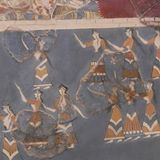
If we begin from the hypothesis ancient Crete was matriarchal, matrifocal, and matrilineal, what would we expect to be the central focus of the its religion?* Harriet Boyd Hawes and her colleague Blanche E. Williams presented an incipiently feminist, woman-centered, analysis of the religion of ancient Crete in Gournia, the book describing their excavation of a Minoan village at the beginning of the twentieth century. Boyd Hawes argued that the archaeological evidence showed not only the pre-eminence of the Goddess, a conclusion with which Williams agreed, but also the strength and independence of women in a culture she defined as matriarchal and matrilineal, centered around the Mother family. If ancient Crete was matrilineal, matrifocal, and matriarchal, we should expect to find evidence that women were not only strong and independent, but also that they had leadership roles in religion and culture. Williams noted the presence of priestesses. The miniature frescoes from Knossos show a group of older women sitting in the place of honor and a group of women performing a ritual dance. Where evidence concerning leadership roles is lacking, it should not be assumed that leadership must have been in the hands of men.
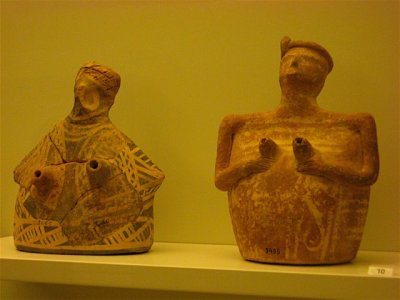
We should not be surprised to find the Goddess or mother earth to be at the center of rituals and ceremonies in ancient Crete. However, to say that the Goddess is central begs the question of what we mean when we say Goddess. In the west, deity is understood to be transcendent of the world, imaged as a dominant male other, and as the judge of the living and the dead. Citing the Oxford English Dictionary, archaeologist Colin Renfrew bases his discussion of Minoan religion on the idea of divine transcendence. But if we accept Marija Gimbutas’ insight that the Goddess represents the powers of birth, death, and regeneration in all forms of life, a different picture emerges. The Goddess is immanent in, rather than transcendent of the world. She is the enlivening force in human beings and all of nature. She is not the judge of the living and the dead, for the dead are returned to her body. Unlike later Greek deities, the Goddesses of Old Europe and ancient Crete are not generally portrayed as idealized human beings. Though they often have eyes, breasts, and sacred triangles, they also have beaks and wings, are shaped like mountains, and decorated with flowing lines symbolizing rivers or streams. These hybrid forms suggest that all of life is in the image of divinity and that humans are not higher, better, or separate from other life forms. Hybrid images celebrate the connection of all beings in the web of life and call human beings to participate in and enjoy this world, not to seek to escape or rise above it. A religion centered around gratitude for life in this world is very different from one that centers around fear and judgment and a longing for life after death. Jacquetta Hawkes’ insight that the religion of ancient Crete celebrated “the grace of life” is exactly right.
Is the Old European or Minoan Goddess one or many? Monotheists have insisted that there can be only one God, yet polytheists revere a plurality of images, while animists celebrate the spirits of (perceived) living beings such as rivers and trees, mountains and caves. The terms monotheism and polytheism are not neutral. Both were developed by monotheists: monotheism describes the correct beliefs of the self; polytheism, the false beliefs of the other. I find theologian and liturgist Marcia Falk’s distinction between exclusive and inclusive monotheism helpful in resolving the question of the one and the many. According to Falk, inclusive monotheism is an intuition of the unity of being within the diversity of the world: celebrating the unity of being, it welcomes a plurality of images to represent diversity and difference in the world. From this point of view, the boundaries between monotheism and polytheism are porous. When Gimbutas spoke of the powers of birth, death, and regeneration in all of life, she was referring to the unity of being underlying the diversity of life forms, including plants, animals, and human beings. Similarly, when indigenous peoples speak of mother earth as the giver of all and all beings as relatives, they recognize that all life is sustained by a single source. The fact that ancient Cretans imaged divinity in different ways and with different characteristics does not require the conclusion that they worshipped many discrete deities as some archaeologists argue: I suggest that they intuited a unity of being while celebrating the diversity of life. This appears to have been the conclusion of Williams who wrote of “the prominence of a goddess under various aspects.”
If matrilineal, matrifocal, and matriarchal cultures tend to view the earth as a great and giving mother, we can expect this insight to be expressed in rituals and ceremonies. Gratitude is the appropriate response to gifts freely given. I suggest that gratitude for the gift and gifts of life was not only a focus, but the central focus, of religion in ancient Crete. If this is so, we should expect to find rituals celebrating the gift of life in the birth of babies, the coming-of-age of girls, as well as in as well as in death rituals honoring the ancestors. We can also expect to find rituals honoring the mother line and expressing gratitude for the wisdom of ancestors. Many of these rituals would have taken place in the matrilineal House as archaeologist Jan Driessen suggests. Rituals for the ancestors might also have taken place in cemeteries. We should also expect to find rituals expressing gratitude for the food that sustains life, for example, in offerings of first fruits to mother earth and in the pouring of libations that are absorbed back into her body. If, women invented agriculture, and if as Gimbutas argued, Old European religion celebrated the processes of birth, death, and regeneration in all of life, we should find rituals focused on planting, harvesting, and storing seeds. Some of these rituals might have taken place in the matrilineal Houses, while others surely took place in nature and in the fields. If pottery-making and weaving were understood to be mysteries of transformation involving birth, death, and regeneration, we might find evidence of rituals associated with these activities in the Houses or in workshops. It is known that rites in ancient Crete involved trees, mountains, and caves, as well as water sources. We must ask if and how such ceremonies expressed gratitude to the mother earth, the source of life, and the cycles of birth, death, and regeneration.
*These musings are part of an early draft of the methodological prologue to an essay I have been asked to write on Religion in a Minoan Village to be published in the archaeological report on recent excavations at Gournia. In the preceding part of the prologue, I discuss the theories about matriarchal, matrifocal, and matrilineal cultures of Harriet Boyd Hawes, Blanche E. Williams, Marija Gimbutas, Heide Goettner-Abendroth, and others.
When I went to the hospital for chemo on Thursday, the doctor told me it would be my last one. That was a surprise. I thought I would have at least one more. But it was a good surprise, because I had felt more tired than usual after my most recent treatment. Apparently, I had started to feel a bit better when my cancer became inactive, but chemo is cumulative, and it caught up with me.
I slept well on Thursday night. On Friday morning I felt great relief and joy thinking that my chemo was ending. I called a number of friends to tell them the good news. I suspected that I might feel very tired for a few weeks from the last dose of chemo. But after that, all of the symptoms caused by the chemo would begin to lessen—including numbness in my right foot, instability, lack of energy, shortness of breath, anemia, and hair loss.
By the mid-afternoon the tiredness set in again. This time I did not get the few good days that I have attributed to a prescribed dose of cortisone to counter the effects of the chemo. Even though I predicted that the last chemo would make me very tired, there is a part of me that wants this all to be over—and now!











 A few days ago, a Greek friend told me she was going to bring holy water from a church so that we could bless my house. Ever since I moved to my new apartment in Heraklion, I have intended to do a house blessing, following rituals I learned from Z Budapest. But with unpacking and settling in interrupted by illness, I never got around to it. I did burn frankincense early on to clear out vibes left by the previous inhabitants of my space, but nothing more. I have slowly made the house a home, but I have been waiting for the renovations to be finished before doing a final blessing. As I still anticipate remodeling the kitchen island, I did not proceed.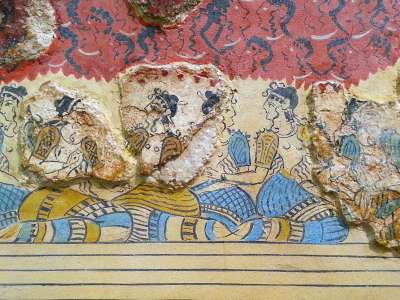
 Feminism and Religion