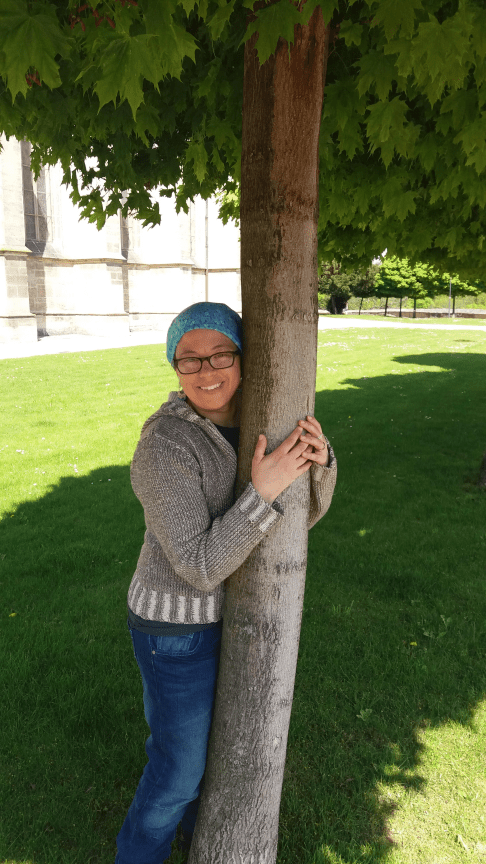
Saying Goodbye to May by Sara Wright

Friday night’s dream alarmed me. I had already lost two dogs, and the dream told me that I had lost three. Was my present beloved animal companion at risk?

The weekend passed with increasing heat and dryness and a strange escalating depression that dominated the atmosphere around me. This, with so much astonishing autumn beauty on my doorstep.
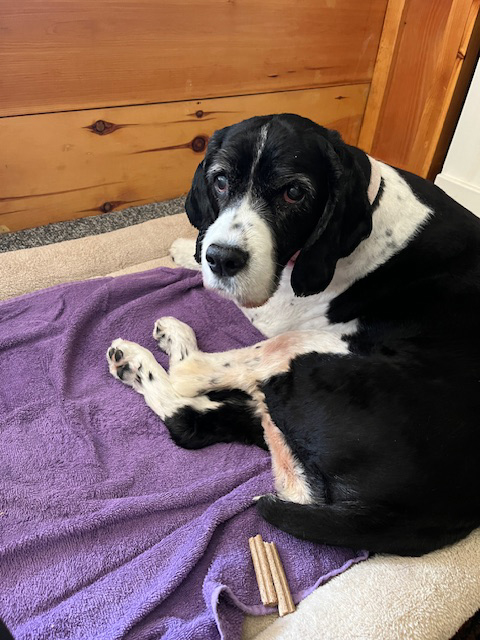
Maybe this mood was why I was having so much trouble completing an essay (The Doorway) that when done would finish a heartbreaking odyssey that began last December 24th when my beloved Hope almost died from heart failure. Eight months later Hope was dead. With Lucy’s death five weeks later, I was left dogless and bereft – except for the help from a couple of friends and May, a 15 -year – old Springer Spaniel who had stolen my heart months before when I first met her.

Instant recognition characterized our first meeting – woman and dog – linked through that mysterious animal thread that was grounded in deep compassion.

Continue reading “Saying Goodbye to May by Sara Wright”
In My End: My Beginning by Margot Van Sluytman

In my end is my beginning.
T. S. Eliot

This year two colleagues of mine died. And my heart roared. Tears aplenty accompanied me. Poet that I am. Word-lover. Image-seeker. Meaning-making-hound-dog. Doggedly seeking a place to plant myself so that the ache of these losses within the crucible in which I find myself grounded, honed, chiselled, challenged, challenging, writing, wording, rewording, sculpting relationship with my students, who are too my teachers, is soothed. By tiny shards. Soothed. And death finds home everywhere. In each nook. Cranny. Crevice. Concreted crenellation or grassy llano, there she be.

What research, I ask myself, can we do when the heart fails to cease its eking, leaking ache, and crushing sorrow? What academic skill need we birth, resurrect, divine in order to erase this over-whelming tsunami of acknowledging our finitude? Where to look? What book? What paper? What journal? To what podcast need we creep, crawl, scurry, bound, fling ourselves in order to quell brutal, blistering despair? Self-immolation cannot work, for too, too many teeming tears douse the flames.

Continue reading “In My End: My Beginning by Margot Van Sluytman”

Goddess in a Twig by Sara Wright

In 2024, science seems to be catching up with reality. “A rapid succession of peer-reviewed studies and reports all point to a single unambiguous conclusion: that Canada’s unqualified claims of ‘sustainable forest management’ belie a reality of widespread forest degradation”. 

Almost 36 million acres of forests have been clear cut in Quebec and Ontario alone. Canada still has six percent of old growth forests left but clear cuts almost exclusively. Maine has one tenth of a percent of old forests remaining but says it maintains a few limits on clear cuts (the research is ambiguous and around me we have mostly clear-cut mountains, so I am deeply suspicious). 

Why should we care? 

A new crop of trees will be moving north into Canada along with the rest of the migrants (birds, animals, understory/woodland plants) because of a warming climate and loss of habitat. Too many people.

Continue reading “Goddess in a Twig by Sara Wright”

Reaching a Time Space Reality by Caryn MacGrandle

Daily meditation has changed my life allowing me to stop taking anti-anxiety medication and giving me the tools I needed to change my life.  For years now, I have been escaping each and every day to the woods around my home: ten minutes of a recorded meditation and ten minutes of silence. 

A couple of weeks ago, thanks to technological eavesdropping, after asking my partner  what Joe Dispenza meant by “Space-Time” and “Time-Space”, up pops on my YouTube feed a meditation by Joe Dispenza on “Space-Time” and “Time-Space”.

The meditation is sixty minutes long, and I have been doing this almost daily for weeks.

It is not easy. 

Continue reading “Reaching a Time Space Reality by Caryn MacGrandle”

The Importance of Religion for Eco-Feminism by Ivy Helman

untitled.png“Why is religion important to ecofeminism?”  A student, in the Master’s course I teach at Charles University, asked this as we began the class session dedicated to the topic.  Given the overwhelming presence of atheism in the Czech Republic, I wasn’t too surprised by the inquiry.  Nonetheless, the idea has been at the back of my mind ever since: what does religion have to do with ending patriarchy and bolstering the health of the planet?  While I may take the connection as obvious, it is clearly not for many feminists out there.  Here is how I understand it.

First, it is true: many of our inherited religious traditions have been and still are considerably patriarchal.  Because of that, some feminists outright reject religion.  In fact, some feminists even consider religion dangerous and threatening, as it is often utilized to contradict many feminist aims.  Yet, there are many, many feminists who find, within their given or chosen tradition, non-patriarchal elements that can be recovered, remembered and/or (re)created.   Religious feminists work tirelessly to transform religions in life-sustaining and post-patriarchal ways not just for themselves but also for those women and men who belong to the same communities.   Continue reading “The Importance of Religion for Eco-Feminism by Ivy Helman”