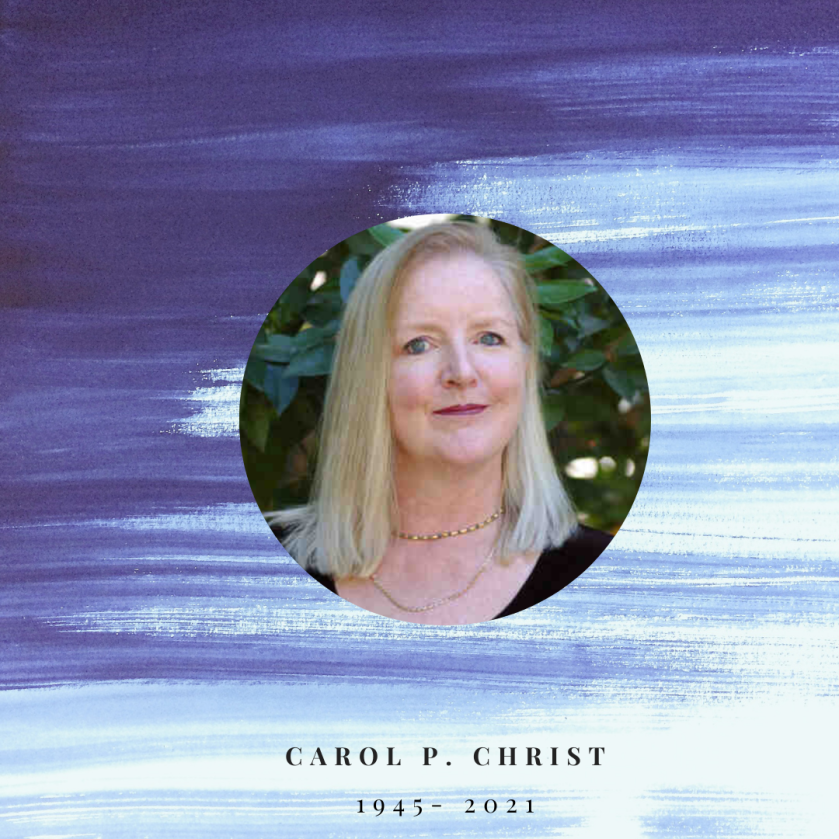
Legacy of Carol P. Christ: Why a Goddess Pilgrimage?

This was originally posted on October 1, 2012

What is a Goddess Pilgrimage and why are so many US, Canadian, and Australian women making pilgrimages to ancient holy places in Europe and Asia?  The simple answer is that women are seeking to connect themselves to sources of female spiritual power that they do not find at home.

Traditionally pilgrims leave home in order to journey to a place associated with spiritual power.  “Leaving home” means leaving familiar physical spaces, interrupting the routines of work and daily life, and leaving friends and family behind.  For the pilgrim, “home” is a place that has provided both comfort and a degree of discomfort that provokes the desire to embark on a journey.  The space of pilgrimage is a “liminal” or threshold space in which the supports systems of ordinary life are suspended, as Victor Turner said.  A pilgrim chooses to leave the familiar behind in order to open herself to the unfamiliar—in hopes that she will return with new insight into the meaning of her life. 

Continue reading “Legacy of Carol P. Christ: Why a Goddess Pilgrimage?”

Initiation and Descent part 1 by Terry Folks

Review: In my first two posts about my recent Goddess Pilgrimage to Crete, I invited you to consider your stage in your current Heroine’s Journey as you followed me.

In my hybrid of Joseph Campbell’s mono-myth with feminist scholar Maureen Murdock’s version, the first six stages of the Heroine’s journey are: Ordinary World, the Call to Adventure, Refusal of the Call, Arrival of Mentors, Crossing the First Threshold, and Encounters with Tests, Allies, and Enemies. These archetypal stages were overlaid with Murdock’s Separation from the Feminine, Identification with the Masculine, Gathering of Allies, Road of Trials, Meeting Ogres and Dragons, Finding the Boon of Success, and Awakening to Feelings of Spiritual Aridity and Death.

Briefly: At home on Vancouver Island, Canada, I was overworked, other-focused, burnt out and overwhelmed with horrific family crises. I was terrified of doing the Goddess Pilgrimage on my own. I finally accepted divine assistance and flew to Crete. I tested positive for COVID on the first day of the pilgrimage.

Continue reading “Initiation and Descent part 1 by Terry Folks”

Crete as the cradle of a culture of peace – Part Two by Laura Shannon

Part One of this article spoke of our collective yearning for peace, and the difficulty of imagining a peaceful world when we are taught to believe that “patriarchy and with it war and domination are universal and inevitable.” (Carol Christ, 2015)

But this is a myth. The peaceful civilisation of Bronze Age Crete lasted two thousand years with no sign of violence, slavery, or war. Most likely matriarchal, matrifocal, and matrilineal, ancient Crete embodied the final flowering of Old Europe. Art and archaeology reveal a life-loving people who honoured the earth, the Goddess, and nature, particularly mountains, caves, and trees. Key values and symbols of this culture of peace survive today in Cretan women’s dances and folk arts including pottery, textiles, baskets, and bread.

Continue reading “Crete as the cradle of a culture of peace – Part Two by Laura Shannon”

Crete is the Cradle of a Culture of Peace – Part One by Laura Shannon

These are difficult days. We awaken daily to the ongoing horror of senseless killing. My heart is filled with a yearning for peace. Now is the time to dream of peace, to choose peace, to practice peace – within our selves, with those we love, in our communities and in our world.

But what might a peaceful world look like? It can be hard to even imagine – not only because we live in a world filled with war, but because we have been taught to believe, as Carol Christ explains, that “patriarchy and with it war and domination are universal and inevitable.” However, she goes on, “this is a myth perpetrated by those who do not want to give up the power and privilege the patriarchal system has accorded to them.” War is not inevitable. Peace is possible.

Continue reading “Crete is the Cradle of a Culture of Peace – Part One by Laura Shannon”

Legacy of Carol P. Christ: Argument from “Absence” and Absence of Dialogue

This was originally posted August 31, 2015

Recently in a conversation with a noted archaeologist and his male graduate student assistant, I proposed that the absence of war and the trappings of war, including images of larger than life-size warrior kings, suggested to me that we should not understand the social structure of ancient Crete on the model of patriarchal kingship. “Kings are always warriors,” I said, “yet there is no clear and convincing evidence of organized warfare in ancient Crete. And,” I continued, “because warrior kingship is not a ‘natural state,’ but one achieved through warfare and domination, kings must legitimate and celebrate their power through larger than life-size images of themselves. Such images were common in ancient Sumer and in ancient Egypt, but are not found in ancient Crete.”

The response I received was unexpected: both archaeologists seemed dumbfounded. “Is kingship always associated with war?” they asked. “Yes,” I responded, “this is a conclusion I reached many years ago while studying the cultures of ancient Greece and ancient Israel, and I have recently elaborated this theory in a series of essays on the blog Feminism and Religion ( See “Patriarchy as a System of Male Dominance Created at the Intersection of the the Control of Women, Private Property, and War”).”

Continue reading “Legacy of Carol P. Christ: Argument from “Absence” and Absence of Dialogue”

Legacy of Carol P. Christ: The Heraklion Museum: A Critique of the Neolithic Display

This was originally posted April 2, 2018

If I had been asked to write the words that introduce visitors to the Heraklion Archaeological Museum of Crete to its earliest inhabitants, I would have said something like this:

While there is evidence that human beings visited Crete as early as 150,000 years ago, the first permanent settlers arrived from Anatolia in the New Stone Age or Neolithic era, about 9000 years ago, bringing with them the secrets of agriculture and soon afterward learning the techniques of pottery and weaving. As the gatherers of fruits, nuts, and vegetables and as preparers of food in earlier Old Stone Age or Paleolithic cultures, women would have noticed that seeds dropped at a campsite might sprout into plants. Women most likely discovered the secrets of agriculture that enabled people to settle down in the first farming communities of the New Stone Age. As pottery is associated with women’s work of food storage and preparation, and as weaving is women’s work in most traditional cultures, women probably invented these new technologies as well. Each of these inventions was understood to be a mystery of transformation: seed to plant to harvested crop; clay to snake coil to fired pot; wool or flax to thread to spun cloth. The mysteries were passed on from mother to daughter through songs, stories, and rituals.

Continue reading “Legacy of Carol P. Christ: The Heraklion Museum: A Critique of the Neolithic Display”

Legacy of Carol P. Christ: The Beauty Way

This was originally posted on January 22, 2018

When I learned about the Navajo Beauty Way, I understood it to be a path in which human beings respect all beings in the web of life and live in harmony with them. But I didn’t understand why this path was called the “Beauty Way.” As a young woman, I knew that my worth was defined by many in terms of my ability to conform to ideals of female beauty promulgated in movies, tv, and advertising. I didn’t believe the Navajos were talking about beauty in that sense, but because of my conditioning, I was not yet able to fully grasp what they might mean by beauty. I would have called the way they were describing a “Way of Harmony” or a “Way of Respect for Life.”

Still, I wondered: why the Beauty Way?

Continue reading “Legacy of Carol P. Christ: The Beauty Way”

TRAVELOGUE INTO HISTORY: MY BIG FAT GREEK ODYSSEY (Part 2) by Sally Mansfield Abbott

Part 1 was posted yesterday. You can read it here.

Arriving in Heraklion on Crete, I was enlivened by the sea air and the informal “island” vibration. My sister and I made our way through its labyrinthine streets, following Daedalus, a pedestrian street named after the legendary creator of the labyrinth at Knossos, the prototype of the artist, who Joyce names as his stand-in in Portrait of the Artist as a Young Man and Ulysses. Our hotel was on Theotokopolous Street. (They’d call you El Greco too if your name was Domenikus Theotokopolous.) Nikos Kazantzakis was also from Heraklion, a city noted for its artists.

Knossos was a small, contained place circled by pine trees, unlike the sprawling sun-drenched expanse of a typical archeological site. There were restored ocher columns, four storeys to the palace, open courtyards for bull leaping, and cisterns that had been used for self-purification. Its red clay and turquoise frescoes were so familiar to me, with their vivid colors and playful lines that Matisse could have envied. No wonder it was the prototype of a work of art!

Continue reading “TRAVELOGUE INTO HISTORY: MY BIG FAT GREEK ODYSSEY (Part 2) by Sally Mansfield Abbott”

Carol P. Christ’s Legacy: Is This How Patriarchy Began?

This was originally post on June 19, 2017

In my widely read blog and academic essay offering a new definition of patriarchy, I argued that patriarchy is a system of male dominance that arose at the intersection of the control of female sexuality, private property, and war. In it, bracketed the question of how patriarchy began. Today I want to share some thoughts provoked by a short paragraph in Harald Haarmann’s ground-breaking Roots of Ancient Greek Civilization. Haarmann briefly mentions (but does not discuss) the hypothesis that patriarchy arose among the steppe pastoralists as a result of conflicts over grazing lands. As these conflicts became increasingly violent, patriarchal warriors assumed clan leadership in order to protect animal herds, grazing lands, and the women and children of the clan.

On the recent Goddess Pilgrimage to Crete, while we were driving through sparsely populated grazing land, my friend Cristina remarked that the shepherds on foot wearing traditional clothing that she had seen several decades earlier had been replaced by men in shirts and jeans, driving farm trucks. Her nostalgic reverie was interrupted by our young Cretan bus driver who said, “You would not want to be alone with one of those men, not now and certainly not then.”

Continue reading “Carol P. Christ’s Legacy: Is This How Patriarchy Began?”

Carol P. Christ’s Legacy: THE LABRYS: A RIVER OF BIRDS IN MIGRATION

Moderator’s Note: Carol Christ died from cancer in July, 2021. Her work continues through her non-profit foundation, the Ariadne Institute for the Study of Myth and Ritual and the Goddess Pilgrimage to CreteThis blog was originally posted July 29, 2013. You can its original comments here.

labrys seal ring

“There’s a river of birds in migration, a nation of women with wings.” Goddess chant, Libana

On the Goddess Pilgrimage to Crete, I explain that many of the names given to “Minoan” (c. 3000-1450 BCE) Cretan artifacts and architecture are products of patriarchal and Eurocentric imaginations, and as such, are misleading.  For example the name “Minoan” was given to the culture of Bronze Age Crete in honor of “King Minos,” who was said to have ruled in Crete a few generations before the Trojan War–several hundred years after the end of the culture to which his name was attached.  In fact, despite his eagerness to find evidence that King Minos ruled at Knossos, the excavator Sir Arthur Evans finally had to concede that the best he could do was to produce a fresco of a “Prince of the Lilies” which he identifed as the image of the male ruler of the culture he called “Minoan.”  Evans’ Prince had white skin, a fact that Evans conveniently overlooked–because according to his own interpretation of “Minoan” iconography, white skin would mark the figure as female.  Mark Cameron, who reviewed Evans’ reconstruction of the fresco, suggested that the Prince is more likely to be a young woman who is perhaps leading a bull to take part in the bull-leaping games.  He also stated that the “crown” belonged to another fresco altogether.

Continue reading “Carol P. Christ’s Legacy: THE LABRYS: A RIVER OF BIRDS IN MIGRATION”