It was through these many conversations that I continued a dialogue with myself about my own role in the divisive nature of our relationships and the need to acknowledge individual identity and lived experience in relation to one’s perspective.
Over this past year, I’ve been in an uncomfortable place of searching and growth. Challenges and life transformations have left me struggling with my own identity, beliefs, and values and I continue to grapple with questions feeling a bit lost in this destructive world of political civil war here in the U.S. Having the privilege to teach, speak, and write publicly about my ideas, I have been particularly focused on is whether I am part of the problem or the solution.
Recently, I was humbled to deliver the 40th Annual Nash Lecture at Campion College; a Catholic Jesuit institution at the University of Regina in Saskatchewan, Canada. My visit to Campion was soul feeding. I met incredible scholars, administrators, students, and community members who embraced me with generosity and compassion.I felt overwhelmed — in a positive way — by the spirit of hospitality and friendship and was impressed by the inquisitive, articulate, and respectful students who were enthusiastic to connect with me and further explore their own questions about feminism and faith.Continue reading “Dialogue as Revolution by Gina Messina”
Have you felt the satisfaction of putting someone in their place? Have you ever felt the rush of power that comes with delivering a cutting set-down? Have you ever felt a glow of pride after making fun of a horrible person or group, and having the people around you laugh appreciatively?
I sure have. In high school, the bully-types in my classes learned not to pick on me to my face, and not to pick on my sister when I was in the room. I got damned good at snide, witty comebacks, and so people stopped messing with me. That kind of success was incredibly rewarding. It was a useful skill I honed over the years, so I could trot it out whenever needed. Rare these days, but my sister still occasionally says, “I’m just glad Trelawney’s in my corner.”
Oh, it feels good to WIN, to experience verbal conquest, and to know I’m justified in using my tongue as a sword, because that person SO deserved it! Ah, the adrenaline, the afterglow, the notch in my belt!
I use words like “mutuality,” “listening,” and “love,” here as I discuss my understanding of feminist justice-making and eschew debate…I want to make it abundantly clear: I see these as powerful, often forceful and even angry tools. We listen to what oppressors say so that they cannot deceive with their “alternative facts.” We love forcefully…We counter violence—we do not debate it—with anger, humor, creativity and power, in order to redirect its energies into more mutual possibilities.
Participating in the Women’s March on Jan. 21st in Los Angeles fed my soul deeply. I didn’t realize how much I needed to protest in this way, how stuck I had been in grief and despair after the election, and the way that coming together as a community would help me to mourn. There’s nothing quite like standing together with hundreds of thousands of people who also care deeply with hope, humor, and real power. Marching helped me to find the energy to fight back. It refilled a reservoir, so depleted in 2016, much as the badly needed winter rain in my home state of California has helped to abate the severe drought. Continue reading “You Can’t Debate Mutuality by Sara Frykenberg”
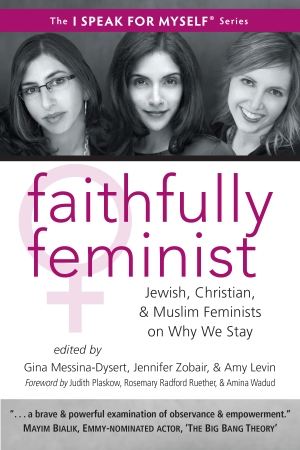
“Feminism saved my faith” is the concluding phrase of one of the writers in Faithfully Feminist, and though not everyone would say it that way, most of these women have found feminism and faith vibrantly interrelated. The contributors to this anthology articulate a range of reasons that feminists might choose to remain within a patriarchal religious tradition. They also remind us that women reconcile their faith and feminist identities in diverse ways. This volume testifies to the dynamism within the religious communities of Judaism, Christianity, and Islam in the United States, and to their internal diversity. This diversity allows for the contributors to engage in a process of their own development as feminists of faith that interacts with similar processes of development going on in their religious communities.
The overriding common bond for these women of faith is the shared conviction that the conflict between religion and feminism is real— even when it is generated by other people’s expectations that those two identities are separate and irreconcilable. Once each woman arrived at a place where she no longer felt an imperative to abide by an either/or dichotomy, she was able to define the terms of her religion and feminism for herself and to own both identities as significant.
Multiply the individual accounts in this volume by tens of thousands, and the effect of these women’s decisions and the concerted actions for change that have flowed from them has been enormous. For example, feminism has profoundly altered American Judaism in the last forty-plus years. Women are ordained in all branches of liberal Judaism and, in all but name, in modern Orthodoxy. New denominational prayer books written in English use inclusive language and incorporate writings by women. Feminists have written Torah commentaries, designed rituals for important turning points in women’s lives, and created new scholarship on women that contributes to a fuller history of the Jewish people.
Likewise, Christianity has been significantly impacted by the work of feminist theology. While some branches continue to refuse leadership roles to women, many others have acknowledged that every person embodies the spirit of Christ and have embraced the ordination of women. In 2006 the Episcopalian Church ordained its first woman bishop, the highest office in the church. Inclusive language has found its way into the prayers and rituals of many churches and feminist commentaries have shifted thinking on scriptural interpretations. Dialogue within and across branches of Christianity are expanding borders, and movements like Woman Church and online feminist spaces have created opportunities for women to claim agency and participate in roles that have been traditionally withheld.
In the long road to Islamic feminism, women have sometimes lacked agency to define either Islam or feminism. Traditional definitions of these words which operate as a constraint on work within Islam towards justice, equality and dignity; feminism was connected to Western imperialism and invasion into Muslim-majority nation states, and centuries of patriarchal control and interpretation stifled women’s efforts to claim Islam for themselves. This is changing, aided by campaigns such as the 2009 launching of the Musawah movement for equality and justice in Muslim family law. A new freedom is emerging that allows Muslim women the dignity and honor of defining Islam and feminism for themselves—no matter how little they might know of global discourses and historical traditions. All that was necessary was to, identify as a believer and expect a life of justice within that belief. Islam has also witnessed women-led prayers and a move toward inclusive prayer spaces.
The profound changes feminists have inspired and worked for do not mean that all problems have been solved and that women’s subordination is a thing of the past; there is plenty of work for a new generation. The difficulties with overcoming the glass ceiling and balancing work and life that women within the larger society face also bedevil women in all three religious communities. Panels, boards, and publications often exclude women’s voices completely or have only token female participation. Ordained women in Judaism are paid less than their male counterparts and rarely become senior rabbis in large or prestigious congregations. If women “choose” to serve smaller synagogues —the explanation often tendered to explain these gaps—that is partly because the expectations surrounding the rabbinate have not kept pace with its changing demographic, and women who want to combine rabbinic work with raising a family face considerable obstacles. Christian ordained women face similar obstacles within the priesthood and continue to be denied leadership roles in some branches, including Catholicism and Mormonism. Similarly, Muslim women are often excluded from panels at religious conferences and are underrepresented on the boards of religious institutions. The idea of women leading Muslim prayers remains controversial. And too often, discussions about women’s role in Islam still revolve around the issue of hijab, or covering.
The challenge for feminists today is passing on feminist insights and gains to the next generation. Is women’s history being incorporated into elementary and high school texts, or are students being taught the same parade of male names and faces? More particularly for Jews, Christians, and Muslims, when a girl or woman wants to mark some nontraditional ritual occasion, is it clear where to turn for resources? Do most Jews, Christians, and Muslims even know that it is possible to create new rituals that feel deeply meaningful and religiously authentic?
Finally, when teachers—and parents—talk about God, how is God imagined? Are children still growing up thinking about God as a distant male figure, or are they offered a range of images, and emboldened to create their own? Are children being encouraged to talk about and challenge passages in and interpretations of the Torah, Bible, and Qur’an that are misogynist or otherwise unethical? Are they developing critical tools that will allow them to engage with and transform difficult parts of tradition?
The next generation of feminists should consider a move beyond rhetoric and terminology towards substance and personal affirmation. Identifying as feminists of faith helps forge global alliances towards meaningful dialogue across difference—even the differences within. It is only when these deeper levels of change are addressed that the question, “Why stay?” will cease to be relevant.
amina wadud is Professor Emerita of Islamic Studies, now traveling the world over seeking answers to the questions that move many of us through our lives. Author of Qur’an and Woman: Rereading the Sacred Text from a Woman’s Perspective and Inside the Gender Jihad, she will blog on her life journey and anything that moves her about Islam, gender, and justice, especially as these intersect with the rest of the universe.
While I sit and write this post, Christmas celebrations are concluded and I prepare, with the rest of the world, to embark on a new year; a year with my idealistic hopes and want for a better future for humanity. So for New Year’s I am taking out my golden lamp and making three big wishes: peace, kindness, and dialogue in the Catholic Church.
Peace
“True peace is not a balancing of opposing forces. It’s not a lovely façade which conceals conflicts and divisions…. peace calls for daily commitment.” – Pope Francis
Peace transcends governments and countries. Peace should be a daily commitment that each one of us lives every day and practiced in each of our relationships. Looking forward to a new year, I hope to put this into practice and we will see a shift in politics and attitudes that reflect an ideal of peace and reconciliation – not just nationally, but communally.
With peace also comes reconciliation. Fighting takes too much energy. Making a point to reconcile with that relative or friend that you had a falling out with is a goal that has the potential to bear fruit and be restorative.
Kindness
“Kindness is the language which the deaf can hear and the blind can see.” – Mark Twain
With peace and reconciliation comes kindness. This wish is a large request and one that the Pope calls us to embrace. A kindness is required that reaches the poor and oppressed, that reaches non-Catholics including atheists, and, that touches every race, class, and orientation. We do not have the right to judge – a sentiment that the Pope continues to reiterate.
According to Julia Baird, “even scientists are now touting the physical and psychological benefits of kindness, compassion, and selflessness. Multiple studies now show: a single act of kindness can trigger dozens more … and repetitive acts of kindness can make people happier, and less depressed.” This is not a new revelation, but a reminder of the benefits of kindness – a reminder we need to carry into the New Year.
We should, however, remember help the homeless, the children, and the oppressed. This group of people is often ignored the news media, but lack of attention to a problem does not diminish it. According to the Pope, scandals are the news of today, but the children without food are not news worthy. According to Pope Francis, we should not “interfere in the lives of others” in a way that is malicious, like gossiping or being boastful. This behavior brings hurt, bitterness and envy. Kindness is necessary for a better future for all of humanity.
Dialogue with the Catholic Church
“Fifty years ago, Vatican II spoke of communications. Let us listen to, dialogue with, and bring Christ all those we encounter in life.” – Pope Francis
Let us not focus on rituals and rules in the Church; rather, we need to focus on the people of the Church. People,
after all, make up the Church – not brick and mortar. Because of this, we need to focus on dialogue – a dialogue with each other, regardless of belief or life choices. This dialogue should be rooted in a positive attitude and carried out with love and humility. It should include a focus that reaches out to facilitate peace. This dialogue should also include the discussion of women’s roles in the Church. There are so many things to discuss. The Church is a human church. With the invitation to dialogue and re-address so many of the untouched or misinterpreted teachings of Vatican II, might we move forward and rebuild this Catholic Church on the shoulders of one who served the poor, loved everyone, and gave of himself?
What are your wishes for the new year? I would love to hear from you.
From my family to yours, may you have a peace-filled, prosperous, and delightful 2014.
Michele Stopera Freyhauf: Doctoral Student in the Department of Theology and Religious Studies and a Member of the Centre for Catholic Studies at Durham University as well as an Instructor at John Carroll University’s Department of Theology and Religious Studies, Adjunct Professor in Religious Studies at Ursuline College and the University of Mount Union. Michele has an M. A. in Theology and Religious Studies from John Carroll University, and did post-graduate work at the University of Akron in the area of History of Religion, Women, and Sexuality. She is also a Member-at-Large on the Student Advisory Board for the Society of Biblical Literature and the student representative on the Board for Eastern Great Lakes Biblical Society (EGLBS). Michele is a feminist scholar, activist, and author of several articles including “Hagia Sophia: Political and Religious Symbolism in Stones and Spolia” and lectured during the Commission for the Status of Women at the United Nations (2013). Michele can be followed on Twitter @msfreyhauf and @biblicalfem. Her website can be accessed here and is visible on other social media sites like LinkedIn and Google+
This past week I was honored to have the opportunity to talk with Tavis Smiley on PBS about the resignation of the Pope and the future of the Catholic Church. Although some have argued that the pope stepping down means little if anything for Catholics, I think this acknowledgment that tradition can change is at least a step in the right direction. While an end to sexism in the Church is still far off, in the spirit of a feminist ethic of risk, I think we must recognize this step and continue on in the struggle.
What a privilege it was and is to have a platform to share these thoughts. As a feminist progressive Catholic I have repeatedly received friendly and not so friendly warnings about sharing my beliefs. In an age characterized as “the New Inquisition,” the Vatican has worked hard to keep individuals like myself from challenging Church teaching. Any mention of reproductive justice or women’s ordination can quickly lead to one’s livelihood being threatened and the very real possibility of excommunication – just ask Fr. Roy Bourgeois. That said, we each still have the responsibility to retain our power, refuse to be silent, and use our voices to encourage and create change. Continue reading “Hate Mail and the Privilege of Having a Voice by Gina Messina-Dysert”
On Tuesday, President Obama’s acceptance speech included the following statement about coming together as a country across differences of opinion. He said, “We will disagree, sometimes fiercely about how to get [toward the future we hope for]…by itself, the recognition that we have common hopes and dreams won’t end all the gridlock or solve all our problems or substitute for the painstaking work of building consensus and making the difficult compromises needed to move this country forward…”
How do we really do this work? How do we come together across difference to make change? How do we foster productive dialogue that produces genuine and real results? In this dialogue, what principles do we use? What values do we honor? What criteria do we use to judge opinions of others? When is an opinion wrong or when is an opinion just different from our own? Continue reading “Building a Bridge toward the Future: Will You Meet Me in the Middle? By Ivy Helman”
If I see a flaw in contemporary Mormon feminism, it’s that we haven’t ventured outside our own religious community to partner with other religious feminist activists. Working separately or in ignorance of the work already done by other religious feminists, we’re more likely to spend time reinventing the wheel than building upon the lessons learned.
Fortunately, there’s an exciting shift afoot.
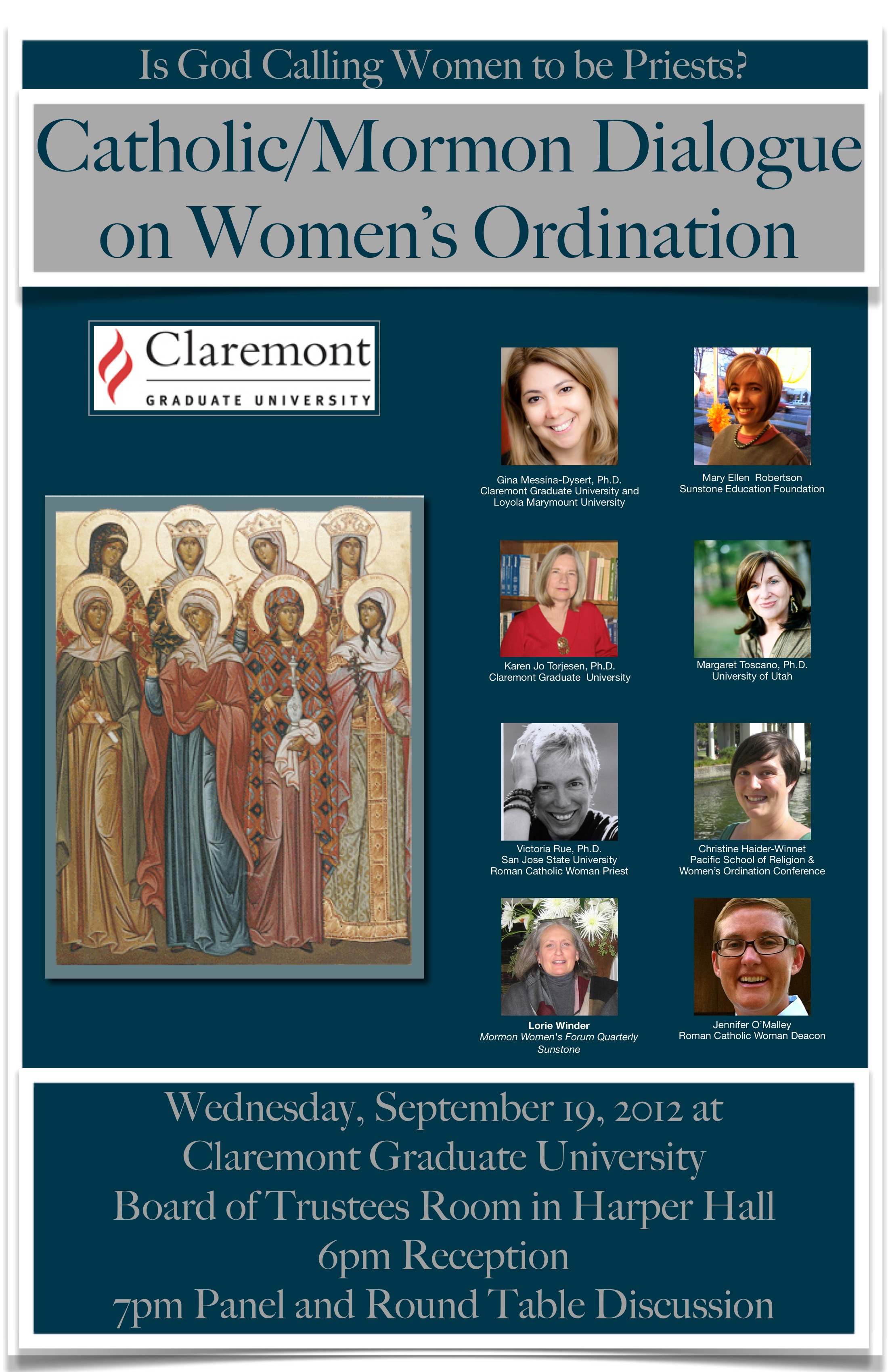
Last week, Catholic and Mormon women came together for a dialogue on women’s ordination.
Hosted by Claremont Graduate University, this discussion brought together six women from patriarchal religions to explore what happens when we call an all-male priesthood into question and examine the theological and cultural assumptions upon which an all-male priesthood rests. Continue reading “A Sea Change Towards Women’s Ordination by Mary Ellen Robertson”
The Catholic/Mormon Dialogue on Women’s Ordination at Claremont Graduate University will take place Wednesday, September 19, 2012. It is an incredibly relevant topic today and particularly interesting with a Mormon/Catholic presidential ticket before us.
It makes sense to bring Catholics and Mormons together to dialogue about this issue. Women’s ordination in both Churches is considered a taboo topic and one that if discussed in public can lead to excommunication. Certainly the women who will stand publicly to address this issue and share their passion and conviction for the need to ordain women are courageous and committed to the recognition of the full humanity of every woman and every man. Continue reading “Catholic/Mormon Dialogue on Women’s Ordination”
Those were a few of the questions I fielded the year I, a devout Mormon, worked as an intern at the University of Utah’s new Women’s Resource Center. As I studied at the “U” in the early 1970’s I encountered second wave feminism and its brand of secularism that challenged the prevailing Mormon-centric environment.
I was introduced to feminism in workshops at the newborn Resource Center, and as an intern I helped plan and put on its inaugural women’s conference. The women there were excited and exciting. They were exploring feminist ideas during a very heady time for college women. Continue reading “1972: Can We Talk? — Looking for Spaces to Share by Lisa Clayton”


 Over this past year, I’ve been in an uncomfortable place of searching and growth. Challenges and life transformations have left me struggling with my own identity, beliefs, and values and I continue to grapple with questions feeling a bit lost in this destructive world of political civil war here in the U.S. Having the privilege to teach, speak, and write publicly about my ideas, I have been particularly focused on is whether I am part of the problem or the solution.
 Participating in the


 Feminism and Religion