In Dreams by Natalie Weaver

I am grateful for dreams.  I don’t know what they are, of course, in any absolute sort of way.  Defining dreaming is as elusive as dreams themselves.  Moreover, I find that understanding dreaming is complicated by the vastly variegated quality one finds in hearing people speak of their experiences of dreaming.  Some say things such as “I can never remember a dream,” while others say they only remember bad dreams.  Some place no stock in dreams at all, while for others they are the numinous truth realms beneath all waking phenomena.  I have spoken with hard-science minded colleagues as well as artists about dreams, who regardless of professional vocation can be utterly untouched by their nighttime journeying.  On just a few occasions have I ever heard people speak of their dreams as definitively shaping their lives in the way that my dreams, or more precisely, in the way that the faculty of dreaming, has impacted my life.

Continue reading “In Dreams by Natalie Weaver”

Following My Dreams by Natalie Weaver

Dreaming has always been a huge part of my life.  When I was a little girl, I would run to my mom in the morning, before I was even completely awake, and tell her what I had been dreaming,  It would seem very important, I mean, desperately, terribly important, to share whatever journey I had been on.

I would have repeating dreams; dreams with choose-your-own-adventure options; dreams with strange symbols and images and words.  I must have known that my dreams were valuable in a particular way to my waking mind, my manner of knowing, and even my concepts of reality because quite early on in my life I started to try to understand what dreaming actually was.  I remember getting a book called Far Journeys (or something like that) about lucid dreaming.  I remember learning about dream paralysis, which was a cause of great relief, since I occasionally experienced it and had to overcome the sense of terror it created.  I developed an early and avid interest in dream symbolism and psychology.  I was relieved when I finally learned the name Carl Jung.  In short, dreaming was central to my total experience of mind. Continue reading “Following My Dreams by Natalie Weaver”

A Healing Home of Dreams by Joyce Zonana

I had few expectations before my visit in the winter of 1999 to Cairo’s Rav Moshe Synagogue, also called the “Rambam.” I only knew it to be an obscure synagogue and yeshiva associated with the renowned twelfth-century theologian, sage, and physician, Moses Maimonides.

I left Egypt as an infant with my parents in 1951. Now I was finally back, hoping to experience the place that had shaped my family. Accompanied by a Muslim Egyptian friend, I walked the streets my parents had walked, attended services in the elegant downtown synagogue where they’d been married, tasted the familiar foods of my childhood, listened with delight to the melodious sounds of Egyptian Arabic. But seeking the Rambam was little more than a whim, sparked by a few lines in a Guide to Jewish Travel in Egypt. “Not on any tourist itinerary,” the brief blurb stated about the derelict synagogue in ‘Haret al Yahud, the city’s medieval Jewish quarter, far from where my parents had lived. Still, I had to go.

Continue reading “A Healing Home of Dreams by Joyce Zonana”

Earth Dreaming, Water Dreaming: How Elemental Dreams Offer Healing for the Earth and Us by Jill Hammer

I once dreamed I was giving a lecture on a spiritual philosophy called magmatheism.  The literal meaning, I thought when I awoke, would be something like “belief in the divinity of molten rock.”  I had the sense this dream was trying to tell me something about what I had come to believe and know.  When I asked my friends what they thought magmatheism was, they gave answers that delighted and intrigued me.

One said: “the belief that God/Goddess dwells below the ground and every once in a while erupts out gloriously.”

Another said: “By studying the ways in which rock is liquid, we can understand the oneness of all things… Our separation is an illusion.  We are part of the whole.”

A third said: “Honoring the magnetic pull to earth.”

A fourth said: “The unmanifest that creates the foundation of all life.”

The dream told me something real about the power of dreaming. It let me know that a life physically and spiritually connected to the earth—the life I was trying to live and to encourage others to live—did not only occur when I was awake, but when I was asleep.  The dream told me that the earth was speaking to me in my dreams.  As dream tender Stephen Aizenstat writes, “Dream images are not representations of our personal nature only, but are also informed by the subjective inner natures of the things and creatures out there in the world. (Aizenstat, S. Dream Tending: Awakening to the Healing Power of Dreams. New Orleans, LA: Spring Journal, Inc. (2011), pp. 149-150).

Continue reading “Earth Dreaming, Water Dreaming: How Elemental Dreams Offer Healing for the Earth and Us by Jill Hammer”

Sleeping: Thinking about Bodily Practices, Pt. 2 by Elise M. Edwards

Elise EdwardsAs I mentioned in my previous post, I’ve been reflecting on bodily practices–especially those that are not typically associated with feminism and religion. Our lives as embodied persons are so multi-dimensional! There is so much we perceive and experience through our senses, through our movements, and through the places we locate ourselves. So I have decided to use this blog to think through some ideas and learn from you in this community of readers, contributors, and commenters. Over the next few months, I will continue to discuss the ways I am becoming more intentional about connecting habits surrounding the body to feminist and religious concerns. Once again, I’ve glossed on only a few of the many connections we could make about women, religion, and bodily practices. Today I write about sleep. I would love to hear your thoughts in the comments below.

Do feminism and religion have anything to do with sleep?

Sleeping is as vital to human survival as food and water. But lamentably, getting the proper amounts of sleep is not one of those healthy goals that is fiercely defended. It is much more common to hear someone brag about how productive she can be on a few hours of sleep than to boast about her productivity after a full night’s rest. I have to admit, I am always a little suspicious of those people who proudly proclaim they only need 4 or 5 hours of sleep, and I’m a little antagonistic to those who want to recruit the rest of us into their sleepless world: “There is so much else you could be doing with your time than sleeping!” They say, “I’ll sleep when I’m dead!” I have even heard “Sleep kills dreams!” Um, actually, dreams come when you sleep. Sleep breeds dreams, you could say. More on that below.

As you might be able to tell, I am the type of woman who loves sleep. I love climbing into my bed at night. I enjoy the feeling of waking up with a rested body and a renewed spirit and a groggy-but-fresh mind. I especially love naps for that reason. The most enjoyable and perhaps “productive” seasons of my life have been those when I could take a nap after class, after work, or after the gym.

Sleep is vital because it allows the body to rest. In the Christian tradition, we claim that rest is part of the creation of the world. That God marveled at the wonderful world God created, and when the work was done, God rested. This rest inspires the Sabbath. Sabbath is a day set aside for rest, worship, and contemplation of the holy. It is regrettably observed less and less in contemporary American Christianity. Since we have let go of the need for the Sabbath, it certainly no surprise we have also lost sight of the importance of daily rest, too.

Although my thoughts are little uncharitable towards those who preach the gospel of little sleep, I am very sympathetic to those who feel they do not have enough time to sleep. To those who feel like sleep is a luxury they cannot afford. Certainly many women tasked with numerous responsibilities often feel this frustration. They make do with less sleep because they have to complete more tasks in their waking hours. Yet it has been my experience that even those who are overworked and overscheduled appreciate the uncommon times when they can sleep a little longer than usual.

For me, times of sleep are very much connected to gratitude. In the past year or so, I have retrieved the practice of nightly prayer, which sadly got left behind in my childhood years. In all honesty, it was not a renewal of spiritual piety that led me to resume these bedtime prayers. It was insomnia. As much as I love sleep, I am often kept from it by anxieties and thoughts of the coming day. I started using bedtime prayers as a way of turning my cares over to God. These silent prayers become conversations about what is important to me and what concerns me. I talk to God about what I am grateful for. I talk to God about my family and my friends, about their lives and concerns that weigh on me. And then I let it go–at least for the night–and trust my soul to the divine power who cares for me while I sleep.

These nightly prayers have not only promoted peaceful sleep (for most nights, at least) but also the experience of vivid dreams. Dreams, like other visions, are honored in many religions as a place where the divine communicates with humanity. But this too, seems absent from contemporary American Christianity. Perhaps it is because dreams are associated with the intuitive senses, and therefore the feminine, that they are overlooked. Dreams are less clear and presumably more open to speculative interpretations than the texts we read during the day. I cannot say whether I meet God or whether I meet my deeper self in dreams, but I do know I am connected to powerful ways of being in my sleep, and that this is important for my spiritual life.

My final reflection about sleep is an acknowledgment that we often do not sleep alone. While sleep itself takes us to a solitary place, we often share our beds with lovers, children, and other family members and friends. Like those bedtime prayers, the words we speak under the covers in those moments before sleep connect us to our bed-mates. Whether they are ghost stories or secrets or incoherent ramblings about the day to come, these nighttime words prepare our minds for the sleep that will soon overtake us. Unless, of course, we are next to someone who snores or kicks.

Elise M. Edwards, PhD is a Lecturer in Christian Ethics at Baylor University and a graduate of Claremont Graduate University. She is also a registered architect in the State of Florida. Her interdisciplinary work examines issues of civic engagement and how beliefs and commitments are expressed publicly. As a black feminist, she primarily focuses on cultural expressions by, for, and about women and marginalized communities. Follow her on twitter, google+ or academia.edu.

Cleaning My “House” by Sara Frykenberg

Sara FrykenbergPrompted by a dear friend of mine during the new moon, last month I set an intention to “clean my house.”  This intention does, to a degree, involve the actual “house,” aka, apartment in which I live.  Great—fantastic even, and no problem at all!  I actually love to clean, particularly cleaning out closets, garages, cupboard or really, any space where junk can be hidden away, brought into the open, sorted and organized.  I’m really not joking.  I tell people this, and they laugh and say, “oh, I should have you come clean at my house.”  Seriously—do.  I am still waiting for several invitations.

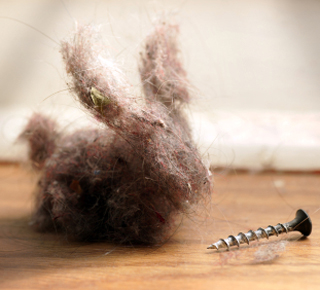
Dust Bunny- sourced from http://www.rhl.org/blog/blog/dorm/dust-bunnies-and-more-keeping-a-clean-dorm-room/2909/

But meditatively speaking and in dreams, one’s “house,” is often one’s self and one’s physical body in particular.  This work has been a bit more challenging to me.  As I shared in my January post, I have been working this year to “create a healthier relationship to food in at least one way,” which also involves creating a healthier relationship with my body altogether, physical, spiritual, mental and emotional.

One reason I began to practice yoga and meditation was so that I could learn to better care for my body.  Feminism teaches me to reclaim embodiment and value physical bodies more, and yoga teaches me to incorporate what I learn in a highly physical way.  In yoga, I also found a safer place to access what I consider sacred and divine by approaching it primarily in my body while my mind and emotions unlearned an abusive relationship to God.  I have even searched my “house” once before through active meditation and visualization.  It was extremely powerful.  I fixed broken locks.  I gave people back items I didn’t even know I had been storing for them.  I also realized that I was not ready to open some doors. The process was fun and very rewarding, involving almost two hours of seated meditation.

Yet, I have also struggled to maintain this practice.  I felt very disconnected from myself before the new moon last month and hadn’t wanted to meditate.  I wanted a vacation from embodiment and myself.  Embodiment, after all, often demands that we actually hear what our bodies are trying to tell us.  Honestly, I don’t always want to listen.  When I have too much work to do, I don’t want to know that I am tired.  When I am anxious, I would rather feel in control.  I knew, however, cognitively, that “cleaning my house,” would be good for me so I made myself set the intention.  I pushed myself to carve out moments in passing during the day to focus my mind and tell me what I wanted to do.  I then proceeded to have four powerful dreams in the week following this intention-setting, all related to my “house.”  In the final dream, I spoke to me, literally.  I faced myself and said very assertively, “You need to work with what you have.” Continue reading “Cleaning My “House” by Sara Frykenberg”

ON NOT GETTING WHAT WE WANT AND LEARNING TO BE GRATEFUL FOR WHAT WE HAVE BY CAROL P. CHRIST

Many women’s dreams have not been realized. How do we come to terms with this thealogically?

Although I am as neurotic as the next person, I am also really wonderful—intelligent, emotionally available, beautiful (if I do say so myself), sweet, caring, and bold. I love to dance, swim, and think about the meaning of life. I passionately wanted to find someone with whom to share my life. I did everything I could to make that happen—including years of therapy and even giving up my job and moving half way around the world when I felt I had exhausted the possibilities at home.

For much of my adult life I have asked myself: What is wrong with me? Why can’t I find what everybody else has? Even though I knew that there were a lot of other really great women in my generation in my position and even though I knew that many of my friends were with men I wouldn’t chose to be with, I still asked: What is wrong with me? Continue reading “ON NOT GETTING WHAT WE WANT AND LEARNING TO BE GRATEFUL FOR WHAT WE HAVE BY CAROL P. CHRIST”