Today is my mother’s birthday and although she has been dead for more than a decade I still think of her almost every day. At the time of her death I had not seen her for twelve years. Not by choice. After my father’s sudden demise my mother chose my children, her two adult grandsons to be her protectors, and dismissed me from her life, permanently.
When she died, my mother divided her assets evenly between my children and me, forcing her only daughter to live beneath the poverty level for the remainder of her life.
The final betrayal.
At the time of her death I was teaching Women’s Studies at the University.
Nature is a Living Being. Animals and plants have souls, and a spirit. Each species is unique, and yet we are all interconnected, human and non – human species alike. This is more than a both and perspective; its multi-dimensional.
Many books are written about using nature to heal humanity of its ills. ‘Recreate’. Climbing a mountain, or taking a walk are common examples of using nature to help ourselves, but how many of us are asking the question of how we can give back?
This is a question I was obsessed with for about thirty years and may be the reason I gained entrance into this seemingly secret world that we call Nature.* When I experienced unconditional love from both animals and plants I needed to reciprocate in kind. This idea of reciprocity between humans and the rest of Nature is probably similar to what Indigenous peoples experienced because they loved (or feared) and learned directly from animals, plants and trees. They respected animals, for example, for their unique qualities. Indigenous people never psychologized Nature the way westerners routinely do.
I rarely read books about Nature anymore because I am so troubled by this psychologizing. From my point of view psycho-babble is just another way of dismissing the reality of Nature as a living feeling, sensing, sentient Being.
There are people in my family who believe Christianity to be so inherently oppressive and harmful, that anyone who identifies as Christian is culpable for all of the harm done by all imperial colonization by Christian empires and nations, all harm done to Native Americans, to LGBTQ people, most slavery, racism, genocide, ecocide, and basically almost every problem the world has had for 2000 years.
Theirs is not an unusual view. I encounter this view regularly here in the Northeast US, though most people assign the blame to religion in general. For parts of my family, Christianity is the true evil because it was so popular, and thus the religion most commonly tied to violent and oppressive political leaders and structures.
I also encounter this attitude from feminists, quite frequently. According to many feminists, I am everything that is anti-feminist and misogynist… precisely, solely because I am Christian.
Here in the high desert it has been raining off and on for the last few days. A giant puddle sits in the driveway and all the trees range in color from subtle shades of sage to emerald. Fringed Chamisa, spun gold and salmon wildflowers are bent low but stems are luminescent. Seedlings are sprouting in unlikely places.
I can’t think of a better mother’s day present for the desert than these ongoing cloud-bursts that are nourishing the earth with water and minerals from the sky. I am profoundly grateful for this year’s spring greening.
The earth is experiencing a sense of renewal. I wish I could say the same for me with respect to mothering and mother’s day. I cross this cyclic threshold with the same feelings of dread and grief that overpower me each year. Neither of my children acknowledge me as the mother who once loved them so fiercely, but oh so imperfectly in her own confusion and despair.
I was such a young wife, barely twenty when I became pregnant with my first child. Two years later I was a mother of two sons. Within five years I was divorced and on my own.
Although I tried to repair the damage as soon as I was able, neither child was willing to join me. I desperately suggested counseling – many times. As adolescents and young adults both Chris and later David, responded with chilling silence and apparent indifference to every frantic attempt I made to bridge the gap.
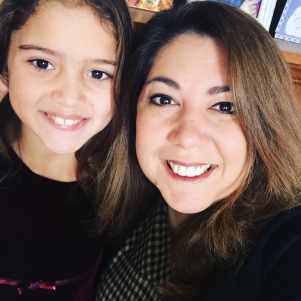
Today, Good Friday, marks the seventh anniversary of one of the most significant dates in my life – the adoption of my daughter, Sarah. On Easter Sunday, 2012 I wrote about the resurrection of my family.
Much has changed since the government acknowledged that Sarah is my child – something I knew from the moment we saw each other. My seventeen year marriage ended, I lost significant persons in my life to death — and to the 2016 presidential election, and my career has had many ups and downs. While many of us think of our lives as a path to resurrection, what I have come to understand in being a mother, is that resurrection is not a once and for all thing. Every day, I find salvation in the moments I experience with Sarah. I recognize the ways my loved ones are resurrected in me. And I have found new appreciation for the joys life brings, even when they seem few amongst the ways we experience suffering and loss.
In the years that I have been blogging, this is by far my favorite post and I have been so grateful for the many wonderful responses I have received from it. It seems an appropriate time to revisit this incredible experience and once again, give thanks for the experience of salvation in my life, and proclaim the miracle of my family.
*******************************************
As I had written about in a previous post, my ex-husband and I had a very long struggle with infertility. After nine years, multiple failed rounds of infertility treatments, and much heartache, we decided to look at alternative options to grow our family. Once we had made the decision to adopt, I felt new hope. There was a light at the end of the tunnel and I knew a child would be coming home to us before long. I had a dream that Mary, the mother of Jesus, had come to me and told me that I would be a mother. She promised that a child was waiting that needed and wanted mg love and would arrive soon. I began praying to a shrine of Mary at a local parish near my home; she became my source of strength and solace.
Not long after being approved for the adoption waiting list, I embarked on a trip to Italy with my family to visit my father’s hometown and meet our relatives. It was quite an adventure and during our excursion I stopped in every church I passed to say a prayer to Mary. Half way through the trip I received a call that a child was matched with me. To say I was overjoyed would be a complete understatement. I tried to catch an earlier flight home but was unable. A once in a lifetime trip was suddenly of no interest as I sat around my hotel room looking at baby items, reading parenting info, and preparing for the homecoming of my daughter.
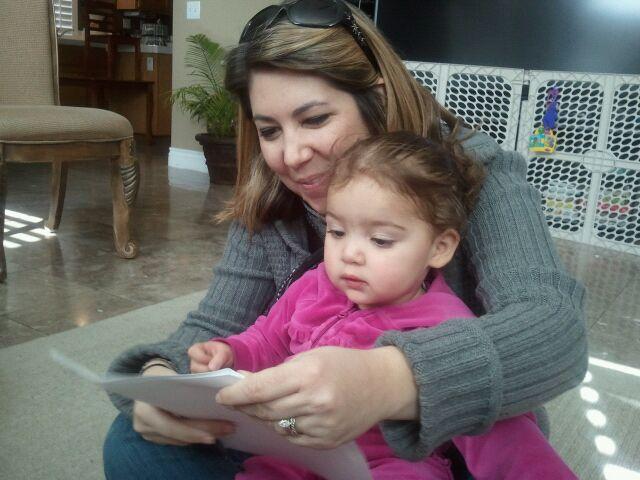
Mommy and Sarah meet for the first time.
I met my daughter – Baby S – for the first time in January, 2011. She was 20 months old and from the moment I saw her, I knew we were destined to be together. I had been terrified on our way to meet her wondering what she would be like. Would she like me? Love me? Would she accept me as her mother? When I entered her foster home and came around the corner, we locked eyes as she ran toward me giggling; I picked her up and we embraced and I instantly fell in love. She was the child Mary had promised me.
After my daughter had been home for about a month, I was notified that there was a problem with her adoption. A biological relative had hired an attorney and was seeking custody. It was an incredible shock; I was frightened and found that I had no rights in the process because I was considered a foster parent until the adoption was finalized. After three months of having my daughter home a court ruled that she had been placed with me in error. Baby S was taken from my custody and my world crashed around me.
The grief I felt was unbearable and I questioned what kind of God would be so cruel. My family was lost, as was my dream of being a parent. I had given up on motherhood; after losing Baby S I could not imagine bringing another child into my home.
Five months passed when I received the unexpected and unbelievable call from the adoption worker that the relative was no longer able to care for Baby S; she had asked that Baby S be returned to my care. It was a miracle, my daughter was coming home to me.
From the time I received the call until Baby S came home, nearly three weeks had passed. Again, I was worried about seeing her for the first time. How difficult would it be for her to move again? What had her life been like for five months? Would she accept me as her mother? When she finally arrived Baby S walked into our home and into my arms. Our connection had never faded. She was my daughter. Mary had known it, and at that moment, I knew it.
Baby S has been home for a little over six months now. She has changed my life in so many ways and every day I wake up thankful to be her mom. While the grief I had (and Sarah too) endured was unspeakable, the end result was worthy. I have come to know Baby S’s biological family well. They are wonderful people and together we all share a deep love for Baby S and want what is best for her. We will have an open adoption, a true gift in so many ways. Had we not gone through this entire ordeal, we would have never come to know her biological relatives. I believe Baby S’s life will be better for it, as will ours.
I had been unable to share our wonderful news previously because our adoption was pending. However, on Good Friday we entered a courtroom with Baby S and her adoption was finalized. I wept as the judge who had removed Baby S from my custody a year ago stated that it was clear she belonged with me. It was the moment I had been waiting for; although Mary told me Baby S was destined to be my child, although I have known she is my daughter for sometime, the legal system has finally recognized this as well. So here, on this Easter Sunday, I am writing to tell you our family has been resurrected.
Gina Messina, Ph.D. is an American feminist scholar, Catholic theologian, activist, and mom. She serves as Associate Professor of Religious Studies at Ursuline College and is co-founder of FeminismAndReligion.com. She has written for the Huffington Post and is author or editor of five books including Jesus in the White House: Make Humanity Great Againand Women Religion Revolution. Messina is a widely sought after speaker and has presented across the US at universities, organizations, conferences and on national platforms including appearances on MSNBC, Tavis Smiley, NPR and the TEDx stage. She has also spoken at the Commission on the Status of Women at the United Nations to discuss matters impacting the lives of women around the globe. Messina is active in movements to end violence against women and explores opportunities for peace building and spiritual healing. Connect with her on Twitter @GMessinaPhD, Instagram: @GinaMessinaPhD, Facebook, and her website ginamessina.com.
Fourteen years ago, I was pregnant with William Valentine. I had no idea what to expect. I knew only that I was in a body, and it was pregnant. Things happened to me, to my body, that seemed extrinsic to my person, so much so that for most of those forty weeks, I felt as though the doctor’s office was having the baby, and I was a mere observer. But, when the time came to deliver the baby, I realized it was my body that was trying to make passage for another’s. The particularities of myself and the baby’s self seemed to fade away into something more vital and primordial in the process of the transmission of life. After a safe delivery, I felt a deep and curious gratitude that was beyond the gratitude I had for my child or for our health. This strange gratitude was born of the passage I had been so fortunate to experience, that is, this novel yet ancient, essential yet unparalleled dimension of human being-ness. I had given live birth, and I was grateful to know what that was like. In that experience, I was more connected to my human brothers and sisters than I had ever been before, including to this new baby, who I knew in my deepest self was more fundamentally a brother human than even he was my own child. I knew that in this transmission, I had helped a fellow traveler, and that transmitting life was simple even while it was giant in scope. The experience was and would always be about walking with each other, from the cradle to the grave, in our vulnerability, in our fragility, in our humility, and in that walk, to find our strength, our dignity, and our luminescence, as persons, as creatures that think and speak and love. To have been a party to another’s coming to be, this was an occasion of the greatest gratitude I had known.
In accompanying my father in this final stage of his life during these challenging and difficult months as he journeyed toward his death, I felt that same vital and primordial passage of being that I had in giving birth. While it was not my body that this time labored and worked, I was party to his experience. I witnessed his courage and another kind of transmission of life. For, I saw a man go from self-concern to other-concern; from hope of getting well to hope to of making things better for others; I witnessed a man move from verbal complaint to silent focus; and I heard his relocation of worry for himself to concern for me because he knew I was hurting as I was watching him, mostly powerless to do anything but sit next to him. I saw a man graduate from a regular man to an elder and then to naked spirt in God’s care, and I was honored to be one of his midwives on that journey. In his final hours, he became full of grace, and he fulfilled the trajectory of becoming the father and man he always intended to be. It was an honor to behold, and I am grateful.
Parshah Vayigash covers Genesis 44:18 to 47:27. It involves the reunification of Joseph with his brothers and his father, the immigration of Jacob’s entire family to Egypt and Joseph successfully leading Egypt through famine. In other words, the parshah provides the backdrop for how the Israelites become slaves in Egypt.
Any mention of women is confined to verses 46: 14-26. They are not active participants, but are remembered as mothers and (a few) daughters and help explain the size and development of Jacob’s family. It is most striking that they are mentioned at all as the text is heavily preoccupied with sons. Nonetheless, according to the account, Jacob’s family has 70 members and a seemingly very small number are women and daughters.
Clearly it comes as no surprise that this text is highly influenced by its patriarchal roots and we could dismiss it for that reason. Nonetheless, it has become a project of mine in this blog over the past few months to find redeeming qualities and food for thought within these texts. In other words, despite its sexist pitfalls, there are still holy insights and life lessons as my previous blogs attest. Continue reading “Vayigash: Lessons from Joseph’s Behavior by Ivy Helman”
This has been another hard month. I don’t feel it to be hard. I just know objectively that it is. The typical challenge of balancing my work with the children’s needs and the management of a household has been intensified by the onset of a serious medical condition in my family. I now enter that phase of elder care, which I understand is more or less bound to bankrupt the average household. I have become the much-begrudged adult child, compelled to make decisions for other people’s lives and regarded in the fog of suspicion. My intentions are now under scrutiny; my time is usurped; my efforts are thankless. I’m not complaining really. I am just describing.
In the midst of things, I have managed to take my older son to the seeming ends of the earth to visit potential high schools. I am managing a Destination Imagination team for my fourth grade son’s class. I am teaching six courses, and my home is relatively clean. I am running a weekly lecture series, I volunteered at the Church this month, and no one has missed any meals. I even managed to sew a blanket for a friend’s new baby. There are many more serious family, medical, and economic issues that underlie my day-to-day, but along with everyone else, and perhaps a little more so than some others, I just accept that I am amazingly over-extended.
Trigger warning: rape, sexual assault, domestic abuse, graphic sexual content
In Part 1 of this story, I introduced a discussion of Johan Galtung’s theory of cultural violence as it relates to my experience as a young woman in an abusive relationship. To recap:
Cultural violence is: “…any aspect of a culture that can be used to legitimize violence in its direct or structural form. Symbolic violence built into a culture does not kill or maim like direct violence or the violence built into the structure. However, it is used to legitimize either or both.”
Cultural violence against women is: Normalization and promotion of pornography, prostitution, degradation, and sexual objectification of females in media, predominantly male language in civic, business, and religious institutions, gender roles and stereotypes, misogynist humor, gaslighting, minimizing or denying any of these forms of violence.
My husband’s stepmother, Ginny, died last week. She lived several months past her 97th birthday. Here is her obituary.
Ginny shared her life with three husbands, outliving each one. Three sons were born from her first union. She then married John, my husband’s father, and warmly welcomed us (John’s family) into her life. When John died, Ginny married Fred. After Fred’s death, Ginny told me, “Of all my husbands, Fred was my favorite. He was fun.”
Ginny lived at the Brethren Village Retirement Community in Lancaster, Pennsylvania—a home with several levels of care—for over 30 years, moving there a few years after marrying my father-in-law. She said, “We made a good decision. I never wanted to be a financial burden on my children.” And she wasn’t.
Throughout her life, Ginny attended a fundamental, evangelical church. Had she been able to vote in the 2016 national election, she would no doubt have voted Republican. She had no use for feminism (women who rail against God’s ordained order), liberalism (the Devil’s message), homosexuality (perversion of God’s perfect creation) and immigrants (they siphon resources from hard-working Americans).
Yet, at the same time, Ginny was generous, giving to causes that fit with her ideological worldview such as missions. It was important to her that people come to understand the “truth” as seen through the prism of the theology she embraced. Within her community, she was loving, actively engaged, and caring, helping people in practical ways—donating food and other necessities to organizations sponsored by her church.






 Today, Good Friday, marks the seventh anniversary of one of the most significant dates in my life – the adoption of my daughter, Sarah. On Easter Sunday, 2012 I wrote about the resurrection of my family.




 Parshah Vayigash covers Genesis 44:18 to 47:27. It involves the reunification of Joseph with his brothers and his father, the immigration of Jacob’s entire family to Egypt and Joseph successfully leading Egypt through famine. In other words, the parshah provides the backdrop for how the Israelites become slaves in Egypt.

 Feminism and Religion