 We were playing six-degrees of separation, I think. I don’t know if there are rules to follow. It was after dinner, and we were talking about people we had encountered and their linkages to others. Surprisingly quickly, we found ourselves connected to Dwight D. Eisenhower, Elvis, Winston Churchill, and the Queen of England, herself. My mom had autographs from Jerry Lee Lewis, Duke Ellington, the Globe Trotters, and a gaggle of NFL players and professional golfers. She once chatted up Tori Spelling in a bathroom in Canton, Ohio at a Football Hall of Fame Induction ceremony. My husband worked in film in Los Angeles and Cleveland, meeting a crowd of stars and politicians over the years. One time he had a chance, face-to-face encounter with Prince (the artist himself!) as one rode up and the other rode down an escalator at a Borders in Chicago. As the distance between them closed, my husband quietly acknowledged him, saying, “Bravo!” Prince, whose head was angled away so as to avoid having to say anything, apparently, after a moment of consideration, looked back over his shoulder as they passed and silently mouthed, “Thank you.” I still give my husband kudos here… I mean, what else do you say to Prince? This connection, moreover, gave us our links to Morris Day, Jerome, Apollonia, and Shelia E., so we were all excited at his impressive list. I had a far less remarkable cast of characters to contribute, but I could offer a Vatican insider acquaintance, providing thereby a papal connection, which gave us our links to several world leaders. I felt I had contributed my part, even without autographs and celebrities.
With the exception of a Robert Redford encounter while volunteering on a political campaign, the couple that was with us had fewer serendipitous meetings to report. But, we did learn that there was a grandfather in their mix who had served as a royal cook in Hungary. The game now shifted to linkages in history. Who were our notable ancestors? Who were our ancestors, period? Continue reading “Six Degrees of Separation, Hungarian Royalty Chefs, & A Trip to Lens Crafters by Natalie Weaver”


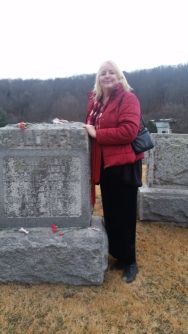 In the past week I visited Cherry Ridge, Honesdale, Wayne, Pennsylvania in the Pokonos, where I was welcomed by my third cousin Marcia Perry Gager whose family never left the place where our ancestors settled. Marcia and I have been corresponding about our family’s history since Ancesty.com connected us about three years ago. During that time, together with another cousin, Debra Ball, we have managed to decipher the complicated history of Henry Iloff, his two wives, and their eighteen children.
 I’m not particularly fond of my periods – they’re painful, full of cramps. But they are a part of who I am, and I’m not going to apologize for them. We women, especially those of us belonging to the sub-continent, have been shamed or embarrassed into silence, while being reminded that motherhood is the most exalted position a woman could ever hope for. I mean, isn’t that paradoxical – if it weren’t for the bloody nemesis (pardon the pun), we would never get to experience motherhood.
 When the wheel of the year turns towards fall, I always feel the call to retreat, to cocoon, to pull away. I also feel the urge for fall de-cluttering—my eyes cast about the house for things to unload, get rid of, to cast away. I also search my calendar for those things which can be eliminated, trimmed down, cut back on. I think it is the inexorable approach of the winter holiday season that prompts this desire to withdraw, as well as the natural rhythm of the earth which so clearly says: let things go, it is almost time to hibernate.


 “A woman can spin a primal umbilical rope within her womb through which she passes life-energy to the future.” –Melissa Raphael
 Feminism and Religion