 Magnitude 5.2 earthquake Feb 6, 5:51 AM I awake to the sound of the windows and shutters rattling and the bed moving up and down beneath me for a few seconds.
Magnitude 5.4 earthquake Feb 6, 12:58 PM This is the first time I can remember two big earthquakes coming so close together.
Magnitude 4.9 earthquake Feb 6, 1:45 PM A friend calls to ask if I think the earthquakes are building up. “The big ones are rare” I say.
The first seismologist to weigh in assures us there is nothing to worry about, as this new series of quakes is not on a major fault.
Magnitude 5.1 Tuesday Feb 7, 2:24 Shake, rattle, and roll.
Magnitude 4.5 Tuesday Feb 7, 5:15 Awakened.
Magnitude 4.6 earthquake Feb 7, 21:35 PM Another jolt.
Magnitude 4.3 earthquake Feb 8, 12:53 AM The bed shaking and the windows rattling.
Magnitude 4.9 earthquake Feb 8, 3:38 AM Awakening again, feels bigger this time.
A second seismologist warns that the series of quakes could be building up to a big one like the 6.6 quake that caused significant damage to the island in 1865.
I become uneasy. My friend decides to move temporarily to a hotel at the other end of the island, farther away from the epicenter.
Magnitude 3.5 Feb 8, 15:31 I wonder if I should leave the village too.
I decide to sleep in my study, fearing the ceiling fan above my bed could fall on me.
Magnitude 3.6 Feb 9, 12:37 AM The couch makes less noise than the bed.
Magnitude. 4.0 Feb 9, 10:13 AM Louder than the one in the night.
Magnitude 3.6 Feb 9, 15:01 PM Not as big as the last one.
I sleep in my study a second night. No quakes.
In the morning I move my blankets and pillows back to the bed.
Magnitude 4.5 earthquake Feb 10, 10:55 AM. The house shakes.
Magnitude 4.3 Feb 10, 12:27 PM A sharp jolt gives me a slight whiplash.
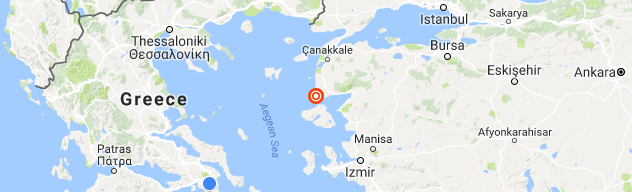
Mithimna (also known as Molivos), Lesbos, where I live is at the top of the triangle that is Lesbos, about 11 miles from the epicenter of the earthquakes. Besides the larger quakes, there have been one or two smaller ones just about every hour during the past week.
There have been no major quakes for more than twenty-four hours. Is it over?
In the long run, it is not. The Anatolian fault runs from below Istanbul to just above Lesbos and out into the Aegean Sea. The Anatolian plate is being pushed westward by the Arabian plate and northward by the African plate. The Anatolian plate is being prevented by moving northward by the European plate. Many years from now the African plate will collide with the European plate and there will be no Mediterranean Sea.
The movement of the earth’s plates is a result of its molten core. “The planetary community has long accepted that as the Earth lost its internal heat, it would eventually settle into a quiescent stagnant state much like Mars.”
Like it or not, uncertainty and instability in the ground under our feet is part of what makes ours a living planet. This is the literal truth. Is it also a metaphor for our lives?
Update: After a quiet day on Saturday we had a 4.8 at midnight and a 5.2 at about 4 in the afternoon. 3.7, 3.6, and 3.5 on Sunday night and early Monday morning, rounding out a full week of tremors. NO it is not over.
(Note: Though there are cracks in the plaster in many of our buildings, including in my house, there has been no significant damage at this time.)
***
 Be among the first to order A Serpentine Path, Carol’s moving memoir. Carol’s new book written with Judith Plaskow is Goddess and God in the World: Conversations in Embodied Theology.
Carol wrote the first Goddess feminist theology, Rebirth of the Goddess and with Judith Plaskow co-edited the path-breaking Womanspirit Rising and Weaving the Visions.
Join the spring Goddess Pilgrimage to Crete by Feb 15. Save $200.


 Yesterday morning when I learned about the Open Letter to Attorney General Sessions: Join Us In Selma On the Right Side of History, I paused Joy Reid’s interview with William Barber II in order to search for the petition site. The letter’s authors invited the Attorney General to join them in Selma to commemorate the 52nd anniversary of “Bloody Sunday” when peaceful marchers demanding the right to vote were attacked with billy clubs and tear gas. The Letter also asks the Attorney General, who was born in Selma, to join them in a non-partisan commitment to ensure the right to vote for all Americans. The letter calls upon the Justice Department to restore the protections against voter suppression enshrined in the Voting Rights Act.
 In our book
  On the morning of January 20, 2017, the world watched Donald J. Trump stand on Capitol Hill for inauguration as the 45th president of the United States. He did not stand alone. Timothy Michael Dolan, Catholic cardinal and archbishop of New York, also stood, and he invoked the divine feminine as he opened the inaugural ceremony with a recitation of King Solomon’s prayer from the Book of Wisdom.
 There are two types of authoritarians: those who jump out in front and say “follow me, only I can solve the problem”; the far greater number of authoritarian personalities are those who want to be told how to think, what to do, “this is daddy, I’ll take care of you.” Those are the people who are the followers and while some of those would like to be leaders themselves, most of them are just happy to follow, and they don’t want to ask questions, and they want to be told what to do and how to think. And that’s a very scary lot. —John Dean
 I have been thinking about deserts lately, what places are desired, which ones are deserted, and by whom. Cabo de Gata of Andalusia is one of the four deserts in Spain. In 2010, it became public knowledge that the Ministry of Development planned to locate a nuclear waste dump there. The last I have heard was that they had ordered a feasibility survey with nuclear scientists, but I can find no other updates. Why would the government and academic institutions penetrate a protected region, sacred for its ecological richness and beauty? The dump would be created 1,000 meters below the surface where the radiation would be dissolved (so they said) and then carried into the sea. Whether we hide waste inside the earth or shoot it up into space or keep it in someone else’s backyard, when will we pause?
 I’m sitting in my parents’ balcony in Pune, India, on a quiet morning. Well, this being a bustling Indian city of six million, it can’t really be quiet. As I sit with cup of tea in hand, I try and meditate – I’ve been practicing mindful meditation of late, and so, rather than block out the noises, I embrace the various sounds that make up this Monday morning.
 Participating in the
 Feminism and Religion