Legacy of Carol P. Christ: THE TWO AND THE ONE: CAN WE EMBRACE AND CELEBRATE SINGLENESS AS MUCH AS MARRIAGE?

This was originally posted on 7/22/13

Like many other readers of this blog, I have followed the progress of the Prop 8 and DOMA cases to the Supreme Court and waited with bated breath during the month of June to see how the cases would be decided. 

On June 26th I rejoiced in decisions that brought the United States several steps closer to affirming the full equality of all human beings.  I am happy that lesbian and gay couples can now get married in California, the state of my birth, the state where I still vote.  As one commentator remarked, “This story has a happy ending—it leads to marriage.”  I am also pleased that lesbian and gay couples will not be excluded from “marriage benefits” offered to heterosexual couples, simply on the basis of their sexual preference.

Still, the gay marriage victories raise other questions.  Much of the rhetoric surrounding the push for marriage equality assumed that “marriage” is or should be “the norm” for all people.  Those arguing for the right of gay people to marry often seemed to be saying: “We are just like everyone else.”

Continue reading “Legacy of Carol P. Christ: THE TWO AND THE ONE: CAN WE EMBRACE AND CELEBRATE SINGLENESS AS MUCH AS MARRIAGE?”

The Pope Punts and Catholics Vote with Their Feet by Carol P. Christ

Reading the receCarol Molivos by Andrea Sarris 1ntly released papal letter “The Joy of Love,” I was surprised to see that it opens a “new” discussion of marriage and the family with a very old patriarchal trope from Psalm 128:

Blessed is every one who fears the Lord,

who walks in his ways!

You shall eat the fruit of the labour of your hands;

you shall be happy, and it shall go well with you.

Your wife will be like a fruitful vine

within your house . . . (see ch. 1, pp. 7-8)

Notwithstanding the “inclusive language” translating the male generic in Hebrew as “one,” there is no way around the fact that this psalm is addressed by a male God to men. It compares women to property owned and tended by men. Nor does it provide any opening to consider the blessings of same sex marriage. Continue reading “The Pope Punts and Catholics Vote with Their Feet by Carol P. Christ”

#LoveWins by John Erickson

On Saturday, September 19, 2015 I married two of my best friends Andrea and Cindy in holy matrimony in Appleton, WI.

John Erickson, sports, coming out.Don’t urge me to leave you or turn back from you.
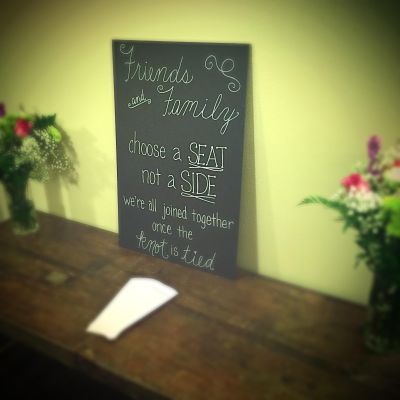
Where you go, I will go, and where you stay, I will stay.
Your people will be my people and your God my God.
Where you die, I will die, and there I will be buried.
May the God deal with me, be it ever so severely, if even death separates you and me.
Book of Ruth 1:16-17

On Saturday, September 19, 2015 I married two of my best friends Andrunnamedea and Cindy in holy matrimony in Appleton, WI.  Having been ordained since 2009, I truly never thought I’d ever get the chance to use these credentials until they asked me a few months back.  Although my answer was an automatic yes, I sought to make sure that my homily and the words of advice I gave them on their special day were something unique, not always heard at wedding ceremonies. Continue reading “#LoveWins by John Erickson”
Spouses for Life by Marie Cartier

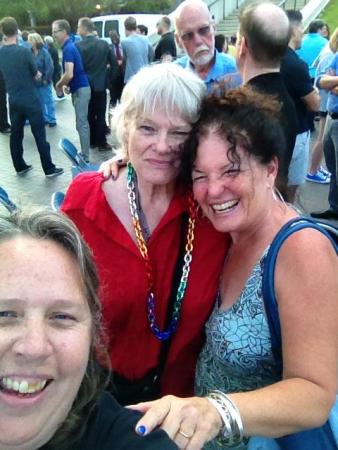
Marie & friends at Long Beach, CA celebrations of the Obergefell decision

This essay is perhaps the last in an occasional series I have written since the New Year, which can be read here and here. Gay marriage as of June 26th is now legal in the United States. What has changed—and what has not?

If public opinion drives public policy, then the motivation for banning same-sex marriage was moral disapproval, religious disapproval—and the belief that God was not “on the side” of the homosexuals and had cast homosexuals as sinners in the faith choice of the person formulating the public policy critique. Public discourse —based on religious formulations such as “sinner” and what “God intended” had been the primary agents erected into state law to ban the LGBTIQ population from civil rights—such as marriage.

Religious sentiment, such as “you are a sinner” should not make the case for legal judgment. In fact, it was unconstitutional.

Love the Sinner. Hate the Sin. Continue reading “Spouses for Life by Marie Cartier”

Gay Marriage: “Tell me why I shouldn’t hate you…?” asks the straight Christian to the lesbian by Marie Cartier

MarieCartierforKCETa-thumb-300x448-72405This is the third of a series exploring gay marriage as a game changer within religion and politics. I have explored the topic as political animus and earlier as almost fairy tale come to life. Today I am examining it from a very person view.

Consider a gay woman (myself) being asked by a straight attempting to understand the “right” for gay marriage, “What does it matter if I know you’re ‘gay’ if I’m not attracted to you?”[1]

Then consider that another right of “marriage” –or being known as “gay”—is the right to be admitted into the hospital room of a loved one, who is considered one’s primary partner, or “spouse.” Yes, one wants to say to the questioning woman in the above scenario, the rights for marriage include the crucial family relationships which allow one person to be able to take sick leave to care for a partner, or a partner’s child; being able to make critical medical decisions, and the right to be together in crisis situations (such as a hospital emergency room).[2]

Imagine the gay woman speaking to the straight woman and saying, “Because I am more than someone you might or might not be attracted to. I am my own person with my own life. I want to among other things, get into the hospital room of my partner, my loved one, the one I am actually attracted to.” Continue reading “Gay Marriage: “Tell me why I shouldn’t hate you…?” asks the straight Christian to the lesbian by Marie Cartier”

The Inalienable Right to Life, Liberty, and the Pursuit of Happiness vs. the Right to Religious Freedom by Carol P. Christ

carol p. christ photo michael bakasIn his speech announcing that he signed the Religious Freedom Restoration Act, Governor Mike Pence of Indiana did not mention the issue of the so-called “right” to refuse service to gays, lesbians, and transgendered individuals as one of the reasons this bill came to his desk. However, the idea that bakers could be “coerced” into baking cakes for gay weddings, photographers “required” to photograph them, and venue owners “forced” to provide space for them was frequently mentioned in discussions of this and similar bills. Governor Pence’s evident defensiveness during his press conference, and his repeated assertion that “this is not about discrimination” made it clear that an elephant was very much in the room.

Instead of defending the alleged “right” of religious individuals to discriminate against gay, lesbians, and transgendered individuals, Governor Pence invoked the right of employers to refuse to provide contraception to women as part of employee insurance plans, mentioning the Hobby Lobby and University of Notre Dame cases. If anyone has forgotten, in the Hobby Lobby case the Supreme Court decided that employers with a deeply held conviction that birth control is wrong do not have to offer it to their employees as required by federal law if “less restrictive” ways of providing it can be found.

Governor Pence apparently thought that openly defending the so-called “right” to discriminate against women is less controversial in his state than openly defending the so-called “right” to discriminate against lesbians, gays, and transgendered individuals. In fact, these two issues are linked in the minds of the people like Governor Pence. Continue reading “The Inalienable Right to Life, Liberty, and the Pursuit of Happiness vs. the Right to Religious Freedom by Carol P. Christ”

Spouse for Life & the Fight for Gay Marriage by Marie Cartier

marriage
Marie & Kim’s Legal Marriage California 2008

Today, I am exploring the following question set:

What is the shifting conception of religious liberty as religious groups carve out exemptions in complying with laws on LGBTQI rights, particularly as they relate to marriage? As gay marriage becomes “normative” how does it change the structure and study of religion? How did the anti-gay rights movement in California, regarding Proposition 8, funded largely through religious organizations such as the Church of Latter Day Saints and the Catholic Knights of Columbus, have a direct impact on state decisions, and animate new conversations about the juncture of religion and politics?

Let’s start with this information:

Sociologist Brian Powell posed the question of why people were opposed to gay marriage. Do what people say match the legal arguments that justify the opposition to gay marriage? Since legal arguments are based on public policy, what public policy was shaping the legal arguments? The findings, published recently in Social Currents, show that the most common reason for gay marriage opposition was given as: “Because I don’t believe God intended them to be that way.” Running a close second was: “Well, they’re sinners.”

If public opinion drives public policy, then the motivation for banning same-sex marriage is moral disapproval. Or as stated in Powell’s findings—religious disapproval—and the belief that God is not “on the side” of the homosexuals; casting homosexuals as sinners in the faith choice of the person formulating the public policy critique. With these formulations, Powell suggested that public discourse —based on religious formulations such as “sinner” and what “God intended” are the primary agents erecting state laws that ban access to civil rights- such as marriage- for the LGBTQI population. Continue reading “Spouse for Life & the Fight for Gay Marriage by Marie Cartier”

THE TWO AND THE ONE: CAN WE EMBRACE AND CELEBRATE SINGLENESS AS MUCH AS MARRIAGE? by Carol P. Christ

carol p. christ 2002 colorLike many other readers of this blog, I have followed the progress of the Prop 8 and DOMA cases to the Supreme Court and waited with bated breath during the month of June to see how the cases would be decided. 

On June 26th I rejoiced in decisions that brought the United States several steps closer to affirming the full equality of all human beings.  I am happy that lesbian and gay couples can now get married in California, the state of my birth, the state where I still vote.  As one commentator remarked, “This story has a happy ending—it leads to marriage.”  I am also pleased that lesbian and gay couples will not be excluded from “marriage benefits” offered to heterosexual couples, simply on the basis of their sexual preference.

Still, the gay marriage victories raise other questions.  Much of the rhetoric surrounding the push for marriage equality assumed that “marriage” is or should be “the norm” for all people.  Those arguing for the right of gay people to marry often seemed to be saying: “We are just like everyone else.”

This assumption leaves out a whole lot of people—among them large numbers of single women.  Continue reading “THE TWO AND THE ONE: CAN WE EMBRACE AND CELEBRATE SINGLENESS AS MUCH AS MARRIAGE? by Carol P. Christ”

Out of the Bars and Into the Streets and ….by Marie Cartier

I remember the election season of 1984. At the 1984 Democratic National Convention on July 18 in San Francisco, California, Jesse Jackson delivered the Keynote address, entitled “The Rainbow Coalition.” The speech called for Arab Americans, Native Americans, Asian Americans, youth, disabled veterans, small farmers, lesbians and gays to join with African Americans and Jewish Americans for a political purpose. My lover at the time woke me up very early in the morning to tell me that Jesse Jackson had said the words “lesbians and gays” as part of his speech at the Democratic Convention. I started to cry and called my mother and she cried, too. We both cried. It was a moment I will never forget…because in that moment I as a lesbian existed on national television and in the imagination and spoken word of the country’s political system where I live and pay taxes—in a way I never had before—I was spoken out loud. Continue reading “Out of the Bars and Into the Streets and ….by Marie Cartier”

“I do, I do, I do believe in gay marriage” by Marie Cartier

I do believe in gay marriage. I mean fairies, I mean gay marriage. I’m a lesbian. I’m approaching my legal fourth year anniversary on October 29, 2012 with my wife. I’m voting for Obama for many reasons, and one of the strongest for me is that he is the only president who has “come out” in support of gay marriage.

An acquaintance recently said to me, “I don’t believe in gay marriage.” There is not a counter narrative to this in my vocabulary. I cannot say “I don’t believe in heterosexual marriage.” I can say I don’t support it—but even that is not true because my taxes do support a system which privileges partnering legally over not partnering. The metanarrative of religious discourse privileges belief statements. So when someone says “I don’t believe in gay marriage”—they are encasing my life in the world of theology where we cast our lot with belief or non-belief.  I’m Catholic—I believe in the Virgin Mary. I believe in the canon of saints. I don’t believe in Hell, however, or Purgatory. I’m not sure of my belief system regarding Heaven. As a New Age practitioner– among these practices are Wicca, yoga, martial arts, Western inspired meditation practice, psychic readings, etcetera– I feel empowered to question the belief systems of the Church, and even more so as a feminist. Continue reading ““I do, I do, I do believe in gay marriage” by Marie Cartier”