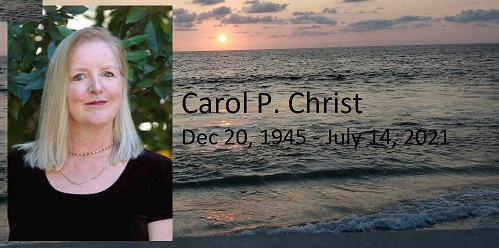
Legacy of Carol P. Christ: “Immanent Inclusive Monotheism” with a Multiplicity of Symbols Affirming All the Diversity and Difference in the World

carol-christ

This post was originally published on March 10th, 2014.

In recent years monotheism has been attacked as a “totalizing discourse” that justifies the domination of others in the name of a universal truth. In addition, from the Bible to the present day some have used their own definitions of “exclusive monotheism” to disparage the religions of others. Moreover, feminists have come to recognize that monotheism as we know it has been a “male monotheism” that for the most part excludes female symbols and metaphors for God.  With all of this going against monotheism, who would want to affirm it?

In response to some or all of the above critiques, many modern pagans define themselves as polytheists, affirming at minimum, the Goddess and the God, and at maximum a vast pantheon of individual deities, both female and male, from a single culture or from many, including divinities with animal characteristics.  Other pagans define themselves as animists, affirming a plurality of spirits in the natural world. A group of Christian feminists have argued that the Christian Trinity, the notion of God Three-in-One, provides a multiple and relational understanding of divinity.

While also rejecting exclusive monotheism and male monotheism, Jewish poet, ritualist, and theologian Marcia Falk provided a definition of inclusive monotheism that I find compelling.

Monotheism means that, with all our differences, I am more like you than unlike you. It means that we all share the same source, and that one principle of justice must govern us equally.  . . Continue reading “Legacy of Carol P. Christ: “Immanent Inclusive Monotheism” with a Multiplicity of Symbols Affirming All the Diversity and Difference in the World”
Legacy of Carol P. Christ: GODDESS WITH US: IS A RELATIONAL GOD POWERFUL ENOUGH?

This was originally posted on Sept 2, 2013

Last week I wrote about Protestant Neo-Orthodoxy’s deification of male power as power over.  This week I want to ask why the relational Goddess or God* of process philosophy has not been more widely embraced, both generally and in feminist theologies.

Could it be that a relational God just isn’t powerful enough? Are some of us still hoping that an omnipotent God can and will intervene in history to set things right?  Do we believe an omnipotent God can save us from death?

Process philosophy provides an attractive alternative to the concept of divine power modeled on male power as domination.  According to leading process philosopher Charles Hartshorne, the power to coerce, power as power over and domination, is not the kind of power God has.

The concept of divine power as omnipotent (having all the power) leads to what Hartshorne called “the zero fallacy.”  If God has all the power and can dominate in all situations, then the power of individuals* other than God is reduced to zero.  In effect, this means that individuals other than God do not really exist, but at most are puppets whose strings are pulled by the divine power.

Continue reading “Legacy of Carol P. Christ: GODDESS WITH US: IS A RELATIONAL GOD POWERFUL ENOUGH?”

Legacy of Carol P. Christ: SHE WHO CHANGES*

This was originally posted on May 21, 2012

She changes everything She touches and everything She touches changes. The world is Her body. The world is in Her and She is in the world. She surrounds us like the air we breathe. She is as close to us as our own breath. She is energy, movement, life, and change. She is the ground of freedom, creativity, sympathy, understanding, and love. In Her we live, and move, and co-create our being. She is always there for each and every one of us, particles of atoms, cells, animals, and human animals. We are precious in Her sight. She understands and remembers us with unending sympathy. She inspires us to live creatively, joyfully, and in harmony with others in the web of life. Yet choice is ours. The world that is Her body is co-created. The choices of every individual particle of an atom, every individual cell, every individual animal, every individual human animal play a part. The adventure of life on planet earth and in the universe as a whole will be enhanced or diminished by the choices we make. She hears the cries of the world, sharing our sorrows with infinite compassion. In a still, small voice, She whispers the desire of Her heart: Life is meant to be enjoyed. She sets before us life and death. We can choose life. Change is. Touch is. Everything we touch can change.

Continue reading “Legacy of Carol P. Christ: SHE WHO CHANGES*”

Legacy of Carol P. Christ: EASTER OF THE GODDESS: A VIEW FROM GREECE

This was originally posted on April 16, 2012

On Good Friday, Easter Saturday, Easter Sunday, and Easter Monday the blogs on feminismandreligion.com celebrated mothers and God the Mother.*

 This is my body, given for you.
This is my blood, given for you.

While these words are the center of a Christian liturgy celebrating the sacrifice of Jesus as the Christ, they are more appropriately spoken of our own mothers. Your mother and my mother and all mothers, human and other than human, mammalian, avian, and reptilian, give their bodies and blood so their offspring might have life. True, mothers do not always make conscious choices to get pregnant, but almost all mothers affirm life in their willingness to nurture the young who emerge from their bodies and from their nests. Had mothers—human and other than human–not been giving their bodies and their blood from time immemorial, you and I would not be here.

Continue reading “Legacy of Carol P. Christ: EASTER OF THE GODDESS: A VIEW FROM GREECE”

Legacy of Carol P. Christ: To a Friend, on the Loss of her Daughter

This was originally posted on April 23, 2012

One test of a thealogy is whether it can help us “make sense” of our lives—even the senseless parts of them.

Recently a friend told me that the teen-aged daughter of a friend of hers had committed suicide. “What would your thealogy say to that?” she asked me. Here is what I might say to a friend who lost her daughter:

I am so sorry for your loss. This never should have happened.

I remember times when I wanted to commit suicide. My pain was intense and my mind was stuck. All I could think was: this hurts too much to go on, and it will never change, so I might as well die. I am so sorry if your daughter felt that way, because I know it is a horrible way to feel. I am sorry she was not able to understand that it could have–and probably would have–changed. Don’t blame her. Sometimes pain is so overwhelming you really cannot see beyond it. Don’t blame yourself either. I am certain you did everything you could think of to help her. I know that if you could have prevented her, you would have. It really was not your fault. I don’t blame you, and no one else should either.

Continue reading “Legacy of Carol P. Christ: To a Friend, on the Loss of her Daughter”

Legacy of Carol P. Christ: Reading Plato’s Allegory of the Cave as Matricide and Theacide

This was originally posted on October 22, 2012

When I read Plato’s allegory of the cave as an undergraduate, I was told it had something to do with the idea that the “form” of a table is more “real” than the table itself. I must confess that I had no idea what this could possibly mean.

As a graduate student, I struggled with philosophical and theological ideas rooted in Platonism.  Rosemary Radford Ruether named the flawed worldview created by a “classical dualism” that separates mind from body, spirit from the world, rationality from emotion, and male from female.  Her ground-breaking essay “Mother Earth and the Megamachine” clarified the difficulties I was having.

Continue reading “Legacy of Carol P. Christ: Reading Plato’s Allegory of the Cave as Matricide and Theacide”

Musings on The Crown by Janet MaiKa’i Rudolph


Even though I was a late-comer to the Netflix series The Crown, when I did watch it, I was riveted. Lots of thoughts ran through my mind at this picture of royalty. The concept of royalty in human history is vast and multi-faceted, however in this blogpost I am only pulling on a few threads that tugged at me as I watched this show.

I laughed as people greeted the Queen and said, “your highness.” Does that make the rest of us lownesses? And where did all this pomp come from anyway? And why is the British monarch the head of the Church of England which is a bible-based Christian religion?

Monarchy, religion and war have always seemed so connected in our culture. Indeed, during the coronation of Queen Elizabeth, she was handed “the sword of state” as if she would actually be using it. (I looked it up, true to the ceremony). Continue reading “Musings on The Crown by Janet MaiKa’i Rudolph”

“Immanent Inclusive Monotheism” with a Multiplicity of Symbols Affirming All the Diversity and Difference in the World by Carol P. Christ

carol-christIn recent years monotheism has been attacked as a “totalizing discourse” that justifies the domination of others in the name of a universal truth. In addition, from the Bible to the present day some have used their own definitions of “exclusive monotheism” to disparage the religions of others. Moreover, feminists have come to recognize that monotheism as we know it has been a “male monotheism” that for the most part excludes female symbols and metaphors for God.  With all of this going against monotheism, who would want to affirm it?

In response to some or all of the above critiques, many modern pagans define themselves as polytheists, affirming at minimum, the Goddess and the God, and at maximum a vast pantheon of individual deities, both female and male, from a single culture or from many, including divinities with animal characteristics.  Other pagans define themselves as animists, affirming a plurality of spirits in the natural world. A group of Christian feminists have argued that the Christian Trinity, the notion of God Three-in-One, provides a multiple and relational understanding of divinity.

While also rejecting exclusive monotheism and male monotheism, Jewish poet, ritualist, and theologian Marcia Falk provided a definition of inclusive monotheism that I find compelling.

Monotheism means that, with all our differences, I am more like you than unlike you. It means that we all share the same source, and that one principle of justice must govern us equally.  . . Continue reading ““Immanent Inclusive Monotheism” with a Multiplicity of Symbols Affirming All the Diversity and Difference in the World by Carol P. Christ”

GODDESS WITH US: IS A RELATIONAL GOD POWERFUL ENOUGH? by Carol P. Christ

carol-christLast week I wrote about Protestant Neo-Orthodoxy’s deification of male power as power over.  This week I want to ask why the relational Goddess or God* of process philosophy has not been more widely embraced, both generally and in feminist theologies.

Could it be that a relational God just isn’t powerful enough? Are some of us still hoping that an omnipotent God can and will intervene in history to set things right?  Do we believe an omnipotent God can save us from death?

Process philosophy provides an attractive alternative to the concept of divine power modeled on male power as domination.  According to leading process philosopher Charles Hartshorne, the power to coerce, power as power over and domination, is not the kind of power God has.

The concept of divine power as omnipotent (having all the power) leads to what Hartshorne called “the zero fallacy.”  If God has all the power and can dominate in all situations, then the power of individuals* other than God is reduced to zero.  In effect, this means that individuals other than God do not really exist, but at most are puppets whose strings are pulled by the divine power.

Moreover, as Hartshorne argued, the power to coerce is not the kind of power Goddess “should” have.  Although many have been forced to submit to them, tyrants and bullies do not empower others.  Should we not understand the “highest power in the universe” as empowering of others?

For process philosophy Goddess is understood to be the most sympathetic or empathetic of all relational beings.  Continue reading “GODDESS WITH US: IS A RELATIONAL GOD POWERFUL ENOUGH? by Carol P. Christ”

Goddess Mother by Molly

Mamapriestess

She who changes
She who expands and contracts
She who stretches her limits
She who digs deep
She who triumphs and fails
Every day
Sometimes both within a single hour
She who tends her own hearth
She who comforts and connects and enfolds
She who opens wide

She whose heart cracks open at birth
She who tension bunches her shoulders
And lines her face
She who laughs
She who carries the world
She who sings with her sisters
Molly Remer mamapriestess Triple goddessAnd circles in ceremony
She who holds precious her daughters and her sons

She who defends and protects
She who opens her heart just a little wider
She who trusts
She who tries again
She who gathers to her breast
She who gathers women in ritual
She who hopes
Prays
Fears
She who loves so deeply
That it crosses all boundaries
To eternity. Continue reading “Goddess Mother by Molly”