Standing as a stark and graceful contrast to the corruptions of freedom of religion, expression, and human rights we hear about every day, there was a grand display of feminine empowerment and beauty at the most recent Burning Man festival, an event in Black Rock City, Nevada. It was a magnificent temple created for Mazu—the Chinese Goddess of the Sea. Her temple and its towering lotus flower were built, and soon thereafter ritualistically burnt, in the simplistic beauty of the desert.
An aesthetically calming temple honoring her came about by the collaboration of Project Manager Nathan Parker and Taiwanese arts foundation, the Dream Community. When I arrived at Burning Man and first saw the temple, I was in awe. The open, octagonal building created from bamboo was rustically elegant. It was designed to be indicative of a structure floating in water. Two piers stretched outwards on either side, while an eye-catching arbor framed the path to the entrance. Blue LED lights flickered on the ground in wave patterns around the temple to create the essence of water encircling the goddess’s temple. A towering 40-foot pink lotus flower sat atop the structure, while fire breathing dragon statues flanked the four corners. Once inside, a center pillar held burning incense, notebooks and pens for reflections, and small strips of papers inscribed with prayers for people to take.
In recent years “the Sacred Feminine” has become interchangeable with (for some) and preferable to (for others) “Goddess” and “Goddess feminism.” The terms Goddess and feminism, it is sometimes argued, raise hackles: Is Goddess to replace God? And if so why? Does feminism imply an aggressive stance? And if so, against whom or what?
In contrast, the term “sacred feminine” (with or without caps) feels warm and fuzzy, implying love, care, and concern without invoking the G word or even the M(other) word–about which some people have mixed feelings. Advocates of the sacred feminine stand against no one, for men have their “sacred feminine” sides, while women have their “sacred masculine” sides as well.
Nothing lost, and much to be gained. Right? Wrong.
Perseus with the Head of Medusa: Sacred Masculine and Sacred Feminine?
When Goddess feminism emerged onto the scene early in the feminist movement, it had a political edge. It was about women affirming, as Meg Christian crooned in “Ode to a Gym Teacher,” that “being female means you still can be strong.” Goddess feminism arose in clear opposition to patriarchy and patriarchal religions. It was born of an explicit critique of societies organized around male domination, violence, and war; and of the male God or Gods of patriarchal religions as justifying domination, violence, and war. In this context, “the sacred masculine” was not understood to be a neutral or positive concept. To the contrary, the male Gods of patriarchy were understood to be at the center of symbol systems that justify domination.
The terms “the masculine” and “the feminine” were floating around and sometimes evoked in early feminist discussions, but when examined more closely, they were rejected by most feminists as mired in sex role stereotypes. The psychologist Carl Jung, for example, associated the masculine with the ego and rationality and the feminine with the unconscious. True, he argued that modern western society had developed too far in the direction of the masculine and needed a fresh infusion of the feminine in order to achieve “wholeness.” This sounded good, but when feminists looked further, they discovered that Jung and his followers harbored a fear of the uncontrolled feminine.
Jungians consider the unconscious to be the repository of undisciplined desires, fears, and aggressive feelings that require the rational control of the ego. Though strong and intelligent women were among Jung’s most important followers, Jung and his male companions retained a fear of independent women, speaking of women who developed their rational sides fully enough to argue with men and male authorities as “animus-ridden,” a term not meant as a compliment.
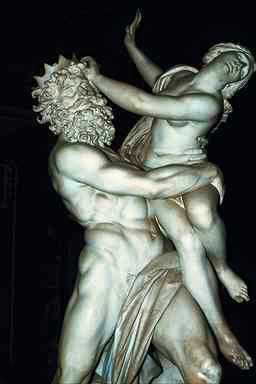
Hades Abducting Persephone: Marriage of Sacred Masculine and Sacred Feminine?
Jungians, following Erich Neumann, understand the progress of history through an evolutionary model in which humanity began in a matriarchal stage in which the unconscious reigned. This period of culture, which spawned the image of the Great and Terrible Mother, was primitive and irrational. Matriarchy was naturally superseded by patriarchy, in which the individual, the ego, and rationality emerged. In the patriarchal stage of culture, male Gods and heroes were the primary symbols, and rationality reigned supreme.
The patriarchal stage of culture had its limitations, which were revealed in the two World Wars of the twentieth century and the nuclear and environmental crises that followed. Rational man, Jungians argued, had come to the point where he needed to reconnect with his feminine side. The unconscious feminine was now understood to be a nurturing matrix that included the body, nature, and feeling, from which rational man should and could never fully separate himself.
The great archaeologist Marija Gimbutas also spoke of two cultures within Europe, an earlier matrifocal one she called Old Europe and a later patriarchal one. The Jungian Joseph Campbell endorsed Gimbutas’ work, leading some to assume that Gimbutas and Jungians hold similar theories of human history. In fact they do not: Gimbutas did not subscribe to an evolutionary theory of culture. She would never have said that the earlier matrifocal culture “had to be superseded” by the later patriarchal culture “in order for civilization to advance.” The clear conclusion to be drawn from Gimbutas’ work is that the patriarchal culture was in almost every way inferior to the one it replaced.
For Gimbutas, the agricultural societies of Neolithic Old Europe were peaceful, egalitarian, sedentary, highly artistic, matrifocal and probably matrilineal, worshiping the Goddess as the powers of birth, death, and regeneration. These societies did not evolve into a higher stage of culture, but were violently overthrown by Indo-European invaders. The culture the Indo-Europeans introduced into Europe was nomadic, patriarchal, patrilineal, warlike, horse-riding, not artistic, worshiping the shining Gods of the sun as reflected in their bronze weapons. Gimbutas did not look forward to a new “marriage” of matrifocal and patriarchal cultures. Rather she hoped for the re-emergence of the values of the earlier culture. Her theories had a critical edge: she did not approve of cultures organized around domination, violence, and war.
This critical edge is exactly what is lost when we begin to substitute the terms “sacred feminine” for “the Goddess” or “Goddess feminism” and “sacred masculine” for “patriarchy” and “patriarchal Gods.” When we allege that we all have our “masculine and feminine sides,” and that it is important “to reunite the masculine and the feminine,” it is easy to forget that in our history, the so-called sacred masculine has been associated with domination, violence, and war.
If we hope to create societies without domination, violence, and war, then we must transform the distorted images of masculinity and femininity that have been developed in patriarchy. We must insist that domination, violence, and war are no more part of masculinity or male nature than passivity and lack of consciousness are part of femininity or female nature. It may feel good to speak of reuniting the masculine and the feminine, but feeling good will not help us to transform cultures built on domination, violence, and war.
“As my mother passed from this life, she was surrounded by a great matrix of love. As she died I began to understand that I too am surrounded by love and always have been. This knowledge is a great mystery.”— Carol P. Christ, A Serpentine Path: Mysteries of the Goddess (forthcoming, FAR Press, 2016)
It has taken me 66 years—my entire life—to learn to love my mother, and, even more importantly, to accept her love for me.
When I was younger, I could not distinguish that love from control, and I felt smothered by her constant attention, care, and what I took to be criticism. I felt overwhelmed, stifled. I resisted, fighting to assert my autonomy and freedom, my difference. Our relationship become one of painful, sometimes ugly conflict, extending well beyond my adolescence and into my adulthood. For too many years, it was almost impossible for me to be in the same room with her.
A few days ago I received a message out of the blue on Facebook:
Thank you for your accepting my friend request. I am fighting to find my way out of depression during a life transition as I move into retirement from my years of work as an educator. I look forward to your book this spring. I have long called myself a Goddess feminist having struggled with patriarchal Christianity since my youth, but have felt abandoned by the Goddess for many years now. I’m not sure how I found you today. I stumbled onto a blog from you on your book while googling something else. Your words gave me a spark of hope. Laurel
In my blog I said that when I began to write A Serpentine Path, I felt abandoned by the Goddess. I wrote back, hoping that sharing what I had learned on my journey would be helpful.
The short answer is that the Goddess has never abandoned any of us. However, She does not have the power to make everything turn out as it could be or should be or we wish it would be. Hers is the power to inspire but not to control. If you have been unhappy, She is with you, She understands your pain, and She will be with you as you seek to find your way. I hope this doesn’t sound too preachy. It is from the heart of my experience. Take care of yourself.
I immediately received an answer back.
Thank you. Those were just the words I needed to hear with my heart. I am “too much in my head,” having spent a life in academia.
This interchange got me thinking about how we import toxic ideas from traditional theologies into what we believe are new religious worldviews. In this case the toxic idea is omnipotence—the idea that the Divine Power is in control of everything. It follows from this that the Divine Power can answer our prayers. If the Divine Power does not answer our prayers, there must be a reason. The reasons we give are many, including: because we are sinful and unworthy or because the ways of God are not our ways. We sometimes conclude, as Laurel and I did: the Divine Power simply does not care about me.
The prominence of magic in Wicca, the most widely known form of contemporary Goddess religion, can contribute to this feeling of abandonment. The Western occult or magical tradition teaches that there are practices, including rituals and spells, through which we can manifest our wills and achieve our deepest desires. In Goddess practice rituals and spells are directed to or through the Goddess. In this situation, it can feel logical to blame the Goddess when, after working very hard and doing every ritual and spell we can think of, our will or desire is not manifested. “Why me,” the child within us asks. “Why has the Goddess abandoned me?”
In the story I tell in A Serpentine Path, I felt precisely that. What I learned was that the Goddess had never abandoned me. She had been with me all along. Where I went astray was in believing that the world could become as I wanted it to be.
The world is made up of a multiplicity of wills, including my will and the will of the Goddess, but also the wills of every other individual, human and other than human, who has lived or is living now. If individuals, human and other than human, have the power to affect the world, then even the Divinity cannot have all the power. This means that Her power (and our power) is the power to influence the world, but not to determine or control it. This is one of the key metaphysical insights of process philosophy, but it is also an existential truth.
The Divine Power is not omnipotent. And neither am I. It may seem odd to put these two statements together. Yet they are mirror images: both ideas deny the reality that a multiplicity of wills have shaped and continue to shape the world we experience. The world really is not at my beck and call. Not even the Goddess gets that.
I would never have said that I believed that the world revolved around me. Stating it so baldly makes it clear how silly idea that idea is. For me “enlightenment” came when I realized—really understood—that the world is not “about me.” Once I gave up having to have what I thought I needed to have, I found, felt, and experienced love and beauty all around me. This truly is a-mazing grace. To feel love and beauty is not to deny suffering. Yet much of our suffering is caused by ideas about how life should be, as Laurel recognized, by living too much in the thoughts of our heads.
“The serpentine path is the path of life, a snakelike, meandering path, winding in and out, up and down, with no beginning and no end, into the darkness and into the light.”
As the year draws to a close, I am putting the finishing touches on A Serpentine Path: Mysteries of the Goddess. In the spring of 2016 it will be published by the Far Press, founded by Gina Messina-Dysert. A Serpentine Path is the original title of the memoir of my journey from despair to the joy of life on the first Goddess Pilgrimage to Crete. It was published in 1995 as Odyssey with the Goddess,a title chosen by the publisher.
A Serpentine Path marked a turning point in my life and in my career as a writer. During the time described in my memoir I had fallen into a deep despair, sparked by the end of a marriage, the end of a love affair, and disappointment in my career. Hoping to make a fresh start, I moved to Greece. Not surprisingly, my despair followed me there. Nonetheless, as I would learn, I made the right decision, for as my Greek therapist was to tell me, I needed to learn to live in my body, not my head, and Greece was the place to learn that.
I was at a crossroads in my spiritual quest. I left Christianity for Goddess feminism, yet I felt the Goddess had abandoned me. I had a contract to write the first Goddess thealogy, but as I said in a speech at I gave at Harvard Divinity School just before I made the decision to move to Greece, I was not sure of the meaning of the symbol of the Goddess. Is Goddess a personal being who cares about the world? Or the name we give to the cycles of birth, death, and regeneration in nature? My inability to answer this question led my editors to return draft of my Goddess thealogy with the comment that something was missing. Continue reading “Announcing A Serpentine Path: Mysteries of the Goddess by Carol P. Christ”
My daughter Hazel was born on a November afternoon. Just over two weeks old, my own individual role as mother is too young to comment on much here—I am thinking too much and too little about what it means, adjusting to my little one’s schedule, feeling like my boobs are going to fall off from my breastfeeding efforts, and loving in a new way. (It’s amazing how excited one can get about ‘poopy’ after baby has been struggling for days, isn’t it?)
But when I am lying in my bed, sometimes at night, I find myself amazed and grateful for the community it took to bring my daughter into being. I was pregnant but I also had a pregnant community. I labored with community; and what I am learning, is that my motherhood is also a function of community—something, for me, that would not have been possible without the many, many people who supported Hazel and me through the process of new birth. Continue reading “Birth and Community by Sara Frykenberg”
In a recent blog describing conversations with my friend Rita Gross, I said that I think of myself as a “kind of a Buddhist” because I have given up a great deal of the ego(tism) described by Buddhists. I also remarked that “I must be a Buddhist after all” because I accept my finitude and do not fear death. At the same time, I said that the idea of a relational world coheres with my experience and is more satisfying to me than the Buddhist theory of nondualism. When I speak of a relational world, I am referring to the worldview of process philosophy.
One of the central insights of Buddhism is the concept of “dependent origination.” This means that “no thing” exists in and of itself: “all things” are related to and dependent upon “other things.” One of the key assumptions of western philosophy is that “things” exist in and of themselves: all things have an single, unchangeable “essence” or “nature.” Buddhism considers this assumption to be false: if all things are dependent on other things, then they cannot finally be separated from the web of dependence in which they exist. Buddhism insists, moreover, that the interdependent world is in flux. This means that what a thing-in-relationship is in one moment changes in the next.
When Rita Gross visited me in Lesbos two summers ago, we spent many long hours discussing our lives and work. Rita and I met at the Conference of Women Theologians at Alverno College in June, 1971 when we were young women. We did not know it then, but our lives would continue to be intertwined through our common interests, first in the Women and Religion section of the American Academy of Religion, and then through our work on Goddesses and feminist theology.
We had a scrumptious dinner of fresh fish, salad, fried potatoes, local amber-colored wine, and tiny olives. Later the two waiters, Themis and Nikos, bearing another pitcher of wine, sat down at our table.
They told us they were best friends and had just gotten out of the army. When they discovered that we were writers, the two young men were intrigued. “Our village has a very interesting history and many interesting customs,” they told us. “If you would like to come back and write about it, we will introduce you to all of the old people.” This conversation was in Greek, but I translated for Naomi. “This must indeed be a very interesting village,” I said to her, “because when they learn that I am a writer, most Greek men will say ‘write about me, I have a very interesting story.’ These men, in contrast, want us to write about their village.”
When we finished our wine, the young men offered to give us a lift back to our hotel on their motorbikes, suggesting we could have a coffee at the hotel bar. When we got to the hotel, they didn’t stop. “What happened?” I asked. “The bar wasn’t open at the hotel, so we’re looking for another place.” I wondered what Naomi, perched on the back of a motorbike and unable to speak Greek, must be thinking—especially since she was afraid of the unknown. We drove through the town and turned down a dirt road, arriving at the Zaros water factory. “We wanted to show you this,” they said sheepishly. “People drink our water all over Crete.” “O.K., “Naomi said, “but then you must take us back.” There were a few workers on the night shift, and the boys told us they had worked there too, before going into the army.
Leaving the factory, we continued down the dirt road heading away from the town. “Where are we going?” I asked, wondering what we had gotten ourselves into. “Just a minute,” Themis said, as he got off the bike in front of what looked like a small house in the middle of nowhere. “We need to go back,” Naomi said definitively. “Yes, I already said that,” I answered. “Come inside,” Themis beckoned. “We want to show you how they make the raki (the colorless alcoholic drink that had been offered to us in shot glasses us after meals). This is the still,” he continued, as he showed us into a small dark room with a glowing fire. “After the wine is pressed, they put the skins and stems into barrels like those you see in the corner. The mixture takes six weeks to ferment, and then they bring it to a still, where it is heated over a fire. The steam that rises is directed through long curved pipes, and comes out as raki,” he said, pointing to various parts of the mechanism. Continue reading “Dionysian Rites by Carol P. Christ”
Gardening is one of my greatest loves. The rhythm of the earth revealed in this little piece of Eden in sunny Queensland Australia, pulses in the cells of my being. Through close observation of the natural cycle of all life in my garden and atuning into the greater cosmological ebbs and flows, waxes and wanes I have come to know intimately not only this ‘outer’ space, but the inner as well.
Imagery and metaphor are effective tools for personal growth and transformation and the metaphor of gardening is a powerful way of looking at and experiencing the process of inner growth. I only need to look to my garden to see what needs tending, weeding, pruning, tilling, feeding, harvesting and composting in my life. Continue reading “Life’s a Garden by Jassy Watson”


 Standing as a stark and graceful contrast to the corruptions of freedom of religion, expression, and human rights we hear about every day, there was a grand display of feminine empowerment and beauty at the most recent Burning Man festival, an event in Black Rock City, Nevada. It was a magnificent temple created for Mazu—the Chinese Goddess of the Sea. Her temple and its towering lotus flower were built, and soon thereafter ritualistically burnt, in the simplistic beauty of the desert.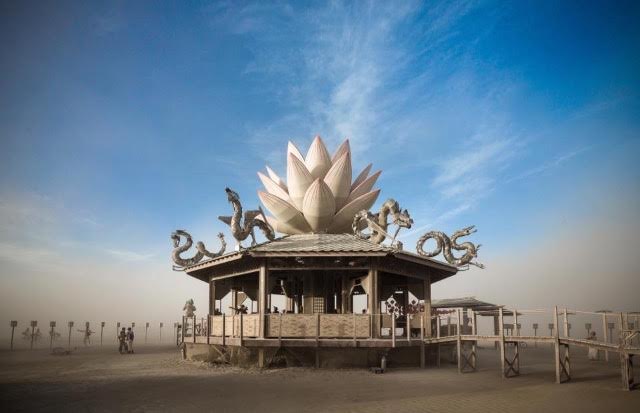
 ears “the Sacred Feminine” has become interchangeable with (for some) and preferable to (for others) “Goddess” and “Goddess feminism.” The terms Goddess and feminism, it is sometimes argued, raise hackles: Is Goddess to replace God? And if so why? Does feminism imply an aggressive stance? And if so, against whom or what?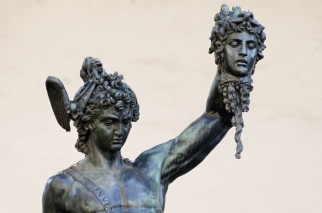
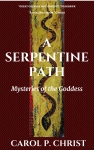 A Serpentine Path: Mysteries of the Goddess

 A few days ago I received a message out of the blue on Facebook:
 “The serpentine path is the path of life, a snakelike, meandering path, winding in and out, up and down, with no beginning and no end, into the darkness and into the light.”

 When Rita Gross visited me in Lesbos two summers ago, we spent many long hours discussing our lives and work. Rita and I met at the Conference of Women Theologians at Alverno College in June, 1971 when we were young women. We did not know it then, but our lives would continue to be intertwined through our common interests, first in the Women and Religion section of the American Academy of Religion, and then through our work on Goddesses and feminist theology.


 Feminism and Religion