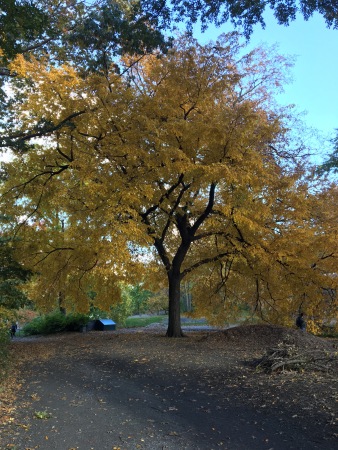
Almost every day, I walk in Central Park. There are certain trees there I’ve come to know: the gnarled cherry trees by the reservoir, the bending willows and tall bald cypress by the pond, the sycamores that drop their bark each summer, the hawthorn not far from Central Park West. Lately I’ve been taking photos of the trees to try to capture their essence, their posture in the world. The trees around me feel like friends, which is what an ancient midrash (interpretation/legend) called Genesis Rabbah says about trees: that they are friends to humankind. To me, they’ve always been a central manifestation of Mother Earth.
Currently, the national parks in the United States have no staff because of the government shutdown. Some people have taken the opportunity to cut down the rare and endangered Joshua trees in the Joshua Tree National Park—just for fun, I guess, or as a trophy of some kind. Meanwhile, President Bolsonaro of Brazil recently has indicted that he wants to remove protection for the rainforest, in order to allow development. It appears that my friends the trees have enemies. Sometimes the enmity is for personal/corporate gain, and sometimes the enmity seems to have no reason at all.
Fourteen years ago, I was pregnant with William Valentine. I had no idea what to expect. I knew only that I was in a body, and it was pregnant. Things happened to me, to my body, that seemed extrinsic to my person, so much so that for most of those forty weeks, I felt as though the doctor’s office was having the baby, and I was a mere observer. But, when the time came to deliver the baby, I realized it was my body that was trying to make passage for another’s. The particularities of myself and the baby’s self seemed to fade away into something more vital and primordial in the process of the transmission of life. After a safe delivery, I felt a deep and curious gratitude that was beyond the gratitude I had for my child or for our health. This strange gratitude was born of the passage I had been so fortunate to experience, that is, this novel yet ancient, essential yet unparalleled dimension of human being-ness. I had given live birth, and I was grateful to know what that was like. In that experience, I was more connected to my human brothers and sisters than I had ever been before, including to this new baby, who I knew in my deepest self was more fundamentally a brother human than even he was my own child. I knew that in this transmission, I had helped a fellow traveler, and that transmitting life was simple even while it was giant in scope. The experience was and would always be about walking with each other, from the cradle to the grave, in our vulnerability, in our fragility, in our humility, and in that walk, to find our strength, our dignity, and our luminescence, as persons, as creatures that think and speak and love. To have been a party to another’s coming to be, this was an occasion of the greatest gratitude I had known.
In accompanying my father in this final stage of his life during these challenging and difficult months as he journeyed toward his death, I felt that same vital and primordial passage of being that I had in giving birth. While it was not my body that this time labored and worked, I was party to his experience. I witnessed his courage and another kind of transmission of life. For, I saw a man go from self-concern to other-concern; from hope of getting well to hope to of making things better for others; I witnessed a man move from verbal complaint to silent focus; and I heard his relocation of worry for himself to concern for me because he knew I was hurting as I was watching him, mostly powerless to do anything but sit next to him. I saw a man graduate from a regular man to an elder and then to naked spirt in God’s care, and I was honored to be one of his midwives on that journey. In his final hours, he became full of grace, and he fulfilled the trajectory of becoming the father and man he always intended to be. It was an honor to behold, and I am grateful.
As I finalize my manuscript for Women Rise Up, to be published with the FAR press in early 2019, I want to share this excerpt from my chapter on Mary Magdalene.
The Spirit of God moves at unexpected times and places. When I spot a single red bloom among the barren trees in wintertime. When I watch my daughter takes a bite out of sun-ripened strawberry. When something catches me off guard and pulls my full attention to the present moment. These breath-taking moments illuminate the presence of Spirit at work.
One frigid Saturday morning I took the two-hour train ride from New Haven, Connecticut where I was living at the time to New York City for the day. I’d been invited to join a gathering of advocates working to end gender-based violence. Around a hundred of us made our way to an upper-floor classroom at The New School in Greenwich Village. When we entered the room, most of us were strangers, but in a matter of hours, we managed to form a sacred community of survivors. We took turns sharing our own pain-filled stories of violence, betrayal, survival, and hope. Both gut-wrenching and healing, the act of naming our collective suffering fused us together: our cacophony of individual experiences blended into a unified chorus for justice. What once was hidden had now come into the light.Continue reading “Unexpected Divine Encounters by Katey Zeh”
After my year of teaching high school students, I found a kinship with them in their frustrations, longing, apathy, hopelessness, and hope. Fortunately, we studied together Jean Paul Sartre, whom I want to get to know more intimately, but we, the teens and myself, could take the spiritual answer to our questions about the meaning of life (is there one? What is it?): The meaning of life is to give it meaning.
I am not sure about their generation, but adolescence for me, in mine, was about discovering, not necessarily creating. Of course, now I think it is a little of both.
Sometimes I wonder if there is also a lesson. Being an academic, perhaps I love learning and teaching. I demonstrate my love as Jonathan Livingston Seagull does, by offering to others, perhaps a specific community of others, those who have chosen or must be in a state of learning (easily found in institutions of high school and college), the truths I have gathered (59). Of course ‘truth’ is a word that tastes a bit tannic, for it needs to be rolled around by the tongue a bit to be cleansed; perhaps to mitigate its toxic potential, we can never consume it undigested, but must gestate it and transform it within our warm bodies, just at the cliff, before we allow it to permeate our organs in a chemical structure that serves us.
Lady Death is knocking on my dear old Poppy’s door. His health has been getting progressively worse with each day and it is a sad and trying time for all of the family. Naturally, with death, comes reflection, unresolved issues are stirred up and we are inevitably confronted with our own mortality. I have been reflecting and reminiscing about times spent with my Pop as a child. So many wonderful memories are warmly held in my heart.
Visiting Pop and Nanna’s house as a child was always very exciting, namely because of all the lollies Pop had hidden in his cupboards – XXXX mints and licorice all sorts his favourites. I remember him Irish jigging in his blue tartan dressing gown around the campfire, and the times he would stick out his false teeth, roar and scare us silly. Slim Dusty, an Australian country music icon was one of his favourite singers, he would play his records on the old player as loud as can be, I knew the words to “I’d love to have a beer with Duncan” back to front. Every weekend the horse races would blare out of his little radio in the kitchen, I would listen along and try to pick a winner for him.
My sister and I would stay at Nanna and Pops house most school holidays and we would both wait at the front gate for him to come home from work, we were always so happy to see him coming down the path, covered in concrete and dirt, his skin so tanned from being in the sun all day. He always greeted us with a big smile and a pat on the head. We would have dinner early and no matter what was on the menu, much to Nanna’s disappointment, he would cover his food in a river of ‘black horse,’ slang for Worceteshire sauce. We would then watch the goings on in the neighbourhood from the back verandah; Pop could, and still can, tell you what everyone else was up to! He was, and still is a cheeky old thing, as stubborn as an ox, and I love him so very much.
Death of one of my family members is not something I have any experience with. Knowing that the time will soon be nigh however, has me naturally thinking about the cycle of life and death. As an avid gardener I witness this cycle daily. I plant seeds, watch them grow, set seed, decay then watch their progeny pop up all over the place. I find cocoons where caterpillars will eventually emerge as beautiful butterflies, only to flutter for two days and pass on. On my early morning bug hunts I find all sorts of larvae waiting to hatch, the strongest survivors grow; have a grand feast on my veggies, only to become a meal or compost themselves. Leaves and branches fall to the ground, animals perish and decay, feeding the earth and maintaining the fertility of the soil in the process.
This Life/Death/Life cycle is no new concept. Since time beginning human life was directly linked to the cycle of the seasons and the cycle of life and death. Humans were inextricably linked and connected with their natural environments. They imitated animals and worshipped the sun, moon, trees, rivers and mountains, elaborate rituals and ceremonies were created concerning these cycles and transitions. It was understood by careful observation of nature, that death was a natural part of the life cycle.
But why, in much of our Western culture is there so much fear and denial over death when religions and philosophies the world over have endeavoured to offer solace to humans in the face of our mortality by promising eternal life? Dr. Estes says that, “In much of Western culture, the original character of the death nature has been covered over by various dogmas and doctrines until it is split off from its other half, Life”. This is not how it is, for “death is always in the process of incubating new life”. This is life’s greatest paradox; even in our state of living, we are in fact dying and it is this dance between the two and the nature of the Life/Death/Life cycle that has been contaminated by a fear of death. This splitting in two of life and death, I feel, is largely a result of our disconnection from nurture and nature. This disconnection has impacted on every aspect of society, our ability to flow with these cycles is often weak and as a result impacts all kinds of relationships and structures, particularly that of family and community.
I am not sure what my pop believes about the nature of death as he is not religious, nor does he have any faith in an after life. He doesn’t even want a funeral of any kind. I do remember him though, saying to me as a child rather emphatically, “when you’re dead, you’re dead: food for the worms!” This has stayed with me for life and in it’s simplicity shows an understanding of the cycle. He was an avid gardener too, growing plenty of vegies for the household, and if I look deeper into his comment, which he made on more than one occasion, he was really saying that we become compost, teeming with new life, we feed the earth (the worms) and so the cycle continues.
I am certain though, that Pop fears death, and I know that he fears leaving the living, and while we can talk about, have faith in, and come to accept the Life/Death/Life cycle, it doesn’t mean that it is ever going to be easy. Surrendering to death, not just the physical death of our bodies, but any kind of death, I think, is life’s greatest lesson.
Lady Death is waiting for pop to answer the door, she has come to embrace him and comfort him in his pain and ease his transition. He is not quite ready, but the time will come soon and I feel strong in my knowing that despite how much suffering can accompany the dying, this is the way it is meant to be. From his death new life will emerge.
He will forever live in my heart and memories.
Returning, by Jassy Watson
Jassy Watson, who lives on the sub-tropical coast of Queensland Australia, is a mother of four, a passionate organic gardener, an artist, teacher of the Colour of Woman Method, and a student of ancient history and religion at Macquarie University, Sydney. She runs a small business Goddesses Garden and Studio to keep women’s sacred circles, art, music and gardening practices alive. Jassy teaches regular painting workshops based around themes exploring the feminine.
The Torah is bursting with hopes over-fulfilled. Abraham and Sarah hoped for a child and gave birth to a nation. The Israelites hoped for freedom from slavery and eventually received an entire Promised Land. We understand hope and, in so many ways, we live on it, as hope has sustained us for thousands of years. Today, our hopes inspire our actions and motivate us to work for peace, justice and equality. In Jewish terms, we call this goal or vision of a better world in the here-and-now: redemption.
Yet, redemption does not just appear out of thin air or because we wish it. Redemption and the hope of it requires work and cooperation with the Source of All Life. As Deuteronomy 30:19 says, “I have put before you life and death… [therefore] choose life…” This cooperation could be a simple commitment to tikkun olam, repairing the world (some times translated as social justice). For others, choosing life could mean more observant religious practice. It could also be a combination of the two. In the end, though, I think both hope and redemption require choosing life in some form or another.






 Feminism and Religion