The Motherhood of God by Mary Sharratt

Doing a recent talk on pioneering woman writers, I like to do the Before Jane Austen test with my audience. Who can name a single woman writer in the English language before Jane Austen? Alas, because woman have been written out of history to such a large extent, most people come up blank. Then we talk about pioneering Renaissance authors, such as Aemilia Bassano Lanier, the subject of my recent novel, THE DARK LADY’S MASK, or her mentor, Anne Locke, the first person of either sex to write a sonnet sequence in the English language.

But my next question takes us even further back into history. Who was the first woman to write a book in English?

The answer is Julian of Norwich, who wrote Revelations of Divine Love. Continue reading “The Motherhood of God by Mary Sharratt”

Shakespeare’s Sister Revisited: A Circle of Female Lineage by Mary Sharratt

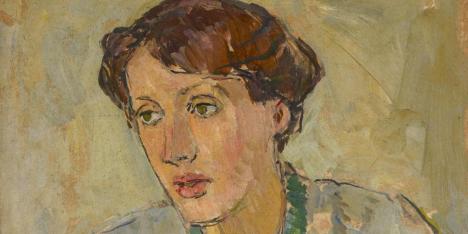
Vanessa Bell’s painting of her sister, Virginia Woolf

What do groundbreaking 17th century poet, Aemilia Bassano Lanier, and 20th century feminist icon, Virginia Woolf, have in common? A lot actually.

In her 1929 essay, “A Room of One’s Own,” Woolf imagines the tragedy of Shakespeare’s brilliant sister, Judith, barred from the grammar school because of her sex and forced to hide her writing from her family. To escape a forced marriage to a man she hates, she runs away to London to seek her fortune in the theatre, only to end up pregnant, abandoned, and destitute. Out of despair, she kills herself. Continue reading “Shakespeare’s Sister Revisited: A Circle of Female Lineage by Mary Sharratt”

Straight from the Horse’s Mouth: Celebrating Epona by Mary Sharratt


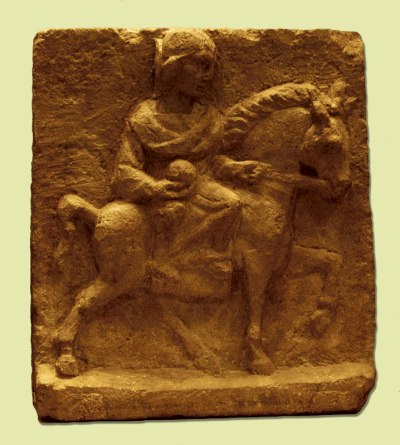
epona-of-kastel

The following is a guest post by Mary Sharratt’s Welsh mare, Miss Boo aka Queen Boudicca


The ancient Romans and Gauls knew something that many modern day humans have forgotten. Mares are divine.

The worship of Epona was popular throughout the Roman Empire. Epona was a Gaulish deity whose name means “divine mare” or “she who is like a mare.” Epona was the the only Celtic divinity to receive her own official feast day in the Roman Calendar: Eponalia, December 18, was celebrated on the second day of Saturnalia, the Roman midwinter celebration (December 17 to December 23). But as far as we horses are concerned, every day is Epona’s Day! Go out and hug a horse right now!

The patron deity of horses, ponies, donkeys, and mules, Epona also protected those who looked after equines or worked with them. Thus she was beloved of the Roman cavalry. Epona’s worship stretched from Roman Britain, across Gaul and Germania to Spain, Rome, and Eastern Europe. Not only did she have a temple in Rome and her own holiday, but there were shrines to her in almost every stable. Her altars were adorned with fresh roses. Horses and donkeys were adorned with roses for her processions.

Some modern humans are inspired by these ancient traditions. At midsummer, my human ties roses in my beautiful mane when we ride out together.
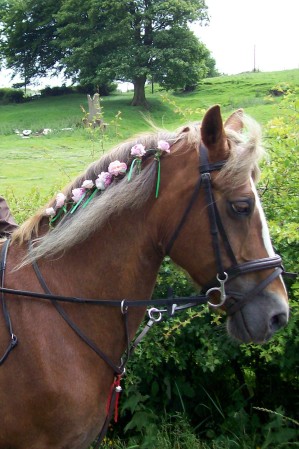
midsummer-boo-4

In her iconography, Epona is often depicted as a majestic woman riding side saddle, always travelling from left to right. In the image at the top of the page, “Epona from Kastel,” she is riding and carrying a round fruit or loaf. Epona is associated with abundance, fertility, and sovereignty.

A votive image from Budapest shows Epona as a great sovereign lady seated between two horses who feed from her lap.
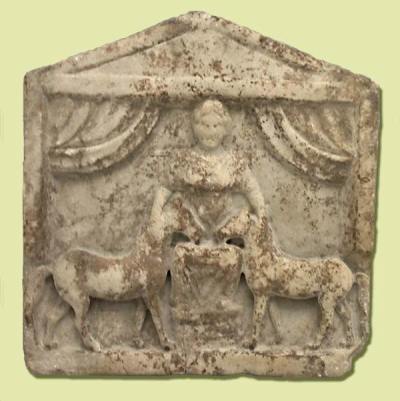
epona-of-budapest

In the Middle Ages, Epona’s archetype lived on in literary figures such as Rhiannon in the Mabinogian.

Epona was a nurturing mother figure, a giver of abundance and plenty. But what does this mean for us today? Anyone who has spent any time around us horses knows that we are capable of great empathy. Any person who is sad or depressed should spend some time just quietly grooming horses and being with them, and the healing will unfold. When my human is upset, I know right away and I’m especially gentle with her and give her lots of tender snuffles. I also love children and am extra careful around them. Here’s a picture of me with one of my little human friends.
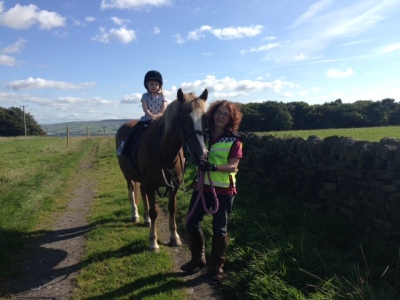
boo-saffron


People have reported great success using horses to treat autistic children and adults. Even people suffering from eating disorders can heal if they spend time with equines. Horses have huge hearts. Especially mares! We’re hard-wired to nurture.

Heartland Girls’ Ranch in Minnesota offers equine therapy to help heal sex-trafficked girls. Each girl is matched with a horse that she cares for and this partnership helps build back her sense of trust and self-worth.

The Romans celebrated Eponalia by giving every horse, donkey, and mule a day of rest. Modern humans who keep horses can observe this by giving their horses a day off and by offering them apples, which are sacred to Epona. Humans can also honour Epona by donating to equine charities, to Heartland Ranch, or your local horse rescue centre.

What would human civilization look like had there not been a millennia-long partnership between humans and equines? Have a heart for the horses who have carried their humans so far and so faithfully.

Links: Epona.net

Epona’s Day: The Gifts of Midwinter by Caitlin Matthews

Heartland Girls’ Ranch

Miss Boo aka Queen Boudicca is a Welsh mare who lives in the Pendle region of Lancashire. A hereditary Welsh trad witch in the most archetypal sense of the word, Miss Boo lives in deep communion with the Earth and is a keeper of ancestral wisdom. Miss Boo is a committed feminist, and she and her herd preserve an ancient matriarchal social structure unchanged since the dawn of their species. Don’t mess with chestnut mares! She is the proud owner of the author, Mary Sharratt. All royalties from Mary’s book sales will go to keeping Miss Boo in the style to which she has become accustomed. Visit her human’s website.
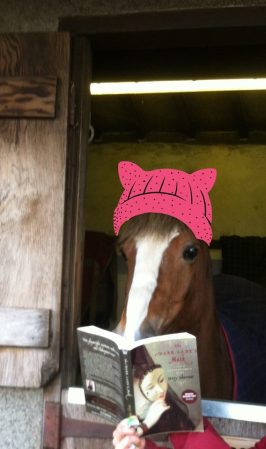

boo-pussy-hat

Mother Demdike, Ancestor of My Heart, Part 3 by Mary Sharratt

mary sharrattContinued from Part 1 and Part 2 When Bess was in her fifties, walking past the quarry at sunset—called daylight gate in her dialect—a beautiful young man emerged from the stone pit, his hair golden and shining, his coat half black, half brown. He introduced himself to her as Tibb and promised to be her familiar spirit, her otherworldly companion who would be the power behind her every spell.

Maureen Stopforth who runs the Witches Galore gift shop in Newchurch has warned visitors of a malign energy rising from the quarry but I sense nothing evil, merely a yearning that draws me in deeper until, near the back of the old stone pit, I find a man’s face carved in the rock—the handiwork of some fanciful Victorian who wished to pay tribute to Bess’s Tibb.

Attending a Halloween ghost walk, I bristle as the guide glibly describes Tibb as the “devil in disguise.” From my research, I learned that the devil, as such, appeared to be a minor figure in British witchcraft. Instead the familiar spirit took center stage—the cunning person’s spirit helper who could shape shift between human and animal form. Bess described how her Tibb could appear as a hare, a black cat, or a brown dog. In traditional English folk magic, it seemed that no cunning man or cunning woman could work magic without the aid of their familiar. Continue reading “Mother Demdike, Ancestor of My Heart, Part 3 by Mary Sharratt”

Mother Demdike, Ancestor of My Heart, Part 2 by Mary Sharratt

mary sharrattContinued from Part 1. As I sought to uncover the bones of the cunning woman Mother Demdike’s story, I was drawn into a new world of mystery and magic. It was as though Pendle Hill had opened up like an enchanted mountain to reveal the treasures hidden within. Every stereotype I’d held of historical witches and cunning folk was dashed to pieces. Continue reading “Mother Demdike, Ancestor of My Heart, Part 2 by Mary Sharratt”

Mother Demdike, Ancestor of My Heart, Part 1 by Mary Sharratt


beltaine-pendle-view

Pendle Hill, seen from the back of my house, in May.

mary sharrattThe Soul of Gaia is the numinous earth beneath my feet, her soil cradling the bones and the stories of the ancestors who have died into the land and become part of the ever-living spirit of the place.

An expat writer, my home is everywhere and nowhere. A wanderer, I have lived in many different places, from Minnesota, my birthplace, with its rustling marshes haunted by the cries of redwing blackbirds, to Bavaria with its dark forests and dazzling meadows and pure streams where otter still live. But I don’t know if any place has touched me as deeply as Lancashire, England, my home for the past fifteen years. Continue reading “Mother Demdike, Ancestor of My Heart, Part 1 by Mary Sharratt”

Calling on the Muse: A Meditation for Creative Spirits by Mary Sharratt

mary sharrattThe world at large might view artists and writers as free spirits rocking la vie bohème, but creative people know that it’s much more complicated than that, especially if we’re striving to earn even a modest living from our work. As a writer, I often fall into the trap of measuring my success or failure on factors completely beyond my control, such as the ups and downs of a fickle book buying market.
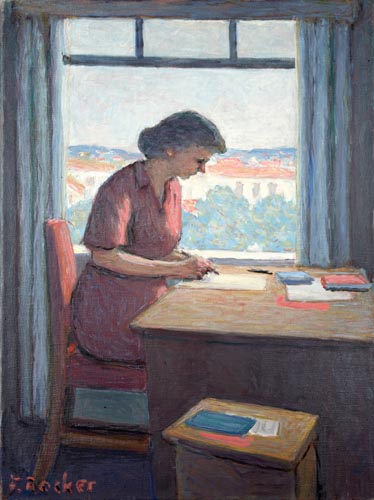

I know that I’ve often wrestled with the feeling that I’ll never be enough. Never be big enough, never be a bestseller. Sometimes it’s hard not to succumb to a flailing sense of helplessness—why are any of us doing all this? Worst of all is my fear of creative dryness—that my inspiration will turn to dust and I’ll never write—let alone publish—another book.

woman_writing

Continue reading “Calling on the Muse: A Meditation for Creative Spirits by Mary Sharratt”

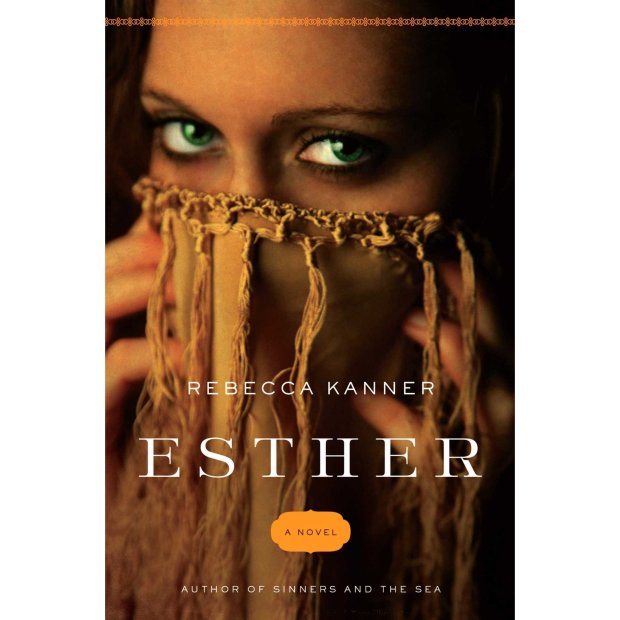
Book Review by Mary Sharratt: ESTHER by Rebecca Kanner

esther


We have been lost to each other for so long. My name means nothing to you. My memory is dust. This is not your fault or mine. The chain connecting mother to daughter was broken and the word passed into the keeping of men, who had no way of knowing. That is why I became a footnote, my story a brief detour between the well-known history of my father and the celebrated chronicle of my brother.

-Anita Diamant, The Red Tent

To a large extent, women have been written out of history. Their lives and deeds have become lost to us. To uncover the buried histories of women, we must act as detectives, studying the clues left from ages lost.

At its best, historical fiction can write women back into history and challenge our misconceptions about women in the past. Anita Diamant’s novel, The Red Tent, became such an iconic classic because she turned our stereotyped image of women in the Old Testament on its head by allowing the biblical Dinah to tell her own story in her own voice. Continue reading “Book Review by Mary Sharratt: ESTHER by Rebecca Kanner”

Lucy Pick’s Pilgrimage by Mary Sharratt

mary sharrattIn medieval Europe, religious devotion provided an alternate narrative for women’s lives in a male-dominated culture. Defiant women who stood up for themselves in the face of rape, incest, and murder were hailed as virgin martyrs. Religious vocations, such as becoming a nun or a beguine, provided a viable and esteemed alternative to forced marriage.
Even women who were married with children could escape their domestic entanglements and conjugal duties by taking an oath of celibacy as 15th century English mystic Margery Kempe did, leaving behind her husband and 14 children to go on pilgrimage to Santiago de Compostela, Rome, and Jerusalem. Her Book of Margery Kempe, the tale of her travels, reads like a kind of late medieval Eat, Pray, Love and is the first autobiography written in the English language.

Though it might seem surprising to us today, women of the European Middle Ages possessed more rights and freedoms than their descendants in the Renaissance, Early Modern, and Victorian ages. Women worked as craftspeople and artisans and were members of the guilds, alongside men. Monarchs such as Eleanor of Aquitaine were global power brokers while religious leaders such as Hildegard von Bingen devoted their lives to intellectual and artistic pursuits, composing music and writing weighty philosophical and theological books that are still being discussed today.

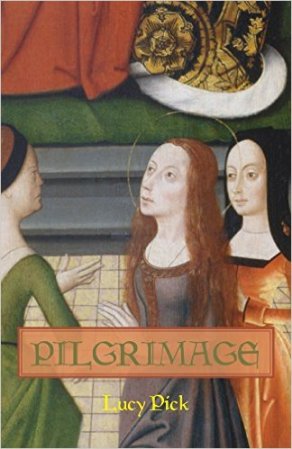
lucy pick pilgrimageThe cover of academic historian Lucy Pick’s novel Pilgrimage shows details from a painted altarpiece dedicated to Saint Godeleva. A victim of forced marriage who was strangled by order of her husband, this legendary saint was a patron of abused wives. Lucy Pick’s novel concerns the saint’s daughter, the blind Gebirga of Gistel in Flanders. What would it be like to be the daughter of a martyred saint whose miracles cured everyone except you?

Considered unmarriageable due to her blindness, Gebirga rejects life as a nun in an abbey dedicated to her sainted mother. Instead, in a bid for freedom, she embarks on a pilgrimage to Santiago de Compostela in faraway Iberia, an epic journey for that time. She serves as the companion to a highly strung teenage noblewoman and is charged with delivering the girl to the Spanish king she is contracted to marry. During their travels, Gebirga must use all her intelligence and resourcefulness to protect herself and her young charge from the considerable dangers and political intrigues they face on their way. Though they encounter hardship and heartbreak, this is a pilgrimage of miracles, healing, and redemption.

Lucy Pick, the Director of Undergraduate Studies and Senior Lecturer at the University of Chicago’s Divinity School, has infused her novel with impeccable research into the lives of medieval women. This novel is a medievalist’s delight and fans of the late Margaret Frazer will devour this book.

Mary Sharratt’s book Illuminations: A Novel of Hildegard von Bingen, won the 2013 Nautilus Gold Award, Better Books for a Better World. Her forthcoming novel, The Dark Lady’s Mask: A Novel of Shakespeare’s Muse, tells the tale of the groundbreaking Renaissance women poet Aemilia Bassano Lanier and will be published by Houghton Mifflin Harcourt in April 2016. Visit Mary’s website.


Embracing Fierceness by Mary Sharratt

maenad dancing with snake

Maenad dancing with snake, ancient Greece, ca 450 BCE

This post is in part inspired by Donna Henes’s brilliant post, I am Mad. Too often as spiritual women, we are told we have to be nice all the time. Accomodating. Compromise our boundaries and principles.

Mainstream religions tell us we must forgive those who mistreat us. Too many women in very abusive situations literally turn the other cheek–to their extreme detriment. As Sherrie Campbell points out in her essay The 5 Faults of Forgiveness, the obligation of forgiveness oppresses survivors of abuse because it makes it all about the perpetrator and not about the healing, dignity, or boundaries of the survivor.

In my own Catholic upbringing I learned to swallow my anger and rage until it erupted in depression and burning bladder infections. My background did not teach me to skillfully dance with anger and it’s been a difficult learning curve for me. But I learned the hard way that owning my anger was crucial if I wanted to stand in my power and speak my truth.

Continue reading “Embracing Fierceness by Mary Sharratt”