Catholicism, Contraception, and Conscience: Church Imposed Teaching, God’s Gift of Free Will, and Political Rhetoric by Michele Stopera Freyhauf

Certainly one cannot turn on the news without seeing a story about the feud over the Catholic Church’s stance on forbidding the use of contraception and Obama’s Patient Protection and Affordable Care Act (PPACA) that mandates free contraception to women.  In preparing this article, I took the time to review many articles from liberal and conservative news outlets, law professors who are experts on constitutional law, and statements from the USCCB and Bishops.  Before asking questions, I want to outline the following points:

  1. In the literature reviewed, only two women, Sr. Carol Keehan and Sr. Mary Ann Walsh, made a statement against this policy stating that the government is interfering with the working of the Church.  Most voices heard and shouting the loudest are members of the clergy.
  2. Hospitals considered “Catholic” hire people of all faiths and various beliefs.  They also treat patients of all faiths.  They are not exclusively “Catholic.”
  3. Catholic identified Colleges hire professors and staff that are not Catholic.  Moreover, their student body is not totally Catholic.
  4. Catholic Charities, once again, hire non-Catholics.
  5. Insurance plans currently in place often offer contraception prescriptions at a zero to low co-pay price.  These plans are in-force at many Catholic Institutions.
  6. Under HIPAA, healthcare of employees are protected and the Employer, even the Catholic Church cannot violate the privacy of the patient, even if it is an employee.
  7. Birth Control Pills are often prescribed for women with endometriosis or other “female” reproductive disorders and not birth control.
  8. Women pregnant, carrying a dead baby, cannot have surgery due to risks are given medication to induce abortion are given. Continue reading “Catholicism, Contraception, and Conscience: Church Imposed Teaching, God’s Gift of Free Will, and Political Rhetoric by Michele Stopera Freyhauf”

Hagar: A Portrait of a Victim of Domestic Violence and Rape

This week Twitter has been a flurry with information for victims of   domestic violence and rape.  This ranges from the U.S. redefinition of rape to include men to Nigeria’s first anti-rape toll free hotline for women.  There is even a male movement to stand against rape.  This problem is an ongoing issue, one that shows no sign of diminishing or going away.  According to Amnesty International, one in three women worldwide have been beaten, coerced into sex, or otherwise abused and their abuser is normally someone they know.  As I contemplate this very difficult issue, I am reminded of the Biblical Hagar in Genesis 16. The story of Hagar and Sarai is abundant

Men Can Stop Rape (http://www.mencanstoprape.org/)

in ethical situations that draw in the reader and presents complex issues that can be very troublesome.  If you take the text hermeneutically, through an ideological examination in its English translation, we have an Egyptian woman, who is also referred to as slave or concubine, forced to engage into sex with her owner’s husband for producing an heir.  Here the abuser is a woman with a docile and obedient husband portrayed by Abram.  What can we  glean from such a story for today’s battered women?  Hope or horrific defeat? Continue reading “Hagar: A Portrait of a Victim of Domestic Violence and Rape”

Son of Man: An Updated Gospel Story of Jesus Set in South Africa by Michele Stopera Freyhauf

January 12, 2012

Son of Man is an updated story of the life of Jesus set in the fictional State of Judea that is modern day South Africa – complete with warlords and child soldiers.    It could easily be mistaken for modern day Rwanda or Darfur with its modern issues and political overtonesRoger Ebert stated, “The secret of the movie is that it doesn’t strain to draw parallels with current world events – because it doesn’t have to.”  The director draws parallels between the gospels and 21st century Africa.  According to Dartford-May, “we wanted to look at the Gospels as if they were written by spin doctors and to strip that away and look at the truth.”  The director “captures the rhythms of African life in both rural settings and sprawling townships.”  “Feather-clad young angels offer an eerie echo and reminder of Africa’s lost generations.”

The movie also sticks with what Eric Snider calls “Traditional African trial music, dance, and costumes” as a type of worship or or allusion to Jesus’ godhood.  Judea is in flux; warlords and corruption take center stage.  Poverty, violence, and oppression affect the all of the people.  The key idea is that Jesus is a freedom fighter – one that fights injustice and oppression.  The director does not emphasize “Jesus’ divinity so much as his leadership, good sense and compassion.”  Jesus is not violent and his followers, most of whom were former child soldiers, are encouraged to respond non-violently, which goes against their upbringing and training. Continue reading “Son of Man: An Updated Gospel Story of Jesus Set in South Africa by Michele Stopera Freyhauf”

Enduring the Trials of Graduate School: From Conception to Labor Pains and Birth By Michele Stopera Freyhauf

Going back to school at 30-something to complete a B.A. in a completely different field (from accounting to Religious Studies and Theology) was an interesting endeavor.  After many years of legal and business writing as well as crunching numbers, learning how to write academically, including formatting citations and using new technology was quite an undertaking that has proven to be rewarding.  All the searchable databases in the library no longer included card catalogues and microfiche.  This was amazing!  No more correction ribbon and electric typewriters (am I showing my age yet?!)  Going to college in 1985 is different then going back to college in 2006.

The transition did not stop with technology and formatting papers.  With each class and each instructor, a new transition was introduced on my way to the finish line.  It was a very large transition and more difficult when you sit in classes with students your own children’s ages. Add to that the reintroduction of the grammar game; in-text citations or footnote citations, semi-colons or dashes, commas or no comma, etc.  With the help of great mentors and patient professors, I prevailed and moved on to my next task (I mean transition) – Graduate School.  New professors, new demands, different writing styles, scholarly growing pains in abundance.  The research and writing intensified (which is an understatement).  Then there is the addition of critical reviews, peer reviews, and multiple presentations.  Each professor with his or her own format and requirement. Each with their own style of subjectivity or, if you are lucky, a specific grading protocol with tangible prompts or goals.  It is a world of unexpected twists, but, in my opinion, better than undergraduate work.  Continue reading “Enduring the Trials of Graduate School: From Conception to Labor Pains and Birth By Michele Stopera Freyhauf”

Pink Smoke, Call to Disobedience, and a Holy Shake-Up: Is it Time to Convene the Third Vatican Council? By Michele Stopera Freyhauf

This past August I wrote about the canonical warning that Fr. Roy received and the issue surrounding the exercise of conscience over church teaching.  For a more detailed explanation of the warning and the background regarding the ordination of women, please see my prior article.

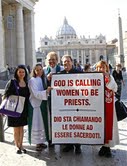
October 17th (this past Tuesday), Fr. Roy Bourgeois, Erin Saiz Hanna (Executive Director of Women’s Ordination Council), Therese Koturbash (Coordinator of Canada’s Catholic Network for Women’s Equality), Nicole Sotelo (Call to Action), Miriam Duignan (Womenpriests), and about 14 other representativesof various other Catholic organizations from around the world went to the Vatican to

present a petition containing 15,000 signatures supporting full and equal participation of women as deacons, priests, and bishops in a renewed church. The group was not permitted in St. Peter’s Square because of their signs; they did not have the proper permit.  Access was also denied to the Women who wore albs/stole because their dress was considered a form of protest.  “We love our family, the Catholic Church,” stated Miriam Duignan of Women-Priests.  “We feel obliged in conscience to make our carefully considered reasons known.  In doing so, we fulfill our canon law duty to speak out, as our present Pope has encouraged us to do.”  Koturbash states “even though canon law invites our Church leaders to hear from the faithful, our leaders are silent when we try to engage.” Continue reading “Pink Smoke, Call to Disobedience, and a Holy Shake-Up: Is it Time to Convene the Third Vatican Council? By Michele Stopera Freyhauf”

Criminalizing Miscarriages: Latin America’s Zero Tolerance Policy on Abortion By Michele Stopera Freyhauf

Imagine suffering a miscarriage.  All of us have or know someone who has suffered one; I had two.  For me it was a terrible time and I still remember the day of loss and the expected due date.  We all cope differently with this loss, but it is just that – a physical and/or emotional loss.  Statistically 15-25% of women in childbearing years will suffer a miscarriage anywhere from 5 to 20 weeks gestation.  In the United States, when we suffer a miscarriage we go to the hospital.  Often times the visit results in a dilation and curettage (or D&C) to stop bleeding and possible infection.  For me this was also done after the doctors removed the baby girl that was dead inside of my womb.

If this would have occurred in certain Latin American countries, especially in El Salvador, Chile, Colombia, Malta, Nicaragua, and even Mexico, the emergency room doctor would notify the authorities of my miscarriage and I would be arrested and jailed anywhere from 3-50 years for having an “abortion.”  El Salvador even has a prosecutor’s office responsible for crimes against minors and women whose responsibilities are capturing, trying, and incarcerating women who have abortions and miscarriages.  In this office, there are police, investigators, medical spies, and forensic vagina inspectors.  Medical providers have an obligation to report abortions; this is focused more on young uneducated and impoverished women.  For these women, there is no presumption of innocence; they are guilty. Continue reading “Criminalizing Miscarriages: Latin America’s Zero Tolerance Policy on Abortion By Michele Stopera Freyhauf”

Diminished Quality of Catechesis as a Basis for Limiting the Role of a Catholic Theologian: An Examination of the Controversy Surrounding Elizabeth Johnson’s Book The Quest for the Living God By Michele Stopera Freyhauf

The biggest mistake people make is to use theology and catechesis interchangeably.  This is an important distinction that impacts the scholarly community of Catholic Theologians.  So what is the difference?  Catechesis in the Catholic tradition is an “echoing” of the faith.  Theology on the other hand, using St. Anselm’s definition, is “faith seeking understanding.”  Michael G. Lawler and Todd A. Salzman, in “Beyond Catechesis: What is the Proper Role of Theology”, states that catechesis can be included in theology, but theology is distinguished from catechesis because it “uses scholarly principles not only to communicate the truths of faith but also to explore the meanings of those truths and contemporary ways of articulating them.”  Also the theologians’ role is seen as mediator between the magisterium and the faithful. Richard P. McBrien states that the required role of a theologian is to investigate and examine the whole of the Christian tradition; what it means, how it fits, how it is developed, and how it relates to the outside the world in theory and in practice.   Ex Corde Ecclesiae also emphasizes community and dialogue, which is not always realized in practice.  Continue reading “Diminished Quality of Catechesis as a Basis for Limiting the Role of a Catholic Theologian: An Examination of the Controversy Surrounding Elizabeth Johnson’s Book The Quest for the Living God By Michele Stopera Freyhauf”

Using the Bible to Promote and Impose Terror on Women By Michele Stopera Freyhauf

Terrorism is a worldwide issue, not specific to one religion. While we attribute the atrocities of 9/11 to Islamic extremists, Christianity has a long history of imposing terror, especially on women. Phyllis Trible’s book Texts of Terror describes texts in the Old Testament that causes harm to women, i.e. abuse, betrayal, torture, rape/gang rape, and mutilation (See Genesis 16212 Samuel 13:1-22, Judges 11:29-4019:1-30). Texts such as these are used to validate violence against women, because of the fundamental view that the text is divinely revealed or God’s own words.

This phenomenon is not specific to the Old Testament.  Writings in the New Testament are used to put women in their place, define their role in church, family, and society.  The remedy for disobedience allows for violence to be committed against the offender.  The most damning of these texts are derived from the Pastoral Epistles (1 Timothy2 Timothy, and Titus).  Here, women’s place and role in society is defined.  Women should be silent, submissive, and subservient to men.  Women are to be veiled, dress modestly without adornment, no gold or pearls.  Finally women are not permitted to teach and have no authority over men (See 1 Timothy 2:9-15). Continue reading “Using the Bible to Promote and Impose Terror on Women By Michele Stopera Freyhauf”

Interlocking Pieces and the Maleness of Jesus: Exegeting the “America’s Pope’s” Statement on Gay Marriage and Ordination of Women By Michele Stopera Freyhauf

On a 20/20 interview, posted August 21, 2011, Morley Safer interviewed the Archbishop of New York, Timothy Dolan.  Dolan is also referred to as “America’s Pope.”  In this article, Safer calls him a scholar and a “passionate defender” of issues that he considered to be “settled questions.”  These settled questions? Gay marriage and women’s ordination.

Gay Marriage: Incest, “Necessary Attributes,” and Interlocking Pieces

Dolan makes an unbelievable comparison of gay marriage to the desire to marry his mother:  “I love my mom, I don’t have the right to marry her.”  He further compared gay marriage to his desire to be a shortstop for the Yankees, which is not possible because he does not have “what it takes.”  Both analogies Dolan uses give a clear indication that he does not understand what a committed relationship looks like for a gay couple.  Many in society share this ignorance.  In fact during my daughter’s health class, at a public school no less, she was told that sex was only between a man and a woman because they fit together like a jigsaw puzzle.  Not only does this fail on words, it lays the foundation for bullying, repression of identity, sexual confusion, and problems for children who are members of a modern family.  Besides, last time I checked not all puzzles have interlocking pieces.   Continue reading “Interlocking Pieces and the Maleness of Jesus: Exegeting the “America’s Pope’s” Statement on Gay Marriage and Ordination of Women By Michele Stopera Freyhauf”

Is it Right to Intentionally Lie Because the Church Says to? The Case of Fr. Roy’s Assertion of Conscience Over Vatican’s Mandate to Lie By Michele Stopera Freyhauf

Fr. Roy Bourgeois has many titles: Nobel Peace Prize winner, purple heart recipient, former missionary, member of the Maryknoll Fathers for 44 years, and ordained priest for 38 years.  He has long been associated with social justice and helping the oppressed and marginalized.  He was a peace activist during the Vietnam War and founded the School of Americas Watch.  He is found often marching and protesting in front of the School of Americas (now WHINSEC ), a terror training camp at Ft. Benning  where soldiers are trained in devices of torture.  This is where soldiers that were members of the death squads that existed in Latin America, especially in El Salvadorwere trained. This is also where the soldiers who killed the Jesuits, their maid, and her child as well as Monsignor Romero were trained.

Fr. Roy is and continues to be an important activist for peace and justice and a champion for the poor.   At the risk of being defrocked, Fr. Roy is also an advocate on behalf of another oppressed group – women in the Catholic Church. Fr. Roy, through his actions, is now among the group of the oppressed and stands in punishment of a crime considered “delicta gravioria” by the Vatican.  The brevity of his crime defined as “delicta gravioria” is shared with other offenders such as John GeoghanJohn Birmingham, Paul Desilets, Robert V. Gale, and others found guilty of pedophilia in the Sex Abuse Scandal that rocked the United States.  However Fr. Roy’s crime is not pedophilia; it is the public support of ordaining women. Continue reading “Is it Right to Intentionally Lie Because the Church Says to? The Case of Fr. Roy’s Assertion of Conscience Over Vatican’s Mandate to Lie By Michele Stopera Freyhauf”