Legacy of Carol P. Christ: IS GODDESS “WITH US” OR “IN CONTROL” OF EVERYTHING? THE “THEOLOGICAL MISTAKE” OF DIVINE OMNIPOTENCE

carol-christ

This post was originally published on Feb. 24th, 2014.

How do we make sense of loss, great loss, and everyday disappointment? Some would tell us that “everything has a purpose” or that whatever happens “must be the will of God.”  I have found that these answers to questions raised by life as we know it often do more harm than good.  Yet they have a sticking power–we hear them all the time, sometimes even from other feminist seekers.

From the beginning feminists in religion rejected “the God out there” who rules the world from a throne in heaven. Most of us have insisted that “God” is more “in” the world than “beyond” or “outside it.” However we have not always been consistent in our convictions. When feminists are confronted with untimely death or great evil or just not getting what we think we want, we can sometimes be overheard to wonder, “Why did God (or Goddess) let that happen?” This question is based in the assumption that God or Goddess is omnipotent and rules the world from outside it. This is the theological idea I intend to question today.

The “zero fallacy” is a term philosopher Charles Hartshorne used to explain the “theological mistake” known as divine omnipotence.  Hartshorne pointed out that if God is omnipotent, then God has “all” or “100%” of the power. If this is so, then human beings and all other beings have “zero” power.  But if we have zero power, then do we even exist?  Continue reading “Legacy of Carol P. Christ: IS GODDESS “WITH US” OR “IN CONTROL” OF EVERYTHING? THE “THEOLOGICAL MISTAKE” OF DIVINE OMNIPOTENCE”

Legacy of Carol P. Christ: WHAT DOES “GOD INTEND”?


This post was originally published on Oct. 29, 2012 

Indiana Republican candidate Richard Mourdock’s statement that pregnancies resulting from rape are “something God intended” not only shows an appalling lack of empathy and distain for the experiences of raped women, it also is bad theology.

The controversy ignited by Mourdock provides a good opportunity to discuss the theological mistake of “divine omnipotence” also known as the “zero fallacy.”  Mourdock’s belief that God intends the pregnancies of raped women is rooted in the notion that “whatever happens” is the will of God.

The theological category of “divine omnipotence” means that God is all-powerful.  It also means that God has all the power. From this it is said to follow that everything that happens must in some way be the will of God.  Such views are held not only by many devout believers, but also by everyone else who asserts that “there must be a reason” when bad things happen.

The notion that a good God is responsible for all the events that occur in the world is rendered questionable by every bad thing that happens–particularly by bad things that happen to good people. This was the question of Job, and there has never been a satisfactory answer to it. If God can intervene to stop the innocent from being harmed, why does he not do so?  God’s failure to stop rape suggests that either that God is not good, or that a good God chooses a really bad outcome, or that God is not the cause of everything that happens in the world.

Charles Hartshorne called the notion of divine omnipotence the “zero fallacy.” Continue reading “Legacy of Carol P. Christ: WHAT DOES “GOD INTEND”?”

Legacy of Carol P. Christ: GODDESS WITH US: IS A RELATIONAL GOD POWERFUL ENOUGH?

This was originally posted on Sept 2, 2013

Last week I wrote about Protestant Neo-Orthodoxy’s deification of male power as power over.  This week I want to ask why the relational Goddess or God* of process philosophy has not been more widely embraced, both generally and in feminist theologies.

Could it be that a relational God just isn’t powerful enough? Are some of us still hoping that an omnipotent God can and will intervene in history to set things right?  Do we believe an omnipotent God can save us from death?

Process philosophy provides an attractive alternative to the concept of divine power modeled on male power as domination.  According to leading process philosopher Charles Hartshorne, the power to coerce, power as power over and domination, is not the kind of power God has.

The concept of divine power as omnipotent (having all the power) leads to what Hartshorne called “the zero fallacy.”  If God has all the power and can dominate in all situations, then the power of individuals* other than God is reduced to zero.  In effect, this means that individuals other than God do not really exist, but at most are puppets whose strings are pulled by the divine power.

Continue reading “Legacy of Carol P. Christ: GODDESS WITH US: IS A RELATIONAL GOD POWERFUL ENOUGH?”

Legacy of Carol P. Christ: SHE WHO CHANGES*

This was originally posted on May 21, 2012

She changes everything She touches and everything She touches changes. The world is Her body. The world is in Her and She is in the world. She surrounds us like the air we breathe. She is as close to us as our own breath. She is energy, movement, life, and change. She is the ground of freedom, creativity, sympathy, understanding, and love. In Her we live, and move, and co-create our being. She is always there for each and every one of us, particles of atoms, cells, animals, and human animals. We are precious in Her sight. She understands and remembers us with unending sympathy. She inspires us to live creatively, joyfully, and in harmony with others in the web of life. Yet choice is ours. The world that is Her body is co-created. The choices of every individual particle of an atom, every individual cell, every individual animal, every individual human animal play a part. The adventure of life on planet earth and in the universe as a whole will be enhanced or diminished by the choices we make. She hears the cries of the world, sharing our sorrows with infinite compassion. In a still, small voice, She whispers the desire of Her heart: Life is meant to be enjoyed. She sets before us life and death. We can choose life. Change is. Touch is. Everything we touch can change.

Continue reading “Legacy of Carol P. Christ: SHE WHO CHANGES*”

Omnipotence: The Ultimate Homage to Male Dominance as Control by Carol P. Christ

The concept of divine omnipotence is the ultimate expression of male dominance as control.  Divine omnipotence is the view that everything that happens in the world happens according to the will of a divinity, who is in control of everything that happens in the world. When someone dies or great suffering occurs, we are told, “everything happens for a purpose,” “it was meant to be,” or “everything happens according to the will of God—or Goddess.” In our recent book Goddess and God in the World, Judith Plaskow and I criticize and reject this view on both rational and moral grounds.

The doctrine of divine omnipotence is widely assumed, not only in Christian theologies, but in Islam and to a lesser extent in Judaism. Moreover, it is also to be found in western metaphysical and mystery traditions and in the many New Age and Goddess theologies based upon them. Thus we not only hear that whatever happens in the world must be “the will of God,” but increasingly that it must be the “will of the Goddess.” Traditional views of divine omnipotence create and fail to resolve the theological conundrums known as “the free will problem” and “the problem of evil.” Continue reading “Omnipotence: The Ultimate Homage to Male Dominance as Control by Carol P. Christ”

“And God Said It Was So”: Donald Trump Is the Spittin’ Image of Bad Theology by Carol P. Christ

Carol P. Christ by Michael Bakas high resoultionI try very hard this election season to avoid reading about, watching, or listening to Donald Trump: the man is a liar, a cheat, a bully, a narcissist, a racist, a sexist, the list goes on. Yet even progressive commentators are talking almost exclusively about him. And now I am joining them–despite my best intentions.

Reflecting on why facts seem to matter so little to Trump, Patricia J. Williams characterizes his campaign as an exercise in one-way communication:

Freedom of expression is reduced to an arbitrary insistence upon one-way communication, a barked order. Making America “great again,” by this measure, is a command, not a hope. . . This assumption—the belief that communication flows in one direction only, that it is the role of some to speak and others only to listen—is a paradox that stifles rather than encourages debate.

Continue reading ““And God Said It Was So”: Donald Trump Is the Spittin’ Image of Bad Theology by Carol P. Christ”

Elie Wiesel’s Stories: Still the Dialogue by Carol P. Christ

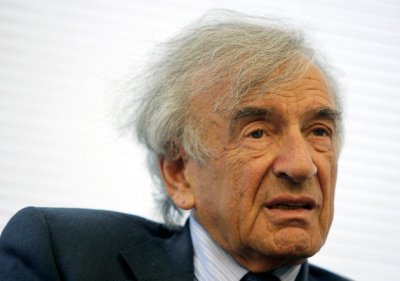
Elie Weisel is interviewed by Bob Edwards in New York, Wednesday, June 20, 2007. (AP Photo/Seth Wenig)

This blog is dedicated to Elie Wiesel, September 30, 1928-July 2, 2016

During the summer following my second year [as a graduate student] at Yale, I read Elie Wiesel’s The Gates of the Forest[1], which someone had recommended as a book in theology and literature. Elie Wiesel was not well-known, and I had not heard of him. I was totally unprepared to enter into his world. I had heard about the concentration camps and had read Anne Frank’s The Diary of a Young Girl, but I had not faced the reality that was the Holocaust, nor had I connected what happened to the Jews to my belief in the God of the Old Testament.

Reading The Gates of the Forest challenged my theology to the core. I believed God was powerful, loving, and good, and I believed that He had a special relationship with the Jews. Continue reading “Elie Wiesel’s Stories: Still the Dialogue by Carol P. Christ”

A-mazing Grace by Carol P. Christ

carol p. christ photo michael bakasA few days ago I received a message out of the blue on Facebook:

Thank you for your accepting my friend request. I am fighting to find my way out of depression during a life transition as I move into retirement from my years of work as an educator. I look forward to your book this spring. I have long called myself a Goddess feminist having struggled with patriarchal Christianity since my youth, but have felt abandoned by the Goddess for many years now. I’m not sure how I found you today. I stumbled onto a blog from you on your book while googling something else. Your words gave me a spark of hope. Laurel

In my blog I said that when I began to write A Serpentine Path, I felt abandoned by the Goddess. I wrote back, hoping that sharing what I had learned on my journey would be helpful.

The short answer is that the Goddess has never abandoned any of us. However, She does not have the power to make everything turn out as it could be or should be or we wish it would be. Hers is the power to inspire but not to control. If you have been unhappy, She is with you, She understands your pain, and She will be with you as you seek to find your way. I hope this doesn’t sound too preachy. It is from the heart of my experience. Take care of yourself.

I immediately received an answer back.

Thank you. Those were just the words I needed to hear with my heart. I am “too much in my head,” having spent a life in academia.

This interchange got me thinking about how we import toxic ideas from traditional theologies into what we believe are new religious worldviews. In this case the toxic idea is omnipotence—the idea that the Divine Power is in control of everything. It follows from this that the Divine Power can answer our prayers. If the Divine Power does not answer our prayers, there must be a reason. The reasons we give are many, including: because we are sinful and unworthy or because the ways of God are not our ways. We sometimes conclude, as Laurel and I did: the Divine Power simply does not care about me.

The prominence of magic in Wicca, the most widely known form of contemporary Goddess religion, can contribute to this feeling of abandonment. The Western occult or magical tradition teaches that there are practices, including rituals and spells, through which we can manifest our wills and achieve our deepest desires. In Goddess practice rituals and spells are directed to or through the Goddess. In this situation, it can feel logical to blame the Goddess when, after working very hard and doing every ritual and spell we can think of, our will or desire is not manifested. “Why me,” the child within us asks. “Why has the Goddess abandoned me?”

In the story I tell in A Serpentine Path, I felt precisely that. What I learned was that the Goddess had never abandoned me. She had been with me all along. Where I went astray was in believing that the world could become as I wanted it to be.

The world is made up of a multiplicity of wills, including my will and the will of the Goddess, but also the wills of every other individual, human and other than human, who has lived or is living now. If individuals, human and other than human, have the power to affect the world, then even the Divinity cannot have all the power. This means that Her power (and our power) is the power to influence the world, but not to determine or control it. This is one of the key metaphysical insights of process philosophy, but it is also an existential truth.

The Divine Power is not omnipotent. And neither am I. It may seem odd to put these two statements together. Yet they are mirror images: both ideas deny the reality that a multiplicity of wills have shaped and continue to shape the world we experience. The world really is not at my beck and call. Not even the Goddess gets that.

I would never have said that I believed that the world revolved around me. Stating it so baldly makes it clear how silly idea that idea is. For me “enlightenment” came when I realized—really understood—that the world is not “about me.” Once I gave up having to have what I thought I needed to have, I found, felt, and experienced love and beauty all around me. This truly is a-mazing grace. To feel love and beauty is not to deny suffering. Yet much of our suffering is caused by ideas about how life should be, as Laurel recognized, by living too much in the thoughts of our heads.

Email from Laurel Tangen-Foster, Ph.D.

Carol P. Christ is author or editor of eight books in Women and Religion and is one of the Foremothers of the Women’s Spirituality Movement. She leads the Goddess Pilgrimage to Crete in Spring and Fall. Photo of Carol by Michael Bakas.

A Serpentine Path Cover with snakeskin backgroundA Serpentine Path: Mysteries of the Goddess will be published by Far Press in the spring of 2016. A journey from despair to the joy of life.

Goddess and God in the World: Conversations in Embodied Theology with Judith Plaskow will be published by Fortress Press in June 2016. Exploring the connections of theology and autobiography and alternatives to the transcendent, omnipotent male God.

Facing Depression by Carol P. Christ

carol mitzi sarahThe suicide death of Robin Williams prompted me to reflect again on my own experience with depression and to share my story in the hope that it can help others.

In my twenties, thirties, and forties, I suffered severe intermittent depressions. My life in those days was a series of ups and downs. When I feel in love and was having good sex, I was in love with the world and could literally feel energy radiating from my body connecting it to the world. When I was dumped, the energy retreated, and I crawled into a dark hole of despair and self-pity from which there seemed to be no escape. In the in-between times, I carried on my life with neither the highs or the lows.

In recent days, a number of people have tried to describe what depression feels like. Here is what it felt like to me.

It was as if my mind had a single track on which were repeated a few deadly words: “No one loves me. No one will ever love me. I might as well die.” I could not erase the track or jump to another one. The words repeated themselves relentlessly in my mind.

Although I usually managed to get up and go to work during those times, these words were ever present: they would take over when my mind wandered on the bus or the subway and whenever I was alone. I could go through the motions of life, but I could not connect to the wellsprings of my creativity.

In the low times, I thought often about suicide. Indeed the words “I might as well die” encouraged them. Thoughts of my mother usually stopped me.

One time I decided to slit my wrists (slightly) to see if committing suicide would hurt. When I found that it didn’t, I immediately called two friends and asked them to take me to their home for the weekend.

When I was depressed, well-meaning friends told me that “this too will pass” and assured me that “you will find someone else.” I didn’t believe them. When I was in the place of depression those words did not help at all.

In therapy I learned that depression often masks enormous anger. Sometimes I screamed out my rage at my latest boyfriend in the confines of my apartment. But when the depression had taken hold, this did not help either.

I also tried all kinds of spells and divination to see “if our love was meant to be,” “to bring him back,” and “to find my true love.” None of this worked. (Readers of this blog who have wondered why I put little faith in divination and spells have their answer: not from lack of trying!)

Just as I was coming out of my last serious bout with depression, a friend who had suffered in similar ways told me that she had resorted to anti-depressant pills. She explained to me that the pills seemed to move her mind away from her depressing thoughts. When she felt stronger, she weaned herself off of them gradually. She said that she would go back to the pills if the depression came back. I was elated to learn that there was something that could work, and I filed this information in the back of my mind.

I don’t suffer from depression any more. Yes, life has its ups and downs, and I sometimes feel lonely or under-appreciated. I never did find “the right” man. But my disappointments no longer spiral down into depression and not wanting to live.

What happened?

It was like a miracle.

When my mother died, I felt the room fill with love. From that day to this I have never doubted that there is enough love to go around and that I am loved.

Thinking about the change that “happened” in my life, I can now say that I was suffering from an “error in thought.” I had equated “being loved” with finding my “true love.” In the process I was discounting all the many other forms of love in my life—including the love of my mother and grandmothers that had sustained my childhood years, and the love of friends, family, animals, plants, and the universe itself that continued to sustain it.

Soon after that, I realized that I had compounded my suffering with a major “error in theology.” When I bemoaned my inability to find “true love,” I was blaming the universe. I was blaming the divine power.

When, years earlier, I expressed my anger at God for not “saving” women from patriarchy, I heard the words: “In God is a woman like yourself. She shares your suffering.” These words inspired my journey to the Goddess.

cave woman climbingBut I needed to take another step.

I was still angry at the universe for not giving me what I wanted and thought I needed in my life. I was angry at Goddess because I thought She could make my life better and She was not doing it!

When I finally expressed my enormous anger to Her, I learned that I had been making the “theological error” of attributing omnipotence to Goddess. However She sympathized with my suffering, She did not have the power to “send my true love to me” when I poured out my heart to Her.

“The path you are on is not easy,” She said to me, “but I will be with you all the way.” Reflecting on those words, I understood that Her power is not omnipotence, but omnipresence, not power over, but power with.

So what advice would I give to those are in the throes of depression. (I am speaking here to those who suffer as I did from “garden variety” depression, not its more serious forms.)

• I would tell them that I understand how they are feeling. I would tell them that I understand how bad it really can feel. Not: “oh come on, it’s not that bad.”

• I would recommend getting in touch with the anger and sadness that underlies depression with the help of therapy, spirituality, family, and friends. A depressed person often feels that whatever underlies depression is too horrible to be faced. Yet there is nothing that cannot be faced “with help” from someone who can listen. However, this might have to wait until the depression has lifted.

• I would encourage exercise, singing, and dancing. Sometimes moving the body can also move the mind off the fixed track that leads to depression.

• I would suggest anti-depressant drugs not for the long-term, but for their short-term power to move the mind off a fixed track.

• After the depression has lifted, I would ask if “errors in thought” led to the conclusion that life is not worth living. I would urge them to open new tracks in their minds that lead to different conclusions—while they are healthy enough and strong enough to do so. Repeating a mantra like, “my true love is me,” “life is worth living,” or “life is a gift” just might help.

• I would also ask them to examine their “theology”–even if they think they don’t have one. Feelings that “God” could make things right, but in “this particular case” chooses not to, are one of the pathways to depression.

• I would urge them to be open to miracles.

Carol is looking forward to the fall Goddess Pilgrimage to Crete–$150 discount for the next two women to sign up for the fall 2014 tour–www.goddessariadne.org.  Carol can be heard in a recent interviews on Voices of the Sacred Feminine, Goddess Alive Radio, and Voices of Women.  Carol is a founding voice in feminism and religion and Goddess spirituality. Her books include She Who Changes and Rebirth of the Goddess and with Judith Plaskow, the widely-used anthologies Womanspirit Rising and Weaving the Visions.  Follow Carol on GoddessCrete on Twitter.

 

IS GODDESS “WITH US” OR “IN CONTROL” OF EVERYTHING? THE “THEOLOGICAL MISTAKE” OF DIVINE OMNIPOTENCE by Carol P. Christ

carol-christHow do we make sense of loss, great loss, and everyday disappointment? Some would tell us that “everything has a purpose” or that whatever happens “must be the will of God.”  I have found that these answers to questions raised by life as we know it often do more harm than good.  Yet they have a sticking power–we hear them all the time, sometimes even from other feminist seekers.

From the beginning feminists in religion rejected “the God out there” who rules the world from a throne in heaven. Most of us have insisted that “God” is more “in” the world than “beyond” or “outside it.” However we have not always been consistent in our convictions. When feminists are confronted with untimely death or great evil or just not getting what we think we want, we can sometimes be overheard to wonder, “Why did God (or Goddess) let that happen?” This question is based in the assumption that God or Goddess is omnipotent and rules the world from outside it. This is the theological idea I intend to question today.

The “zero fallacy” is a term philosopher Charles Hartshorne used to explain the “theological mistake” known as divine omnipotence.  Hartshorne pointed out that if God is omnipotent, then God has “all” or “100%” of the power. If this is so, then human beings and all other beings have “zero” power.  But if we have zero power, then do we even exist?  Continue reading “IS GODDESS “WITH US” OR “IN CONTROL” OF EVERYTHING? THE “THEOLOGICAL MISTAKE” OF DIVINE OMNIPOTENCE by Carol P. Christ”