From the Archives: New Year and Sustainable Resolution by Sara Frykenberg

This was originally posted on January 3, 2017

I am writing this blog on New Year’s Day, so Happy New Year! Today I say these words as both a statement of hope and as invocation. Happy New Year: may it be! My twin told me that our horoscope said that 2017 would be a party: we should throw our energies into anything and everything we want to see happen in our worlds because it can and will happen this year—may it be! Because it certainly doesn’t feel like a time for flourishing. I echo the introductory sentiments of Kate’s blog last Friday:

I am fried. These last two years proved personally & professionally exhausting. And yet, another year looms ahead unavoidably — another incredibly demanding year which will require more than I can fathom I actually have to give at this moment.”

Yes Kate. Oh my god/dess yes. This is exactly how I feel… and sitting down to write this blog this morning, I felt overcome with a wave of anxiety and stress, focused on all the things I have to do, the lack of time I have to do them, and the lack of energy I feel. Lurking beneath this stress is real pain and fear. What should we expect this year, in light of what’s already happening, in light of the hate already ignited? I think I have been locked in this pain and this fear.

Continue reading “From the Archives: New Year and Sustainable Resolution by Sara Frykenberg”

From the Archives: Thanksgiving and Service by Sara Frykenberg

This was originally posted on December 3, 2103

Growing up in an evangelical Christian church, I was taught that human beings should serve one another and put others before themselves.  These two different teachings, paired with patriarchal misogyny, have sometimes been very problematic for me.  I tend(ed) to give too much.  Too many demands with which I complied were self-negating (which after all, helped me to make other people more important than myself).  It took me a long time to learn how to appropriately prioritize my own needs, to stop mistaking self-esteem for the”‘sin of pride,” and how to say no when I needed to… Actually, I am still learning some of these lessons.

Conversely, my ritualized service to the church was sometimes confusing, awkward or embarrassing.  I clearly remember having the opportunity to serve as something like an usher during Thanksgiving at our family’s church as a child.  This involved wearing a pilgrim costume, which for me meant finding a Puritan style costume in the church’s closet that fit my overweight childhood frame.  This was not an easy task and left me feeling ashamed.  Later as an adolescent, my youth group asked us to wash one another’s feet as Jesus did for his disciples.  Now, don’t misunderstand me here— I do believe that this ritual has the potential to be very powerful and meaningful for those involved.  However, my teenage self could not identify with the symbolic gesture beyond realizing that:

1)    I thought touching other people’s feet was gross, as was having my dirty feet touched and,
2)    I knew I ‘should’ get something out of the ritual but did not, so I felt spiritually guilty or inadequate.

Overall, I often associated Christian service with guilt, inadequacy, my role as a daughter or woman or my sacrificial duty.

Despite these issues, I usually genuinely enjoy serving others and giving to other people.  I love to host people and care for them.  I like to help.  I even prefer to help.  Serving one another we can express and allow others to express love.  But this past week, one day before Thanksgiving, a dear friend of mine gently challenged me to allow myself to be served or, as she put it, “to give someone else the gift of giving to me.”  Specifically, she was referring to a pending holiday meal for which I expressed my anxiety and frustration with not being allowed to help—which somehow makes me feel like a child.  Even writing this phrase, “makes me feel like a child,” I know that I have touched deeper feelings of helplessness or vulnerability that at some point, I learned to battle with competence and over-achievement.  I do often feel like a child or guilty when other people do for me what I think I could or should do for myself; and my friend’s brief words encouraged me to explore this relationship to being served.

“Service” can sometimes feel uncomfortable for the reasons I mention above, but more so, for its connection to the coercive “servitude” required by existent hierarchies within andro-kyriarchal oppressive systems.  I have been subject to this coercive servitude, and also, its beneficiary.  As a white, middle class, Western woman I have far too much privilege that is contingent upon the forced labor and oppression of other people.  This kind of forced servitude is very wrong; and I am still learning how and where to choose other than to be complicit in this abuse.  But, there have also been many distinctive instances in my life where I have felt reciprocally and undeniably “served” by people around me, without abuse and without manipulation.

Driving to Colorado one summer to see the friend I mentioned above, my two companions and I served one another.  The individual in the back seat was responsible for cutting bagels and spreading cream cheese on them for the driver and navigator, while the navigator held the drink, food or whatever other item that the driver could not.  This may sound like a small thing, but it wasn’t.  I felt taken care of and loved in this small and traveling community.  We also had a safe word that meant, “leave me alone, I’m grumpy” on our long trip.  We made agreements to account for one another’s  discomfort and effort.  We respected one another and cared for each other.

Beginning my work as an adjunct professor, I encountered a great deal of stress and often long and awkward work hours.  Many times I felt like I needed help, but there was nothing I could ask for help with when it came to my job: I needed to grade my own papers, plan my own lectures, and yes, write my own blogs.  My husband has responded by taking care of me in other ways.  He makes me dinner, goes to the store and makes sure I take breaks.  We take turns taking care of one another, and I am grateful for him.

This past week after talking to my friend, I noticed how willing people were to touch me to soothe aching muscles.  I’m not sure how to describe what I felt, but it was like something invisible in certain spaces was suddenly visible.  I also realized that it had been a very long time since I had freely and openly received this touch.  Later during the weekend, a friend came to my house  and she made me dinner!  My husband rubbed my chest after a long night of coughing yesterday because I still haven’t completely rid myself of the smoldering in my lungs.  I was defensive for so long.  Shedding my defender allows me to rediscover all those things for which I am thankful.

Gratefulness is an action.  It can be found in those expressions that return, receive and allow for mutual loving.  I am learning new rituals that help me to remember that this kind of mutual serving and being served is sacred.  In a summer ritual, my friend and I washed one another’s hair instead of our feet.  I am still learning to ask for assistance from the goddess after freeing myself from an abusive omnipotent god, but I am starting to ask.

I am starting to pray again.

BIO: Sara Frykenberg, Ph.D.: Graduate of the women studies in religion program at Claremont Graduate University, Sara’s research considers the way in which process feminist theo/alogies reveal a kind transitory violence present in the liminal space between abusive paradigms and new non-abusive creations: a counter-necessary violence.  In addition to her feminist, theo/alogical and pedagogical pursuits, Sara is also an avid fan of science fiction and fantasy literature, and a level one Kundalini yoga teacher.

My Daughter’s Religions by Sara Frykenberg

I find it interesting how certain or settled we often expect our little ones to be instead of getting curious about them or acknowledging that they are curious.

My daughter, Hazel, is six years old and will be starting first grade next week. She loves cats, swimming, her cousin, and food. Purportedly, Chinese style barbecue pork buns come first in her heart, even before mommy and daddy (though we are a close second). She also prefers to run instead of walk; and has recently declared that she is Taoist and Shinto. This determination came after some discussion which went something like this:

Sitting at the kitchen table one morning, Hazel declares “My best friend asked me if I was a Christian and I told her I was. I am a Christian.”

Mommy the agnostic is a little surprised. Daddy, the atheist, is biting back a retort—he is somewhat hostile towards Christianity. I am only hostile to abusive, hetero-Patriarchal Christianity. I say to Hazel, “Oh. That’s interesting. Do you know what that means?”

“No. What do Christians believe,” she asks.

Continue reading “My Daughter’s Religions by Sara Frykenberg”

Turning Five by Sarah Frykenberg

My daughter turned five years old this week. I am now a five-year-old-mother of one. Big Five <3. I’ve been thinking a lot about the fact that this is the age when children’s brains are developed enough to start creating more permanent memories of their childhood. What will my daughter’s earliest memories be when she is grown?

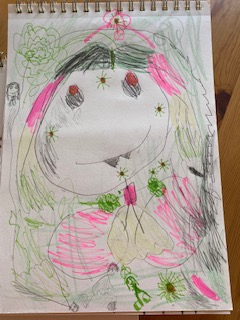
Four was a pretty chock-full year.

Fires—though those may seem like just another California season to her by now. Pandemic; staying home with Mommy, Daddy, and our new roommates, Auntie and Uncle for weeks on end.

Learning to ride a bike.

Pages upon pages of art, including a whole notebook almost exclusively dedicated to her “study” of “Hazel Vampire” (I blame Uncle and Auntie for this one).


Pandemic. More pandemic.

Continue reading “Turning Five by Sarah Frykenberg”

Moments of Beauty by Sara Frykenberg

Last week a friend of mine started a post asking people to share something that they’ve enjoyed or appreciated since shelter-at-home orders began across the country and globe. This friend was in no way trying to minimize the very difficult situations that so many of us find ourselves facing during this pandemic. Rather, the list she elicited and generated helped to create, at least for me, a moment of hope or peace—a moment that I suspect many of us need right now.

Inspired by my friend (who has quite a talent for pointing out the potential for joy or happiness), I would like to add to her list here by sharing a couple of my “moments of beauty” in the hopes I can share this hope or peace. Continue reading “Moments of Beauty by Sara Frykenberg”

Staying Un-Frozen by Sara Frykenberg

It is February 14th, Valentines Day. So, today I want to explore my daughter’s love affair with Frozen; a story that I did not like, but that I learned to love by watching it through her eyes. A story which through her eyes, has taught me a lot about how to stay and be un-frozen.

I did not understand the phenomenon that was Disney’s Frozen in 2013. I did not like film’s premier song Let it Go, which you could hear e-v-e-r-y-w-h-e-r-e. The film wasn’t even about Elsa; the queen with magical powers who sings this song while reveling in the new-found freedom of her isolation. It’s about Elsa’s sister, Anna, and her quest to find Elsa. So really, I thought, the song was misleading. I also didn’t like the ‘loveable Olaf;’ and while switching up the “true love’s kiss” narrative was a positive change for Disney (Anna saves herself and Elsa with her love, instead of that of a man), I just didn’t get the widespread appeal. Continue reading “Staying Un-Frozen by Sara Frykenberg”

Teaching After the Getty Fire by Sara Frykenberg

This is the third year in a row that I will be writing about wildfires in California and their impact on me and my community.

This year, I don’t have any poetry.
This year, I’m not afraid.
This year, I’m angry. I am very angry. And again, I am awash in the (not so?) mundane concerns that surface in the wake of devastation. I am continually struck by this: the strangeness of the everyday next to the blackened hillside, the restricted access, and soot covered floors—the persistence and tremendous regularity, even normality of the everyday. Continue reading “Teaching After the Getty Fire by Sara Frykenberg”

I’m [Not] Batman by Sara Frykenberg

A little tongue-in-cheek, somewhat punchy, somewhat angry reflection for your consideration. Thank you for reading.

Ever have trouble speaking your mind? I do. I do, particularly in situations where I was taught (in all sorts of ways, violent and nonviolent alike, religious, patriarchal) to be “a good girl.” The “good girl” training I received is so deeply ingrained in me that I often don’t realize when I’m doing it. I catch myself being agreeable with people when I want to be arguing. I use extra exclamation points in communications with my online classes to appear more likable, friendly or non-threatening. I also have a peculiar habit of, unconsciously, changing my clothes repeatedly until I ‘match’ someone around me, usually in color. I honestly don’t mean to do this, and only became aware of the habit in the last decade because my husband started pointing it out to me ALL THE TIME.

But I’m working on it. “Be authentic, Sara.” “Be yourself.” That’s got to be different than being good, right? I probe my habits and relationships for the tell-tale signs of this “good girl.” Continue reading “I’m [Not] Batman by Sara Frykenberg”

What We Can’t See by Sara Frykenberg

As a professor, I find myself returning to a similar struggle again and again. I know what I know; and I know what I hope students will gain from the class, in terms of content knowledge, critical thinking, classroom community-making, etc. But often, I don’t know what they don’t know.

This might seem a silly kind of observation. No duh, Sara, you barely know this group of people. Also, this may seem an easy question to answer. And sometimes it is; and I do have part of the answer when I begin a class. My “Intro to Ethics” students, for example, will understand and be frustrated by the way people use the Bible to justify their own positions, but they usually won’t know the term “proof texting,” or easily understand “hermeneutics.” My “Women in Christianity” students will understand sexism and often, the idea of gender as a social construct, but they are usually unfamiliar with the dualistic gendering and ranking of larger social realities, like nature and culture, production and reproduction, etc.

There are obvious differences in academic training—that’s why I’m allowed to teach at a university after all. But I’m not really wrestling with what I can contribute in terms of content knowledge or historical/ theoretical contextualization. I think what I don’t know is what understandings of reality they bring into the classroom and what these realities have allowed them to see. Learning and/or teaching feminist theory and theo/alogy for the last fifteen years at least, I also often take my own reality for granted. I “know what I know,” after all—I just can’t always remember what it was like to learn it. And all of these classroom dynamics can make it harder to catch the realities we can’t yet know or can’t see. Continue reading “What We Can’t See by Sara Frykenberg”

Just South of Ventura by Sara Frykenberg

For those of us living in Southern California, it has been a tense week to say the least: flames ravaging up and down the coast, homes lost, thousands displaced, freeway and school closures, smoke thick in the air, and ash raining from the sky.

And the fires are still raging. 

Whether or not one is directly impacted by the wildfires here in Ventura and Los Angeles County, you can’t walk through the grocery store, turn on the radio, or get a cup of coffee without engaging the fear and concern, or hearing about the devastation left behind. We are sharing a trauma, howbeit differently, and with different levels of need.

I have been lucky during the fires.  I live just south of Ventura. My work is on the Getty side of the 405: it was threatened, but not in flames.  I spent the week checking in with family and friends, offering my home, and breathing the toxic air. I also made dinner, picked my brother up from the airport, attended a baby shower, and graded papers. … This is a strange juxtaposition, and like many Californians, I have had a hard time processing what’s going on.

On Sunday afternoon, surrounded by the unnatural darkness of an ash filled sky while traveling down the 101 freeway, I wrote the following. This is my effort to make sense.  And I offer it to you all here, in case this helps you make sense too.  Continue reading “Just South of Ventura by Sara Frykenberg”