Of Cruelty and Compassion: Jane Goodall: Messenger of Hope by Beth Bartlett

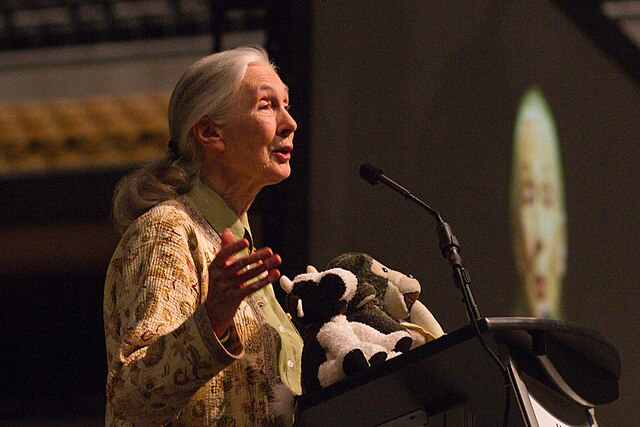
Mark Schierbecker, Wikimedia Commons

During the last week of September I had the opportunity to spend a few days in solitude in a place that is my soul’s home.  I spent part of my time reflecting on questions posed by ecotheologian Mary DeJong to mark the autumnal equinox.  The first question was “What is a desire you carry into the autumn season? What are you seeking?”  After much contemplation, the words that came were, “I wish for a change in government – to be rid of Trump and company – for freedom, equality, respect, for the dignity of all, for an end to the suffering in Gaza and the reign of terror of ICE in this country – the horrors of those being abducted and imprisoned – for an end to cruelty. Yes, for an end to cruelty everywhere.  Why is this country so cruel? I do not understand cruelty. Where does it come from? Why would anyone want to be cruel? How could anyone even stomach the suffering of another?  How does that happen? Yes, I desire an end to cruelty.”

A few days after writing those words, on October 1st, scientist, environmentalist, and humanitarian Jane Goodall passed away in her sleep, prompting me to re-read her book, Reason for Hope. There I found her words echoing my own, “To me, cruelty is the worst of human sins. . . “[i] And while she had not set out to study human cruelty, how we become cruel and how we might move beyond our worst impulses, her work with chimpanzees eventually would lead her to this.

Continue reading “Of Cruelty and Compassion: Jane Goodall: Messenger of Hope by Beth Bartlett”
To See Ourselves in Others: Part Two by Beth Bartlett

Part 1 was posted yesterday. You can read it here.

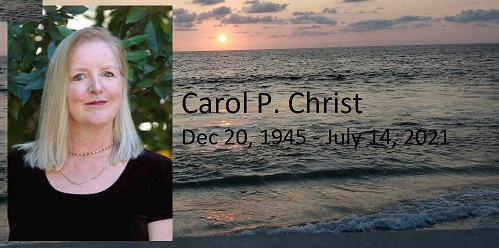
Patriarchy is a system of male dominance, rooted in the ethos of war which legitimates violence, sanctified by religious symbols, in which men dominate women through the control of female sexuality, with the intent of passing property to male heirs, and in which men who are heroes of war are told to kill men, and are permitted to rape women, to seize land and treasures, to exploit resources, and to own or otherwise dominate conquered people.[i]Carol Christ

In Part I, I urged against the distancing that intellectual analysis can bring to situations that require us to respond from the depths of our being, and yet, how can one be a reader of this blog and not examine the intertwining strands of patriarchy, religion, women, and war in this current conflict.

Continue reading “To See Ourselves in Others: Part Two by Beth Bartlett”

To See Ourselves In Others: Part One by Beth Bartlett

I have felt both a responsibility and a reluctance to write about the escalating conflict in the Middle East.  The situation is so complex and such an unspeakable tragedy – acts of such terror and violence on the part of Hamas toward civilian populations met with even greater violence and repressive measures on the part of Israel toward the people of Gaza. It is a perplexity of the human condition that a people with such a deep history of being displaced and oppressed rather than refusing to oppress in turn, instead engage in the displacement and oppression of others that then erupts into more violence. Both are traumatized peoples acting out of deep pain and woundedness. Thousands have died, more are wounded and displaced, all will carry more trauma into generations to come. The very earth bears the scars of war. In the face of such unspeakable suffering, any kind of analysis feels distancing at a time when what we most need is to let the suffering move us to our depths.

Continue reading “To See Ourselves In Others: Part One by Beth Bartlett”

Curiosity by Beth Bartlett

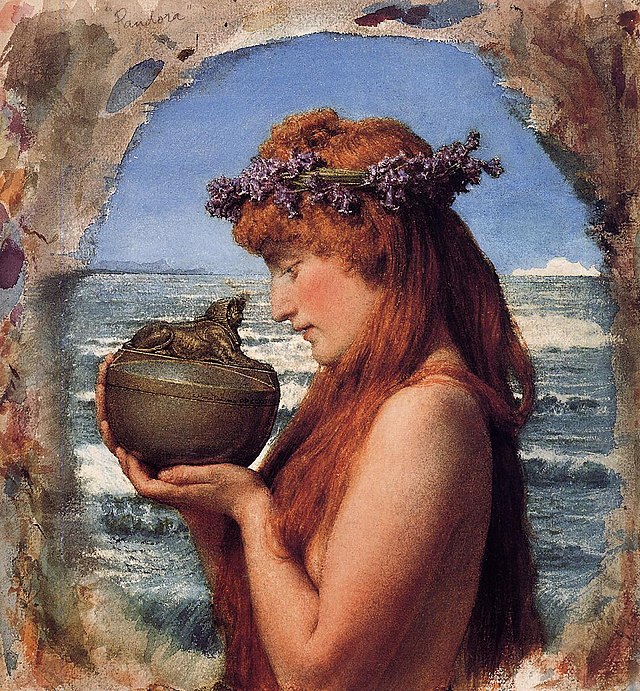
In my last post I mentioned the tale of Prometheus who stole fire from the gods.  Zeus’s punishment of eternal torture was not enough to avenge the offense.[i]  In addition, Zeus punished the entire human race by sending the first woman, Pandora.  Pandora is a woman of “all gifts,” one of which is the curiosity that drives Pandora to open the forbidden jar, unleashing evils and miseries into the world.  Woman as punishment, as the bringer of evil and misery — these themes have shaped the western view of women for millennia.

Continue reading “Curiosity by Beth Bartlett”

Common Ground: Part Two:  On Enclosure, the Commons, and Awe by Beth Bartlett

Can we rise to ourselves and see what is in the nature of the soul to see – that we exist on this common ground together?” – Susan Griffin

The ideology, discussed in Part One, that land that is not being cultivated, mined, lumbered, or otherwise used to create goods and capital is ‘waste” continues its devastating effects to this day in mountaintop removal, destruction of old growth forests, fracking and drilling and mining of once pristine lands, plowing the plains into dust and spreading herbicides and pesticides over the land. Devastate – from the Latin devastare, meaning to “lay waste, ravage, make desolate.” Devastate – to de-vast – is to destroy the vastness. And so has the vastness of lands around the world been plundered, laid waste, so as not to “waste” it.

Continue reading “Common Ground: Part Two:  On Enclosure, the Commons, and Awe by Beth Bartlett”

Common Ground: Part One:  On Enclosure, the Commons, and Awe by Beth Bartlett

I spent the first half of my academic career studying and teaching the history of Western political philosophy – the works of Plato, Aristotle, Augustine, Aquinas, Hobbes, Locke, and Rousseau to name a few.  It gave me the best possible grounding in understanding the foundations of patriarchy.  In more recent years, I have used these works to explain the Western paradigm of thought to my ecofeminism students so they could better understand how women, colonized others, and the earth have been defined and dominated based on these assumptions.

Continue reading “Common Ground: Part One:  On Enclosure, the Commons, and Awe by Beth Bartlett”

Breath, part 2 by Beth Bartlett

You can read part 1 here.

Much has been written about the last breath, but not much about the first. Recently, I happened to listen to a re-broadcast of an episode of NPR’s Radiolab on “Breath.”  It began with an explanation of the ingenious, miraculous first breath in which we transition from water-dwelling beings in the watery womb to air-dwelling beings outside in the world.  In the water-dwelling fetus, the lungs have no function. Instead, the fetus gets its oxygen from its mother through the placenta and umbilical cord, the oxygenated blood flowing directly from the right to the left chambers of the heart through a hole — the patent foramen ovale — bypassing the lungs that in fetuses are filled with water.  But in the split second of that first breath, the umbilical cord shuts down the flow of oxygenated blood and the patent foramen ovale closes, requiring that the once water-filled lungs now be filled with air.  The right and left sides now forever closed off from each other, from now on, the oxygen-deprived blood that flows into the right side of the heart must be pumped out of the heart into the lungs where it is enriched with oxygen, and then returns to the left chambers of the heart where it is then pumped to every tissue in our bodies.  That first breath enables the continual flow of in-breath and out-breath, for most of us, about 500 million times in our lifetimes. I will never forget that first breath of my own child as he came in to the air-breathing world. That first cry remains, and always will, the sweetest sound I have ever heard. Aware now of all that happens with that first breath, I am filled with an even deeper awe.

Continue reading “Breath, part 2 by Beth Bartlett”

Legacy of Carol P. Christ: Woman and Nature: Our Bodies Are Ourselves

This was originally posted on June 26, 2017

This earth is my sister; I love her daily grace, her silent daring, and how loved I am how we admire the strength in each other, all that we have suffered, all that we have lost, all that we know. We are stunned by this beauty, and I do not forget: what she is to me, what I am to her.

These words are from Susan Griffin’s Woman and Nature which I often recommend as one of my favorite books. Over the years I have read this passage and others from Woman and Nature aloud with my students, and we have always been moved, most  of us to tears. More recently these words have become the center of the “Morning Blessing” on the Goddess Pilgrimage to Crete.

Continue reading “Legacy of Carol P. Christ: Woman and Nature: Our Bodies Are Ourselves”

Legacy of Carol P. Christ: His Terror

Moderator’s Note: This was originally posted on March 25, 2019. AND the issues are still with us and as vivid as ever.

The first two parts of Susan Griffin’s Woman and Nature, “MATTER” and “SEPARATION,” are written in the authoritative voice of western philosophy and science that declares matter to be dead and the body an impediment to thought, and proceeds to separate the mind from the body. All of this, Griffin suggests, is based in the fear of death.

As Griffin notes, in this equation woman is identified with the body and her voice is silenced. Re-reading these parts of Woman and Nature for the umpteenth time for a class I am teaching felt even more painful than it had before. I was reliving parts of my own story.

I was brought up in the tract home suburbs of post-war Los Angeles in a world of women. Both of my grandmothers played central roles in my upbringing, introducing me to nature and the spirit of life they experienced as we explored trails the Los Angeles County arboretum before it was fenced or when we frolicked in the waves and picked up sand dollars at the seashore south of San Francisco. When I was ten years old my family moved to a new neighborhood that was almost entirely made up of families like ours with small children, fathers who worked, and mothers who stayed home.

Continue reading “Legacy of Carol P. Christ: His Terror”

When Earth Meets the Son by Sara Wright

As I curl up

in my hatchback

open to sky

I am a snail

loving her shell
sun warms

me from behind
Autumn light
shimmers, leaves
a testament
to breeze

 some withered

by a freeze.
Burnt umber
Gold
Salmon
the understory
in full glory
Bare hardwoods 

peer down

 sentries stationed
Overhead
Acorn browned oak 
leaves smudge

 sage greens

dark crimson

bleeds
geese fly by

haunting goodbye
A dragonfly lands
on my foot
Not a grouse 
in sight
Hunted
in thickets
too thorny
for stealth
She’ll
live to see
another dawning
Scarlet pockmarked palms
lie face up

on the ground.

Warning.

 Signs are everywhere.
Insect ridden leaves –
puncture marks
deform once

smooth hands
some shriveled

beyond recognition.

Continue reading “When Earth Meets the Son by Sara Wright”