In those first few days after the holidays, when the togetherness, warmth, and happy times with family and friends came to an abrupt end, a song my son used to sing as a small child kept running through my mind:
Keep Christmas with you all through the year. When Christmas is over, save some Christmas cheer. These precious moments, hold them very dear And keep Christmas with you all through the year..
The simple glee of my 21-month-old grandson finding ways to scoot and slide down the small icy slope in our backyard was enough to keep the grief over the loss of my sister and my recent loss of my dearest friend at bay. But in the days after their departure, as I spent time with my friend’s family planning her memorial gathering and visited another dear friend who has chosen to enter hospice in her final days of a terminal illness, coupled with the hooded ogre of the approaching Project 2025, saving Christmas cheer has had its challenges.
But my son found a way. He and his wife decided they didn’t want the precious times to end, and within a week had decided to pull up stakes from their home 150 miles away, found and signed on to buy a house just five minutes from our home so that the precious moments could continue.
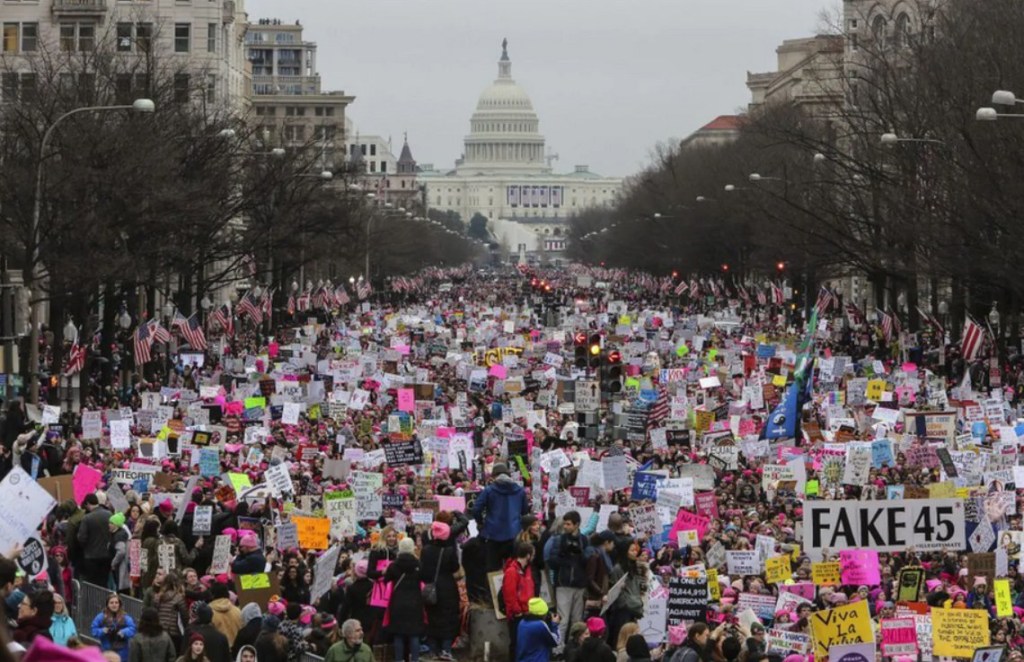
Marches and Rallies will be held all over the United States this Saturday January 20th to mark the upcoming 51st anniversary of Roe vs. Wade. WomensMarch.Com
But what is happening in our world right now is Bigger than Roe.
It is not about Life, it is about Control.
I voted for Trump in 2016. There. I said it. My entire family was Republican. My husband at the time was Republican. I spent many years on an Airforce base where I saw firsthand that things the government run are full of red tape and inefficiency.
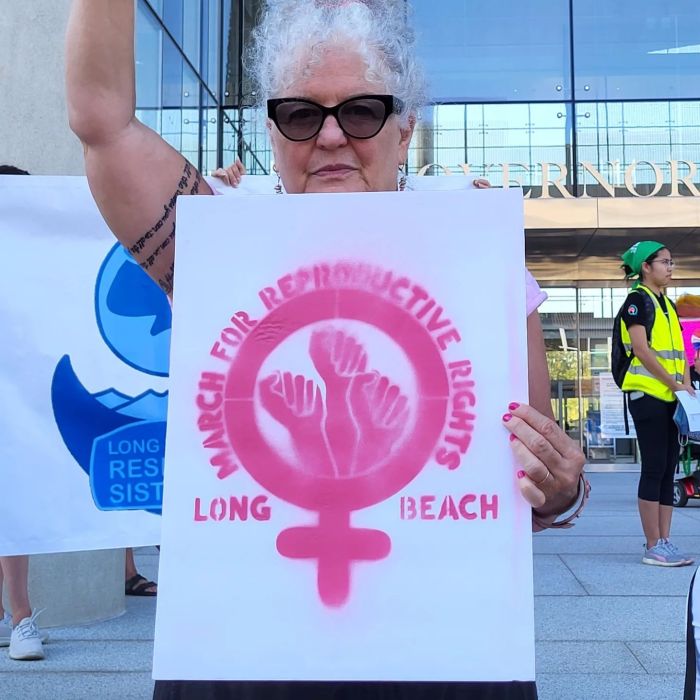
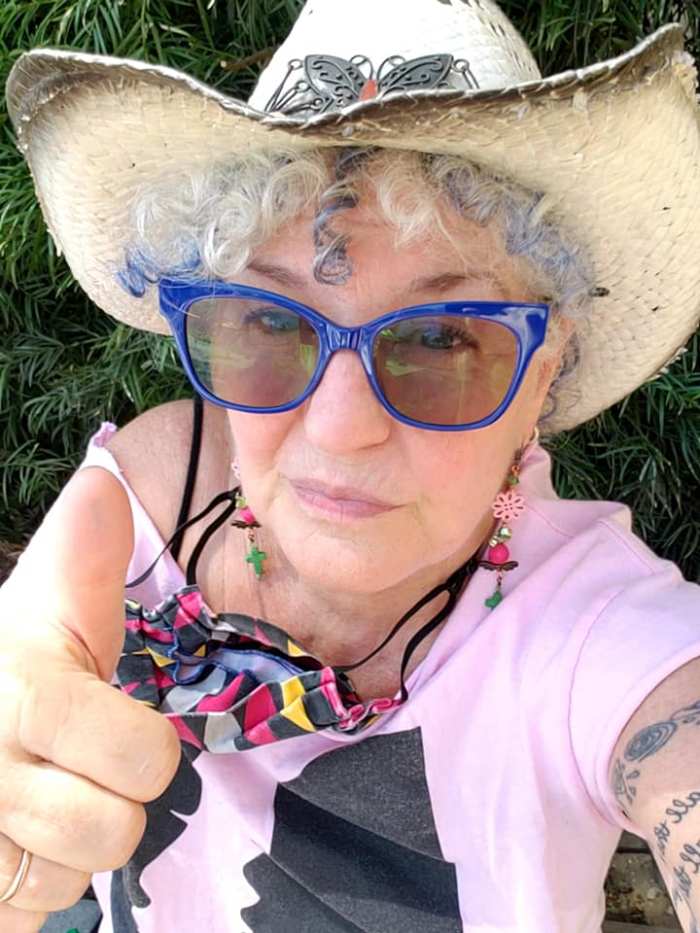
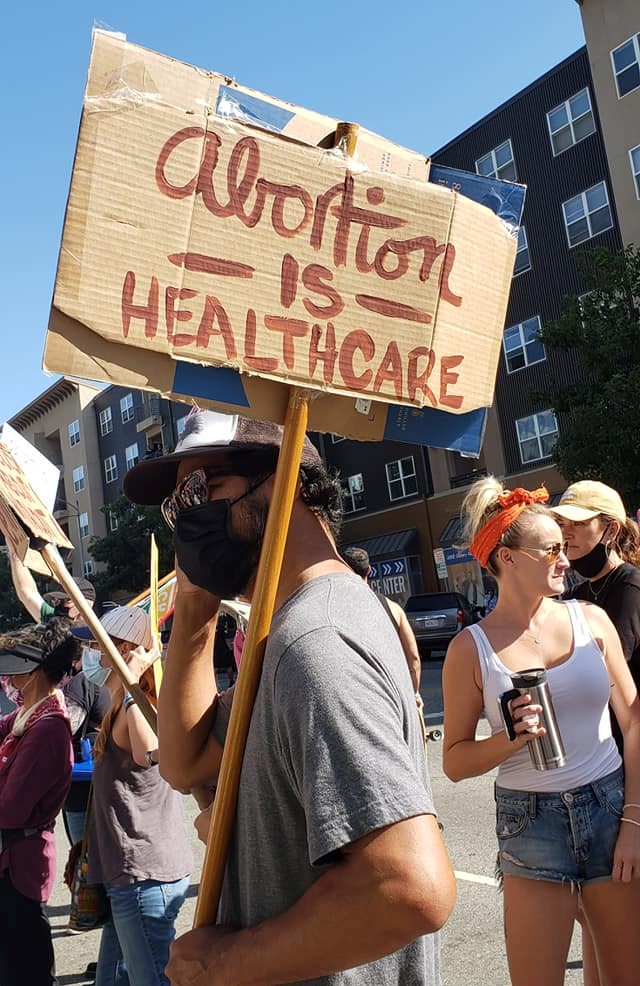
Hello FAR family! Here are photos from the October 2nd Women’s March in Long Beach, CA. The Women’s March began after the 2016 “election” and continued through the Trump years, and was not immediately active after Biden won. But after Texas passed it horrific ban on abortions with no exceptions, the Women’s March re-ignited across the nation… especially in response to the recent Supreme Court approval of the unconstitutional ruling on abortion in Texas which limits abortion access to 6 weeks of pregnancy – a time span that denies abortion completely as almost all women do not even know they are pregnant within this time, never mind having time to decide if an abortion is their choice.
The Women’s March came together in October in a very short amount of time. For example the Long Beach rally came together in just 10 days. I attended and was one of 500+ (though reports said 200, I was there and we were more!
Click then scroll to see full image…
May the revolution continue! As Hillary Clinton said, “Women’s Rights are human rights.” And my favorite chant throughout the March was, “Who sent us? Ruth sent us!!”
Bio
Marie Cartier has a Ph.D. in Religion with an emphasis on Women and Religion from Claremont Graduate University. She is the author of the critically acclaimed book Baby, You Are My Religion: Women, Gay Bars, and Theology Before Stonewall (Routledge 2013). She is a senior lecturer in Gender and Women’s Studies and Queer Studies at California State University Northridge, and in Film Studies at Univ. of CA Irvine.
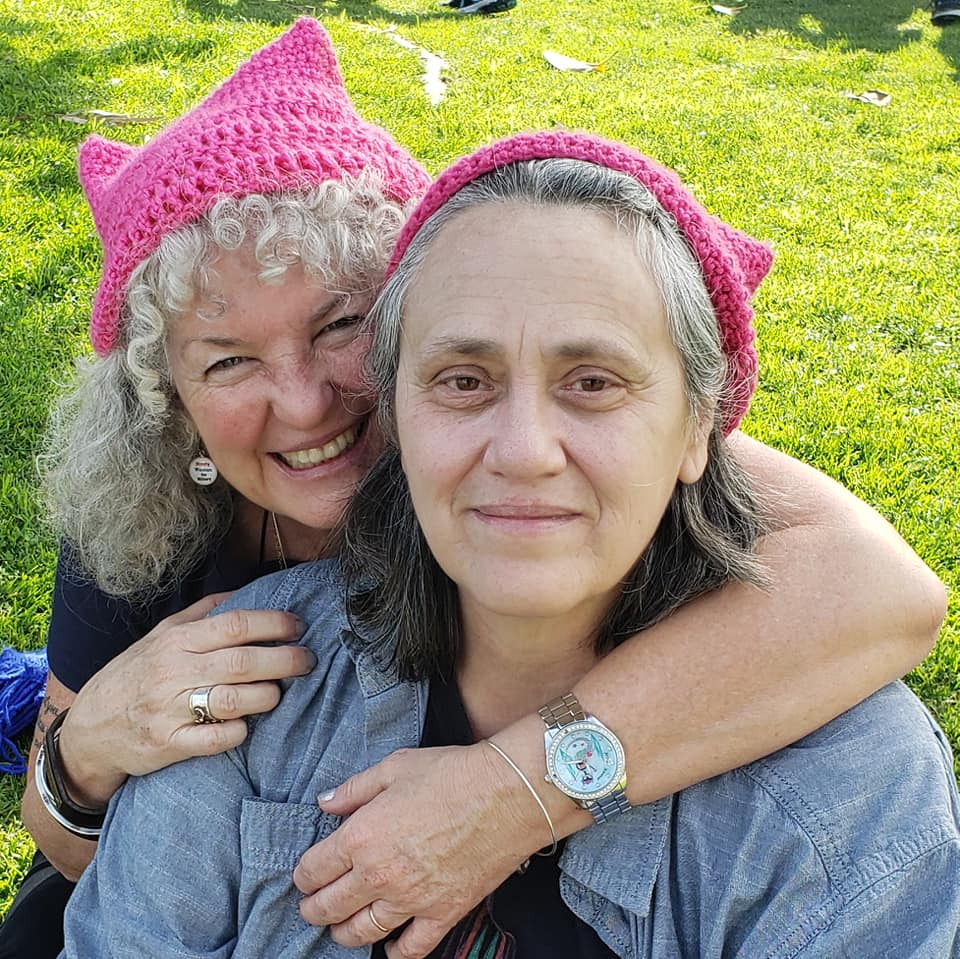
Photo of the author (left) and her wife Kimberly Esslinger
Here we are at the fourth now annual Women’s March. I have done a photo essay of the March every year for Feminism and Religion (FAR), the first two from the Los Angeles March, and the last two from Orange County.
I’m taking a break this month from the series “In These United States” poems I have been delivering to FAR (back with more poems next month) to showcase some of the activism, commitment, humor, and courage that showed up at the March I attended in Santa Ana in Orange County, California, January 18, 2020.
In this part of these United States the marchers chanted, danced, laughed, and were very serious. Santa Ana is a densely populated city where almost 62% of the population is Mexican. This evidenced itself in the March where for the first time I saw ballet folkloric by a company dressed in traditional folkloric costumes, in suffrage colors. Continue reading “2020 Women’s March by Marie Cartier”
Well over 100,000 people and counting have read a blog post called “Nothing But the Truth: A Word to White America After the Recent Unpleasantness in Washington DC” that I wrote. Going on 400 commenters have weighed in on my website. I have not been able to keep up with replying to all the comments, but I have read them all. And a few cluster around the topic of childhood innocence and the role of adults in nurturing/protecting/informing children around the realities of things like racism, sexism, and the ugly layers of American history.
This exploration of the nature of childhood and our culture’s role in nurturing what we value about childhood calls out for feminist reflection. So, I put this out to the FAR community of conversation for discussion.
Some of the comments that interest me the most are those who gave the young men from Covington Catholic a pass because they are “just kids.” And they felt media and others were being too hard on them to expect them to understand what was going on in front of the Lincoln Memorial when competing narratives about our country converged.
Please be warned, this post details violence against women.
A new March 8.
Another year protesting
Another evening taking the streets of our cities around the world
In Rome, in Lima and Santander
A new slogan, a new banner, for the same rage
A decent man, one of those who define himself as a good citizen and father stands in front of me asking: “Why are you so angry? …. Why are feminists so angry? I am asking you: Why are you so fucking angry?”
Why are you angry?
Because my friend went to the police to put a complaint that her husband beat her and they did not take the complaint. When she returned home, her husband hit her again.
Why are you angry?
Because I am 16 years old and every day after school, older men shout sexual things to me in the street, they even follow me and when I get upset and tell them not to do it they say that I am being rude … I am afraid to walk in the street. Continue reading “Why Are You So Angry? by Vanessa Rivera de la Fuente”
I’ve long held that feminism, in order to be true and engaged and practical, must be intersectional. The work of justice for women must also include justice for other marginalized groups. Because many women are also LGBTQ, people of color, people with disabilities, Muslims, immigrants, and others marginalized for identities other than their gender. Paying attention to these intersections—of sexuality, gender, race, class, ability, religion—and acknowledging that many people have multiple intersecting identities for which they are oppressed is vital to the work of justice.
These thoughts remained at the forefront of my mind as I recently marched in one of the sister marches of the Women’s March in my home of Hilo, Hawaii. I heard many straight, white, cisgender women claim that women are not oppressed while mocking the march as irrelevant. I heard some gay men purport that such a march was unnecessary. And I wondered. Are not women of color also women? Muslim women? Immigrant women? Women with disabilities? Queer women? Trans women? Are not our quests for liberation and rights and legal validity interrelated, mutually dependent, might I even say, intersectional? Continue reading “The Protest Goddess by Angela Yarber”
When I was in graduate school, I learned to doubt myself. Despite having won Danforth and Woodrow Wilson graduate fellowships that paid for my tuition and living expenses, I was continually told by professors and male students alike that I would not finish my degree and that if I did I would get married, have children, and never use the degree I had earned. I tried hard to maintain my confidence in myself, but it was difficult when I was the only woman in the program. There was one other woman my first year, but she was older than I was, a nun, and I never saw her in class or at social events. My self-esteem was gradually eroded. If I had not had a fellowship, I would probably have dropped out.
Fast forward a few years. There were several more women in the program, but only one in theology, my friend Judith Plaskow, and she too struggled. I was working on my comprehensive exams and wondering if I had what it takes to pass them and then write a Ph.D. thesis. After the initial shock of being treated as if I was not the equal of the male students in the program, I began to look around me. A few of the male students seemed really bright, many of them were average, and some of them were plodders. I hate to admit it, but I looked at the least competent among them and said to myself, “If he can do it, then surely I can.” And I did. I passed my exams. A few years later my Ph.D. thesis was approved.
If contributions to the field are any indication, Judith Plaskow and I were not only as good as the most mediocre men in our graduate program, we smarter than the average ones, and at least as smart as the smartest ones. But we didn’t know that then. Men have been getting degrees and being promoted and moved up that ladder because other men like them, identify with them, feel sorry for them, and for lots of other reasons having nothing to do with excellence, and sometimes not even do do with competence.
Last week I heard Cecile Richards say something to Lawrence O’Donnell that reminded me of this. Speaking of the huge numbers of women who—inspired by the women’s marches–will be voting, registering voters, campaigning, and running for office in 2018 and beyond, she said women “totally understand that they can do better than who’s in office now.”
photo by Marie Cartier
For far too many years women have been held back by lack of self-confidence and self-esteem. We didn’t think we could and we didn’t. We don’t think we can and we don’t. We thought men were smarter than us or had more time or more drive. The founder of the Society of Women Engineers at San Jose State told my classes that women who got even one B+ in an engineering class were likely to drop out of the program, while men graduated who graduated with C averages went on to get great jobs. Now we see truly mediocre white men holding public office all across the country and in its highest offices. The harm they are doing to women, to children, to the elderly, to people of color, to the environment has been a wake-up call for all of us. There are so many mediocre white men in office that women–of all colors and ethnicities–are realizing that we can do better than that! Once we begin to see what we can do when there are large numbers of us holding office all across the country, there will be no stopping us!







 Well over 100,000 people and counting have read a blog post called
 I’ve long held that feminism, in order to be true and engaged and practical, must be intersectional. The work of justice for women must also include justice for other marginalized groups. Because many women are also LGBTQ, people of color, people with disabilities, Muslims, immigrants, and others marginalized for identities other than their gender. Paying attention to these intersections—of sexuality, gender, race, class, ability, religion—and acknowledging that many people have multiple intersecting identities for which they are oppressed is vital to the work of justice.
 When I was in graduate school, I learned to doubt myself. Despite having won Danforth and Woodrow Wilson graduate fellowships that paid for my tuition and living expenses, I was continually told by professors and male students alike that I would not finish my degree and that if I did I would get married, have children, and never use the degree I had earned. I tried hard to maintain my confidence in myself, but it was difficult when I was the only woman in the program. There was one other woman my first year, but she was older than I was, a nun, and I never saw her in class or at social events. My self-esteem was gradually eroded. If I had not had a fellowship, I would probably have dropped out.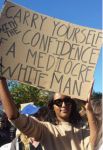
 Feminism and Religion