

This was originally posted Dec. 8, 2019.
 I attend Czech classes twice a week. This time of year the courses focus on Christmas. I’ve attended three different schools over the last five years, and all handle Christmas similarly. Even though the Czech Republic is only marginally Christian, for many Czechs being Czech and observing Christmas seem to go hand-in-hand. In fact, Czech customs around Christmas even figure into the citizenship exam.
In last Tuesday’s class, my teacher asked me how I celebrate Christmas here. She knows I’m Jewish. When I said that I don’t observe Christmas traditions in my home, she responded, “you don’t have to be a believer to do Advent-related and Christmasy things. Only 20% of Czechs are, and yet we all participate in Advent and Christmas.” It was part invitation, part assimilation request. However, the excited in-class discussion felt more like an attempt at conversion. Don’t you want to be a part of this amazingly joyful time?
It is hard to judge the extent to which Christmas observance here is cultural and how much is religious. Certainly life under communism transformed Christmas into less of a religious holiday and more of a Czech cultural tradition drawing on pagan roots. Yet, it is hard to deny that Christmas still has religious connotations here. For example, baby Jesus brings presents on Christmas Eve. The 24th, 25th, and 26th of December are each a different religiously-motivated state holiday. Most companies throw Christmas parties. There is even traditional Christmas Eve food: fried carp and potato salad. The fish is sold live or butchered on the street at small stalls next to elaborate Christmas markets.
While Christmas is certainly not only a cultural event, my invitation to participate in Advent and Christmas is also unsettling historically. In the late 1700s through the 1800s, many Czechs thought that Jews could be useful citizens if they were willing to leave their Judaism behind. In 1849, the well-known Czech literary figure, Karel Havlíček Borovský wrote the following about Czech Jews: “And how can Israelites belong to a Czech nation when they are of Semitic origin?…Thus it must not be said that Jews living in Bohemia of Moravia are Czechs of a mosaic religion. We must regard them as a special nation, a Semitic one living in this country merely by chance and sometimes understanding and speaking our language… And it is also impossible to have two countries, two nations and serve two masters. Thus he who wishes to be a Czech must cease to be a Jew,” (in Jewish Prague by Ctibor Rybar). Such delineations of nationality and high degrees of nationalism wreaked havoc on Europe throughout the 20th century. They paved the way for two world wars. Rampant European nationalisms are at least part to blame for the deaths of the Jews at the hands of the Nazi Regime during World War Two. Blatant anti-Jewish prejudice and scientific racism had significant roles as well.
At the same time, it is definitely not just Jews that struggle under such sentiments here in the Czech Republic. The Czech Republic also has a large Vietnamese population, who are predominating Buddhist. They came here in the 1950s as part of a communist educational and work exchange program (See here for more). Many stayed after communism fell. In fact, they are the fourth largest ethnic minority in the country after Slovaks, Ukrainians and Russians.
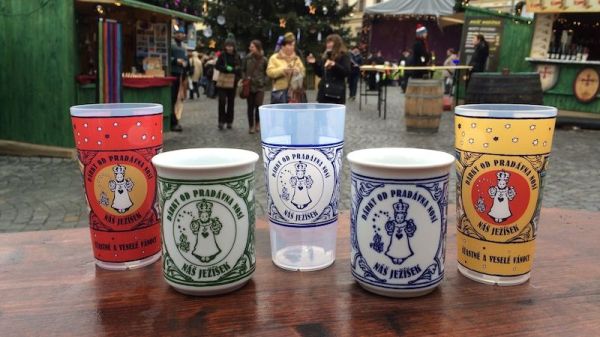
Returning to Borovsky’s sentiments, he believes that to be Czech, Jews cannot be Jewish. But, we live in a different time. Czech nationalism isn’t now what it was then. Nonetheless, there is still a measure of nationalistic pride in the equation of Czechs with Advent and Christmas. The proof is in the citizenship test.
For many non-Christians to participate in this supposedly cultural event requires a willingness to abandon certain beliefs. Could you imagine a Jewish or Buddhist child receiving a present from baby Jesus on Christmas Eve? How does one explain that? Likewise, can you imagine trying to decide on when to light the menorah if Hanukah also falls during the holiday? Before or after baby Jesus’ presents? So far, no one has offered a secular or cultural interpretation that would work on my Jewish sensibilities.
Indeed, I think my Czech teacher’s description of Christmas being open to everyone was more of an attempt at inclusion than exclusion. Thanks for the invitation! Like most people, I’m happy to be considered included, but, if I decline the invitation that is not an excuse to question my loyalty. I like the Czech Republic. In so many ways, it has become my home, but that doesn’t mean I’m willing to give up aspects of my identity in order to fit in better.
It is perhaps a fair question to consider whether I’m being particularly sensitive or overreacting to these discussions since the Czech Vietnamese population seem to struggle less with the invitation to participate. However, in light of the continuing anti-semitism here and throughout Europe, I don’t think so. In terms of my physical safety, I’ve often felt it to be more difficult to come out as Jewish than as a lesbian.
This is not to say that people aren’t entitled to celebrate their religious holidays or find them joyful and exciting. I hope they do. The problem lies in equating Christianity to nationalistic pretences, and, therefore, failing to acknowledge, understand and appreciate diverse religious traditions. More importantly, history has shown what can happened when questioning the nationalistic loyalty of non-Christians. Nationalism has the potential to be very powerful under patriarchy and, historically, has caused considerably more harm than good.
This situation isn’t unique to the Czech Republic. Nonetheless, it needs to change. An innocent invitation to participate in Christmas is not as innocent as it seems. In the right environment, in fact, nationalistic tendencies can become extremely destructive. Look at the insidious white nationalism in Europe and the United States.
While it is true that some Czechs celebrate Christmas, some do not. Those who don’t should not be deemed less Czech. We need to acknowledge that. More importantly, we need to reconsider the nationalistic tendencies of modern “cultural” and religious practices.
Ivy Helman, Ph.D.: A feminist scholar and faculty member at Charles University in Prague, Czech Republic where she teaches a variety of Jewish Studies, Feminist and Ecofeminist courses.
Discover more from Feminism and Religion
Subscribe to get the latest posts sent to your email.

 Feminism and Religion
Interesting post that raises important questions….”An innocent invitation to participate in Christmas is not as innocent as it seems. In the right environment, in fact, nationalistic tendencies can become extremely destructive. Look at the insidious white nationalism in Europe and the United States” It definitely is NOT innocent in the US. You either participate in the christmas frenzy or are ignored or worse shunned. I can’t imagine a Jewish festival or the presence any other religion taking hold around here. Everyone is christian – Of course context is important… I live in a western Maine- here we speak of diversity but don’t act it out… One way to keep going strong is to start having Christmas festivals for months before the big Santa CLAWS day Two things are accomplished – the ‘rightness’ of Christmas is the underlying message as THE RELIGION and consumption and keeps people busy busy busy and buying buying buying ad nauseam – Consumption reigns… I am not a Christian but have these roots…. and what I see happening around me bears little resemblance to Christmas as it was celebrated in my home when I was a child – gathering greens and creating wreaths, making all presents, festooning the house with greens, singing, fires in the fireplace – and sharing a good meal. I was the only one who went to church but it was tolerated in this family of intellectual atheists… I left Christianity behind with my brother’s death -I was 24 – and lived through the loneliness of not belonging anywhere until my love for nature called me. Since all religions have their genesis in Nature it seems so much simpler to focus on the whole… ALL RELIGIONS ARE FOR PEOPLE – and I am no exception – As an ecofeminist I found home in the goddess tradition because it meshed so well with what I experienced in Nature – I think if we understood that the root of all religions comes out of human perspectives we might have more tolerance? I have no issue with any religion unless it’s tied to Nationalism – .
LikeLike