A Tiny Life by Barbara Ardinger

Barbara Ardinger

The news is getting me down. Nearly three hundred Nigerian schoolgirls kidnapped by Boku Haram. The capsized South Korean ferry and more than 300 drowned students. Kids taking guns to school and the governor of Georgia signing a law that says anyone can carry a gun almost anywhere in the state. The ever-continuing feminization of poverty. A couple Saturdays ago, I heard an enormous noise of cawing and shrieking and wings flapping outside my window. It went on for several minutes, so I finally set my book aside (I was trying to ignore Eyewitless News), got up, and looked out into the courtyard. Two huge, noisy crows were chasing a smaller bird. I think it might have been a scrub jay. I have no idea what the jay’s crime had been in the crows’ eyes, but they were chasing it back and forth, up and down, and one of them finally speared it with its beak. The jay fell. The crows landed on the roof of the building across the courtyard and strutted back and forth for several minutes. One of them went down for a closer look at the fallen jay. Then they flew away.

I’ve seen crows attacking other birds before. They’re extremely intelligent birds, but they also get aggressive. Some years ago, I sat at a desk in an office, gazing out the window, and saw a crow destroy a hummingbird’s nest and eat the babies. Sad, yes, but this is how crows around the world find food. My coworkers wanted to storm outside immediately and (I guess) shoot the crow and maybe tear the little tree out of the ground. “No,” I said. “Leave it alone. Tennyson was right when he wrote that nature is bloody.” Continue reading “A Tiny Life by Barbara Ardinger”
A Beltane Story by Barbara Ardinger

Barbara ArdingerOnce upon a time there was a beautiful princess—NO, stop right there. Tales like this do not require princesses. Let’s try again. Once upon a time there was a sturdy young woman who lived in a small town in Mitteleuropa not too far from the castle of the Holy Roman Emperor.

The girl’s name is Madchen. Her parents are a Farmer and a Cunning Woman. She is proud to say that just last fall she actually saw the Emperor, who is a stiff, elderly man who always wears a fussed-up military uniform and a pince nez and has enormous sidewhiskers. The Emperor did not, of course, notice the girl as he sat in his carriage and waved stiffly to his subjects. But what Madchen doesn’t know is that Crown Prince Rufus, whose uniform and sidewhiskers are considerably more modest than his father’s and who was riding on a great red Royal coachstallion in the parade behind his father’s coach, noticed her immediately. That girl, he said to himself, is a girl I must have! Continue reading “A Beltane Story by Barbara Ardinger”

What’s Good About Good Friday? by Barbara Ardinger

Barbara ArdingerI grew up Calvinist and Republican in a suburb of St. Louis, Missouri. My parents belonged to—but rarely attended—Immanuel Evangelical & Reformed Church in Ferguson, Missouri. When children reached the age of twelve, they were “confirmed” in the church, which meant taking a Bible class taught by the minister, Rev. Press, and then going through a ceremony that made them eligible to take communion, which in that church was grape juice and tasteless crackers. Transubstantiation? I learned what the word meant, but I had (and still have) no idea if it really happens.

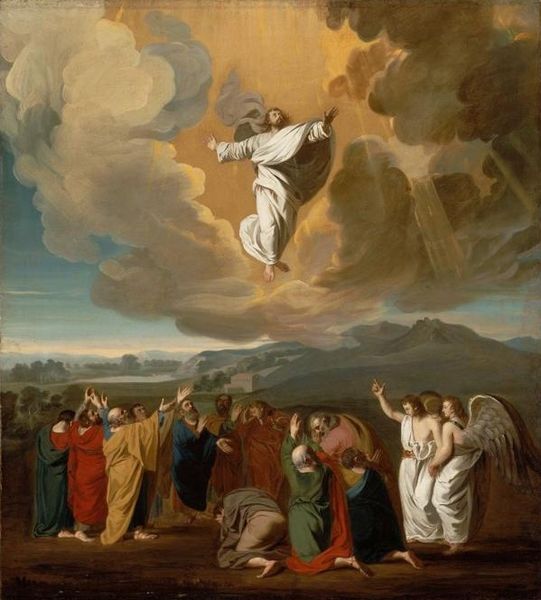
Ascension by John Singleton Copley (1775)

I’ve always been one to ask untidy questions, so of course I asked a lot of questions in confirmation class. God tells us half a dozen times in the Old Testament, for example, that he is a “jealous god.” How, I asked Rev. Press, can a jealous god be a loving god? What’s good about a jealous god? (A couple decades later, when I was studying the Aramaic Bible as translated by George M. Lamsa from the Pshitta manuscripts, I learned that the correct word is “zealous.” That was no help. I still don’t see much good in either jealousy or zealotry.) A week or two later, I asked Rev. Press, “What’s good about Good Friday?” Shortly thereafter, my mother advised me to stop asking questions in confirmation class. (Can we assume she’d received a pastoral phone call?) Continue reading “What’s Good About Good Friday? by Barbara Ardinger”

Persephone by Barbara Ardinger

Here we are, creeping up on the vernal equinox (March 21), which astronomers and weathermen on TV tell us is the start of spring. I see Imbolc (as described by Deanne Quarrie) as the true beginning of spring, however. It’s when we see the first little crocuses popping up through the snow…..oh, yeah…..well, maybe not this year, when more than half the U.S. is buried under mountains of snow. Let’s just agree that in ordinary years crocuses pop up and bloom and trees start showing us their tiny green leaves in February. The equinox is really the turning point of spring, the hinge of time when the rising energy tips over into falling energy that is flowing toward summertime, which will arrive at Beltane (May 1 or 2).

Persephone
Demeter and Persephone

We’re probably all familiar with the story of Persephone, who under her childhood name, Kore, was out picking flowers in the meadow one day when her Uncle Hades roared up out of the earth in his mighty chariot and kidnapped her. This led her mother, Demeter, the grain goddess, to search for her and finally go on strike and let the world turn back into winter. This went on until Aunt Hecate told Demeter where her daughter was. When Persephone, now queen of the underworld, came back up with her mother—voilà! It was springtime. That’s how the vegetation myth goes. Continue reading “Persephone by Barbara Ardinger”

Let’s Build an Altar for Springtime by Barbara Ardinger

Barbara ArdingerWith spring springing up all over and warm days coming back in the colder climates, let’s build an altar to celebrate life. Now don’t worry—I’m not advising you to worship idols and do anything to insult your god. We’re not building a churchly altar, but one based on the concept of love respect for the earth we live on, the powers of Mother Nature, and the indisputable fact that we are all kin. This altar represents no disrespect for any religion, faith, sect, or denomination. Its purpose is to focus our awareness that the galaxy, the universe, the earth, the continent we live on, the town we live in, and spaces where we live and work are all sacred. The purpose of this altar is to remind us every day that every religion is sacred and that even the most humble among us have a place on the planet.

We start by considering the four elements—fire, air, water, and earth—which go back at least as far as classical Greek philosophy. Long ago, people believed that everything partook of these four elements. They looked around and saw the elements in action every day: ovens and lightning, soup and rivers, breezes and birds, gardens and hills. The four elements became the four humours, which came to the principles of medieval medicine that ruled our temperaments. The elements are also prominent in alchemy and astrology. Continue reading “Let’s Build an Altar for Springtime by Barbara Ardinger”

Who Are the Pagans? by Barbara Ardinger

Barbara ArdingerIt has occurred to me that it’s possible that some of the bloggers and readers of this site may not know very much about pagans, so here’s a little New Year’s lesson. The first thing to know is that pagans are almost by definition rebels. That means any generalization anyone may make will almost certainly have a thousand exceptions. You may have heard what Will Rogers wrote in 1932: “I am not a member of any organized political party. I am a Democrat.” Well, the same goes for pagans: many of us joke that we don’t belong to an organized religion. “Pagan,” by the way, is the generic term. Witches, Wiccans, and eclectics (among others, see below) are specific terms. Many of us belong to what are called traditions, which are somewhat analogous to the Protestant denominations. Some traditions are said to go back to the Middle Ages (or further back), but this is generally nonsense. Paganism as it is practiced today is a modern religion looking for (and—voilà! finding!) roots in the ancient and classical pantheons or in Old Europe, where archaeology shows us that the Goddess was worshipped thousands of years before Abraham met his god, ca. 2000 BCE (see Marija Gimbutas’ text for more information on this). Continue reading “Who Are the Pagans? by Barbara Ardinger”

Let’s Celebrate the Holiday Shopping Season by Barbara Ardinger

We’ve recently celebrated Thanksgiving, when I hope that, like me, you gave thanks to the deity of your choice for the wise and thoughty blogs we’ve been reading on this site. Now we’re well into the holiday season, which seems (at least in the malls) to start earlier every year. No matter what you call the December holiday, its origin lies in the winter solstice, which is the tipping point of the year’s dark season. The solar gods—Adonis, Amon-Ra, Apollo, Attis, Baal, Horus, Jesus the Christ, Lugh, Marduk, Mithra, Shamash, Sol Invictus, and the rest—are born or reborn now. These are the gods who live for a season or a year in great honor, after which they’re sacrificed, spend a season underground, and are then reborn. This happens every year at the winter solstice. (Just so you know: if Jesus was a real man, he was probably born in the spring or fall between 7 and 4 B.C.E. In 354 C.E., Bishop Liberius of Rome moved his official birth date to December 25 to match the birth date of the popular Roman god Mithra.)

Also born and reborn at the winter solstice is the light itself, the solar light and the temple light, too. We can think of the reborn light as literal light—a lamp in a temple that burns for eight days when it has fuel for only one—or metaphorical light, that is, learning, wisdom, and generosity. Hanukkah (which usually comes in December but which coincided with Thanksgiving this year) embraces both literal and metaphorical light. Continue reading “Let’s Celebrate the Holiday Shopping Season by Barbara Ardinger”

A Thanksgiving Story by Barbara Ardinger

A Turkey Tail Tale

Once upon a time, oh, maybe five hundred years ago, there lived a little girl and her brother in a small village at the foot of a high, flat hill, on the crown of which stood the palace of the Prince and Princess and the large city that surrounded the palace. The two children were practically orphans. This was because their ethereally beautiful mother had died as the result of the misapprehension of an impetuous unicorn, and their father, who was a printer, had to frequently leave their little cottage and climb the hill. This was because no one in the village knew that printing had recently been invented, so, slinging his incunabula and foul copies across his back, the printer had to leave his sub-urban village and climb the hill to the city and the palace to secure printing work. Fortunately, the Prince employed a highly literate and prolific dwarf who was always composing epic tales that just called out to be printed and preserved in folio editions with highly decorated covers. The printer’s two children were thus neglected and often hungry; they would, in fact, have starved if not for the generous neighbor women who took pity on them and fed and washed them and patched their clothes at least once every seven days.

When the printer came down from the city one day at the beginning of summer, he was accompanied by a large, loud woman and her two young, loud daughters. “Children,” he said, “this is your new stepmother. And your new stepsisters.” The woman and her daughters took one look at the grubby children and the grubbier hovel (not to mention the cluttered printing room next to it) and raised their noses into the air. This printer, said the woman to herself, promised me a nice cottage! I got the distinct impression that he was rich! Or at least well-off and able to provide good dowries for my daughters. And just look at this! I don’t think my daughters and myself will be able to bear such wretched surroundings. But all she said out loud was, “Well, well, well. Two children. How nice.” But her two daughters pointed at the children and laughed at them. “Why are you even here?” they shouted. “You belong in a cave in the woods with the other filthy wild animals!” Continue reading “A Thanksgiving Story by Barbara Ardinger”

Entering Winter, the Season of Darkness by Barbara Ardinger

Halloween used to be spelled “-e’en,” with the apostrophe replacing the V in “eve.” The N was probably added so the word ends in a consonant and we don’t have “hallow-wheee.” But people get lazy, and since the late 20th century, both the V and “eve” have disappeared. This holy day is the true beginning of winter. In pre-Christian Europe, it was celebrated by the wild Celts, who called October 31 Samhain (pronounced approximately SOW-un). Today it’s a major sabbat, or holy day, celebrated by most modern pagans. Although religious fundamentalists keep trying to convince us that Halloween is an evil pagan festival (emphasis on the evilness of pagans) and pressuring retailers not to sell little collectable witches, the name of this day is in fact Christian: it’s Hallowed (or Holy) Evening, or the Eve of Holy Days. In the olden days and still today in, for example, the Jewish calendar, a holy day begins when the moon rises on the evening before. October 31 precedes All Saints Day (November 1) and All Souls Day (November 2). Like Christmas Eve, it’s a holy (but seldom silent) night.

All Saints Day, the Catholic Encyclopedia informs us, was instituted in the fourth century when dioceses began to divide up and exchange the relics of martyr-saints. At first, only martyrs and St. John the Baptist were recognized, but in 609 Pope Boniface IV consecrated the Pantheon in Rome to the Blessed Virgin and all martyr-saints. The theological basis for All Souls Day is the doctrine that “souls that have not been perfectly cleansed from venial sin are debarred from the Beatific Vision.” With prayers, the living can help the dead pass through purgatory. To commemorate “the faithful departed,” the Catholic Encyclopedia further tells us, the priest recites the Office of the Dead and celebrates a Requiem Mass. The vigil for All Saints, or Hallows Eve, was also first celebrated in the fourth century. The Mexican version of this holiday is Día de los Muertos, which is also celebrated on November 1 and 2. That’s when we see the wonderful costumed skeleton figures and the sugar skulls. Like similar festivals in cultures around the globe, this is a celebration of family and ancestors.

Continue reading “Entering Winter, the Season of Darkness by Barbara Ardinger”

An Equinoctial Ritual for Balance by Barbara Ardinger

Day and night are in balance twice a year, at the spring and fall equinoxes. (The word “equinox,” of course, comes from Latin words meaning “equal” and “night.) I think most of us will agree that balance is a good thing—after all, many of us are writing these blogs at Feminism and Religion to bring some balance to the ideas and institutions of religion. Many spiritual teachers in many faiths tell us that it’s good to bring ourselves into balance—our physical, emotional, mental, and spiritual bodies are healthier and we’re happier when they’re in balance. This is one reason we try to live healthy lives. Note that the fall equinox is also the day the sun moves into the astrological sign Libra, the symbol of which is the scale with its balance pans.

Working on achieving personal balance is a way we can act locally as we think globally. If we can get ourselves into balance, then maybe our personal balance will ripple out into our family, our extended family, our community, our church, our workplace…heck, maybe eventually into local, state, and federal governments. In this age of civil wars, terrorists, drones, and what seems like universal spying, balance is something devoutly to be wished for. And worked for. To celebrate the equinox (September 22), therefore, let’s do a modest ritual of balance. Continue reading “An Equinoctial Ritual for Balance by Barbara Ardinger”