
BARBARA LEE SPEAKS FOR ME by Carol P. Christ

carol christWhile I was in Crete on the Goddess Pilgrimage teaching about and experiencing a Society of Peace where violence and domination were neither celebrated nor encouraged, another war broke out in Iraq, breaking my heart, breaking all of our hearts—yet again. When will we ever learn, oh when will we ever learn?
Barbara Lee was the only member of Congress to vote against the US war powers authorized after 9/11 which were used to launch war in Afghanistan; she also voted against authorization for the Iraq war in 2002. Hillary Clinton voted for the Iraq war, despite clear indications that the US administration was lying about weapons of mass destruction—which were never found in Iraq. I voted for Barack Obama because he opposed this war. Then he listened to General Petraeus and expanded the war in Iraq. Barbara Lee speaks for me. Hillary Clinton and Barack Obama do not.

The Iraqi people are once again living in fear of their lives as reports surface that armies and militias are engaging in mass executions of their so-called “rivals.” Is there any cause that could justify this? Continue reading “BARBARA LEE SPEAKS FOR ME by Carol P. Christ”

TWO MEANINGS OF ANTHROPOMORPHISM by Carol P. Christ

carol christ“The error of anthropomorphism” is defined as the fallacy of attributing human or human-like qualities to divinity. Recent conversations with friends have provoked me to ask in what sense anthropomorphism is an error.

The Greek philosophers may have been the first to name anthropomorphism as a philosophical error in thinking about God. Embarrassed by stories of the exploits of Zeus and other Gods and Goddesses, they drew a distinction between myth, which they considered to be fanciful and false, and the true understanding of divinity provided by rational contemplation or philosophical thought. For Plato “God” was the self-sufficient transcendent One who had no body and was not constituted by relationship to anything. For Aristotle, God was the unmoved mover.

Jewish and Christian theologians adopted the distinction between mythical and philosophical thinking in order to explain or explain away the contradictions they perceived between the portrayal of God in the Bible and their own philosophical understandings of divine power. While some philosophers would have preferred to abolish myth, Jewish and Christian thinkers could not do away with the Bible nor did they wish to prohibit its use in liturgy. Continue reading “TWO MEANINGS OF ANTHROPOMORPHISM by Carol P. Christ”

WHY I AM RUNNING WITH THE GREEN PARTY IN ANOTHER ELECTION IN GREECE by Carol P. Christ

carol christOn Sunday May 18 the first round of Municipal and Regional Elections were held in Greece, and I ran for office again. A month or so before the 2010 Regional Elections were held in under a newly reorganized electoral system, my friend Michael Bakas sent me an email saying simply: “You are running with the Green Wind in the upcoming elections.”  Michael asked me to run because we had worked together to save the wetlands in Lesbos and he had supported me as I wrote an official Complaint to the European Commission documenting the failures of national and local authorities to uphold European laws.

I did not know what I was supposed to do as a candidate on a Greek parliamentary-system list, but in the end I passed out flyers in my village and the adjoining one. My name was mentioned in a newspaper article because I was foreign-born. To everyone’s surprise, I came in 3rd of 18 candidates for the Green Wind in Lesbos, and we elected our first councilor in the regional government. After the election Michael told me that we were going together to Chios to meet with candidates to celebrate our victory. There I met an amazing group of green activists and despite being a “foreigner” was warmly received.

In 2012, I ran again in the national elections, that time passing out flyers in more than 20 villages and towns.  As I have been pretty busy campaigning, I thought I would share translations of 2 statements from me that were posted in Greek on the blog and facebook page of the Green Wind. Continue reading “WHY I AM RUNNING WITH THE GREEN PARTY IN ANOTHER ELECTION IN GREECE by Carol P. Christ”

COMPLICATIONS AND CONFUSIONS IN DISCUSSIONS OF THE GODDESS by Carol P. Christ

carol christAlthough writing in patriarchal Greece from a patriarchal perspective, Hesiod said in his Theogony or Birth of the Gods that Gaia or Earth alone was the mother of the Mountains, Sky, and Sea. With the male Sky she gave birth to the next generation of deities known as the “Titans,” who were overthrown by Zeus. Hesiod’s was a “tale with a point of view” in which “it was necessary” for the “forces of civilization”–for him represented by warrior God and rapist Zeus–to violently overthrow and replace earlier conceptions of the origin life on earth and presumably also to overthrow and replace the people and societies that created them.

With the triumph of Christianity in the age of Constantine in the 4th century AD, Christus Victor replaced Zeus in the cities, while the religion of Mother Earth continued to be practiced in the countryside. Over time, many of the attributes of Mother Earth were assimilated into the image of Mary, and priests began to perform rituals earlier dedicated to Mother Earth, such as blessing the fields and the seeds before planting. In the Middle Ages “the Goddess” re-emerged within Western Christianity in devotion to the Virgin Mary, the female saints, and figures such as Lady Wisdom, at the same time that the history of the Goddess was being erased.

In the middle of the 19th century, in Das Mutterrecht (The Mother Right), J. J. Bachofen stunned the scholarly world with his theory that matrilineal kinship, matrilineal inheritance, and reverence for the Great Mother were to be found at the origins of civilization. Bachofen challenged the view that patriarchy and the worship of male Gods had existed “from the beginning .” Continue reading “COMPLICATIONS AND CONFUSIONS IN DISCUSSIONS OF THE GODDESS by Carol P. Christ”

RAPE IS A NATIONAL CRISIS by Carol P. Christ

carol christWhen I was in high school I heard a story about a girl who got drunk at a party after a football game and had sex with more than one of the football players. The story was told at the expense of the girl, who was categorized as “easy” and “cheap.” The idea that gang rape might have occurred was not something that either the teller or I might have been capable of considering, for these words and the reality to which they point were not part of our vocabulary.

However, the fact that I remember this story decades later suggests that even then something did not “sit right” with me about the way it was told. The image of the girl, who was cute and had curly long light brown hair still fleets through my memory.

Yesterday I read that the following universities are under investigation for possible violation of Title IX Civil Rights protections for failure to investigate charges of rape on college campuses. Continue reading “RAPE IS A NATIONAL CRISIS by Carol P. Christ”

AM I SUFFERING? by Carol P. Christ

carol christIn response to a recent blog on Buddhism and feminism by  Oxana Poberejnaia, I stated that while I would agree that “clinging” to an identity is a cause of suffering, I am not in favor of “giving up” identity altogether.

Oxana replied that “if you are not suffering,” then you do not need Buddhism. I responded that for the most part I am not suffering because years ago I gave up “having to have” certain things in my life. I added that I often wondered if that made me “kind of a Buddhist.”

One of the things that I gave up was the notion that I “had to have” a lover and life partner. The other was the notion that I “had to have” the job teaching graduate students in women and religion–for which I was eminently qualified.

Not having these “things” that I thought I deserved (and why not?) caused my younger self a great deal of suffering.  In fact, it often seemed to me that a life without a partner and lover simply was not worth living. My suffering was so great that I considered suicide—more than once.

As a result of my first Goddess Pilgrimage to Crete (a story I told in Odyssey with the Goddess), I finally realized that I really could not control all of the conditions of my life–not through hard work, not through desire, not through mental focus, not through magic. This realization led to a major transformation in my life.

Instead of focusing on what I did not have, I began to focus on what I did have.  I realized that though I did not have a life partner, I had many good friends who loved me a great deal. And though I did not have the job I thought I deserved, I had the great good luck to have written books that changed the lives of thousands of women.

I recognized that I had given up exactly the kind of “clinging” to ideas about life that Buddhists say create suffering.

At the same time, I was not drawn to the Buddhist path.  I could never accept the fact that Buddha considered his wife and child an impediment to his spiritual path. Nor was I ever drawn to give up my “ego” or “identity” altogether. Later, I would write in She Who Changes that all paths of spiritual “rebirth” seemed to me to be based upon “matricide” which I defined as the idea that birth through the body of a mother into a life that includes death “just isn’t good enough.”

I consider this life to be a gift.  For me a life that includes death is the only life we have.  Although I too suffer the loss of those I love, I accept this as part of life. I do not expect that “I” should live forever, and in fact I consider the idea that “I” should be immortal or reborn, to be the height of folly.  I do not seek to escape what Buddhists call the “cycle of birth and death” but rather to affirm the cycles of “birth, death, and regeneration.” For me it is enough to know that life will continue: I do not need to imagine that “I” will live forever.

My comment to Oxana that “I am not suffering” was belied in the days after I wrote it.  I have been suffering this week as a result of the thought (and most likely fact) that I have been “cheated” by the man who sold me a new computer and promised to reinstall all of my programs and documents so that the new computer would work exactly like the old one.

This afternoon I was told by the technician who failed to turn up for several appointments that I should not contact the man who sold me the computer again, because he has my money and does not intend to fulfill his part of the contract.  The technician said he would finish the work “for me” even though he would not be paid by the store owner.

I was so angry, my stomach tensed and I feared that I would fall victim to the stress for which I have been under doctor’s care in recent weeks.  I was about to call the man who sold me the computer to read him the riot act,  but instead called a friend to ask what I should do. She said she had also heard stories about the man who sold me the computer. We agreed that we live in the countryside with people who don’t have any idea of how to run a business.

After I hung up the phone, Oxana’s words “if you are not suffering” came into my head.

I realized that I was suffering because of the idea that because I am a person who should not be cheated or lied to.  As soon as that thought came into my mind, I let go of it. I accepted that the young man who sold me the computer – whether out of ignorance or out of cunning – had cheated and lied to me. I still think I am a person who should not be cheated or lied to, but I gave up the idea that therefore, being cheated or lied to would not happen to me. I decided to pay a technician to finish the work, even though this was not the agreement I had made.

My suffering ended.

Carol P. Christ is looking forward to the spring Goddess Pilgrimage to Crete which she leads through Ariadne Institutespace is still available on the spring tour. Carol can be heard in a recent interview on Voices of Women.  Carol is a founding mother in feminism and religion and women’s spirituality. Her books include She Who Changes and Rebirth of the Goddess and the widely-used anthologies Womanspirit Rising and Weaving the Visions


THE DIVINE DRAMA AND THE UNIVERSALITY OF DEATH by Carol P. Christ

carol christIn Greece the liturgies of lent and especially of the week before Easter are known as the “divine drama,” in Greek theodrama.  This may refer to the “drama” of the capture, crucifixion, and resurrection of Jesus and to the suffering of God the Father and Mary.

However, it is important to recall that the drama in ancient Greece referred to both the tragedies and comedies, most specifically, those that were performed in the theater of Dionysios in Athens.  While we have been taught that the Greek tragedies celebrated “downfall of the hero” due to his “tragic flaw,” it is important to remember that Dionysios was the original protagonist of the Greek tragedy: it was his death and rebirth that was first celebrated.

Some have argued that the Greek tragedies should never be “read” alone, for they were always “performed” in tandem with the comedies, which were followed by the bawdy phallic humor of the satyr plays.  The tragedies end in death and irreparable loss.  But if the comedies and satyr plays are considered an integral part of the cycle, death is followed by the resurgence of life. Continue reading “THE DIVINE DRAMA AND THE UNIVERSALITY OF DEATH by Carol P. Christ”

Curiosity About Everything and the Language of the Goddess by Carol P. Christ

carol christMy recent discovery of Marija Gimbutas on Youtube rekindled my admiration for her work. In her slide-lecture “The World of the Goddess” Marija Gimbutas allows us to follow the line of reasoning she used to decipher the “language of the Goddess” in Old Europe.

Careful attention to her lecture shows that Gimbutas did not close her eyes, dream, and then attach her own ideas and intuitions to the artifacts she later discussed. Rather, she catalogued groups of images with similar symbolism and used her knowledge of nature (what does a water bird or an owl look like?) and folklore (she collected thousands of songs connected to the agricultural and life cycles in her native Lithuania in the 1930s) to unlock the meaning of ancient symbols.

I suspect that most of the critics of Gimbutas lack the knowledge she gained through her wide curiosity about life. Do other archeologists as a group know what specific species of water birds or owls really look like? Do they have the same kind of knowledge of folklore and folk traditions that Gimbutas had?   Continue reading “Curiosity About Everything and the Language of the Goddess by Carol P. Christ”

IS EVIL PART OF THE NATURE OF REALITY AND DIVINITY? by Carol P. Christ

 carol-christWhat is the origin of evil? Is it innate in human nature or even in the nature of the universe? Judith Plaskow and I discuss this question in our forthcoming book Goddess and God in the World and this is a chance to listen in our conversation.

I am responding to Judith’s allegation that in imagining Goddess as loving and good I am fantasizing an ideal deity who exists apart from the evil-and-good world that we know. Judith speaks of an “evil impulse” in human beings which she considers to be innate in human beings and in the nature of reality. Judith says that my “defense” of the goodness of God comes down to “the traditional free will defense.” She also questions my view that human beings can 

I argue that it does not because the traditional free will defense imagines an omnipotent God who existed before the creation of the world. Then I continue:

I think what you meant to say is that like those who invoke the traditional free will defense of the omnipotent God, I attribute humanly chosen evil entirely to human beings—and not to Goddess or God. Continue reading “IS EVIL PART OF THE NATURE OF REALITY AND DIVINITY? by Carol P. Christ”

TWO TORTOISES IN THE WEB OF LIFE by Carol P. Christ

carol-christThe Gods made only one creature like them—man.  Greek TV documentary

The sight of a reptile or an amphibian usually provokes, at the very least, a feeling of repulsion in most people. Natural History of Lesbos

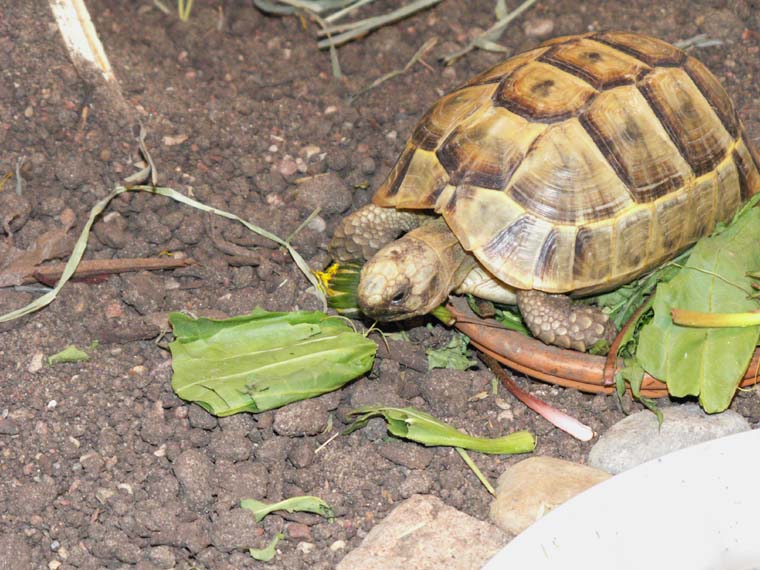
In the past days and weeks the two tortoises with whom I share my garden have woken up from a long winter’s sleep.  Henry, testudo marginata, has been up for a while now.  More than a month ago when I was cutting back and weeding in the area of the garden where he had been sleeping, Henry roused himself to sit in the sun near me for a few hours each day before creeping back under a shrub.  At first I thought I had disturbed him, but when he came back out day after day while I worked, I began to wonder if he was coming out to say hello.

KONICA MINOLTA DIGITAL CAMERAScotty, testudo graeca, was nowhere to be found.  As I moved my work around the garden, I did not find him in the corner where he had slept the previous winter.  This worried me slightly, but I figured he must be under the rue in the one area of the garden still to be trimmed back.  Imagine my surprise when I almost tripped on him on my way down the stairs to the cellar.  Clever boy, he must have found the garden entrance to the cellar open one day in early winter and slipped in.  The fact that I found him at the foot of the stairs and not in a dark corner was evidence that he too had heard the call of spring.

What we love we protect and what we know we love.  Natural History of Lesbos Continue reading “TWO TORTOISES IN THE WEB OF LIFE by Carol P. Christ”
