Holding Our Brokenness by Elizabeth Cunningham

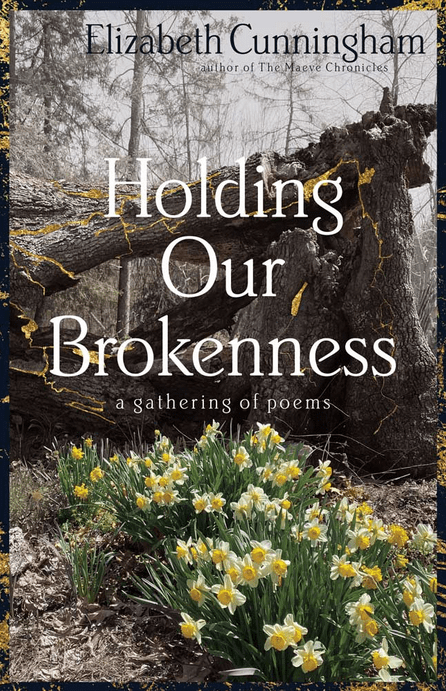
Dear FAR readers, here is a selection from my new collection Holding Our Brokenness, a gathering of poems. I chose these particular poems for their connection to feminism and/or religion. I hope you will enjoy them.

The Old One Speaks 

You must be unmade here
inside my grey cloak
inside my cold womb
here where the ice forms
and breaks
at the river’s edge.

What Kali Tells Me  

It’s all in the rhythm.
Falseness throws you off beat.
Rhythm renews your strength
with every step. That’s how time
becomes timelessness.

Continue reading “Holding Our Brokenness by Elizabeth Cunningham”

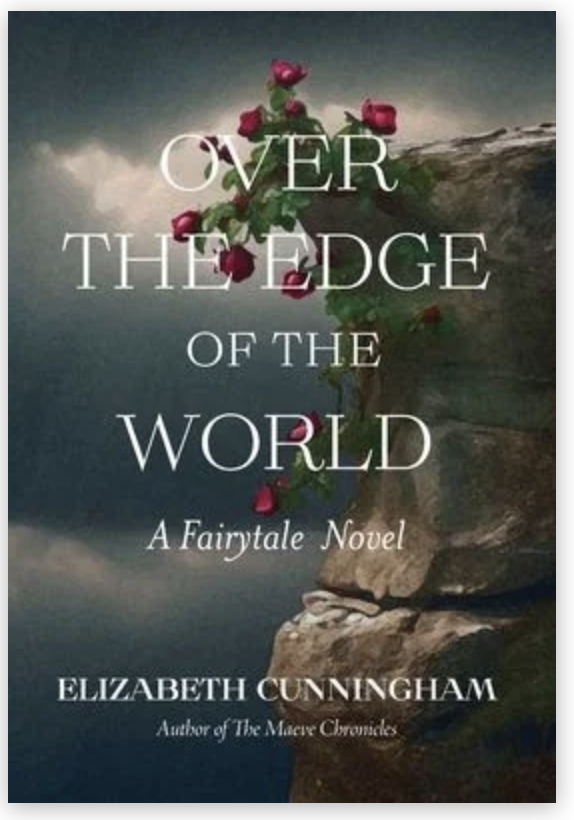
Elemental Grannies: Snippets from Over the Edge of the World, A Fairytale Novel by Elizabeth Cunningham

Introduction: An old woman, Rose begins spinning the tale the children never tire of hearing. Grannies Sweep, Spark, Dirt, and Brine, were old, so old, they forgot who they were and how they came to live where they did: a sheer pinnacle, a walking forest, an old shoe, a ship moored off a hidden shore.

But Rose has never told the whole story—to anyone. The story of a world these children have never seen, where the rich lived inside a vast dome, protected from heat and cold, rain, wind—and hunger. Nor do the children know about madness or cruelty. She has never told them about Noone, the power behind the dome, his obsession with immortality.

If she never tells these stories, who will remember the bravery of the beauty singers who daily risked the ultimate penalty—being thrown over the edge of world. Who will remember the intrepid children who danced defiantly on the dung heaps. If Rose does not tell her own story, who could imagine her birth deep inside the dome, the dangerous secret of her existence. A secret guarded her two huge aunties, once ragged outside boys, who became outrageous bodyguards in towering wigs and heels. To protect the new world and the people she loves, it is time for Rose to tell…

Continue reading “Elemental Grannies: Snippets from Over the Edge of the World, A Fairytale Novel by Elizabeth Cunningham”

From the Archives: Forgive Me My Ancestor(s) by Elizabeth Cunningham

This was originally posted on January 19. 2020. An ‘Update Note’ has been added at the end of the post.

Elizabeth Cunningham

When I was a child in the 1950s we often played cowboys and Indians. There is a photograph of my brother and me in no doubt inauthentic costume complete with feathered headdress. In kindergarten I named myself Morning Star. (I just googled and see that I must have gotten the name from the 50s television series Brave Eagle, the first with an indigenous main character. Morning Star is the female lead.)

When I was a teenager, my aunt came across a privately printed book The Gentleman on the Plains about second sons of English aristocracy hunting buffalo in western Iowa. My great grandfather accompanied them as their clergyman. I wish I could find that book now to see how this enterprise was presented. In my adolescent mind these “gentlemen” looked like the local foxhunters in full regalia. On opening morning of foxhunt season an Episcopal clergyman (like my father) was on hand in ecclesiastical dress to bless the hunt and then invited to a boozy breakfast.

Continue reading “From the Archives: Forgive Me My Ancestor(s) by Elizabeth Cunningham”

From the Archives: In Memory of Margot Adler (1946-2014) Priestess, Journalist, Skeptic, Mystic by Elizabeth Cunningham

This was originally posted on October 22, 2014

“Ritual has the power to end our alienation from the earth and from each other. It allows us to enter a world where we are at home with the trees and the stars and other beings, and even with the carefully hidden and protected parts of ourselves that we sometime contact in dreams or in art.” –Margot Adler

Margot Adler died of cancer on July 28, 2014. A Pagan priestess, she asked for memorial events to be held in the season of Samhain, also known as Halloween.  At this time of year, the rituals of many religious traditions remind us that we are all connected, the living, the dead, and those to come, one continuous communion.  In this spirit, I offer a tribute to the late Margot Adler.

Continue reading “From the Archives: In Memory of Margot Adler (1946-2014) Priestess, Journalist, Skeptic, Mystic by Elizabeth Cunningham”

The Mothers, the Goddess, Lost and Found, part 2 by Elizabeth Cunningham

Excerpts in two parts adapted from My Life as a Prayer: A Multifaith Memoir. Part 1 appeared yesterday. You can read it here.

The Goddess finds me

Between the birth of my son and the birth of my daughter, I had a second miscarriage. The signs that something was wrong were subtle at first. I drove myself to a doctor’s appointment, hoping to be reassured that everything was all right (though I already sensed it wasn’t). En route to the office, perhaps to distract myself, I pondered why it was that I had never written about the church, or Christianity. Then…

I turn onto the main street. I glance at an old clock tower, and there she is superimposed against it, huge, big as the sky, vast as the earth.

I hear her voice.

You have been searching for me all your life.

She speaks inside me, all around me.

The wild mother, the witch in the wood.” [She shows me the stories I’ve written.] “You have been searching for me all your life.

Continue reading “The Mothers, the Goddess, Lost and Found, part 2 by Elizabeth Cunningham”

The Mothers, the Goddess, Lost and Found, part 1 by Elizabeth Cunningham

Excerpts in two parts adapted from My Life as a Prayer: A Multifaith Memoir
(Note: Both excerpts have been edited for brevity)

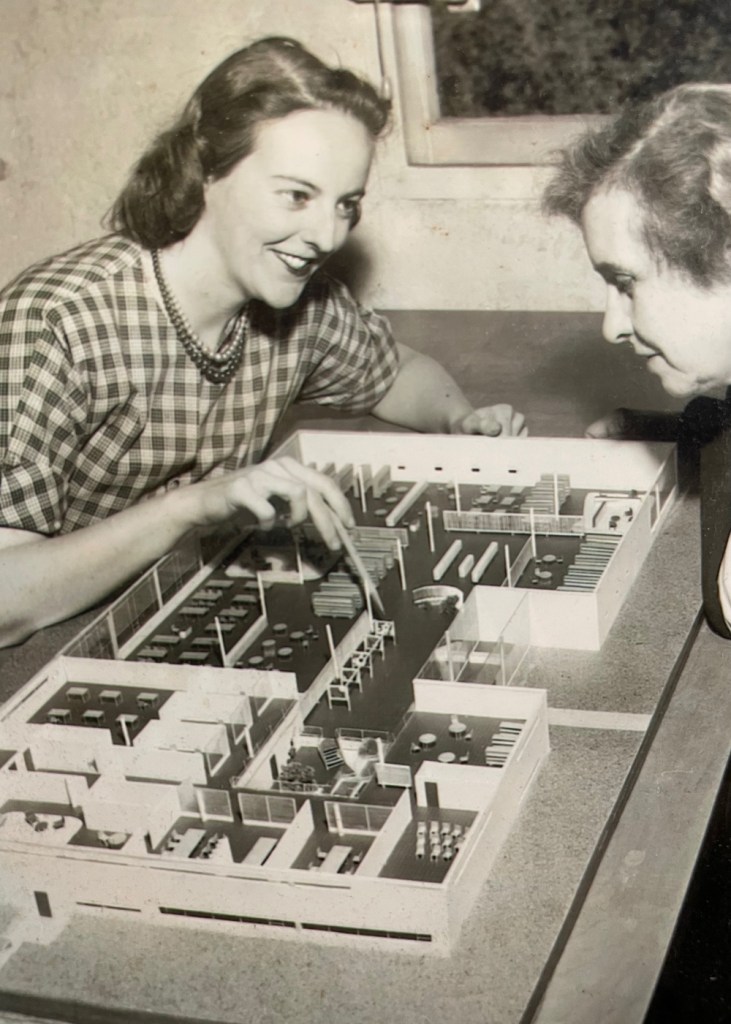
The author’s mother as an architectural student.

The Mothers

When I was fourteen years old, I had a dream. I was pregnant and riding a donkey through a landscape, all golds and browns, hills crowned with ancient trees. I arrived at a monastery where monks with brown hands helped deliver my baby. From that time on, I longed to have a child.

My first pregnancy ended in miscarriage. I was devastated. Not only had I lost my longed-for baby, I had always taken my body for granted. Despite illnesses and injuries, I had assumed my will and my body’s health and strength were one. Now I knew in my own flesh that I was not in control; doing all the right things (thinking all the right thoughts) could not save me from sorrow. I sat in my own small version of Job’s ash heap.

Continue reading “The Mothers, the Goddess, Lost and Found, part 1 by Elizabeth Cunningham”

How Mary Magdalen Came into My Life: an excerpt, edited for brevity, from My Life as a Prayer: A Multifaith Memoir by Elizabeth Cunningham

(Author’s note: Mary Magdalen, or Magdalene, comes to people in many ways. To me, she came as an unconventional, fictional character. I worked hard to get the first century setting of her story as accurate as possible. Otherwise, I make no claim to historicity. I respect all the ways in which others know her.)

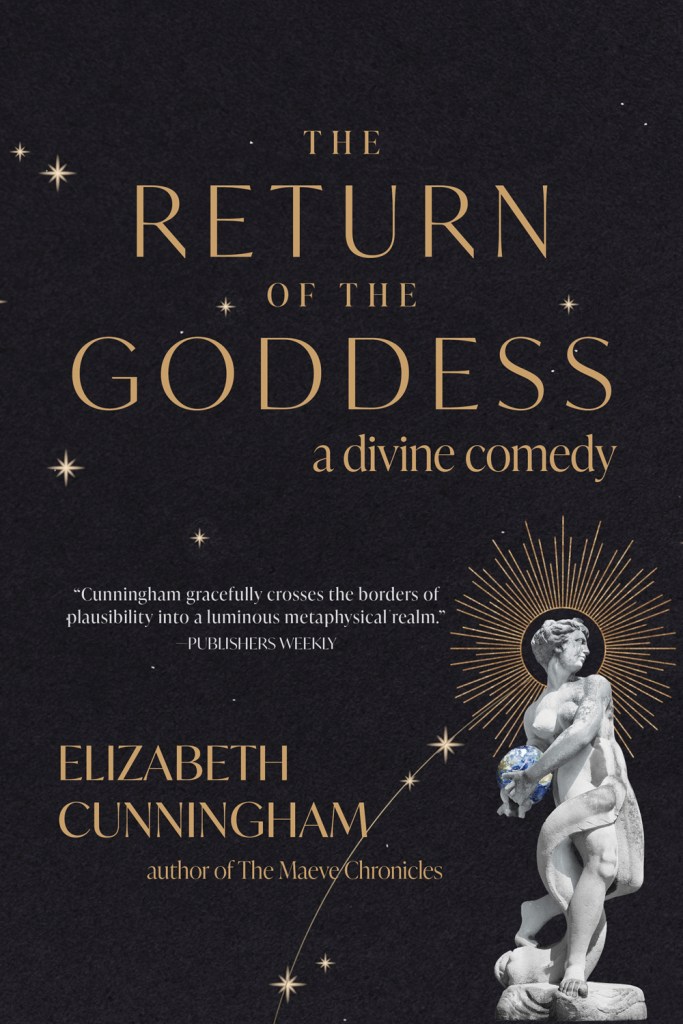
When I finished writing my novel Return of the Goddess in 1990, I thought I had nothing more to say. Yet, I sensed there was something—someone—missing.

An artist friend suggested I take up drawing or painting for a time—visual art being a form in which I had no experience, skill, and best of all, no ambition. I dabbled in paint and charcoal but soon reverted to magic markers, my childhood medium. 

One day a line drawing in brown marker took shape. An ample woman sat naked at a kitchen table having a cup of coffee. The round clock on the wall read a little after three in the afternoon. (The same time of day I was born.) She told me her name was Madge.

Continue reading “How Mary Magdalen Came into My Life: an excerpt, edited for brevity, from My Life as a Prayer: A Multifaith Memoir by Elizabeth Cunningham”

From the Archives: And No Religion Too by Elizabeth Cunningham

This was originally posted on January 17, 2016

Religion. As a species we can’t seem to live with it or without it. There is dispute about the derivation of the word, but some scholars believe it has the same root as the word ligament, ligare, to bind or tie, to reinforce the bonds between human and divine, or perhaps the bonds between believers. The words bond and bind also have a variety of meanings and connotations. A bond can be used to tie someone up; it can be a bond of kinship, or bond given as surety.

Religion’s impulses and manifestations are just as ambiguous. Did religion arise because the world seemed so beyond human control (weather, health of crops, availability of game)? Perhaps there were gods or spirits to appeal to or propitiate? Or did it arise equally from a sense of gratitude for the earth and seas that feed us, for a sky that dazzles us, for the life that flows through us and surrounds us. Song, dance, storytelling, drama, art likely began as religious or ritual expression. No aspect of life was beyond the sacred. And so religion also went into the business of law, social control. Religion has a long, bloody, ongoing history of occasioning and/or justifying war, oppression, persecution, torture, genocide.

Continue reading “From the Archives: And No Religion Too by Elizabeth Cunningham”

From the Archives: Longing for Hermitage by Elizabeth Cunningham

This blog was originally posted on October 20, 2013. You can read the comments here.

At least since the days of the Desert Mothers in the 4th and 5th centuries CE, there have been women in the Christian tradition (and doubtless other traditions) who have lived lives in religious solitude, whether by choice or circumstance.  In Medieval Europe many churches had anchorholds, small enclosures inhabited by men or women dedicated to a life of solitude and prayer. The word anchorhold implies that the presence of the anchoress or anchorite grounded the church community, but the word derives from the ancient Greek verb (pronounced anachōreō) for to retire or withdraw.  Anchoress Julian of Norwich is still revered as the author Revelations of Divine Love, possibly the earliest surviving book written by a woman in the English language.  Six centuries after her death, her vision of Jesus our Mother continues to challenge, comfort, and inspire.

Continue reading “From the Archives: Longing for Hermitage by Elizabeth Cunningham”

From the Archives: Child of the Earth by Elizabeth Cunningham

Moderator’s note: This marvelous FAR site has been running for 10 years and has had more than 3,600 posts in that time. There are so many treasures that have been posted in this decade that they tend to get lost in the archives. We have created this column so that we can all revisit some of these gems. Today’s blogpost was originally posted October 18, 2020. You can visit the original post here to see the comments.

I have a vivid childhood memory of being sick with the stomach flu and standing in the doorway of my parents’ bedroom looking for my mother. Her care for sick children was tender and thorough. She would bring us ginger ale and toast with jelly. When she had time, she read us stories. I can remember her steering me, heavy with fever, back to a bed that she had magically smoothed and cooled. But that day my mother lay in her own bed in an old nightgown, not stirring. She had the flu, too, and could not get up to care for the rest of us. It was a shocking and sobering moment.

As I grew older, I transferred my need for comfort, reliability, and continuity from my mother to the earth, the sure turning of the seasons, beloved trees, waters, and rocks.  As a young mother, I looked forward to sharing my own childhood joys with my children, among them jumping into autumn leaf piles. The first time my children leaped into a leaf pile, they came up covered with the ticks that have now made my region the epicenter of Lyme and other tick-borne diseases. Nor was I able to share with my children the joy of drinking water straight from a stream.

Continue reading “From the Archives: Child of the Earth by Elizabeth Cunningham”