“The Invisible War” Goes On by Marie Fortune

Marie FortuneThe invisible war of sexual assault of female and male military personnel by their fellow soldiers, sailors, airmen and marines continues even as the U.S. Senate holds hearings and presses for substantive changes in the way cases of sexual assault are handled. The Academy Award nominated documentary tells the story of survivors of rape and of an institution long on rhetoric and short on change.

In 2012, there were 26,000 reported rapes in the military which is a 35% increase over the previous year. Since 1991, it is estimated that 500,000 women have been raped in the U.S. military. Half a million. At least 20% of women who serve have been assaulted while serving.  This gives new meaning to “friendly fire.” One commentator compares it to incest: a military unit has a family dimension. You should be able to trust the members of your unit to have your back and your commander to protect you as needed. Continue reading ““The Invisible War” Goes On by Marie Fortune”
I Love Love Tel Aviv By Laurie-Ann Cota

Laurie-annAs a self-identified Jewish musician, pop culture nerd/aficionado, getting in touch with my cultural heritage in creative ways is extremely important to me.  This past year I traveled to Israel for the first time and it was life changing.

I traveled with close friends from my undergraduate days at UCLA.  We had bonded and formed a friendship through the blood, sweat, and tears shed in a Hebrew class.

As a Jew in the United States I realized that I was conforming to social standards without even knowing it.  Coming home to Israel, this became very clear.  For instance, many of my friends have very curly hair – we call it the “Jewfro” – and they remedy this problem with the ever so popular Brazilian Blowout, which definitely makes one look less “ethnic.”  I have BIG hair, which I maintain by getting it razored or thinned out; if I don’t, I end up looking like Einstein.  In Tel Aviv there were big heads of curly hair that were flowing with pride.  My friends and I commented that we didn’t even realize how much of our Jewish identity we hid with simple hair products.  Something as innocuous as our hairstyles made me step back from the manner in which we alter ourselves to fit into society here in the United States. Continue reading “I Love Love Tel Aviv By Laurie-Ann Cota”

Emergence and the Spirituality of the Sacred Feminine by Anne Kathleen McLaughlin

goddesses
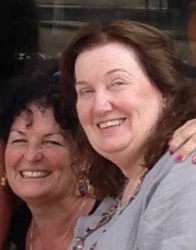
Kathleen and Marie (R-L)

Kathleen and Marie are friends who met at the event in Canada that inspired this post. Marie has given her monthly spot on Feminism and Religion to Kathleen so she can share her reflection with you. 

Emergence: the universe flares forth out of darkness, creating, over billions of years, through trial and error and trying again, astounding newness: carbon for life in the middle of a star…. the birth of planets, our earth holding what is required for life to emerge…. the creation of water from hydrogen and oxygen….the emergence of a cell with a nucleus.

Each of these seemingly impossible happenings did happen, offering us humans the hope that the impossible tasks confronting us in our time can be creatively addressed, showing us, as Brian Swimme expressed it, a domain of the possible beyond imagination. Our human endeavour has been powered by non-renewable energy resources. Our task now is to reinvent the major forms of human presence on the planet in agriculture, architecture, education, economics…. We need to align ourselves with the powers of the universe, consciously assisting, amplifying, accelerating the process of creative endeavour. Continue reading “Emergence and the Spirituality of the Sacred Feminine by Anne Kathleen McLaughlin”

Serving Spirit by Wendy Griffin

Wendy Griffin, Cherry Hill Seminary To me, it isn’t the belief that is meaningful, it is the feeling I get in those magical moments when I am connected to spirit.

When I was young, my mother owned a girls’ camp on the shores of a string of small lakes in Northern Wisconsin. From the age of 2 until I was 16, I spent every summer surrounded by silver birch trees and strong women. We lived in Army surplus tents and learned to ride horses and paddle canoes, build campfires and treasure the female spirit. Sunday evenings we would walk two by two singing through the forest down to the lake, where we would sit on pine logs on a little point of land between two shores and listen to the waves lap against sand as my mother read to us from Gilbran and her favorite poets. Those were our “Sunday vespers services.”

So I was raised on a Goddess path, although neither my mother nor I knew it then.

I had no interest in religion, which to me was Big Daddy in the Sky. It never occurred to me that what I felt in the forest had anything to do with religion, and I thought being spiritual meant that one prayed a lot and didn’t have any fun. When I left home at 18 and moved to Greenwich Village, I left the feelings I had those summers, what I know now was the spiritual part of me, behind. The world seemed full of wonderful adventures, and I wanted to have my share. Continue reading “Serving Spirit by Wendy Griffin”

Cells in The Body Of Earth: Living with Violence, Part 2 by Candice Valenzuela

Candice Rose Valenzuela teaches English Literature at Castlemont High School in East Oakland, California, and she has been teaching and organizing inner-city youth for the past eight years. She is currently pursuing a Masters in East-West Psychology at the California Institute for Integral Studies, and desires to bring indigenous healing methodologies into teaching and learning in the inner-city.

In a previous blog, I wrote about the feelings that have engulfed me and the students I teach at Castlemont High School in East  Oakland, California, following the shooting death of “one of my own,” Olajumon Clayborn.

An indigenous elder told me that I needed to go to the ocean in order to heal. I needed to go to nature, the source, to find the sustenance that will strengthen me in these times.  I went to the ocean yesterday evening after school, though my body was exhausted after running up and down Macarthur Avenue trying to dissuade students from fighting with each other in their anger and grief.

As the waves crashed up and down, back and forth on the shore, and came up steadily to meet me, I suddenly found myself knee deep in water, but I was not cold. And I could see clearly from that place. What I saw was this: Continue reading “Cells in The Body Of Earth: Living with Violence, Part 2 by Candice Valenzuela”

Cells in The Body Of Earth: Living with Violence, Part 1 by Candice Valenzuela

Candice Rose Valenzuela teaches English Literature at Castlemont High School in East Oakland, California, and she has been teaching and organizing inner-city youth for the past eight years. She is currently pursuing a Masters in East-West Psychology at the California Institute for Integral Studies, and desires to bring indigenous healing methodologies into teaching and learning in the inner-city.This week has been especially hard. At the high school where I teach, the youth and staff are facing a level of heightened violence, the likes of which, I have not myself personally seen before. Two weeks ago, a young woman was shot in front of the youth center next door, and two days later there was a drive-by in front of the campus targeting one of our young men. Shots flew through the building as youth and teachers hid under desks. I am writing this now as I process the knowledge that one of my own, Olajuwon Clayborn, was shot and murdered this past Sunday around midnight in front of his home while his mother watched.

I’ve been teaching in urban schools for the past eight years (for one of those years I was a sex educator, two a special ed teacher, and the last five an English instructor). In this time I’ve grown tremendously, through having to face the severe struggles of inner-city youth, face what their struggles trigger in me, and then channel that into something that can be helpful, useful, or inspiring to them. What has resulted are new lesson plans, deep relationships, and a constantly transforming work ethic. Above all, I continue to grow into a person who is greater and wiser than I could have ever imagined, all due to the trust and love of the youth, who literally, often give me more than I give them. Continue reading “Cells in The Body Of Earth: Living with Violence, Part 1 by Candice Valenzuela”

The Myth of Teen Violence and Spiritual Paths by Kelley Harrell

What does it take to decode teenage America? How can we understand the confluence of factors behind rising crime rates involving our youth, changing sensibilities toward bullying, and violence in our society? Better yet, how do we inform ourselves and support young people in finding the facts? Every day I read articles asking these questions, and a San Francisco woman has devoted the last few years researching their answers.

2013-05-13-BethWinegarner.jpg  David Kinnaman and Gabe Lyons in their book unChristian, of the majority religion, Beth Winegarner noted that a lot of teens have "lost respect, because they find [Christianity] anti-homosexual, judgmental, or hypocritical."A passionate supporter of social causes, a civic voice sounding our shifting cultural landscape, a wonderful mother, and a brilliant writer — meet Beth Winegarner. Creator of Backward Messages, a forum openly discussing social elements that feed violence in teen culture, and the media that perpetuates myths around them, Winegarner doesn’t hold back. She takes on sacred cows that have always clouded adult judgment where youth behavior is concerned — heavy metal, video games, the entertainment industry, and the occult. Her work deconstructs every façade that informs our policy, parenting, and perspectives on teens. Not stopping to just debunk socially accepted truths about teens behaving badly, her platform goes on to highlight the real issues creating problems. Among them she cites lack of mental health support, parenting, and in some cases, healthy social communities. Continue reading “The Myth of Teen Violence and Spiritual Paths by Kelley Harrell”

Deciding to Leave or Remain in the Religion of Your Birth – Part II by Judith Plaskow

Photo by Manhattan College

This is a response to Carol P. Christ’s blog of April 29, 2013 on why she decided to leave the Christian tradition. Carol and I discuss these questions further in our forthcoming book Goddess and God in the World: Conversations in Embodied Theology.

You raise the important question of what factors lead feminists to leave or remain within the religion of their birth. Your central challenge to me is how I can commit myself to a tradition in which God is imagined as a violent warrior when these images have harmed and continue to harm women and the world. How can I not recoil from using such images in worship? Why is the power of symbols less important to me than to you?

The first thing I would say is that, like you, I find these images profoundly problematic. One of the projects I have taken on in my retirement is reading the Bible from cover to cover, and I was appalled in going through all the prophets together at the amount of violence in their teachings. When I have spoken on the topic of dealing with difficult texts in the Jewish and Christian traditions—a subject that is dear to my heart—I always talk about God’s violence in addition to texts that demean women. And, yes, I have sometimes asked myself how I can remain part of a tradition in which God is depicted in this way. So I do not disagree with your critique of this imagery, but obviously for me, it is not decisive. Why not? Continue reading “Deciding to Leave or Remain in the Religion of Your Birth – Part II by Judith Plaskow”

The Cooptation of Relational Theology: Another Example of the Erasure of Women’s Contributions to Theology by Dirk von der Horst


DirkThe meaning of relational theology has changed, and not for the better.

Over the last couple of years, I started to notice “relational theology” crop up in what I considered unlikely contexts.  I had previously associated the term primarily with the feminist and womanist work of Carter Heyward, Catherine Keller, Rita Nakashima Brock, Katie Geneva Canon, Karen Baker-Fletcher, Kelly Brown Douglas, and Sharon Welch, as well as the gay/feminist work of Gary David Comstock.  In each of these thinkers, the pursuit of relationality as divinity was always linked to a profound wrestling with suffering and oppression.  Furthermore, a clear diagnosis of individualism, transcendence, and other forms of disconnection as manifestations of patriarchal/hierarchal forms of subjectivity was central to the rationale for doing relational theology.  As I experienced it in the 1990s, relational theology was simply a dimension of feminist theology.  Forging through the searing pain of oppression to the roots of problems in order to propose radical solutions to real social evil, not general ruminations on divine being, was the first step. Continue reading “The Cooptation of Relational Theology: Another Example of the Erasure of Women’s Contributions to Theology by Dirk von der Horst”

The Catholic Church: Love Story or Scold Story? by Dawn Morais Webster

Dawn Morais Webster, the Pope off to his summer palace, Castel Gandolfo. He tells the world he will now become just a “humble pilgrim.”

 “We, the women and men of the church, we are in the middle of a love story: each of us is a link in this chain of love. And if we do not understand this, we have understood nothing of what the Church is.”   Pope Francis

Welcome words of love and acceptance.

Not so the words and actions of Cardinal Tim Dolan who shut of the doors of St. Patrick’s Cathedral in the faces of LGBT Catholics and their supporters on Sunday, May 5.

Leading a silent—but eloquent—protest in New York in response to the  Cardinal’s recent likening of LGBT Catholics to “dirty hands” that needed to be washed clean, Joseph Amodeo describes what happened when the group tried to quietly enter the Cathedral with symbolically charcoal-blackened palms:

We were greeted by four police cars, a captain, and eight uniformed officers. We were informed by the NYPD’s LGBT liaison that the Archdiocese was prohibiting us from entering the Cathedral, because of our dirty hands. When we tried to enter the Cathedral, security advised us that we could not enter. The representative for the Cathedral said that we could only enter the church if we washed our hands. I truly believe that Christ would have welcomed and embraced us. Instead, we stood vigil in front of the Cathedral for an hour. The Archdiocese’s response further reinforces the feeling of spiritual homelessness that many LGBT Catholics and their friends feel. Continue reading “The Catholic Church: Love Story or Scold Story? by Dawn Morais Webster”