Legacy of Carol P. Christ: Is the Spirit of Great Generosity in Crete a Survival of Ancient Matriarchal Values?

This was originally posted on October 28, 2013

carol-christAt a coffee shop in Agios Thomas, Crete last month a perfect stranger offered to pay for the coffees and sodas of the 16 women on the Goddess Pilgrimage to Crete. This spirit of great generosity is rarely experienced in the United States or other parts of Europe, but it is still common in rural Crete and some parts of Greece.

 In fact our group was in Agios Thomas because our bus driver Babis, also in a spirit of great generosity, insisted on stopping to show us his village when we were passing nearby. He guided us to see Roman rock cut tombs and arranged for the early Byzantine church to be opened. At the end of the our pilgrimage, Babis stopped the bus at a wooded glen beside a small church where he offered us his own homemake raki, wine, and olives, accompanied by local sheep cheese he had purchased while we were climbing a mountain. After every meal that we ate in local tavernas, we were offered bottles of cold raki, fruit, and sweets.

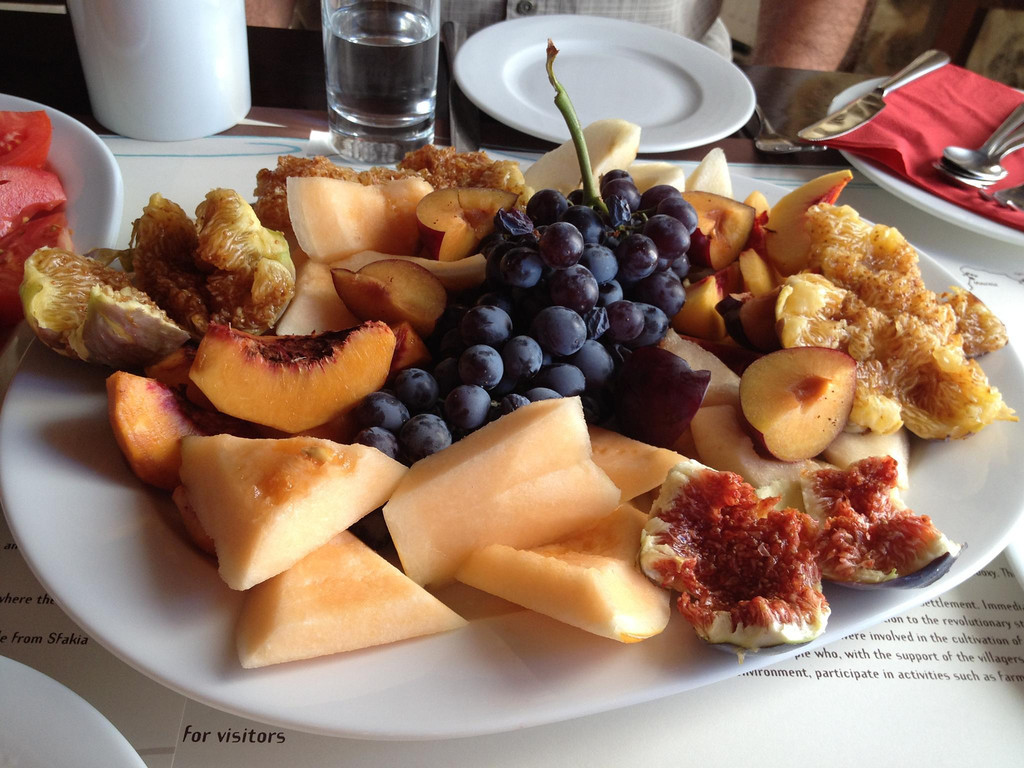
crete fruitsThis spirit of great generosity has long been commented on by travelers in Greece, who often speak of it as unexpected (for them) hospitality to the stranger or traveler. That it is, of course. Through the work of Heidi Goettner-Abendroth, I now understand that the famous Greek hospitality to the stranger has deep roots in matriarchal cultures. According to Goettner-Abendroth, equality of wealth is assured through the widely-practiced custom of gift-giving in matriarchal cultures. Continue reading “Legacy of Carol P. Christ: Is the Spirit of Great Generosity in Crete a Survival of Ancient Matriarchal Values?”

Legacy of Carol P. Christ: SACRED RHYTHMS OF THE OLIVE HARVEST

This was originally posted on December 2, 2013

carol-christOlives are being harvested in the fields outside my town these days.  We have been having the first rains of the season.  The roads are wet and muddy, and the trees are partially shrouded in mist.  The fields are spread with black plastic nets, and people are hard at work, the men hitting the trees to make the olives fall, and the women picking up the olives from the nets.  The harvest will continue throughout the winter.

The olive press is busy. Cars and trucks come and go, unloading heavy bags filled with olives.  These days the bags are white, made of sturdy woven plastic. In Crete this fall several of us bought canvas olive bags, hand-woven by women.  These, along with baskets hand-woven by men, were still in use only a few decades ago.

olive harvest in Lesbos early 20th century by Theofilos Hajimichael

A friend who died a few years ago told me that “in the old days” there were no nets. The women and the children had to pick the olives up from the ground, often cutting their hands on thorns and stones.  The nets are a Goddess-send.  Between harvests, the nets are simply folded up and placed in the crotch of the tree. Here no one steals them.

In the fields where I walk some of the trees have enormous trunks. Some of them have two trunks, growing like sisters.  Many of them are 300, some perhaps 500, years old.  A man emerges from a field that has some particularly old trees.  I ask him how old they are. “Older than I am,” he replies. “They were here before I was born.  They will be here after I die.” Continue reading “Legacy of Carol P. Christ: SACRED RHYTHMS OF THE OLIVE HARVEST”

Legacy of Carol P. Christ: ETHICS OF INDIVIDUAL RIGHTS AND CARE SENSITIVE ETHICS IN THE CONTEXT OF THE GAY MARRIAGE DEBATE

This was originally posted on December 9, 2013

carol-christIs care the beginning of ethics? Has traditional western ethical thinking been wrong to insist that in order to reason ethically, we must divorce reason from emotion, passion, and feeling?

In Ecofeminist Philosophy, Karen Warren criticizes traditional ethical thinking–advocating a “care-sensitive” approach to ethics.  Traditional ethics, as Warren says, are based on the notion of the individual rights of rational moral subjects. Like so much else in western philosophy traditional ethics are rooted in the classical dualisms that separate mind from body, reason from emotion and passion, and male from female.  In addition to being based in dualism, western philosophy focuses on the rational individual, imagining “him” to be separable from relationships with others.  Western ethics concerns itself with the “rights” of “rational” “individuals” as they come into relationship or conflict with the “rights” of other “rational” “indiviudals.”

Those who would think ethically are advised to “rise above” the “emotions” and “passions” or “feelings” of the body, in order to reason dispassionately about the rights and responsibilities of rational individuals.  According to this theory, emotions and passions “get in the way” of rational thinking.  Continue reading “Legacy of Carol P. Christ: ETHICS OF INDIVIDUAL RIGHTS AND CARE SENSITIVE ETHICS IN THE CONTEXT OF THE GAY MARRIAGE DEBATE”

Legacy of Carol P. Christ: IS THE SPIRIT OF GREAT GENEROSITY IN CRETE A SURVIVAL OF ANCIENT MATRIARCHAL VALUES?

carol-christ

This post was originally published on Oct. 28th, 2013

At a coffee shop in Agios Thomas, Crete last month a perfect stranger offered to pay for the coffees and sodas of the 16 women on the Goddess Pilgrimage to Crete. This spirit of great generosity is rarely experienced in the United States or other parts of Europe, but it is still common in rural Crete and some parts of Greece.

 In fact our group was in Agios Thomas because our bus driver Babis, also in a spirit of great generosity, insisted on stopping to show us his village when we were passing nearby. He guided us to see Roman rock cut tombs and arranged for the early Byzantine church to be opened. At the end of the our pilgrimage, Babis stopped the bus at a wooded glen beside a small church where he offered us his own homemake raki, wine, and olives, accompanied by local sheep cheese he had purchased while we were climbing a mountain. After every meal that we ate in local tavernas, we were offered bottles of cold raki, fruit, and sweets.

crete fruitsThis spirit of great generosity has long been commented on by travelers in Greece, who often speak of it as unexpected (for them) hospitality to the stranger or traveler. That it is, of course. Through the work of Heidi Goettner-Abendroth, I now understand that the famous Greek hospitality to the stranger has deep roots in matriarchal cultures. According to Goettner-Abendroth, equality of wealth is assured through the widely-practiced custom of gift-giving in matriarchal cultures. Continue reading “Legacy of Carol P. Christ: IS THE SPIRIT OF GREAT GENEROSITY IN CRETE A SURVIVAL OF ANCIENT MATRIARCHAL VALUES?”

Legacy of Carol P. Christ: In The News – Global Climate Change

This post was originally posted on Nov. 7th, 2012

Climate change is in the news again due to the devasting storm known as Hurricane Sandy.  Scientists, activists, journalists, and politicians are telling us that Sandy is not just another “unpredictable event” brought to us by “Mother Nature.”  Will we listen this time?

Hurricane Sandy is a human-made and entirely predictable and sure to be repeated environmental consequence of the use of fossil fuels, especially oil and coal. Burning fossil fuels puts carbon dioxide into the atmosphere. This raises the global temperature in the air, land, and sea. Melting of polar ice caps is a result of the rise in global temperatures. This will cause a 3 foot or more rise in the seas, leading to the permanent flooding of the seacoasts and sea coast constructions, including homes, restaurants and shops, office buildings, and harbors and ports.

The warming of the seas is also producing extreme weather conditions, including high winds and hurricanes, along with colder winters and hotter summers.  Extreme weather conditions will lead to regular storm-related flooding of rivers and sea coasts, erosion of hills and mountains in winter, followed by catastrophic fires in summer.  Prolonged droughts and unseasonal rains will devastate farms and food production. Wildlife habitats will be destroyed. Places where people live will become too hot, too cold, too wet, and generally unfriendly to life.

Continue reading “Legacy of Carol P. Christ: In The News – Global Climate Change”

Legacy of Carol P. Christ: Cry The Beloved Country

This post was originally published on Nov. 5th, 2012

With the final day of voting in the US election less than 24 hours away, I feel a deep sadness descending on my soul. 

This election will have far-reaching consequences in relation to a number of issues I care deeply about. Among them are health care, social services, a social safety net, a graduated tax structure that taxes the rich and to a lesser extent the middle classes in order to provide services for the poor, equal pay for equal work, a woman’s right to choose, and gay rights.  On these issues there is a clear choice between the two candidates for President and the two parties.

Democrats believe that health care is a human right, that social services should be provided for those who need them, that taxes should be paid by those who can afford to do so, that women have a right to equal pay and control of our own bodies, and that gays and lesbians should have all the rights of other citizens. Republicans believe that government does not need to provide or control health care, that social services are largely unnecessary, that it is unfair to tax the rich, that equal pay is not important if women have husbands, that the church and state should be making decisions about women’s bodies, and that homosexuality is a unnatural.  There is a clear choice on these issues.

For this reason, I urge all of you who have not voted yet—and those of you who are considering not voting–to vote, no matter how long the lines are, no matter what intimidation you may face, and no matter what discouragement and disappointment you may be feeling.*

Nevertheless I feel like crying.

I feel sad that just about half of all Americans who intend to vote will be voting for the rich, against the poor, and against women’s—my–independence.  Continue reading “Legacy of Carol P. Christ: Cry The Beloved Country”

Legacy of Carol P. Christ: How To Find Those Lost Ancestors

 carol p. christ 2002 color

This post was originally published on Jan. 21st, 2013

Over the past year I have written several blogs on ancestor connection.  In this blog I will share what I have learned about how to find ancestors.

I recommend the popular television series Who Do You Think You Are? which has US, UK, and Australian, and other versions, and the PBS series hosted by Henry Louis Gates, African American Lives and Finding Your RootsWhile you might think, as I did, that genealogical research is about finding the names and birthplaces of ancestors, these programs set the genealogical quest in the great flow of history.

Records show that I have ancestors who immigrated to the United States from Ireland, Scotland, Prussia, and Germany in the early 1850s.  Historical research tells me that more than a million people left Ireland and Scotland in the 1850s due to the “potato famine,”* which affected the rest of Europe as well.  History explains why ancestors emigrated.

Begin your search by asking parents, grandparents, aunts, and uncles, for names, dates, places of residence, stories, and other information they remember.  Continue reading “Legacy of Carol P. Christ: How To Find Those Lost Ancestors”

Legacy of Carol P. Christ: What Was Your Childhood Religious Tradition And Do You Still Follow It?

This post was originally published on Nov. 26th, 2012

Recently, in an interview with the Women’s Living History Project of Claremont Graduate University, I was asked: What religious tradition did you identify with as a child and how did it impact your childhood? and: Is your tradition the same today that you had when growing up?

I was surprised that the interview questions didn’t ask anything about feminism, experiencing exclusion in patriarchal religions, or belief.  My religious and political convictions, which are intertwined, have alienated me from family members.  Therefore, I was suspicious of questions that seemed to have been formulated by someone for whom religion and family go together, and for whom believing or not believing (!) did not seem to be an important issue.

After expressing criticism of the questions, I agreed to work with them.  My answer to the first question was that I did not have a single religious tradition as a child. I had four.  Continue reading “Legacy of Carol P. Christ: What Was Your Childhood Religious Tradition And Do You Still Follow It?”

Legacy of Carol P. Christ: The Morning After Pill and Obama’s Daughters

carol p. christ 2002 colorThis post was originally published on May 13th, 2013

By now it should be clear to feminists that when Barack Obama thinks about women, he does not view us as independent individuals, but rather as he said in his 2nd term inauguration address–to my consternation—as “our” mothers, wives, and daughters.  Obama does not address us–he addresses the men he expects to make decisions for us.  I almost wrote a blog on this egregious error in perception and judgment on the part of the President in January, but in order not to be seen as nit-picking, I held my tongue.  The recent decision of the White House to continue to restrict the availability of the Plan B , brings this question to the fore again.

Plan B is a brand name for the “morning after pill.”  If taken within 3 days of unprotected intercourse, it will prevent conception.  There is now a much cheaper generic version as well.

After reviewing the effects and side effects of Plan B, the Federal Drug Administration found it safe and reliable and advised the US Department of Health and Human Services that it should be made available without prescription or age restrictions.  In late 2011, the Obama administration and Kathleen Sibelius made the unprecedented decision to overturn the recommendations of the FDA and to allow Plan B to be purchased without prescription only by women age 17 or older.  Just over a month ago, US District Court Justice Edward Korman of New York ruled that the Plan B and the generic alternatives should be made available without restriction.  Before the ruling could take effect, the Obama administration lowered the age restriction to 15, while announcing that it would appeal Justice Korman’s decision to make the morning after pill as available as aspirin.

“Current and former White House aides said Obama’s approach to the issue has been heavily influenced by his experience as the father of two school-age daughters.”   Continue reading “Legacy of Carol P. Christ: The Morning After Pill and Obama’s Daughters”

Legacy of Carol P. Christ: What Does It Mean to Say that All White Feminists Are Racist? (Questions Posed to White Women/Myself about Our Part in the Dialogue with Women of Color)

This post was originally published on Oct. 7th, 2011

Carol P. Christ, a founding mother in the study of Women and Religion and Feminist Theo/a/logy, has been active in anti-racist, anti-poverty, anti-war, feminist, pro-gay and lesbian, anti-nuclear, and environmental causes (in that order) for many years.  All of these issues have informed her teaching, her scholarship, and her politics.

The recent posting of Mary Daly’s letter to Audre Lorde on the Feminism and Religion blog is a correction of a piece of feminist history that is important in its own right and because of the way Lorde’s letter has shaped feminist discourse and politics up to the present day.  Knowledge of the existence of Daly’s letter and the facts surrounding Lorde’s distortion of history has been in the public domain since the 2004 publication of Alexis DeVeaux’s Warrior Poet, but when I searched the internet for a copy of “Mary Daly’s letter to Audre Lorde” a few days ago, what came up was Lorde’s letter to Daly — not Daly’s letter to Lorde.

I often hear younger feminists say that “all white feminists” of the older generations “were racist.” Sometimes Mary Daly is mentioned. Finding the more detailed record about Mary Daly is one step in retelling the history of feminism in a more complex way. 

Continue reading “Legacy of Carol P. Christ: What Does It Mean to Say that All White Feminists Are Racist? (Questions Posed to White Women/Myself about Our Part in the Dialogue with Women of Color)”