Lucy Pick’s Pilgrimage by Mary Sharratt

mary sharrattIn medieval Europe, religious devotion provided an alternate narrative for women’s lives in a male-dominated culture. Defiant women who stood up for themselves in the face of rape, incest, and murder were hailed as virgin martyrs. Religious vocations, such as becoming a nun or a beguine, provided a viable and esteemed alternative to forced marriage.

Even women who were married with children could escape their domestic entanglements and conjugal duties by taking an oath of celibacy as 15th century English mystic Margery Kempe did, leaving behind her husband and 14 children to go on pilgrimage to Santiago de Compostela, Rome, and Jerusalem. Her Book of Margery Kempe, the tale of her travels, reads like a kind of late medieval Eat, Pray, Love and is the first autobiography written in the English language.

Though it might seem surprising to us today, women of the European Middle Ages possessed more rights and freedoms than their descendants in the Renaissance, Early Modern, and Victorian ages. Women worked as craftspeople and artisans and were members of the guilds, alongside men. Monarchs such as Eleanor of Aquitaine were global power brokers while religious leaders such as Hildegard von Bingen devoted their lives to intellectual and artistic pursuits, composing music and writing weighty philosophical and theological books that are still being discussed today.

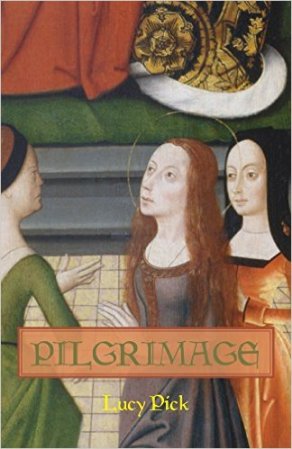
lucy pick pilgrimageThe cover of academic historian Lucy Pick’s novel Pilgrimage shows details from a painted altarpiece dedicated to Saint Godeleva. A victim of forced marriage who was strangled by order of her husband, this legendary saint was a patron of abused wives. Lucy Pick’s novel concerns the saint’s daughter, the blind Gebirga of Gistel in Flanders. What would it be like to be the daughter of a martyred saint whose miracles cured everyone except you?

Considered unmarriageable due to her blindness, Gebirga rejects life as a nun in an abbey dedicated to her sainted mother. Instead, in a bid for freedom, she embarks on a pilgrimage to Santiago de Compostela in faraway Iberia, an epic journey for that time. She serves as the companion to a highly strung teenage noblewoman and is charged with delivering the girl to the Spanish king she is contracted to marry. During their travels, Gebirga must use all her intelligence and resourcefulness to protect herself and her young charge from the considerable dangers and political intrigues they face on their way. Though they encounter hardship and heartbreak, this is a pilgrimage of miracles, healing, and redemption.

Lucy Pick, the Director of Undergraduate Studies and Senior Lecturer at the University of Chicago’s Divinity School, has infused her novel with impeccable research into the lives of medieval women. This novel is a medievalist’s delight and fans of the late Margaret Frazer will devour this book.

Mary Sharratt’s book Illuminations: A Novel of Hildegard von Bingen, won the 2013 Nautilus Gold Award, Better Books for a Better World. Her forthcoming novel, The Dark Lady’s Mask: A Novel of Shakespeare’s Muse, tells the tale of the groundbreaking Renaissance women poet Aemilia Bassano Lanier and will be published by Houghton Mifflin Harcourt in April 2016. Visit Mary’s website.


The Pendle Witches and Their Magic by Mary Sharratt

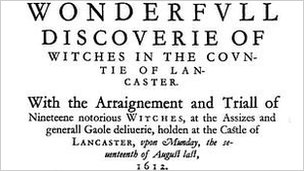
wonderfull discoverieIn 1612, in one of the most meticulously documented witch trials in English history, seven women and two men from Pendle Forest in Lancashire, Northern England were executed at Lancaster Castle.

In court clerk Thomas Potts’s account of the proceedings, The Wonderfull Discoverie of Witches in the Countie of Lancaster, published in 1613, he pays particular attention to the one alleged witch who escaped justice by dying in prison before she could come to trial. She was Elizabeth Southerns, more commonly known by her nickname, Old Demdike. According to Potts, she was the ringleader, the one who initiated all the others into witchcraft. This is how Potts describes her:

She was a very old woman, about the age of Foure-score yeares, and had been a Witch for fiftie yeares. Shee dwelt in the Forrest of Pendle, a vast place, fitte for her profession: What shee committed in her time, no man knows. . . . Shee was a generall agent for the Devill in all these partes: no man escaped her, or her Furies.

Quite impressive for an eighty-year-old lady!

In England, unlike Scotland and Continental Europe, the law forbade the use of torture to extract witchcraft confessions. Thus the trial transcripts supposedly reveal Elizabeth Southerns’s voluntary confession, although her words might have been manipulated or altered by the magistrate and scribe. What’s interesting, if the trial transcripts can be believed, is that she freely confessed to being a healer and magical practitioner. Local farmers called on her to cure their children and their cattle. She described in rich detail how she first met her familiar spirit, Tibb, at the stone quarry near Newchurch in Pendle. He appeared to her at daylight gate—twilight in the local dialect—in the form of beautiful young man, his coat half black and half brown, and he promised to teach her all she needed to know about magic.

Tibb was not the “devil in disguise.” The devil, as such, appeared to be a minor figure in British witchcraft. It was the familiar spirit who took centre stage: this was the cunning person’s otherworldly spirit helper who could shapeshift between human and animal form, as Emma Wilby explains in her excellent scholarly study, Cunning Folk and Familiar Spirits. Mother Demdike describes Tibb appearing to her at different times in human form or in animal form. He could take the shape of a hare, a black cat, or a brown dog. It appeared that in traditional English folk magic, no cunning man or cunning woman could work magic without the aid of their spirit familiar—they needed this otherworldly ally to make things happen.

Belief in magic and the spirit world was absolutely mainstream in the 16th and 17th centuries. Not only the poor and ignorant believed in spells and witchcraft—rich and educated people believed in magic just as strongly. Dr. John Dee, conjuror to Elizabeth I, was a brilliant mathematician and cartographer as well as an alchemist and ceremonial magician. In Dee’s England, more people relied on cunning folk for healing than on physicians.

As Owen Davies explains in his book, Popular Magic: Cunning-folk in English History, cunning men and women used charms to heal, foretell the future, and find the location of stolen property. What they did was technically illegal—sorcery was a hanging crime—but few were arrested for it as the demand for their services was so great. Doctors were so expensive that only the very rich could afford them and the “physick” of this era involved bleeding patients with lancets and using dangerous medicines such as mercury—your local village healer with her herbs and charms was far less likely to kill you.

In this period there were magical practitioners in every community. Those who used their magic for good were called cunning folk or charmers or blessers or wisemen and wisewomen. Those who were perceived by others as using their magic to curse and harm were called witches.

But here it gets complicated. A cunning woman who performs a spell to discover the location of stolen goods would say that she is working for good. However, the person who claims to have been falsely accused of harbouring those stolen goods can turn around and accuse her of sorcery and slander. This is what happened to 16th century Scottish cunning woman Bessie Dunlop of Edinburgh, cited by Emma Wilby in Cunning Folk and Familiar Spirits. Dunlop was burned as a witch in 1576 after her “white magic” offended the wrong person.

Ultimately the difference between cunning folk and witches lay in the eye of the beholder. If your neighbours turned against you and decided you were a witch, you were doomed.

Although King James I, author of the witch-hunting handbook Daemonologie, believed that witches had made a pact with the devil, there’s no actual evidence to suggest that witches or cunning folk took part in any diabolical cult. Anthropologist Margaret Murray, in her book, The Witch Cult in Western Europe, published in 1921, tried to prove that alleged witches were part of a Pagan religion that somehow survived for centuries after the Christian conversion. Most modern academics have rejected Murray’s hypothesis as unlikely. Indeed, lingering belief in an organised Pagan religion is very difficult to substantiate. So what did cunning folk like Old Demdike believe in?

Some of her family’s charms and spells were recorded in the trial transcripts and they reveal absolutely no evidence of devil worship, but instead use the ecclesiastical language of the Catholic Church, the old religion driven underground by the English Reformation. Her charm to cure a bewitched person, cited by the prosecution as evidence of diabolical sorcery, is, in fact, a moving and poetic depiction of the passion of Christ, as witnessed by the Virgin Mary. The text, in places, is very similar to the White Pater Noster, an Elizabethan prayer charm which Eamon Duffy discusses in his landmark book, The Stripping of the Altars: Traditional Religion in England 1400-1580.

It appears that Mother Demdike was a practitioner of the kind of quasi-Catholic folk magic that would have been commonplace before the Reformation. The pre-Reformation Church embraced many practises that seemed magical and mystical. People used holy water and communion bread for healing. They went on pilgrimages, left offerings at holy wells, and prayed to the saints for intercession. Some practises, such as the blessing of the wells and fields, may indeed have Pagan origins. Indeed, looking at pre-Reformation folk magic, it is very hard to untangle the strands of Catholicism from the remnants of Pagan belief, which had become so tightly interwoven.

Unfortunately Mother Demdike had the misfortune to live in a place and time when Catholicism was conflated with witchcraft. Even Reginald Scot, one of the most enlightened men of his age, believed the act of transubstantiation, the point in the Catholic Mass where it is believed that the host becomes the body and blood of Christ, was an act of sorcery. In a 1645 pamphlet by Edward Fleetwood entitled A Declaration of a Strange and Wonderfull Monster, describing how a royalist woman in Lancashire supposedly gave birth to a headless baby, Lancashire is described thusly: “No part of England hath so many witches, none fuller of Papists.” Keith Thomas’s social history Religion and the Decline of Magic is an excellent study on how the Reformation literally took the magic out of Christianity.

However, it would be an oversimplification to state that Mother Demdike was merely a misunderstood practitioner of Catholic folk magic. Her description of her decades-long partnership with her spirit Tibb seems to draw on something outside the boundaries of Christianity.

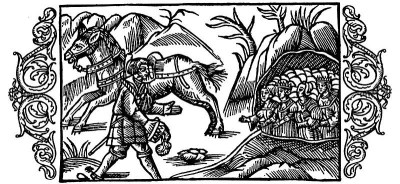
Although it is difficult to prove that witches and cunning folk in early modern Britain worshipped Pagan deities, the so-called fairy faith, the enduring belief in fairies and elves, is well documented. In his 1677 book The Displaying of Supposed Witchcraft, Lancashire author John Webster mentions a local cunning man who claimed that his familiar spirit was none other than the Queen of Elfhame herself. The Scottish cunning woman Bessie Dunlop mentioned earlier, while being tried for witchcraft and sorcery at the Edinburgh Assizes, stated that her familiar spirit was a fairy man sent to her by the Queen of Elfhame.
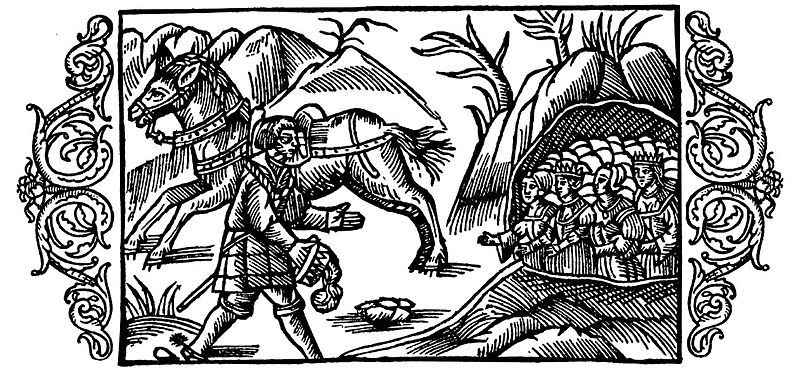
faery queen

A 17th century woodcut depicting a petitioner approaching the fairies in their hollow hill.


Mary Sharratt is an American author living in Pendle Witch country in northern England, the dramatic setting for her novel, Daughters of the Witching Hillbased on the true story of the folk healer and wisewoman, Elizabeth Southerns and her family. Mary is also the author of Illuminations: A Novel of Hildegard von BingenVisit her website.

Embracing Fierceness by Mary Sharratt

maenad dancing with snake

Maenad dancing with snake, ancient Greece, ca 450 BCE

This post is in part inspired by Donna Henes’s brilliant post, I am Mad. Too often as spiritual women, we are told we have to be nice all the time. Accomodating. Compromise our boundaries and principles.

Mainstream religions tell us we must forgive those who mistreat us. Too many women in very abusive situations literally turn the other cheek–to their extreme detriment. As Sherrie Campbell points out in her essay The 5 Faults of Forgiveness, the obligation of forgiveness oppresses survivors of abuse because it makes it all about the perpetrator and not about the healing, dignity, or boundaries of the survivor.

In my own Catholic upbringing I learned to swallow my anger and rage until it erupted in depression and burning bladder infections. My background did not teach me to skillfully dance with anger and it’s been a difficult learning curve for me. But I learned the hard way that owning my anger was crucial if I wanted to stand in my power and speak my truth.

Continue reading “Embracing Fierceness by Mary Sharratt”

Were Hildegard’s Visions Caused by Migraines? by Mary Sharratt

hildegard's vision of christ 2

Hildegard’s vision of Christ, surrounded by concentric circles of light.


When I was forty-two years and seven months old, Heaven was opened and a fiery light of exceeding brilliance came and permeated my whole brain, and inflamed my whole heart and my whole breast, not like a burning but like a warming flame, as the sun warms anything its rays touch.

–Hildegard von Bingen, Scivias, translated by Mother Columba Hart, O.S.B., and Jane Bishop

Neurologist Oliver Sacks believed that the dazzling visions of Hildegard von Bingen (1098-1179), the great Benedictine abbess and polymath, were caused by migraines. Hildegard struggled with chronic health problems. In Scivias, her first book of visionary theology, she described being bedridden when she received the divine command to write and speak about her visions that she had kept secret since childhood. According to Sacks, the symptoms she described are identical to those of migraine sufferers. He also stated that the concentric circles in the illuminations illustrating her visions are reminiscent of a migraine aura.

But can Hildegard’s visionary experience truly be reduced to pathological hallucinations? Continue reading “Were Hildegard’s Visions Caused by Migraines? by Mary Sharratt”

Hildegard the Healer by Mary Sharratt

mary sharrattSaint Hildegard von Bingen (1098–1179) was not only a visionary Benedictine abbess, composer, and Powerfrau extraordinaire. She was also a physician and healer who developed her own highly original system of medical treatment and holistic dietary philosophy.
Saint Benedict of Nursia (480-543), the founder of her order, expressly forbade the study of medicine, which in his era derived solely from texts written by Pagans such as Hippocrates and Galen. Benedict believed that prayer alone must suffice in healing Christians.

But by Hildegard’s time, monasteries had become centers of healing that embraced the medical knowledge of both the Classical Pagan world and the pioneering work of Arab and Persian physicians. Nearly every monastic house had its own infirmary, hospice, apothecary, and medicinal garden. Hildegard would have had ample opportunity to train as a physician and apothecarer at Disibodenberg Monastery, a double monastery housing both monks and nuns, where she lived for most of the first half of her life.

hildegard universal human 200px-Hildegard_von_Bingen_Liber_Divinorum_Operum
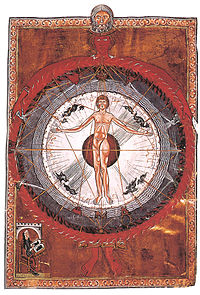
Illumination based on Hildegard’s vision of the human body as the microcosm within the sacred macrocosm.

Continue reading “Hildegard the Healer by Mary Sharratt”

Life Begins at 42: Saint Hildegard’s Guide to Becoming a Midlife Powerfrau

hildegard statue appletrees

We live in a youth-obsessed culture. The cosmetic industry pushes wrinkle creams and hair dye on us while celebrities resort to Botox and surgery to preserve an illusion of eternal girlhood. We live longer than ever before, yet advancing age, once a mark of honour, has become a source of shame.

But what happens when women embrace midlife as an inner awakening and call to power?

One such woman was Saint Hildegard von Bingen (1098-1179), powerfrau and late bloomer par excellence.

Her youth was dire. Offered to the Church at the age of eight, she was entombed in an anchorage. Though she had been haunted by luminous visions since earliest childhood, she didn’t dare speak of them. Her entire existence was bent on silent submission to her superior, Jutta von Sponheim, an ascetic whose regime of fasting and mortification of the flesh eventually killed her.

Only after Jutta’s demise could Hildegard step out of the shadows and carve out a spiritual life based not on suffering but on celebrating life in all its burgeoning green beauty. Even so she might have remained obscure, lost to history.

But when she was forty-two, everything changed.

“When I was forty-two years and seven months old,” she wrote, “Heaven was opened and a fiery light of exceeding brilliance came and permeated my whole brain, and inflamed my whole heart and my whole breast, not like a burning but like a warming flame, as the sun warms anything its rays touch.”

Dazzling visionary experiences descended upon Hildegard, along with the divine summons to write and speak of her revelations. Reluctantly at first she embarked on her first book of theology, Scivias, or Know the Ways. After putting quill to parchment, she could never go back.

Hildegard went on to found two monasteries, go on four preaching tours, compose an entire corpus of sacred music, and write nine books on subjects as diverse as cosmology, botany, medicine, and human sexuality, thus leaving her indelible mark on history.

Most of us believe we live in a more enlightened age than Hildegard’s—after all, children are no longer offered as tithes to monasteries. Yet many young women find themselves in modern and secular forms of servitude—dead end relationships, soul-crippling jobs, credit card debt, a life of junk food and junk television—all the sadness and waste of an unexamined life.

We don’t need to be visionaries to break free. We just need to remember who we are, that we all serve some higher purpose. Each of us has our own unique gift to give the world.

In youth, it’s easy to be beguiled by the glamour of the surface of things—if we get the right job, the right partner, the right clothes we’ll be happy forever.

But in midlife we are gifted with the maturity to see through the false scripts consumer society hands to us. After a certain age we can see just how absurd it is to kill ourselves to emulate airbrushed supermodels. We realize that the greatest lover in the world can’t fulfill us until we are at peace with ourselves. And so we can let ourselves go. Paint the pictures we’ve always longed to paint. Learn French and travel the world. Dance under the stars. Play the saxophone. Offer our own song to the vast symphony of life.

Remember, it’s never too early or too late to embrace your inner powerfrau.

Mary Sharratt’s book Illuminations: A Novel of Hildegard von Bingen won the 2013 Nautilus Gold Award: Better Books for a Better World and was a 2012 Kirkus Book of the Year. Her forthcoming novel, The Dark Lady’s Mask, will be published by Houghton MIfflin Harcourt in Spring 2016. Visit her website.

Journey into Light by Mary Sharratt

mary sharrattDecember 7 marks the Second Sunday of Advent.

Here in Northern England, I find myself plunged into the depths of midwinter darkness. It is in this dark womb of stillness that the Light is reborn. Through the ages and across cultures, world faith traditions have marked this sacred passage through the darkness.

In Christian tradition, Advent is a period of expectant waiting, of anticipating the birth of Christ. The word Advent comes from the Latin adventus, which means “coming.” This First Sunday of Advent marks the beginning of the Western Christian liturgical year.


hildegard's house of light erickson_house_72dpi

 Image: “Hildegard’s House of Light,” painting by Elizabeth Erickson

The Advent wreath and Advent calendar are relatively recent innovations. Christmas and Advent celebrations have gone through many permutations throughout history. Continue reading “Journey into Light by Mary Sharratt”

Hildegard: A Saint Eight Centuries in the Making

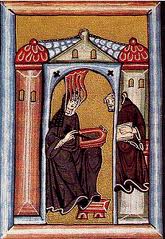
hildegard & volmar

The visionary abbess Hildegard von Bingen (1098-1179) has long been regarded as a saint, with her feast day of September 17, yet she was only officially canonized in May 2012. Why did it take the Vatican over eight centuries to canonize this great polymath, composer, and theologian?

The first attempt to canonize Hildegard began in 1233, but failed as over fifty years had passed since her death and most of the witnesses and beneficiaries of her reported miracles were deceased. Her theological writings were deemed too dense and difficult for subsequent generations to understand and soon fell into obscurity, as did her music. According to Barbara Newman, Hildegard was remembered mainly as an apocalyptic prophet. But in the age of Enlightenment, prophets and mystics went out of fashion. Hildegard was dismissed as a hysteric. Even the authorship of her own work was disputed as pundits began to suggest her books had been written by a man.

Newman states that Hildegard’s contemporary rehabilitation and resurgence was due mainly to the tireless efforts of the nuns at Saint Hildegard Abbey in Eibingen, Germany. In 1956 Marianna Schrader and Adelgundis Führkötter, OSB, published a carefully documented study that proved the authenticity of Hildegard’s authorship. Their research provides the foundation of all subsequent Hildegard scholarship.

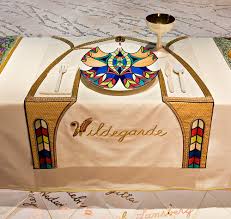
In the 1980s, in the wake of a wider women’s spirituality movement, Hildegard’s star rose as seekers from diverse faith backgrounds embraced her as a foremother and role model. The artist Judy Chicago showcased Hildegard at her iconic feminist Dinner Party installation.

hildegard judy chicago dinner party setting

Medievalists and theologians rediscovered Hildegard’s writings. New recordings of her sacred music hit the popular charts. The radical theologian Matthew Fox adopted Hildegard as the figurehead of his creation-centered spirituality. Fox’s book Illuminations of Hildegard of Bingen remains one of the most accessible and popular books on the 12th-century visionary. In 2009, German director Margarethe von Trotta made Hildegard the subject of her luminous film, Vision. And all the while, the sisters at Saint Hildegard Abbey were exerting their quiet pressure on Rome to get Hildegard the official endorsement they believed she deserved.

Pope John Paul II, who had canonized more saints than any previous pontiff, steadfastly ignored Hildegard’s burgeoning cult, possibly because he was repelled by her status as a feminist icon. Ironically it was his successor, Benedict XVI, one of the most conservative popes in recent history—who, as Cardinal Ratzinger, expelled Matthew Fox from the Dominican Order where Fox had served for thirty-four years—finally gave Hildegard her due. Reportedly Joseph Ratzinger, a German, had long admired Hildegard. He not only canonized her but elevated her to Doctor of the Church, a rare and solemn title given to only the most distinguished theologians.

But I believe the true credit for Hildegard’s triumph is due to the Benedictine Sisters at Saint Hildegard Abbey for keeping Hildegard’s flame burning.

Meditation:

This is drawn from Ann K. Gebuhr’s book, Hildegard!

Take some time to listen to and contemplate Hildegard’s beautiful musical meditation on the Holy Spirit, O ignis spiritus paracliti:

O spirit of fire, bringer of comfort,

Life of the life of every creature,

You are holy, anointing those perilously broken;

You are holy, cleansing festering wounds.

O breath of loveliness,

O fire of love,

O sweet savour in our breasts,

Infusing heart with the scent of virtue.

O clearest fountain,

In which we see

How God gathers the alienated

And finds the lost.

O breastplate of life

And hope of the whole human body,

O belt of honour, save the fortunate.

Guard those imprisoned by the enemy

And free those who are bound,

Whom the divine power wishes to save.

O mightiest course

That has penetrated all things

In the heavens and on earth

And in every abyss–

You reconcile and draw all humanity together.

From you clouds flow, wind flies,

Stones produce moisture,

Water flows in streams,

And the earth exudes living greenness.

You are always teaching the learned,

Who, through wisdom’s inspiration,

Are made joyful.

Thence praise be to you who are the sound of praise,

And joy of life,

And hope and greatest honour,

Granting the gift of light.

(This is Susan Hellauer’s translation from the insert booklet of Anonymous 4’s CD, The Origin of Fire: Music and Visions of Hildegard von Bingen.)

Read Hildegard’s poem slowly as a prayer, contemplating how the Sacred Flame, however you envision it in your own spiritual tradition, relates to your life.

Mary Sharratt’s Illuminations: A Novel of Hildegard von Bingen won the Nautilus Gold Award and was a 2012 Kirkus Book of the Year. Visit her website: www.marysharratt.com.

Book Review: Hild & The Patron Saint of Ugly by Mary Sharratt

OLYMPUS DIGITAL CAMERA

Literature touches our spirit in a way that film, television, and even art cannot. Instead of presenting the passive viewer with a visual image, good writing demands our participation and co-creation. The words become the springboard for our own imagined vision of other worlds and other lives. In this imagined space, we can experience profound insights and revelations–soul-growing experiences we carry with us forever.

Books that try too hard to be spiritual can have the opposite effect. Discerning women demand books that respect us instead of preaching to us. Too often religion has been interpreted by and for men, but when women writers reveal their spiritual truths, a whole other landscape emerges, one we haven’t seen enough of.

Marie Manilla’s The Patron Saint of Ugly (Houghton Mifflin Harcourt, June 17, 2014) and Nicola Griffith’s Hild (Farrar, Straus and Giroux 2013) are two such transporting novels. They both draw on the lives of female saints in fresh and evocative ways.

Continue reading “Book Review: Hild & The Patron Saint of Ugly by Mary Sharratt”

The Soul is Symphonic: Reclaiming Sacred Music

https://i0.wp.com/media.tumblr.com/55c2821e2413450d48ec03b96e4cd426/tumblr_inline_mqcp4y6ZwN1qz4rgp.jpg

Here is a hymn of praise, a beautiful and intimate piece meant to be sung.

Hail, O greenest branch,

sprung forth on the breeze of prayers.

. . . . a beautiful flower sprang from you

which gave all parched perfumes their aroma.

And they have flourished anew  in full abundance.

The heavens bestowed dew upon the meadows,

and the entire earth rejoiced,

because her flesh brought forth grain,

and because the birds of heaven built their nests in her.

Behold, a rich harvest for the people

and great rejoicing at the banquet.

O sweet Maiden,  no joy is lacking in you . . . .

Now again be praised in the highest.

When I posted this sacred text on my blog back in 2008, I asked my friends who come from a diverse range of spiritual backgrounds to guess the author and the divine figure to whom the text is addressed. Some thought it might be an ancient hymn to Persephone. In fact, it is one of Hildegard von Bingen’s ecstatic odes to the Virgin Mary. This song, O viridissima virga, can be found on a number of CDs of Hildegard’s music.

Born in the rich green hills of the German Rhineland, Hildegard von Bingen (1098-1179) entered the religious life at the age of eight. A Benedictine abbess, she composed an entire body of sacred music, including seventy-seven songs and a musical morality play which can be regarded as our first surviving opera. A polymath well versed in science and the healing arts, she developed her own form of natural medicine that is still practiced in Germany today. During her own lifetime, she was most famous for her prophecies which earned her the title Sybil of the Rhine.

Since earliest childhood, Hildegard experienced profound visions which directly influenced her music, theology, and healing practices. Her visions revealed the feminine face of the divine, which is mirrored in her music. Many of her songs are addressed to Mary or female saints, such as Ursula. Even the Godhead itself appeared to her in feminine form. In Scivias, her first book of visionary theology, she writes, “She is with everyone and in everyone, and so beautiful is her secret that no person can know the sweetness with which she sustains people, and spares them with inscrutable mercy.”

Hildegard’s sacred songs are filled with a deep sensuality and reverence for the natural world. In her hymn O viridissima virga, she transforms the Latin word virgo, or virgin, into virga, or branch, addressing Mary as the most verdant and lushly abundant branch on Jesse’s tree. Hildegard was Christian, yet her music and visions have profound resonance for people from all spiritual backgrounds. The more I study mystics and visionaries, the more I am convinced that they draw on the true heart of divinity. They tap into the ineffable.

Sacred music was the bedrock of Hildegard’s spirituality. For her, song was the highest form of prayer, sacred harmonies rising like incense in a perfect offering to heaven. Hildegard believed that the soul is symphonic. Such is the sweetness of music that it banishes human weakness and fear, and draws us back into our original state of grace, reuniting humans to their divine Source.

Benedictine monastic life was structured around the Divine Office: eight times a day, from the dawn office of Lauds to the night vigil of Matins, the choir nuns gathered to sing the Psalms of David and other sacred songs. Near the end of her long life, Hildegard and her nuns at Rupertsberg Abbey were subject to an interdict, or collective excommunication. A supposed apostate lay buried in their churchyard and they refused to allow the ecclesiastical authorities to exhume this man and desecrate his grave. As a result of the interdict, Hildegard and her nuns were denied the Mass and the sacraments—a very old woman, Hildegard herself might have died without the final sacraments or Christian burial. Yet what infuriated her most was that she and her sisters were forbidden to sing the Divine Office. Sacred song was absolutely central to her identity as a religious woman. The interdict was lifted only shortly before her death. I imagine her singing until her dying day.

What relevance does this have for us today? When I listen to recordings of Hildegard’s music, I am struck by its ethereal beauty. Nowadays, for people across the spiritual spectrum, there seems to be a dearth of good music. Much of what is sold as meditation music or inspirational music seems shallow and insipid to me. A regular church-going Catholic is more likely to experience the guitar mass than the mysterious beauty of Hildegard’s music.

As contemporary spiritual people, are we to live our lives severed from the kind of music that can truly feed our souls?

What can we do to reclaim the power of sacred song? Few of us are gifted composers. Many of us cringe to even hear ourselves sing. How do we integrate sacred music into our spiritual practice? Most of us lead busy lives and the stillness of a monastic lifestyle remains an impossible dream. Yet we might find sung devotions at morning and twilight to be deeply enriching. We might start by listening to recorded music that inspires us. From my own practice, I’ve discovered that Hildegard’s music definitely works as a backdrop to meditation and contemplation. It soothes the soul and draws the heart and mind to a higher place. Over time we might gain the courage and will to take the leap to sing for ourselves. It’s not necessary to play an instrument. The voice  God gave us is enough. The next logical step is creating our own new music.

If we can’t find the music to nourish our soul, we must create it. Hildegard took the established tradition of plainchant and wedded it to her own vision to create hymns of incomparable beauty that still move us today. Most of us aren’t visionaries like Hildegard, but we can write our own heartfelt lyrics in praise of the Divine as we see Her. We can write songs to celebrate the sacred cycles of the year and the days we hold sacred. We can take ancient sacred texts and find a melody to carry the words. Medieval plainchant is beautiful in its simplicity. Or perhaps a haunting old folk air will inspire you.

When you offer your songs as prayers, sing like you mean it. It’s not a performance to impress other humans but a pure act of devotion. Meet together with friends in an informal devotional gathering. Share your songs. Inspire each other. Our modern sacred music will inevitably keep evolving as people compose new songs and add to the canon. We each have the opportunity to be part of this evolution.

Mary Sharratt is the author of Illuminations: A Novel of Hildegard von Bingen (Houghton Mifflin 2012, Mariner 2013), winner of the Nautilus Gold Award: Better Books for a Better World. Visit her website.


Sacred Music Discography:

Hildegard von Bingen:
11,000 Virgins: Chants for the Feast of St. Ursula, Anonymous Four, Harmonia Mundi, USA.
The Dendermonde Codex, Dous Mal/Katelijne Van Laethem, Etcetera.
A Feather on the Breath of God, Gothic Voices, Hyperion.
Canticles of Ecstasy, Sequentia, Deutsche Harmonia Mundi.
Voice of the Blood, Sequentia, Deutsche Harmonia Mundi.