Passover and the Exodus: A Feminist Reflection on Action, Hope, and Legacy by Michele Stopera Freyhauf

Freyhauf, Durham, Hahn Loeser, John CarrollLast week, Supreme Court Justice Ruth Bader Ginsburg was in the news again, but not for reasons you would expect.  She, along with Rabbi Lauren Holtzblatt, penned a feminist essay about the Exodus title “The Heroic and Visionary Women of Passover.”  Finding this story was exciting, especially because I am so drawn to the Exodus story (the intrigue and curiosity of which caused me to return to school and study, as one of my main areas of focus, Hebrew Scriptures – along with Archaeology and Ancient Near Eastern History).  Now women’s roles in this story are being elevated thanks to Justice Ruth Bader Ginsburg and Rabbi Holtzblatt.

Before I discuss the message and the importance this message brings, I think it is important to know an important fact about Justice Ginsburg.  Ginsburg is not observant, but does embrace her Jewish identity.  When her mother died, she was excludedRuth_Bader_Ginsburg_official_portrait[1] from the mourner’s minyan because she was a woman; an event in Judaism that is meant to comfort the mourner, brings a sense of community, and is considered obligatory – a means of honoring our mother/father.  This important event left an impression and sent a loud message that inspired and influenced her career path – she did not count – she had no voice – she had no authority to speak.  No wonder her life and career focuses so much on women’s rights and equality.

As many of us know, the story of Exodus is focused on two things 1) Moses and 2) liberation from the bonds of servitude and enslavement; women are rarely discussed.  In the essay co-authored by Ginsberg, women are described as playing a crucial role in defying the orders of Pharaoh and helping to bring light to a world in darkness.  In the Exodus event, God had partners – five brave women are the first among them, according to Ginsburg and Holtzblatt.  These women are: Continue reading “Passover and the Exodus: A Feminist Reflection on Action, Hope, and Legacy by Michele Stopera Freyhauf”

Abuse Does Not Have “Fifty Shades of Grey” by Michele Stopera Freyhauf

WARNING: This article or pages it links to contain information about domestic abuse and sexual violence which may be triggering to survivors.


Freyhauf, Durham, Hahn Loeser, John CarrollNo matter what you call it abuse is abuse. This is highlighted in the popular book and now movie Fifty Shades of Grey. Because of the stir this book caused, I delved into the first book and my initial reaction was that of repulsion and wonderment. How could a woman let a man control her like that? Why would she let him do things like that to her and continue to come back to him? Why is this book so popular?


Are women sexually repressed in a way that their own sexual experiences are routine and boring (the book is full of BDSM) or they have never orgasmed (every time they have intercourse, Anastasia is guaranteed to orgasm)? Why do we find it okay to label body parts as “love boxes” or “considerable length” or the multitude of references to a man’s penis or woman’s vagina that is meant to sound sexy or romantic? Why does he announce “I am going to f*** you now” every single time they have intercourse? Can’t the reader figure out what is going on without making this announcement?

However, after I got beyond my initial reaction (or shock), I took a step back and became upset and outraged.  In essence, the overall issue with the book can be summed up in one word: control. Some women argue that the awkward doe-eyed virgin journalist exercises control over the sexually deviantPicture from fanpop.com

Picture from fanpop.com

billionaire that keeps him coming back to her – I disagree. I see control exercised by the sexually deviant man over a woman enamored by him in such a way that is sexually, physically, and psychologically exploitative and abusive. Yes – I understand this is fiction, but this type of writing causes immense problems.

In a culture that embraces “Blurred Lines,” money and power, and “the bad boy persona,” this storyline fuels the fodders of the fire with a sensationalism that plays on sexual fantasies and/or those wishing prince charming will sweep them away. One needs to look no further than “The Bachelor” or Bret Michaels’ “Rock of Love” television shows that promote the exploitation of women’s desires to be with the rich handsome man at any cost to self and dignity. In fact, an article posted about the movie stated that if Christian Grey was not a billionaire and behaved in the same way, he would be arrested and labeled a sex offender. So again, is the message we want to send to our daughters, nieces, and friends is that the rich can do whatever they want and you should let him? I think not.

Continue reading “Abuse Does Not Have “Fifty Shades of Grey” by Michele Stopera Freyhauf”

Research and the Dissertation: Getting Back to Basics by Michele Stopera Freyhauf

Freyhauf, Durham, Hahn Loeser, John CarrollHistory is written by the victors – this is something that we all know, or at least should know. I apologize in advance for being elementary in my discussion, but I think one thing that scholars tend to do too often is assume our readers or audience has a firm grasp on what we are talking about. With this topic, I am not assuming.

When studying artifacts from past civilizations, an interesting phenomenon of using spolia as a demonstration of conquest is commonplace. If a conquered country’s deity is placed on the bottom of a column, or even turned a different direction, the significance usually means that deity is demoted or inferior – this is found in the Hagia Sophia (especially under the structure). If spolia is found whereby a country adds their deity (even if that deity is their ruler) to another country’s monument, then there is a coexistence or combining of empires with the conquesting ruler in prominent view, even substituting past rulers. This is best demonstrated on the Arch of Constantinople whereby Christian symbols and the likeness of Constantine was incorporated into an arch that once displayed the victories of Marcus Aurelius and Domitian. If you are interested in this topic, please see my article “Hagia Sophia: Political Symbolism in Stones and Spolia” in Popular Archaeology magazine.

Continue reading “Research and the Dissertation: Getting Back to Basics by Michele Stopera Freyhauf”

Reclaiming the Feminist Beginnings of America’s Thanksgiving by Michele Stopera Freyhauf

Freyhauf, Feminism, Religion, Durham, Old Testament, Blogger, Bible, Gender, Violence, Ursuline, John CarrollFor those who are unaware of my research focus and methodology, I try to use history to reconstruct or reclaim the feminine voice through more of an exegetical lens rather than an eisegetical or ideological lens. When it comes to Thanksgiving, I have yet another opportunity to restore credit to or at least bring visibility back to a woman who fought for Thanksgiving to be recognized as a national holiday on the last Thursday of November. Her works, though plentiful and sometimes known only by title, are largely forgotten to history; Sarah Josepha Buell Hale (1788-1879) is responsible for Thanksgiving becoming a national holiday in the United States.

Certainly, I do not have to go into the disparity that befell women during the 1800’s when it came to education and overall fundamental rights – that is a history with which we are all well familiar. Hale was educated through her brother, Horatio Gates Buell, who shared his education while attending Dartmouth College and “seemed very unwilling that [Hale] should be deprived of all his collegiate advantages,” and through her husband, David Hale, a lawyer who helped her cultivate her writing skills in the evenings. They even established a small literary club with their friends that allowed her to write. Hale was left a widow at a very young age with five children, the oldest age 7. Hale, like so many women during that time period, had to find a way to support herself and her family.

Sarah Josepha Buell Hale

After authoring a book of poems with her sister-in-law, The Genius of Oblivion and Other Original Poems, Hale, in 1827, published her first novel called Northwood – a book published the same year as Uncle Tom’s Cabin that also challenged slavery. From fame gained through this novel, Hale obtained a job as an editor of a women’s magazine, Ladies Book (later Godey’s Ladies Book then American Ladies Magazine), where she worked for about 40 years. She wrote about half of the material contained in the magazines, as a means of helping to educated women. Hale helped to discover and promote such authors as Edger Allen Poe, Nathaniel Hawthorne, Harriet Beecher Stowe, Lydia Maria Child, Catherine Sedgwick, Lucretia Mott, Emma Willard, Susan B. Anthony, Henry David Longfellow, Ralph Waldo Emerson, and Oliver Wendell Holmes.

She is credited for helping to establish Vassar College for women and wrote the familiar child’s poem “Mary had a Little Lamb” in 1830 (Poems for Our Children, republished in Juvenile Miscellany), Traits of American Life, which contained the story of “The Thanksgiving of the Heart:”

Continue reading “Reclaiming the Feminist Beginnings of America’s Thanksgiving by Michele Stopera Freyhauf”

Reviewing Gender and Career Progression in Theology and Religious Studies by Michele Stopera Freyhauf

IMG_4764 copy

Abstract from the Study:  The low proportion of women within the subject areas of Theology and Religious Studies has long been observed, and is increasingly recognised as a serious problem for staff and students. In this new study, Mathew Guest, Sonya Sharma and Robert Song chart patterns of gender imbalance among staff and students across UK Theology and Religious Studies departments, exploring why such patterns remain so persistent. Drawing on interviews with Theology and Religious Studies academics across the country, the report examines the professional life of female university staff, and makes recommendations for how universities might address the inequalities of opportunity and practice that emerge.

The Report can be found at this link: http://trs.ac.uk/wp-content/uploads/2013/11/Gender-in-TRS-Project-Report-Final.pdf

While this report focused on UK institutions, it is an important study for this field of study and did garner feedback outside of the U.K.  Some of the findings that may be of interest:

  • Females outnumber males at the undergraduate level in theology and religious studies (60/40).  When moving to the taught post-graduate level, the proportion of female students drop to 42%, and at the post-graduate research level (Ph.D. program) another drop to 33%.
  • Women make up 29% of academic staff in the field of theology and religious studies.  37% amount early career academics and lecturers, 34% senior lecturers, and only 16% amount professors.
  • Comparing the field of theology and religious studies to other disciplines across the humanities, social sciences, and natural sciences reflect the same trajectory of gradual female withdrawal in tandem with academic progression.  The drop-out rate seems to be more dramatic in theology and religious studies, especially between the undergraduate and taught postgraduate levels.
  • Structural factors influencing this pattern include the tendency of theology and religious studies departments to recruit postgraduates from international contexts in which a form of Christianity that favors the authority of men is prominent.
  • Interviews with academics in the field reveal additional factors which include entrenched connections to Christianity and Christian churches, the gendered style of academic engagement in some of the sub-discipllines, and the up-hill struggle to develop the confidence to succeed in a male-dominated environment.
  • Generic issues include poor allowance for childcare and family responsibilities as well as bullying.
  • Advisors have a profound effect as well as interaction with the faculty.
  • Often, women are pressured to perform better than their male counterparts in order to stand out from the other female candidates.
  • Gender stereotypes that work against “women’s entrance and mobility” in academic jobs, especially those related to leadership positions.
  • Collegiality focused on “male sociability”whereby women’s ideas are suppressed or they find themselves on the margins within their departments.
  • Being the lone voice or scapegoat in the department for “women’s issues.”
  • Studying stereotypical topics and migrating away from traditional “male” disciplines.

Continue reading “Reviewing Gender and Career Progression in Theology and Religious Studies by Michele Stopera Freyhauf”

Movement Within the Catholic Church – Time for Receptive Ecumenism? by Michele Stopera Freyhauf

Michele Stopera When I originally learned about the concept of receptive ecumenism and the movement to more fully reach across lines of faith traditions as a means of ecclesiastical growth, my first reaction was to ask the question – what about women in the pews?  

Dr. Paul Murray from Durham University conceived of the idea of receptive ecumenism, which had three international conferences of church leaders and theologians working together in a way that looks to learn from each other. The focus is not that our religion is better than yours, rather what can we learn from your faith tradition that could enrich ours without compromising our tradition. With this final conference and after years of lectures, meetings, and publications, Dr. Murray sent this concept out into the world to see if it had legs – and it really does. Pope Francis embraced this concept, so has the Anglican Church. The movement is also thriving in Australia to the point that eighteen delegates were present at June’s meeting in Fairfield, Connecticut. For my part, I raised the question whether or not the Catholic Church was postured to engage fully in this dialogue. Essentially, it boils down to this, how can we have an inter-faith dialogue when we are unwilling, as a church, to have an intra-faith dialogue that includes all voices. The teachings of the Second Vatican Council laid the groundwork for ecumenical dialogue to occur at a multilateral levels. The council mandated us to look inward as well. Continue reading “Movement Within the Catholic Church – Time for Receptive Ecumenism? by Michele Stopera Freyhauf”

The Feminization of Poverty: The Impact on Migrant Mothers in the U.S. by Michele Stopera Freyhauf

Freyhauf, Durham, United Nations, Feminism and Religion, John Carroll, UrsulineI had the honor of speaking at the United Nations during the Commission for the Status of Women this past March about the Feminization of Poverty and the Impact on Migrant Mothers.  Below is the text of my speech delivered.  By posting my speech, it is my hope to use social media to help draw attention to this problem and use our resources to find solutions.

Over the last thirty years, rich countries have grown much richer, and poor countries have become, in absolute and relative terms, poorer. Global inequality in wages are striking and poor countries are turning to the IMF or World Bank for loans, which require “so-called” structural adjustments of devaluing currency, cuts in support for “noncompetitive industries,” and the reduction of public services such as healthcare and food subsidies, which has provided disastrous results for the poor, especially women and children.

The feminization of poverty not only means that more of the world’s poverty is born by women, thanks in large part to globalization of the world economy, but includes a denial of access to fundamental human rights, including health, education, nutritious food, property, representation, etc. Feminized poverty encompasses more than matters of individual suffering – it ensnares a vicious cycle of poverty that impacts their entire family.

Feminization of poverty has no singular cause. The United Nations Development Fund for Women identified 4 key dimensions that indicated a heightened rate of poverty for women:

First is called “the temporal dimension,” which means that women are often the primary caretakers of children and household duties. Women who live in developing nations may also have agricultural or physical responsibilities. With these demands, less time is available to devote to paid employment causing them to earn a smaller income even though they effectively do more work than their male counterparts.

Second is “the valuation dimension” which is defined as unpaid labor that women perform to take care of family members and other household chores. Work that is considered “less than” because formal education or training is not required.

Third, is “The employment segmentation dimension.” Women are natural caretakers and thus corralled into “women’s work”, such as teaching, working with textiles, or domestic servitude that includes caring for children or the elderly.

Finally, “the spatial dimension.” When employment is non-existent or difficult to find, women may have to migrate to other areas to find work temporarily. If a woman has children, she may refuse to take the job and stay to care her family. However, Some opt to leave their families behind, to secure what they consider a better life – a means of support – but this choice often comes a great cost. Continue reading “The Feminization of Poverty: The Impact on Migrant Mothers in the U.S. by Michele Stopera Freyhauf”

Encountering “the Change” as a Personal Exodus and Liberation by Michele Stopera Freyhauf

Freyhauf, Durham, Gender, John Carroll, Menopause, Celebration, ExodusThe story of Exodus, through a liberation lens, has different meanings depending on the person’s experience in life.  I recently experienced my own kind of liberation, a freedom from decades old enslavement.  Through this realization, I celebrated with many other women with the reminder – you are not alone!

The story of the Exodus is a familiar one. It is a text of oppression, journey, and freedom – a freedom that finds us in new surroundings, a place of revelation and transformation.  Many have written about the Exodus text found in the Hebrew Scriptures from different ideological lenses and social locations.  For me, I propose to apply this to menopause (also known as the “change”).

It is not too far fetched to look at menopause as a transformative event in a woman’s life.  For a woman like me, who struggled with the disease Endometriosis since my teen years, menopause it is not only transformative, but liberative.  The only effective treatment for this disease (for me) was the injections of Lupron Depot that put my body in “medical menopause.” Because of that experience,  I felt like my  body was being liberated from disease – this disease that debilitated me monthly or, at the very least, caused me tremendous pain.

A few weeks ago, I had the experience of attending a musical with a group of friends. I am not in the habit of blogging about my personal life, but I cannot help but wonder if my story and experience might help another.  The problem about “the change” is that we joke about it and usually face it with unbelievable dread.  I propose to look at the “change” as a positive – a new beginning, with a reminder to all women out there – you are not alone!

I received this revelation several months after my surgery at a musical named – you guessed it – Menopause!  What started out as a much needed get together of friends turned into an awakening and celebration. Something that has me celebrating the change – even as I fan myself through the hot flashes (I prefer “personal summers”), tear-up during emotional commercials for no reason (something I haven’t experienced since pregnancy), clinching my teeth due to a quick-igniting temper that causes me to exercise remarkable restrain (and you thought patience was a gift to children and teens), to searching every cabinet for that holy grail of comfort food – chocolate.  As I reflected on that evening, it occurred to me that I was living my own exodus story and the very thing that enslaved me can no longer hurt me – I am now free – renewed and emerged, but still in a strange wilderness that holds different challenges. Continue reading “Encountering “the Change” as a Personal Exodus and Liberation by Michele Stopera Freyhauf”

Seriously?! Let’s Blame Feminism for the Creation of a “Wimpy” Nation by Michele Stopera Freyhauf

FreyhaufIt is so easy to blame feminism for the ills of the world – mainly because of continued misconceptions and misunderstandings about the definition or meaning of feminism. Feminism is responsible for poverty, bad leadership, wars, the polar vortex, the list goes on. Feminism is still considered a derogatory term that serves to incite prejudice against those who label themselves as one.  In fact, negative connotations surrounding feminism are exacerbated in today’s culture, especially in the media.  Fox News seems to be the poster child of “femiphobia” – a term coined by Stephen Ducat and defined as “wanting to repress every man’s feminine side and demonize the feminine and gay wherever we see them.” Elisabeth Hasselbeck and Nick Adams, in a recent interview, illustrate this femiphobic viewpoint by blaming feminism for raising a culture of “wimps” and “wussies” and thus compromising the U. S.’s national security and weakening its global presence.  In other words, feminism is to blame for the problems of the world.

According to Adams, men around the world are no longer allowed to be “manly” and that this phenomenon is a “dangerous” problem:

American men are of course very susceptible to it. It’s really important particularly in America given the leadership role that America has in the world that American men be allowed to be men.

What does in mean to be a man and how is Adams defining that stereotype? While I am aware of the discussion of gender identity and roles even gendered stereotypes, this post is not about what those roles mean.  Rather, for this point of discussion, I want to address the issue of masculinity, feminism, and what it means to be a “wimp” as portrayed by popular media.

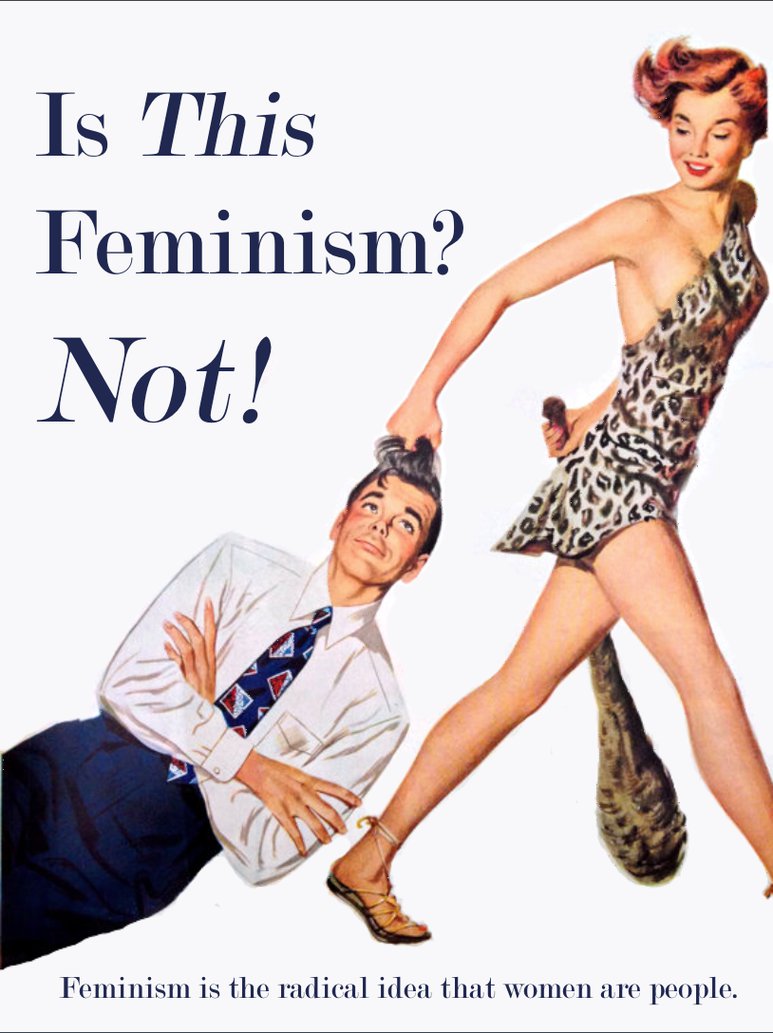
Original photo: http://poasterchild.deviantart.com/art/Feminism-Not-406854334

With that caveat in mind, I ask the following questions:

  • Is the author suggesting a move to a “hypermasculinity”?
  • Is Adams identifying masculinity with aggression and violence in a world where feminists and perhaps all women are demonized?

In a society dominated by the “alpha male” character trait,male  honor and pride are paramount. Is Fox News telling men to replace so-called passive behavior with pride, abrasiveness, authoritarianism, and arrogance–in such a world if where women are demonized, then assaultand rape will follow.  The call for “real men” or “hyper-masculinity” therefore provides a real potential to move us further towards a misogynistic rape culture of violence–in the direction of barbarianism.

Continue reading “Seriously?! Let’s Blame Feminism for the Creation of a “Wimpy” Nation by Michele Stopera Freyhauf”