Exploring the F-word in religion at the intersection of scholarship, activism, and community.
Author: Molly Remer
Molly Remer, MSW, D.Min, is a priestess, mystic, and poet facilitating sacred circles, seasonal rituals, and family ceremonies in central Missouri. Molly and her husband Mark co-create Story Goddesses at Brigid’s Grove (http://brigidsgrove.etsy.com). Molly is the author of many books, including Walking with Persephone, 365 Days of Goddess, Whole and Holy, Womanrunes, and the Goddess Devotional. She is the creator of the devotional experience #30DaysofGoddess and she loves savoring small magic and everyday enchantment.
http://30daysofgoddess.com
“…There, he found a piece of glass and began to tell a story. He was telling one of his tribe’s men’s stories. It was a story for boys to become men, and it was not shared with women. The women had their own stories, not for men to know. I read that and thought, no one took me out into the desert; no one told me stories. That’s what I needed, a passing of history and the ways of living, from one man to another.”
–Christopher Penczak, Sons of the Goddess, p. 51
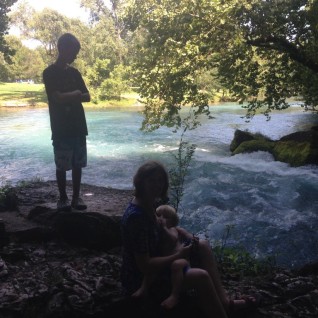
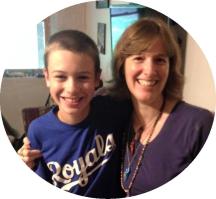
Our oldest son is rapidly sliding into manhood. Creaky voice. Height stretching on a near-daily basis. Fuzz on upper lip. I am finding it hard to hold
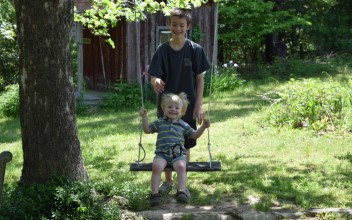
space for his transition as a teenager while still caring for a not-quite-two year old small boy as well, one who reminds me regularly of my first baby boy and what it was like to be a mother to only one, focused on each stage of development, each new word, each successful identification of a new color. Now that first baby boy swings that last baby boy onto one hip with practiced ease, washes dishes, helps to cook, pours milk for his sister.
Several years ago, I was asked to work on a coming of age/manhood ceremony for a friend’s son. It never quite came together—I didn’t feel like I could do it and I still feel regret about having let that boy down. At the time though, and still now, I felt that I’m not “qualified” for the job—I don’t know the men’s stories either. The council of men needs to prepare his ceremony. Where is the men’s council, the circle of men? I think we have them around us, but that there is much less cultural permission for them to gather in groups to honor transitions in sacred ways. Much as women’s circle work feels radical and transformative and even threatening to patriarchal culture, men gathering in circle to honor and guide one another, that is perhaps even more so. I see Red Tents around the world. I see women’s circles springing up with a glorious passion and far flung expression. I am guiding other priestesses in circle work, and Red Tents and Pink Tents, and holding ceremonies for our daughters coming of age. What about our sons? Where are their ceremonies and welcomes into manhood? Where are their stories in the desert? Is it a mother’s job to provide the container for those stories? Can I call the circle for my son and then step back? I know what it means to be a girl reaching into womanhood. I know what it means to circle with other women. Does it have to be different for boys and men?
When I was reading books, looking for ideas for my friend’s son, I noticed that most pagan rituals described for boys include the element of the son being “kidnapped” from the mother, women, and girls and being taken away by the men and left alone. I hate these rituals. Every time I read one like it, my heart screams, “NO, we want more than that for our sons.” Despite being promoted as part of an alternative spiritual framework, how does this type of ceremony support and honor the type of world we wish our children to grow up in? Why do boys need to be kidnapped from their mothers and left alone in order to be men? Isn’t that the very root of patriarchy on this earth? No thank you.
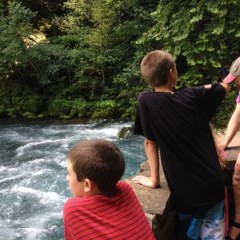
I bought another book specifically because it mentioned including a rite of passage ceremony for boys. I read it with eagerness and was dismayed at what I found. The circle was called, held at dusk, and each person was instructed to bring a rock for the newly fledgling boy. They were to go around the circle and share what they learned, what they were imbuing into the stone…so far, so good, right?…and then, throw it into the darkness and say, “find it for yourself.” When I read this, I had an epiphany. If this was a ceremony for girls, we each would have handed her the stone and welcomed her into the circle with our wisdom, we would have made sure she knew that she was strong, powerful, and capable, but also that part of that power meant that we were standing with her and offering our wisdom in support. She would not have to crawl in the darkness alone looking for rocks, because we’re there. And, that is the core message of most women’s circles and ceremonies for girls. We’re there. You are not alone. So, then I knew…a ceremony for a boy need look no different. Maybe I do not know the stories from the men’s desert, but I do know what it is like to celebrate someone for their unique gifts and strengths, look them in the eye and affirm their power, and sing to them with love of my support of their dreams. This is not a gendered thing, this is humanity. How do we want to welcome boys into the world of adults? By casting away our wisdom and telling them to search in the darkness for themselves? Or by standing next to them, shoulder to shoulder, hand in hand, and offering all that we have, all that we are, in support, and trust, and honor of their evolving selves?
This summer, we gathered in sacred circle for a chanting workshop and a summer ceremony. The men at the chanting workshop sang just as wonderfully together as the women do in the Red Tent. The boys in the summer circle joined hands just like anyone else.
We do know how to do this.
This song below was recorded during the chanting workshop and feels appropriate for this occasion…
Molly has been “gathering the women” to circle, sing, celebrate, and share since 2008. She plans and facilitates women’s circles, seasonal retreats and rituals, mother-daughter circles, family ceremonies, and red tent circles in rural Missouri and teaches online courses in Red Tent facilitation and Practical Priestessing. She is a priestess who holds MSW, M.Div, and D.Min degrees and finished her dissertation about contemporary priestessing in the U.S. Molly and her husband Mark co-create original goddess sculptures, ceremony kits, and jewelry at Brigid’s Grove. Molly is the author of Womanrunes, Earthprayer, and The Red Tent Resource Kit and she writes about thealogy, nature, practical priestessing, and the goddess at Brigid’s Grove.
This is a continuation of Molly’s piece from Wednesday, 10 August 2016. You can read Part 1 here.
After explaining that the homebirth of her second son was her, “first initiation into the Goddess…even though at that time I didn’t consciously know of Her,” Monica Sjoo writing in an anthology of priestess essays called Voices of the Goddess, explains:
The Birthing Woman is the original shaman. She brings the ancestral spirit being into this realm while risking her life doing so. No wonder that the most ancient temples were the sacred birth places and that the priestesses of the Mother were also midwives, healers, astrologers and guides to the souls of the dying. Women bridge the borderline realms between life and death and in the past have therefore always been the oracles, sibyls, mediums and wise women…
…the power of original creation thinking is connected to the power of mothering. Motherhood is ritually powerful and of great spiritual and occult competence because bearing, like bleeding, is a transformative magical act. It is the power of ritual magic, the power of thought or mind, that gives rise to biological organisms as well as to social organizations, cultures and transformations of all kinds… (page unknown).
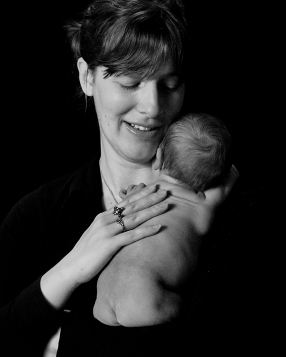
I have been a childbirth educator since 2006 and I have given birth five times. Each birth brought me the gift of a profound sense of my own inherent worth and value. It was the shamanic journey through the death-birth of my tiny third child, however, that ushered in a new sense of my own spirituality and that involved a profound almost near-death experience for me. After passing through this intense, initiatory crisis, the direction and focus of my life and work changed and deepened. Shortly after the death-birth of my third son, I wrote: Continue reading “Priestess as Shamanic Path – Part 2 by Molly Remer”
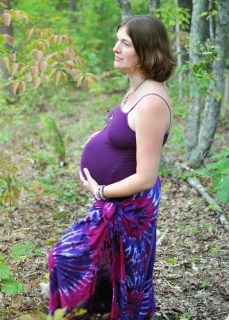
It is late autumn, 2009. I am 30 years old and pregnant with my third baby. He dies during the early part of my second trimester and I give birth to him in my bathroom, on my own with only my husband as witness. The blood comes, welling up over my fingers and spilling from my body in clots the size of grapefruits. I feel myself losing consciousness and am unable to distinguish whether I am fainting or dying. As my mom drives me to the emergency room, I lie on the back seat, humming: “Woman am I. spirit am I. I am the infinite within my soul. I have no beginning and I have no end. All this I am,” so that my husband and mother will know I am still alive.
I do not die.
This crisis in my life and the complicated and dark walk through grief is a spiritual catalyst for me. A turning point in my understanding of myself, my purpose, my identity, and my spirituality.
It is my 31st birthday. May 3rd. My baby’s due date. I go to the labyrinth in my front yard alone and walk through my labor with him, remembering, releasing, letting go of the stored up body memory of his pregnancy. I am not pregnant with him anymore. I have given birth. This pregnancy is over. I walk the labyrinth singing and when I emerge, I make a formal pledge, a dedication of service and commitment to the Goddess. I do not yet identify myself verbally as a priestess, but this is where the vow of my heart begins.
I do not know at the time, but less than two weeks later, I discover I am in fact pregnant with my daughter, my precious treasure of a rainbow baby girl who is born into my own hands on my living room floor the next winter. As I greet her, I cry, “you’re alive! You’re alive! There’s nothing wrong with me!” and feel a wild, sweet relief and painful joy like I have never experienced before.
“When all is said and done I think every Witch should, at some time, face the moon alone, feet planted on the ground, with only his or her voice chanting in the starry night.”
–Laurie Cabot, Power of the Witch
I will never forget the first time I heard someone recite the Charge of the Goddess from memory. Bare-breasted, she strode around the fire in sacred circle at a large goddess festival in Kansas, delivering the words with power, grace, and confident resonance. I thought: I will do that someday.
In February of this year, we took a family trip to Dauphin Island. While there, the afternoon of the full moon, I
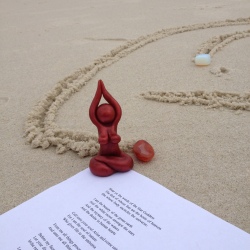
decided that the time had come. I was going to memorize the Charge of the Goddess. First, I thought I would only memorize it a piece at a time. It seemed “too big” to do in a single sitting. I had it printed out on a piece of paper that rapidly became damp with the salty sea air. I drew a labyrinth in the sand with my toes, set one of my goddess sculptures at its entrance, and drew a Womanrunes card.
One stanza at a time, slowly I began to repeat the poem* aloud:
hear ye, the words of the star goddess
the dust of whose feet are the hosts of heaven...
Over and over, I said the words, letting them twine around my tongue and in the air, experimenting with cadence and rhythm. After I could reliably repeat one section, I’d move to the next, letting it build in my memory until I could put the two together confidently and then moving to the next.
I am the beauty of the green earth
the white moon amongst the stars..
I stared into the waves, listening to them rise and fall along with my words. My three older children dug in the sand.
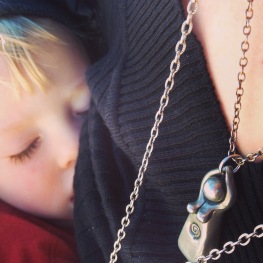
My husband fished. My toddler toddled around and then came to sit on my lap and nursed to sleep for nap time:
before my face
beloved of all…
I whispered into his damp hair. I felt in an altered state of consciousness. The words began to wind their way through me, becoming a part of me, embedded in me. I danced with them as I have never danced with another piece of writing. I felt them merging with me. I sang them aloud. I stated them fast and slow and I built, adding the next line and then the next…
for behold, all acts of love and pleasure
all my rituals.
I turned over hard thealogical questions as the words spun their magic through the air. What does it really mean that “all your learning and seeking shall avail you not, lest your know the mystery.” Do I really feel the goddess within? Do I find her within myself or is she only outside and if she is only outside, does she really exist at all? Tears came to my eyes: do I even like myself?
Two hours passed. My baby awoke and returned to digging in the sand. My husband packed up his fishing gear. The sky began to darken and spit rain. I stood and danced the words into the sand with my feet.
let your divine innermost self
be enfolded
in the rapture
of the infinite
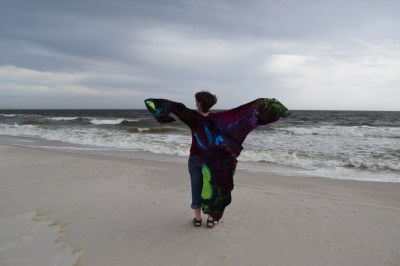
I felt rapturous. I felt triumphant. I had done it. Faster and faster my feet stamped the sand as I called the words into the waves. I spun in circles with my toddler chanting and laughing and offering my devotion before the sea, beneath the moon.
the mystery of the waters
the desire in human hearts…
*I used Shekhinah Mountainwater’s adaptation of the Charge, originally by Doreen Valiente, as included in the book Ariadne’s Thread.
Molly has been “gathering the women” to circle, sing, celebrate, and share since 2008. She plans and facilitates women’s circles, seasonal retreats and rituals, mother-daughter circles, family ceremonies, and red tent circles in rural Missouri and teaches online courses in Red Tent facilitation and Practical Priestessing. She is a priestess who holds MSW and M.Div degrees and recently finished her dissertation about contemporary priestessing in the U.S. Molly and her husband Mark co-create original goddess sculptures, ceremony kits, and jewelry at Brigid’s Grove. Molly is the author of Womanrunes, Earthprayer, and The Red Tent Resource Kit. She writes about thealogy, nature, practical priestessing, and the goddess at her Woodspriestess blog.
A friend once laughed to hear me describe picking wild raspberries as a “holy task,” but it is. A task earthy, embodied, mundane, and miraculous at once. Each year, I sweat and struggle, am scratched and stung, but I return home once again with my bounty.
As I returned, red-faced, sweating, and after having yelled much more than I should and having said several things I instantly regretted, I was reminded of something that I manage to forget every year: one definition of insanity is picking wild berries with a toddler. In fact, the closest I ever came to spanking one of my kids was during one of these idyllic romps through the brambles when my second son was three. While still involving some suffering, this ramble was easier since I had a nine and a half year old as well as the toddler. This time, my oldest son took my toddler daughter back inside and gave her a bath and put her in new clothes while I was still outside crawling under the deck in an effort to retrieve the shoes and the tiny antique ceramic bluebird that my girl tossed over the railing and into the thorns “for mama.”
While under the deck, I successfully fished out the shoes (could not find the tiny bird) and I found one more small handful of raspberries. Since the kids were all safely indoors, I took my sweaty and scratched up and irritable self and ran down to my sacred sanctuary in the woods. I was thinking about how I was hot, tired, sweaty, sore, scratched, bloody, worn, and stained from what “should” have been a simple, fun little outing with my children and the above prayer came to my lips. I felt inspired by the idea that parenting involves uncountable numbers of small, wild adventures. I was no longer “just” a mom trying to find raspberries with her kids, I was a raspberry warrior. I braved brambles, swallowed irritations, battled bugs, sweated, swore, argued, struggled, crawled into scary spaces and over rough terrain, lost possessions and let go of the need to find them, and served as a rescuer of others. I gave my blood and body over to the task.
Like Inanna, I faced thorny gates and descended into darkness, crawled on my knees, and gave up things that I cherished, and in the process discovering things about myself, and then returned with a renewed sense of purpose and an awareness of my own strengths.
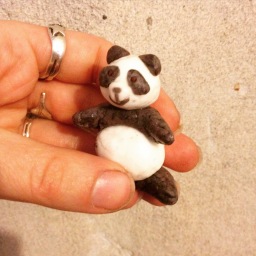
Now this year, I set out to make homemade marshmallow fondant icing for our daughter’s fifth birthday party. My goal: to make little fondant pandas for her birthday cake. I began with my two pounds of powdered sugar, my melted marshmallows, and my all-natural $12 jar of black food pigment. As I kneaded and kneaded the stiff and difficult dough, my journey became more arduous. I ended up yelling at my lovely children who were leaning over my shoulders to watch the adventure unfold. I said, “just get out of the kitchen!” to the birthday girl herself and I hollered for my now 12 year old to come peel the one year old away from my legs as he attempted to scale my body and reach my arms while my hands were covered with black-icing cement. I ranted and raved briefly about how this is an example of my own life-long tendency to overdo and overperform. Making these pandas wasn’t necessary. I do it to myself. Why do this to myself, I lamented over and over. What is the point? What am I teaching my kids—the cost of having fun and doing something nice and neat for each other is yelling and feel strained and tense? What didn’t I just buy lard-frosting, I lamented (meaning slimy hydrogenated oil frosting from the store). Why aren’t we eating Chicken McNuggets and a cake from Wal-Mart right now? Wouldn’t that be better than yelling at my kids and forcing myself to spend hours kneading panda dough? Shouldn’t we just eat frozen taquitos and watch TV all day and never, ever invite anyone to come to a birthday party ever again?
Then, I fell into a rhythm with the fondant. The sugar started to incorporate. The black started to knead in. I could see it coming together. This is a Hero’s Journey, I thought, this is an Inanna’s Descent. I heard the call to adventure, or fondant, as it were, and I answered. I set forth with my tools and my optimism. I was challenged on my journey. I came face to face with my own shadows. My fingernails became stained with effort. I cast away expectations and judgments. And, then I started to emerge, coming back from my trek, bearing my prize, carrying my treasure, offering my sweet elixir to my people. When I realized it was actually going to work, I started to feel a sense of exhilaration and glee. It is empowering to make your own dang fondant. I called out to my husband with a slightly manic bark of laughter, this is another one of those small adventures! Parenting involves hero’s journeys and Inanna’s Descents every day. What if I’d given up when the fondant got tough? Doesn’t that teach my kids to quit, to not bother, to not learn, experiment, do, and try? I thought about giving birth to my children—how the going gets difficult, how you feel like giving up, and then you emerge, tender and strong, a new human in your arms. I did that! I can do anything! My parenting is stronger, richer, and deeper from knowing that I can face difficult tasks and do them anyway, from knowing that I can draw upon my own strength, my own body wisdom, my own power, and succeed. I am a better person, a better mother, for having hit my own limit and then, incredibly, realized I could go beyond it, that I actually still had the will and courage left in me to do it. Those pandas, while less earth-shaking and life-changing than giving birth to children, were birthed from my own love and effort into my black-icing hands, and my willingness to do it myself, for the ones I love.
I’ve said before that I’d rather be the mom that does cool and fun stuff with her kids and sometimes yells while doing it than a mom who doesn’t yell, but who doesn’t do cool stuff because she’s afraid she might yell or worse yet, because she doesn’t have any fun ideas. (Of course, an awesomer option, would be to be the mom who does cool stuff and also doesn’t yell, but I’m not holding my breath on that one!) After I constructed the first tiny panda and seeing how cute it was and how excited my daughter was about her cake, I felt such a sense of thrill and triumph. I thought that if I hadn’t decided to do it and make it easier on myself, sure, I wouldn’t have yelled, but I also wouldn’t have felt the empowering sense of having done exactly what I imagined doing. When you do hard things and encounter shadows and keep going and come out the other side, you are strengthened. You learn something about yourself. You realize your own capacities and power. If you are unwilling to embark, you stay safer, and maybe even are a nicer person, but you do not experience the overwhelming satisfaction of accomplishment. The pairing—the difficultywith the triumph—is what makes the journey worth it. This is it, I told my husband, this is The Return. I have returned to my people and I come bearing bears. It feels good to be home.
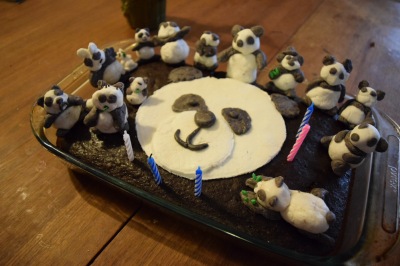
Each child at her party made a panda to add to the cake.
Molly has been “gathering the women” to circle, sing, celebrate, and share since 2008. She plans and facilitates women’s circles, seasonal retreats and rituals, mother-daughter circles, family ceremonies, and red tent circles in rural Missouri and teaches online courses in Red Tent facilitation and Practical Priestessing. She is a priestess who holds MSW and M.Div degrees and recently finished her dissertation about contemporary priestessing in the U.S. Molly and her husband Mark co-create original goddess sculptures, ceremony kits, and jewelry at Brigid’s Grove. Molly is the author of Womanrunes, Earthprayer, and The Red Tent Resource Kit.She writes about thealogy, nature, practical priestessing, and the goddess at her Woodspriestess blog.
If you ever eavesdrop on a conversation between my husband and me around the clamor of our four children’s voices, you will probably hear me making a tired lament: “All I want is a broad swath of uninterrupted time.” In listening to Elizabeth Gilbert’s newest book, Big Magic, on audio book I was interested by her mention that many creative people lament not having long stretches of uninterrupted time available in which to work. She quotes a letter from Herman Melville to Nathaniel Hawthorne, lamenting his lack of time and how he is always pulled “hither and thither by circumstances.” Melville said that he longed for a wide-open stretch of time in which to write. She says he called it, “the calm, the coolness, the silent grass-growing mood in which a man ought always to compose.”
…I do not know of any artist (successful or unsuccessful, amateur or pro) who does not long for that kind of time. I do not know of any creative soul who does not dream of calm, cool, grass-growing days in which to work with- out interruption. Somehow, though, nobody ever seems to achieve it. Or if they do achieve it (through a grant, for in- stance, or a friend’s generosity, or an artist’s residency), that idyll is just temporary—and then life will inevitably rush back in. Even the most successful creative people I know complain that they never seem to get all the hours they need in order to engage in dreamy, pressure-free, creative exploration. Reality’s demands are constantly pounding on the door and disturbing them. On some other planet, in some other lifetime, perhaps that sort of peaceful Edenic work environment does exist, but it rarely exists here on earth. Melville never got that kind of environment, for instance. But he still somehow managed to write Moby-Dick, anyhow.
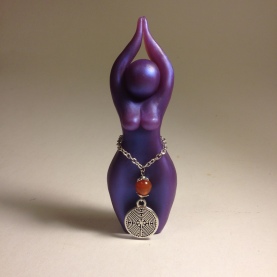
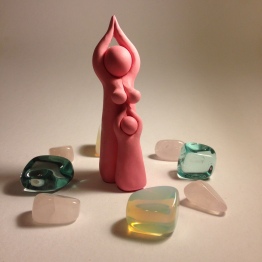
When I create a new sculpture, I am most often creating something that I need to remember or want to learn. The original figures for my Centered Mama sculpture and my Meditation Goddess sculpture were both created while at a friend’s house for a weekend work exchange as my baby toddled around. While I love making figures of mothers and babies, I was feeling a strong urge to make a goddess representation complete unto herself. It felt like a reclaiming of my non-maternal identity and a declaration of self-sovereignty. She turned out a little bigger than some of my other figures, strong and secure and independent. Then, the baby crawled over and knocked off one of her breasts, knocked her over on the tray, smashing the side of her head. I came close to crying. I felt annoyed with my husband who’d “let” him come over and destroy my work rather than noticing him doing it and stopping him. I was frustrated, dismayed, and my feelings felt hurt in a sense. First I felt like, Argh! This is a metaphor for life! And, then I realized it was not just a metaphor for life, it is my actual life! I pouted a bit and said I was just going to smash her and give up and I made some bitter faces at my husband and some long-suffering huffs and signs, but then the baby fell asleep in the Ergo, held close against my chest. I kissed his soft hair and I took my clay and started again. I reclaimed her from the smashed parts and she sat stronger and taller than ever.
She reminds me not to give up and that beautiful work can come from struggle, but also of interdependence (not just the independence I was going for!), co-creation, and tenacity. When the finished version of her, cast from the original sculpt, sits by my bed at night or overlooks my dinner preparations, she reminds me that I am strong and that persistence is worthwhile. She also tries to remind me to be calm and steady, centered and Zen, even though I more often feel like a whirlwind.
That same Saturday at my friend’s house, as my baby tentatively toddled around the kitchen, chewed on a piece of watermelon, and snoozed on my chest, I felt moved to begin creating a new Centered Mama sculpture. I had been going through an emotional rough patch, feeling buffeted by variable emotions and erratic and unpredictable in my enthusiasm and confidence. I was also feeling impatient, snappy, and irritable.
“I will be gentle with myself. I will be tender with my heart. I will hold my heart like a newborn baby child.”
This song by Karen Drucker replayed in my mind as I sculpted. The baby woke, the watermelon got dragged along the floor collecting dust, and it was time for our collaborative dinner, so I had to put her away unfinished. When we got back to our own home, I was compelled to finish her, working feverishly as the baby pulled on my legs and I said, “just a few more minutes!” to the older kids who were trying to play with him to let me work. Again and again I re-rolled the clay baby’s head, trying to make it “perfect,” and worked to lay down the strands of her hair, against of the backdrop of this often-chaotic, noisy, home-based life we’ve consciously and intentionally created together. She was created to represent holding my own center in the midst of motherhood. I will be tender with my heart. I don’t create sculptures like this because I AM so “Zen” and have life all figured out, I make them to remind me what is possible if I listen to my soul.
As I do extensive rearranging, construction, and reconstruction on my slowly ongoing dissertation project, I typed out a quote from the book Priestess: Woman as Sacred Celebrant by Pamela Eakins about her past life memories of making clay goddess figures as a temple priestess:
…to me it brought a continuation of the energy of the sacred objects of the grandmothers. I contained this energy in a new form in the dolls that would be placed upon the altars and in the graves of the daughters living now and the daughters to come…
I felt this process made my own clay stronger, too. Some of the pieces cracked in the fire because of the added ‘impurities’…but, in this case, I felt the impurities were the purest of pure and I worshipped each crack knowing the crack contained the wisdom of the priestesses who had occupied the doll-making table for more moons than I could even imagine. It contained too, the devotional energy of every grandmother who had held it in her hands or placed it on her altar. Sometimes ‘impurities’ sanctify further that which is holy to begin with.
While I tend to have a knee-jerk skepticism about past-life memories, there is something in Eakins’ words that I know at a bone-deep level as I do my own work with goddesscraft:
…Each goddess was imprinted with the sound of sacred life coursing through the Universe. I changed with the priestesses as the figures came through my hands. Each doll received the sacred vibration of life…For seventy-seven moons I made the dolls at the long table with the young Sisters of Nun. My hands were so fast. I made thousands of figures: beautiful little faces, etched collars of gold plates, pubic hair swirled into tiny rows of connecting spirals. They were so precious. At the end of the day, my baked clay shelves were covered with little women.
The clay goddesses healed…
This is how I apprenticed. I learned, in this manner, the art of healing. I learned that to heal means to make whole, and that becoming whole involves learning many levels of purification, balance, and reformation” (p. 32-33).
In Anne Key’s marvelous priestess memoir, Desert Priestess, she makes this important point: “It is of course no small wonder why graven images are so tightly controlled by religious traditions.” (p. 52) Sometimes I feel like this is what I’m tapping into when I make my own goddess sculptures—a resistance to tight control over graven images and over personalization of divinity as male.
I occasionally get requests to make bigger goddesses–-people ask about figures that are large altar pieces 12-18 inches tall or taller. The goddesses I make are all about three inches tall and there’s a reason for that: they fit in the palm of my hand. When I create them, I feel as if I’m part of an unbroken lineage stretching back 30,000 years to the person who carved the Goddess of Willendorf. I feel connected to the priestesses of the Mesopotamian temples who sculpted hundreds upon hundreds of tiny clay goddesses. Someone commented on my sculptures once saying, “echoes of Mesopotamia.” And, I said, “exactly.” I feel the connection between the clay in my hand and the clay in their hands, running through the ripples and eddies of time.
I’ve been inspired recently to re-read Starhawk’s The Spiral Dance, finding new bits of wisdom from it that speak to something different in me than they did the first time I read it. She writes of the attempts to discredit Goddess religion by invalidating the historical narratives or archaeological evidence: “The idea seems to be that if they can disprove our origin story, they can invalidate our spirituality…Is Buddhism invalid if we cannot find archaeological evidence of Buddha’s existence? Are Christ’s teachings unimportant if we cannot find his birth certificate or death warrant?…the truth of our experience is valid whether it has roots thousands of years old or thirty minutes old…a mythic truth whose proof is shown not through references and footnotes but in the way it engages strong emotions, mobilizes deep life energies, and gives us a sense of history, purpose, and place in the world. What gives the Goddess tradition validity is how it works for us now, in the moment, not whether or not someone else worshipped this particular image in the past” (p. 4).
The ancestry of my goddess sculptures may not be the same energy that raised temples and built monuments (or walls), it is the energy that carried a baby on one hip and a basket of supplies on the other and needed a goddess just the right size to tuck down the front of a shirt…
Sometimes I describe my life in the woods as being held in the hand of the goddess. And, I make goddesses that I hold in my hand. Am I in the palm of her hand or is she in the palm of mine? The answer is both.
(One of my all-time favorite fan photos–a rainy day traveling goddess picture, taken by my friend/SIL (this one is only an inch tall, but look how she calls in the waters of the world!)
Molly has been “gathering the women” to circle, sing, celebrate, and share since 2008. She plans and facilitates women’s circles, seasonal retreats and rituals, mother-daughter circles, family ceremonies, and red tent circles in rural Missouri. She is an priestess who holds MSW and M.Div degrees and she is finishing her dissertation about contemporary priestessing in the U.S. Molly’s roots are in birth work and in domestic violence activism. She has worked with groups of women since 1996 and teaches college courses in group dynamics and human services. Molly is the author of Womanrunes: a guide to their use and interpretation, Earthprayer, Birthprayer, Lifeprayer, Womanprayer, and The Red Tent Resource Kit, as well as three social service oriented booklets and a miscarriage memoir. She has maintained her Talk Birth blog since 2007 and writes about thealogy, nature, practical priestessing, and the goddess at her Woodspriestess blog. Molly and her husband Mark co-create original birth art, goddess sculptures, ceremony kits, and pendants at Brigid’s Grove.
“The tools are unimportant; we have all we need to make magic: our bodies, our breath, our voices, each other.”
–Starhawk
As November drew to a rainy close, we had a small family full moon ritual on our back deck and incorporated a simple gratitude ritual into it. The sky was overcast so we couldn’t actually see the moon, but my four-year-old daughter wanted to get out glow sticks left over from Halloween. We had so much fun dancing around with them and making patterns together in the dark night. We sang a chant I recently made up:
Hallowed evening
Hallowed night
We dance in the shadows
We offer our light.
We did a simple gratitude practice by placing corn kernels in a jar, one for each thing we are grateful for from the past month. We started out slowly and taking turns and then we sped up and the gratitude offerings came tumbling out, over one another. Even the one-year-old added corn, rapidly yet with great concentration to make it actually go in the jar. We drummed and called out, “We are ALIVE! We are GRATEFUL! We are POWERFUL! We are CREATIVE!” When we finally decided to close our ritual and go back inside, the moon peeked out from behind the clouds to briefly say hello and it felt like a blessing on the magic we’d just created together.
As we went back inside, I felt relaxed, happy, and connected. For being something very simple, not particularly pre-planned, and semi-chaotic, it felt like one of our deepest and most connected personal family rituals. The quote above from Starhawk floated back into my mind and I reflected that when I try “too hard” to get things ready for a perfect ritual, I often end up feeling a disappointed. Sometimes I feel like giving up on holding ceremonies with my children entirely. Last year, as we prepared to walk our Winter Solstice Spiral, the baby had a poopy diaper that extended up his back. I often end up snapping critically at whomever isn’t doing it “right.” My boys make fart jokes. My husband gives long-suffering sighs. Our circle looks more like a lopsided peanut. Our humming together discordant and off-key. As we lie on the ground together on the Spring Equinox to do our “Earth Listening” practice together, the kids wiggle and fight, pushing one another off the blanket and exclaiming in loud voices so no one can hear what we’re listening for. We listen to a shamanic drumming CD, but the only one to reach a trance state is the baby as I pace back and forth with him in a baby carrier. The four year old ends up crying because she doesn’t see anything and she wanted to see something cool. Martyrpriestess emerges to complain that she doesn’t know why she even bothers trying to do nice things for anyone if this is how you’re all going to act.
I recently finished reading Under Her Wings: The Making of a Magdalene, by Nicole Christine. A theme running through the book was the concept of “As Above, So Below and As Within, So Without.” I read this book as part of my research for my dissertation about contemporary priestessing and as I read, I kept thinking, I want to hear from the Mamapriestesses, from the Hearth Priestesses! Where are the other practicing priestesses with children at home? I noticed in Christine’s book that the bulk of her work took place after her children were grown and, to my mind, she also had to distance or separate from her children and her relationships in order to fully embrace her priestess self. I notice in my reading and my research group that many women seem to come to priestess work when the intensive stage of motherhood has passed, or they do not have children. Is there a very good reason why temple priestesses were “virgins” and village wise women were crones? Where does the Mamapriestess fit?
As I read Christine’s book and witnessed her intensive self-exploration, discovery, and personal ceremonies and journeys, I realized that in many ways personal exploration feels like a luxury I don’t have at this point in my parenting life. How do we balance our inner journeys with our outer processes? Christine references having to step aside and be somewhat aloof or unavailable to let inner processes and understandings develop, since our inner journeys may become significantly bogged down in groups by interpersonal relationships, dramas, venting, chatting, and so forth. For me, this distance for inner process exploration isn’t possible in the immersive stage of life as a mother. And, yet, I also know in my bones that I’m not meant to give it up. How does the As Within and the So Without actually work?
I return to our Full Moon gratitude ritual. My oldest son, 12, whose height is rapidly extending into manhood, totes his tiny brother on one hip with practiced ease, offering his own glow stick and helping my little one hold his into the air. He expresses gratitude for the fun he’s been having this month with his new video game and, “I’m grateful for you for doing things like this with us, Mom.”
My second son, 9, my bravest child, crawls willingly into the darkness under the deck to retrieve lost glow sticks, poked purposefully down porch cracks by the one year old. He returns, triumphant, holding the bundle of sticks aloft.
My daughter, nearly five, tips her face back, looking up at me with eyes alight, “I’m glad to be a Goddess Girl!” she calls out…
Molly has been “gathering the women” to circle, sing, celebrate, and share since 2008. She plans and facilitates women’s circles, seasonal retreats and rituals, mother-daughter circles, family ceremonies, and red tent circles in rural Missouri. She is an ordained priestess who holds MSW and M.Div degrees and she is currently writing her dissertation about contemporary priestessing in the U.S. Molly’s roots are in birth work and in domestic violence activism. She has worked with groups of women since 1996 and teaches college courses in group dynamics and human services. Molly is the author of Womanrunes: a guide to their use and interpretation, Earthprayer, Birthprayer, Lifeprayer, Womanprayer, and The Red Tent Resource Kit. She has maintained her Talk Birth blog since 2007 and writes about thealogy, nature, practical priestessing, and the goddess at her Woodspriestess blog. Molly and her husband Mark co-create original birth art jewelry, figurines, and goddess pendants at Brigid’s Grove.
Note: If you have children at home, I’d love to hear from you about the Mamapriestess topic! If you do not have children by choice, how does this play into your spiritual work? If you do not have children and that is not by choice, how does this play into your spiritual work?
“Human connections are deeply nurtured in the field of shared story.” –Jean Houston
“The universe of made of stories, not of atoms.” –Muriel Rukeyser
This month I went searching for a quote for one of my Red Tent Initiation students. She had shared some powerful reflections about the vulnerability required to reveal our personal stories—there can be a lot of risk, sometimes shame, and more, bound up in our ability to uncover ourselves and speak our truth. What I wanted to communicate with her was the idea that in sharing our stories, including the painful pieces, we free other women to do the same. Our courage to be vulnerable, to be naked, to be flawed, to experiment with ideas, concepts, or ways of being gives permission for other people to do the same.
In 2012, I went to a dancing workshop at Gaea Goddess Gathering. The facilitator mentioned that when facilitating ritual, you have to be willing to look a little ridiculous yourself, have to be willing to risk going a little “over the top” yourself, because in so doing you liberate the other participants—“if she can take that risk and look a little goofy doing so, maybe it is okay for me to do it too.”
After a lot of digging around, I found the quote! I should have known it was from one of my favorite authors and sister FAR blogger, Carol Christ, who said:
“When one woman puts her experiences into words, another woman who has kept silent, afraid of what others will think, can find validation. And when the second woman says aloud, ‘yes, that was my experience too,’ the first woman loses some of her fear.”
This is part of what makes Red Tent Circles so powerful. When women are willing to dig into the questions, activities, and processes, to turn them over, to explore how they work in their own lives…they lose some of the fear and they encourage others to lose their fear too. Continue reading “Story Woman by Molly”
“I believe that these circles of women around us weave invisible nets of love that carry us when we’re weak and sing with us when we’re strong.”
–SARK, Succulent Wild Woman
Seven years ago, a small postcard at the local Unitarian Universalist church caught my eye. It was for a Cakes for the Queen of Heavenfacilitator training at Eliot Chapel in St. Louis. I registered for the training and went, driving alone into an unknown neighborhood. There, I circled in ceremony and sisterhood with women I’d never met, exploring an area that was new for me, and yet that felt so right and so familiar.
I’d left my two young sons home for the day with my husband and it was the first time in what felt like a long time that I’d been on my own, as a woman and not someone’s mother. At the end of the day, each of us draped in beautiful fabric and sitting in a circle around a lovely altar covered with goddess art and symbols of personal empowerment, I looked around at the circle of women and I knew: THIS is what else there is for me. Continue reading “Restoring Ourselves to Ceremony: Red Tent Circles, by Molly”
Like flower growing from rock the world is full of tiny, perfect mysteries. Secrets of heart and soul and landscape guarded tenderly taking root in hard crevices stretching forth in impossible silence.
Sleeping resting waiting watching knowing that all one needs is a crack in stone and a seed of possibility…
One spring evening during my year-long woodspriestess experiment , I went for a walk through the woods with my husband and daughter and we discovered something that delighted and thrilled me. It was rock with a small, perfect flower growing out of it and it was a powerful symbol of what I learned from my time in the woods. Continue reading “Stoneflower by Molly”


 for our daughters coming of age. What about our sons? Where are their ceremonies and welcomes into manhood? Where are their stories in the desert? Is it a mother’s job to provide the container for those stories? Can I call the circle for my son and then step back? I know what it means to be a girl reaching into womanhood. I know what it means to circle with other women. Does it have to be different for boys and men?
 what I found. The circle was called, held at dusk, and each person was instructed to bring a rock for the newly fledgling boy. They were to go around the circle and share what they learned, what they were imbuing into the stone…so far, so good, right?…and then, throw it into the darkness and say, “find it for yourself.” When I read this, I had an epiphany. If this was a ceremony for girls, we each would have handed her the stone and welcomed her into the circle with our wisdom, we would have made sure she knew that she was strong, powerful, and capable, but also that part of that power meant that we were standing with her and offering our wisdom in support. She would not have to crawl in the darkness alone looking for rocks, because we’re there. And, that is the core message of most women’s circles and ceremonies for girls. We’re there. You are not alone. So, then I knew…a ceremony for a boy need look no different. Maybe I do not know the stories from the men’s desert, but I do know what it is like to celebrate someone for their unique gifts and strengths, look them in the eye and affirm their power, and sing to them with love of my support of their dreams. This is not a gendered thing, this is humanity. How do we want to welcome boys into the world of adults? By casting away our wisdom and telling them to search in the darkness for themselves? Or by standing next to them, shoulder to shoulder, hand in hand, and offering all that we have, all that we are, in support, and trust, and honor of their evolving selves?
 Goddess, explains:
 part of my second trimester and I give birth to him in my bathroom, on my own with only my husband as witness. The blood comes, welling up over my fingers and spilling from my body in clots the size of grapefruits. I feel myself losing consciousness and am unable to distinguish whether I am fainting or dying. As my mom drives me to the emergency room, I lie on the back seat, humming: “Woman am I. spirit am I. I am the infinite within my soul. I have no beginning and I have no end. All this I am,” so that my husband and mother will know I am still alive.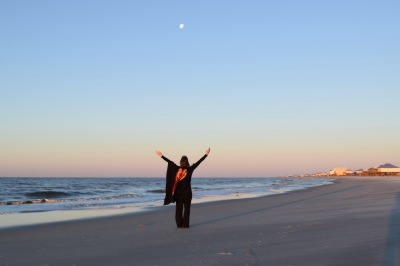
 goal: to make little fondant pandas for her birthday cake. I began with my two pounds of powdered sugar, my melted marshmallows, and my all-natural $12 jar of black food pigment. As I kneaded and kneaded the stiff and difficult dough, my journey became more arduous. I ended up yelling at my lovely children who were leaning over my shoulders to watch the adventure unfold. I said, “just get out of the kitchen!” to the birthday girl herself and I hollered for my now 12 year old to come peel the one year old away from my legs as he attempted to scale my body and reach my arms while my hands were covered with black-icing cement. I ranted and raved briefly about how this is an example of my own life-long tendency to overdo and overperform. Making these pandas wasn’t necessary. I do it to myself. Why do this to myself, I lamented over and over. What is the point? What am I teaching my kids—the cost of having fun and doing something nice and neat for each other is yelling and feel strained and tense? What didn’t I just buy lard-frosting, I lamented (meaning slimy hydrogenated oil frosting from the store). Why aren’t we eating Chicken McNuggets and a cake from Wal-Mart right now? Wouldn’t that be better than yelling at my kids and forcing myself to spend hours kneading panda dough? Shouldn’t we just eat frozen taquitos and watch TV all day and never, ever invite anyone to come to a birthday party ever again?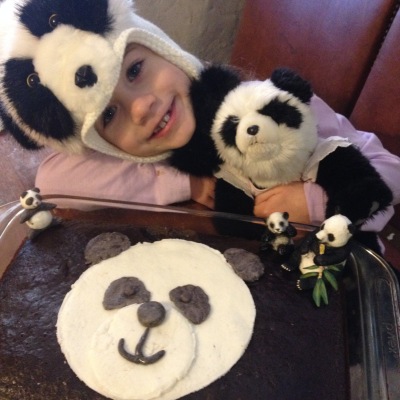
 “If there is one chant in the universe it is to create.”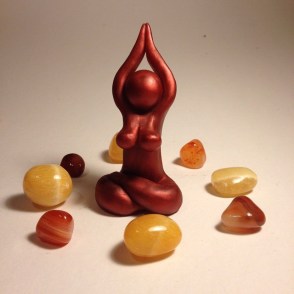
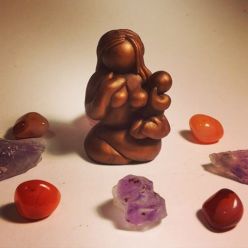
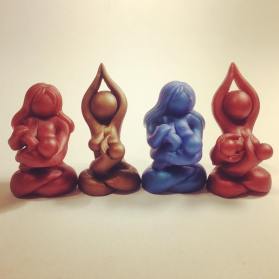
 inches tall or taller. The goddesses I make are all about three inches tall and there’s a reason for that: they fit in the palm of my hand. When I create them, I feel as if I’m part of an unbroken lineage stretching back 30,000 years to the person who carved the Goddess of Willendorf. I feel connected to the priestesses of the Mesopotamian temples who sculpted hundreds upon hundreds of tiny clay goddesses. Someone commented on my sculptures once saying, “
 “Human connections are deeply nurtured in the field of shared story.” –Jean Houston
 Feminism and Religion