Exploring the F-word in religion at the intersection of scholarship, activism, and community.
Author: Molly Remer
Molly Remer, MSW, D.Min, is a priestess, mystic, and poet facilitating sacred circles, seasonal rituals, and family ceremonies in central Missouri. Molly and her husband Mark co-create Story Goddesses at Brigid’s Grove (http://brigidsgrove.etsy.com). Molly is the author of many books, including Walking with Persephone, 365 Days of Goddess, Whole and Holy, Womanrunes, and the Goddess Devotional. She is the creator of the devotional experience #30DaysofGoddess and she loves savoring small magic and everyday enchantment.
http://30daysofgoddess.com
“Beginnings and endings are so very sacred, to give honor to all that has transpired, every experience, every joy, every pain, is a doorway to the magical. Hold your entire year between your hands, every day, every thought, every breath. Now bless it with gratitude, love and humility. You have done more to transform this new year than a thousand resolutions.”
–K. Allen Kay
Two years ago, at the end of the year, I was supposed to hold a closing ceremony for a year-long Ariadne’s Thread study group I had been guiding throughout the year. Every member of the circle ended up backing out of the closing circle at the last minute, but I held the ceremony in full anyway, alone in my front yard, just for myself, and expanding it to include acknowledging and appreciating all the work I had completed in 2016, including my D.Min degree. People’s reasons for backing out of the ceremony were very valid and while on a cognitive level I understood why they couldn’t come, on an emotional level I still felt let down and disappointed at being “abandoned” by them. Holding the closing ceremony for myself anyway and acknowledging that I kept my own commitment to doing a full year of this work in circle, felt like a powerful declaration and affirmation of my own worth. In fact, it was such a validating and powerful experience that I continued the practice with a personal year-end closing ceremony for 2017 as well and I will do the same for myself this year too. Continue reading “Honoring the Completion of the Year, by Molly Remer”
It is October, the veil is thin the year is waning the leaves are turning I am trying to say goodbye to my grandmother she is dying. I do not know what to say.
The leaves are red the sky is blue I saw a crow in the tree behind the house.
The threads of this year are becoming thinner.
The threads of her life too are becoming thinner
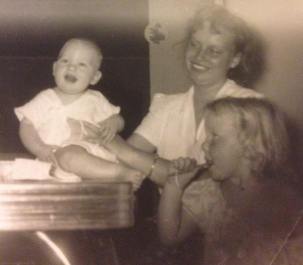
What do I say to the one who breathed life into my father who wove his cells into being who cradled him as a baby who wept into his hair.
Twyla with my dad, Tom, in 1953.
Carrying the cells
of the generations The chain of life
continuing to spiral through time, and place,
and distance and falling leaves.
What do I say as life thins, as breath fades
What do I say when all that remains is the space between us
What do I say
when I catch a glimpse of the swift unraveling of time the wrinkles in eternity
What do I say
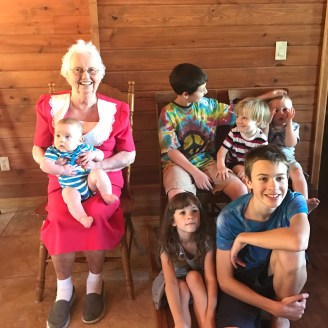
as time folds in on itself and now it is me in the bed and my son, gray-haired, blue-eyed is reading to me in a quiet voice
Grandma Johnson with her great-grandchildren in April, 2017.
as the chapter comes to a close.
Part 2: The Answer
That night, I dreamed of my grandmother she shrank to the size of a small child I picked her up and held her against my body We looked in the mirror cheek to cheek and smiled together I kissed her face and told her: “You are wonderful.” Then we danced around the room together her head against my shoulder I kissed her again on her white hair and no more words were needed.
Part 3: The Memorial
At this time last year, as the leaves fell and the wheel of the year dipped into darkness, my last grandparent died. I recognize that I am fortunate in having reached nearly forty while still having a living grandmother, but there is still such a sensation of finality and ending in saying goodbye to the final grandparent. Twyla was my paternal grandmother and I was not as close to her as I was to my maternal grandmother who died in 2013, but she is the woman who wove my father’s bones into being, and her death left a hole in our family and a sensation of an ended section in the tapestry of generations.
After the dream I write of above, I went back to see her a final time, five hours before she took her last breath. This time, I sat with her alone. I kissed her on her white hair and told her she was wonderful. I played her a song (Beyond the Gates by T. Thorn Coyle and Sharon Knight). I spoke to her of her good work in the world, that she had done it, that she’d finished her work, and that she had given so much and done so well. As a mother myself, the sensation of how powerful it is to have seen all your babies through to adulthood and into grandparenthood themselves filled the room. My dad, her second child and only son, has teenage grandchildren now himself. My grandmother’s youngest child of her five children is in her mid-fifties (and also a grandmother to teenagers). Sitting in the darkened room, listening to the song play, I was staggered by the magnitude of having seen each of your own children through their lives and into grandparenthood. While there are many ways to leave a legacy and it is not a “failure” by any means to not see all of your children into grandparenthood or to not have children yourself, what a gift it must be to bear witness to these generations if it does, in fact, unfold in that way, and to see your own tiniest baby have grandchildren of her own. This is something I hope to see for myself.
My dad holding his youngest grandchild at the memorial.
I then had the blessing, the honor, the privilege of being asked to prepare a memorial service for my grandmother. Five years ago, I was also asked to facilitate the memorial ceremony for my other grandmother. The unique, uncommon blessing of fulfilling this role for both of my grandmothers is not lost on me, as I know no one else who has had the experience of serving both sides of their family of origin in this way. I felt so honored to be trusted to help guide my family through both of these experiences of loss and grief. I spoke to my husband of how humbled, grateful, and fortunate I feel that I have a family who would let me do this, not just for one grandma, but for both of them, and he said, “you know, honey, maybe we should all be grateful to you that you’re willing to do this for us.” So, I received that recognition into my heart with appreciation as well.
My daughter, then six, keeping the candles lit and tended on the altar space during the memorial.
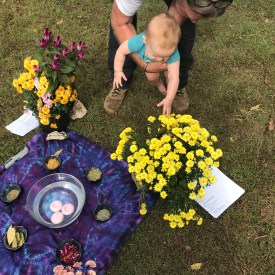
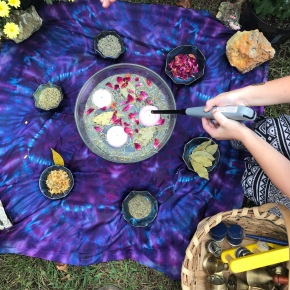
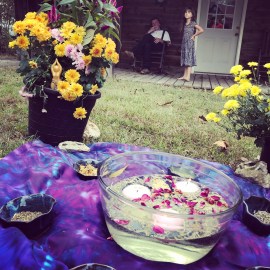
It is powerful to create ceremonies that acknowledge transitions within the life of your family. During this ceremony for my grandmother we each had time to speak of her, I had poems I had written, and readings to share. We had a centerpiece with flowers, floating candles, and photos of her, and we each held handfuls of herbs that we offered into the bowl of water as we shared our stories and memories. Each person took time to do so and spoke with care, tenderness, love, and laughter. Sharing this time and space together and creating a container for people to be heard in their grief and love rather than participating in the type of “canned” or impersonal memorial service that may be more commonly offered by religious groups, was what we needed to say goodbye to this woman who wove a part of our souls. My aunt said: this is the kind of send-off that everyone needs, and that felt very true and real.
My extended family is not pagan or liberal or alternatively religiously minded and as I planned the memorial I was conscious of not wanting it to be “too much” for them. As I typed my outline, I’d first included a song and other practices common to other rituals and retreats I lead and when I heard that my aunts and cousins were coming, I’d removed the song and some ritual elements, fearing making them uncomfortable. They then said they weren’t coming, so I added the singing back in. On the day of the memorial, they did in fact come, and I decided we would sing anyway, whether comfortable and familiar or not. We sang the same song to begin and to end the memorial (“We Are a Circle”) and when I looked around the circle the second time we sang and saw that everyone there holding hands, their faces wet with tears, were all singing too, I knew that it had worked.
If you have the opportunity to create ceremonies and rituals of personal meaning for your own family, please do it. It holds so much value, such life and power and love, in a way that is difficult to create by someone outside of the family. A small group of people who really care and who are willing to connect with each other in a meaningful, connected, vulnerable way, births so much real magic together. This container can be created by you, for you, and for the ones you love the most.
“Everyone can do the life-changing, world-renewing work of magic…the Dalai Lama said, ‘It’s not enough to pray and meditate; you must act if you want to see results.’ We are called to offer real service to others, to the Goddess. That service may take many forms: mopping the floor after the party, priestessing rituals, healing, planning, teaching, carrying the heavy cauldron from the car, sitting with a dying friend, writing up the minutes for a neighborhood meeting, organizing a protest to protect a sacred place from development, writing letters to Congress, training others in nonviolent civil disobedience, growing food, or changing the baby’s diapers. All of these can be life-changing, world-renewing acts of magic…”
—Starhawk and Valentine, The Twelve Wild Swans
There is a companion audio recording available about this memorial service preparation, the death of my grandmother, and about how to weave a strong “ritual basket” to carry a ceremony. The first part is an audio ritual for my online circle with thoughts about claiming your magic, fear of the label of witch, etc., so if you want to skip past that only to the memorial information and ritual theory, skip to 16:20 in the audio:
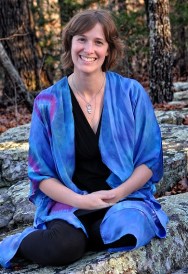
Molly has been “gathering the women” to circle, sing, celebrate, and share since 2008. She plans and facilitates women’s circles, seasonal retreats and rituals, mother-daughter circles, family ceremonies, and red tent circles in rural Missouri and teaches online courses in Red Tent facilitation and Practical Priestessing. She is a priestess who holds MSW, M.Div, and D.Min degrees and wrote her dissertation about contemporary priestessing in the U.S. Molly and her husband Mark co-create Story Goddesses, original goddess sculptures, ceremony kits, and jewelry at Brigid’s Grove. Molly is the author of Womanrunes, Earthprayer, and The Red Tent Resource Kit and she writes about thealogy, nature, practical priestessing, and the goddess at Patreon and at Brigid’s Grove.
I touch the earth and offer gratitude
for this land I call home. I reach towards the sky and offer gratitude
for sun, moon, and stars. I place my hand on my heart
and breathe deep, offering gratitude for all that I am and all that I have and for the many blessings of my life…
June 2016
I am finishing my last semester of college teaching. I have four children ranging from 18 months to 12 years and a thriving home business. I am exhausted. I feel wrung out, weary, overloaded, sped up, and on the edge of collapse. My dominant fantasy, the one that pops unbidden to my mind as I work through my never-ending to-do list is to just lie on the floor, flat on my back. I tell my husband, “this isn’t a sustainable pace for me. If I keep going like this, something bad is going to happen to me.”
“It’s a wild snail festival out here!”
—Tanner (age 3)
This spring we took a family mini vacation to Table Rock Lake, about three hours away from home.
At its best, working and schooling from home with our family of six feels like a beautifully seamless integration of work and life—there is no need to compartmentalize or draw distinctions between “life” and “work,” because it is ALL just life and living. At its worst, it feels like the work bleeds into everything else in an all-consuming way and the to-do list just never ends and something or someone is always getting overlooked or shortchanged. We find that it is helpful for us all sometimes to just all step away and be somewhere else, while the to-do list stays at home! We try to take at least five family adventures/trips a year (some of them small and some more involved).
“Ritual that is alive encourages each person to touch what is sacred in their own way, in their own time, through their own unique experience. So there evolves a dynamic dance between guiding and shaping the group’s experience and encouraging and supporting the individual’s experience, so there is a smooth and cohesive flow to the ritual.” –Suzanne Reitz and Sandy Hoyt (Celebrating, Honoring, Healing)
As a practicing priestess, one of the dynamic dances that I engage in is with the power of story. I both find that women’s stories are the vital lifeblood of conscious engagement and power-building with one another and that they can be one of the elements that bogs down a ritual and makes it lose power and magic. This is partially because the dominant culture may teach us to bond using stories in a way that actually drain our energy through “venting,” swapping complaints, trading to-do lists, and through describing behavior, motives, and character of other people. In women’s ritual space, I encourage people to dig deep, but also to share a here-and-now connection of shared experience rather than a there-and-then rendition of past experiences.
Chameli Ardagh in her Create Your Own Women’s Temple manual from Awakening Women explains:
To hold the group and space as sacred is one of the most important guidelines, and the guideline that may bring up the most questions or protests. It goes against our habits as women and against our identification with the small self; we are quite used to creating intimacy through sharing our wounds and problems. The Temple Group is not a place for processing wounds, analyzing ourselves, solving problems, complaining about our lovers, healing our addictions or sharing the stories of the personality. Many women’s circles (and support groups or sharing circles) are focused mostly on the personality. The Temple Group is, in a way, impersonal because it focuses on the larger vast nature of our true self. In the Temple Group we focus not so much on our identity as separate women, but on the whole group as one feminine divine body and expression. The impersonal guideline may sound uncaring at first, but as you explore new ways of being intimate and nourish each other as women, beyond the words, you discover that those are infinitely more fulfilling and caring than the personality talking and processing (p. 61).
I believe that we live in a storied reality and that we are constantly in the process of storying and re-storying our lives and that seeing our lives, and the lives of others, through a mythopoetic lens, can have a radically transformative impact on our experiences and our relationships. I have written about this for FAR in the past and noted that my personal lived experience is that stories have had more power in my own life as a woman than most other single influences. The sharing of story in an appropriate way is, indeed, intimately intertwined with good listening and warm connection. As the authors of the book Sacred Circles remind us “…in listening you become an opening for that other person…Indeed, nothing comes close to an evening spent spellbound by the stories of women’s inner lives.”
So, what is special about story as a medium and what can it offer to women that traditional forms of education cannot?
Stories are validating. They can communicate that you are not alone, not crazy, and not weird. Stories are instructive without being directive or prescriptive. It is very easy to take what works from stories and leave the rest because stories communicate personal experiences and lessons learned, rather than expert direction, recommendations, or advice. Stories can also provide a point of identification and clarification as a way of sharing information that is open to possibility, rather than advice-giving.
Cautions in sharing stories while also listening to another’s experience include:
Are you so busy in your own story that you can’t see the person in front of you?
Does the story contain bad, inaccurate, or misleading information?
Is the story so long and involved that it is distracting from the other person’s point?
Does the story communicate that you are the only right person and that everyone else should do things exactly like you?
Is the story really advice or a “to do” disguised as a story?
Does the story redirect attention to you and away from the person in need of help/listening?
Does the story keep the focus in the past rather than the here and now present moment?
Is there a subtext of “you should…”?
Several of these self-awareness questions are much bigger concerns during a person-to-person direct dialogue such as at a women’s retreat rather than in written form such as blog. In reading stories, the reader has the power to engage or disengage with the story, while in person there is a possibility of becoming stuck in an unwelcome story. Some things to keep in mind while sharing stories in person are:
Sensitivity to whether your story is welcome, helpful, or contributing to the other person’s process.
Being mindful of personal motives—are you telling a story to bolster your own self-image, as a means of pointing out others’ flaws and failings, or to secretly give advice?
Asking yourself whether the story is one that will move us forward (returning to the here and now question above).
This work is beautiful. It is complex. It is multilayered. It is simple. It is hard. It is easy. It is rich and rewarding. It is dynamic and evolving and flowing. It is never the same.
May you be blessed with many stories together.
Note: there is a detailed audio exploration of the themes of this post available here.
Molly has been “gathering the women” to circle, sing, celebrate, and share since 2008. She plans and facilitates women’s circles, seasonal retreats and rituals, mother-daughter circles, family ceremonies, and red tent circles in rural Missouri and teaches online courses in Red Tent facilitation and Practical Priestessing. She is a priestess who holds MSW, M.Div, and D.Min degrees and wrote her dissertation about contemporary priestessing in the U.S. Molly and her husband Mark co-create Story Goddesses, original goddess sculptures, ceremony kits, and jewelry at Brigid’s Grove. Molly is the author of Womanrunes, Earthprayer, and The Red Tent Resource Kit and she writes about thealogy, nature, practical priestessing, and the goddess at Patreon and at Brigid’s Grove.
“Island living has been a lens through which to examine my own life…I must keep my lens when I go back… I must remember to see with island eyes. The shells will remind me; they must be my island eyes.”
Each winter, we travel with our family to a small island in the Gulf Coast outside of Alabama and spend a month living on the beach. There is something about being on an island that quite literally transports you into another world. The sensation of stepping out, stepping off, and stepping into is palpable as we cross the bridge to the island and settle into the slow, quiet rhythm of island life, guided by the tides, the moon, and the rising and setting of the sun. Our sleep and waking schedules change. Our priorities shift. Our to-do lists become very short. While we enjoy a creative, home-based life and business at home in Missouri, there is something incredibly freeing, and clarifying, about laying everything aside and having the biggest item on the schedule be a long walk on the beach (we walk from two to five hours each day). We actually bring our business along with us in a travel trailer, so we aren’t truly “off work” during this month, but instead of making everything as we go, we only sell the inventory we’ve already completed and brought with us, which leaves us with many extra hours a day compared to our work at home.
As I shed layers of myself at the beach, watching dolphins, running with my children, picking up shells, walking hand in hand with my husband into the setting sun, life feels simple, and what I need and want feels very clean and very clear. My intense self-motivation and drive softens, my itch to get more done and to make more lists fades away, and I am left with the core of myself and discover, anew, how very much I like her.
This year, the morning after we arrived at the island, my husband and I headed to our favorite part of the beach where the beachcombing is the best and the shells are the biggest. We were stopped on the road at a little guard tower and told we could not continue. When we inquired why, the sour-faced man told us with the smirk that the beach was “gone” and it had been destroyed in a hurricane last fall. He clearly took delight in breaking the news to us and very much enjoyed the act of turning us away.
We returned to our beach house in a state of confusion and shock. Our long walks on the beach, our hopes for the new treasures we would discover, the part of the island we so love and have so many happy memories of, all swept away. We walked on a different part of the island feeling a genuine sense of distress and grief. How could the beach just be gone? Does the island now just abruptly drop away into the sea? We feel a sensation that something had died. As we walk, we decide that the “gift” in this disappointment is that we will now explore and learn from different parts of the island than we are used to and that we can find new things to do and love while here, that we need to release our attachment to past visits and the ways things used to be and enjoy discovering what is right here, right now. But, then I say that I do not want to rush to “make it all better,” but instead I would like to just sit with and acknowledge the grief, and loss, and disappointment, rather than hurrying to turn everything into a lesson.
We walk in silence for a time and then realization dawns. There is no way the beach we long for can actually be “gone.” There is still a road visible headed in that direction and many dump trucks and earth-moving equipment driving back and forth. That part of the beach is damaged, we realize, but the facts we can see with our own eyes do not point to the total erasure of it as suggested by our power hungry little friend in his road blocking shed.
Back in the beach house we google to discover that yes, the beach sustained significant hurricane damage in the fall and restoration efforts are underway. The correct description from the guard should have been that the beach is “closed for restoration” and not “gone.” We continue to try to accept our “gift” of making new discoveries in the face of disappointment, but a few days later we decide to ask at the rental company if there is a way we can still go to the closed part of the island. They are able to give us a pass to enter it, and so, in fact, we are able to walk on our favorite part of the beach after all. The parking lot is damaged, but the beach itself is still very much there and very much alive.
This is a new gift, I muse. Rather than accepting our initial grief and disappointment, we tried again. Sometimes, you do not actually need to accept no for an answer, but you can push a little more and get what you want. What if we had just turned away in grim acceptance and “gone with the flow” instead of twisting a little harder and asking for what we want? I try to reconcile the two lessons—the letting go and the pushing, our refusal to let go. And then, a third lesson: not everything has to be a lesson, sometimes things just are.
My favorite shell in the world is from a moon snail. Round, smooth, and beautiful, curling in a wave to a perfect tiny spiral in the center, with colors ranging from brown to pale blue, many of the moon shells we find are small, the size of a quarter or smaller. My holy grail (holy snail) is a palm-sized moon shell that will fill my hand. In the morning as we walk on the previously forbidden part of the beach, I stop to take a photo of one of my goddesses on a piece of faded green driftwood. I am in that state of total presence that I experience often in our island walks, the complete immersion in the moment, stripped of all other purpose or task, but simply myself, walking on the beach. It is a type of what I call: “stepping through,” like I have stepped out of myself, out of reality, and into a different plane of relationship with the natural world. We find several fighting conch shells fairly close together and I say to my husband: “what we really need to do is find where the moon snails come up.” I turn away from the driftwood to continue walking and just as his foot begins to come down on the sand I see it…right below where his foot is poised to step, the distinctive curve of a huge moon snail shell, half-buried in the sand. I grab his arm and pull him back, making an indistinct babbling sort of squeal in my throat. I dig it up and there it is, a sun-bleached moon snail shell that exactly fills the palm of my hand. I laugh with joy and exhilaration and nearly cry in my delight. I tell my husband I feel as excited and happy and full of wild euphoria as if I’ve just given birth to another child. This is one of the best moments of my life! I crow, laughing semi-hysterically, this ranks right up there with the time we saw the otters at the river!
Then, realizing what I have said, I laugh some more. Is it sad, perhaps even pathetic, that some of the best moments of my life have been seeing wild otters and finding perfect shells? No, I decide, I adore being the kind of person who sees with island eyes and who discovers the best moments of her life simply by paying attention to what is happening on the shore.
Molly has been “gathering the women” to circle, sing, celebrate, and share since 2008. She plans and facilitates women’s circles, seasonal retreats and rituals, mother-daughter circles, family ceremonies, and red tent circles in rural Missouri and teaches online courses in Red Tent facilitation and Practical Priestessing. She is a priestess who holds MSW, M.Div, and D.Min degrees and finished her dissertation about contemporary priestessing in the U.S. Molly and her husband Mark co-create Story Goddesses, original goddess sculptures, ceremony kits, and jewelry at Brigid’s Grove. Molly is the author of Womanrunes, Earthprayer, and The Red Tent Resource Kit and she writes about thealogy, nature, practical priestessing, and the goddess at Brigid’s Grove.
“When winter comes to a woman’s soul, she withdraws into her inner self, her deepest spaces. She refuses all connection, refutes all arguments that she should engage in the world. She may say she is resting, but she is more than resting: She is creating a new universe within herself, examining and breaking old patterns, destroying what should not be revived, feeding in secret what needs to thrive…
Look into her eyes, this winter woman. In their gray spaciousness you can see the future. Look out of your own winter eyes. You too can see the future.”
–Patricia Monaghan, Seasons of the Witch
When the wheel of the year turns to winter, I always feel the call to retreat, to cocoon, to pull away. I also feel the urge for significant de-cluttering—my eyes cast about the house for things to unload, get rid of, to cast away. I also search my calendar for those things which can be eliminated, trimmed down, cut back on. I think it is the inexorable approach of the winter holidays that prompts this desire to withdraw, as well as the natural rhythm of the earth which so clearly says: let things go, it is almost time to hibernate.
This shift toward winter is a time of discernment. A time to choose. A time to notice that which has not made it through the summer’s heat and thus needs to be pruned away. In this time of the year, we both recognize the harvest of our labors and that which needs to be released or even sacrificed as we sense the promise of the new year to come. Continue reading “A Winter Woman by Molly Remer”
I lie in bed with him, cementing the details in my memory. The way the morning air is heavy and green. The sound of last night’s raindrops continuing to drip from the overfull gutters on the roof. The insistent stab of a single-note bird song in the air. His head nestles in the crook of my arm the way it has done every morning for three years. Blond hair against my nose, breathing in the slightly baby smell of him. “This is the last time,” I whisper softly. “We are all done after this. This is the last time we will have nonnies.”
This is not the first last time for me, but it is the last, last time. The first baby was born 14 years ago and gathered to my breast with all the tenderness and uncertainty and instinctiveness of a first, first. “Do you want nursies?” I whisper to that new little boy, and we begin the next steps in our bond, nursing for nearly three years, until one day, six weeks away from the birth of the next baby boy, I decide that we truly have to be done. I am a breastfeeding counselor for other nursing mothers and I feel like I should want to tandem nurse my two boys. I fondly envision their hands joining across my body, the easy love and camaraderie between them blossoming through this shared time with their mother. But, I feel an intense irritation with nursing while pregnant, nearly a sense of revulsion and the almost irresistible urge to shove away my sweet little boy as I prepare to greet the life of another. I talk to my midwife about my feelings and she explains that with her own two daughters, the agitated feeling at nursing the older one did not go away with the birth of the second, but instead became dramatically worse. After hearing this, I feel panicky and I decide we do, in fact, have to wean. He is a very verbal and precocious toddler and I am easily able to explain to him that it is time to be finished nursing. One night though, he lies in bed with me crying and begging to nurse. He says he really needs to. I tell him, “remember, we’re all done, but if you really, really need me, if you really, really still need to have nursies, you can.” He doesn’t nurse, but instead falls asleep, reassured that while our nursing relationship might be over, I’m still here.
“Drinking the water, I thought how earth and sky are generous with their gifts and how good it is to receive them. Most of us are taught, somehow, about giving and accepting human gifts, but not about opening ourselves and our bodies to welcome the sun, the land, the visions of sky and dreaming, not about standing in the rain ecstatic with what is offered.”
–Linda Hogan in Sisters of the Earth
The women have gathered in a large open living room, under high ceilings and banisters draped with goddess tapestries, their faces are turned towards me, waiting expectantly. We are here for our first overnight Red Tent Retreat, our women’s circle’s second only overnight ceremony in ten years. We are preparing to go on a pilgrimage. I tell them a synopsis version of Inanna’s descent into the underworld, her passage through seven gates and the requirement that at each gate she lie down something of herself, to give up or sacrifice something she holds dear, until she arrives naked and shaking in the depths of the underworld, with nothing left to offer, but her life.
In our own lives, I explain, we face Innana’s descents of our own. They may be as difficult as the death of an adult child, the loss of a baby, the diagnosis of significant illness, or a destroyed relationship. They may be as beautiful and yet soul-wrenchingly difficult as journeying through childbirth and walking through the underworld of postpartum with our newborns. They may be as seemingly every day as returning to school after a long absence. There is value in seeing our lives through this mythopoetic lens. When we story our realities, we find a connection to the experiences and courage of others, we find a pattern of our own lives, and we find a strength of purpose to go on. Continue reading “Sacred Water by Molly Remer”
“When I dare to be powerful–to use my strength in the service of my vision–then it becomes less and less important whether I am afraid.”
–Audre Lorde
“The purpose of life is not to maintain personal comfort; it’s to grow the soul.”
–Christina Baldwin
When teaching childbirth classes, I would speak to my clients about shifting the common fear-based “what if” cultural dialog of birth to “positive” anticipation rather than fears, encouraging them to ask themselves questions like: “what if I give birth and it is one of the most powerful, thrilling moments of my life?” While I stand by this practice, I also think about the what ifs that crawl out of our dark places and lodge in our hearts. The what ifs that snake around the edges of our consciousness in the early hours of the morning. The what ifs we try to push down, down, down and away. The what ifs that stalk us. The what ifs so very awful that we fear in giving voice to them, we might give life to them as well.
We may feel guilty, ashamed, negative, and apologetic about our deepest “what ifs.” We worry that if we speak of them, they might come true. We worry that in voicing them, we might make ourselves, our families, our communities, our work, or philosophies, our faiths, or whatever look bad. We want to be positive. We want to be blissfully empowered, confident, and courageous. And, guess what? We are. Sometimes that courage comes from looking the “what ifs” right in the eye. Sometimes it comes from living through them. My most powerful gift from my pregnancy with my daughter, my pregnancy-after-loss baby, was to watch myself feel the fear and do it anyway. I was brave. And, it changed me to learn that.
What if we can learn more from our shadows than we ever thought possible? There is power in thinking what if I can’t do this and then discovering that you CAN.


 comfortable and familiar or not. We sang the same song to begin and to end the memorial (“We Are a Circle”) and when I looked around the circle the second time we sang and saw that everyone there holding hands, their faces wet with tears, were all singing too, I knew that it had worked.
 ‘It’s not enough to pray and meditate; you must act if you want to see results.’ We are called to offer real service to others, to the Goddess. That service may take many forms: mopping the floor after the party, priestessing rituals, healing, planning, teaching, carrying the heavy cauldron from the car, sitting with a dying friend, writing up the minutes for a neighborhood meeting, organizing a protest to protect a sacred place from development, writing letters to Congress, training others in nonviolent civil disobedience, growing food, or changing the baby’s diapers. All of these can be life-changing, world-renewing acts of magic…”
 She plans and facilitates women’s circles, seasonal retreats and rituals, mother-daughter circles, family ceremonies, and red tent circles in rural Missouri and teaches online courses in
  I touch the earth and offer gratitude
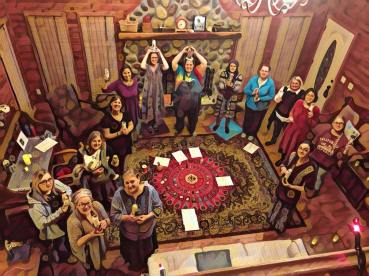 As a practicing priestess, one of the dynamic dances that I engage in is with the power of story. I both find that women’s stories are the vital lifeblood of conscious engagement and power-building with one another and that they can be one of the elements that bogs down a ritual and makes it lose power and magic. This is partially because the dominant culture may teach us to bond using stories in a way that actually drain our energy through “venting,” swapping complaints, trading to-do lists, and through describing behavior, motives, and character of other people. In women’s ritual space, I encourage people to dig deep, but also to share a here-and-now connection of shared experience rather than a there-and-then rendition of past experiences.
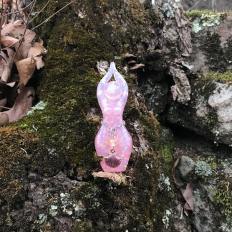 storying and re-storying our lives and that seeing our lives, and the lives of others, through a mythopoetic lens, can have a radically transformative impact on our experiences and our relationships. I have written about
 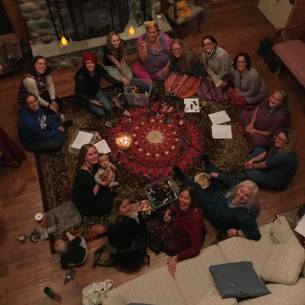 weird. Stories are instructive without being directive or prescriptive. It is very easy to take what works from stories and leave the rest because stories communicate personal experiences and lessons learned, rather than expert direction, recommendations, or advice. Stories can also provide a point of identification and clarification as a way of sharing information that is open to possibility, rather than advice-giving.
 Note: there is a detailed audio exploration of the themes of this post available
  and settle into the slow, quiet rhythm of island life, guided by the tides, the moon, and the rising and setting of the sun. Our sleep and waking schedules change. Our priorities shift. Our to-do lists become very short. While we enjoy a creative, home-based life and business at home in Missouri, there is something incredibly freeing, and clarifying, about laying everything aside and having the biggest item on the schedule be a long walk on the beach (we walk from two to five hours each day). We actually bring our business along with us in a travel trailer, so we aren’t truly “off work” during this month, but instead of making everything as we go, we only sell the inventory we’ve already completed and brought with us, which leaves us with many extra hours a day compared to our work at home.
 clear. My intense self-motivation and drive softens, my itch to get more done and to make more lists fades away, and I am left with the core of myself and discover, anew, how very much I like her.
 now explore and learn from different parts of the island than we are used to and that we can find new things to do and love while here, that we need to release our attachment to past visits and the ways things used to be and enjoy discovering what is right here, right now. But, then I say that I do not want to rush to “make it all better,” but instead I would like to just sit with and acknowledge the grief, and loss, and disappointment, rather than hurrying to turn everything into a lesson.
 of a quarter or smaller. My holy grail (holy snail) is a palm-sized moon shell that will fill my hand. In the morning as we walk on the previously forbidden part of the beach, I stop to take a photo of one of my goddesses on a piece of faded green driftwood. I am in that state of total presence that I experience often in our island walks, the complete immersion in the moment, stripped of all other purpose or task, but simply myself, walking on the beach. It is a type of what I call: “stepping through,” like I have stepped out of myself, out of reality, and into a different plane of relationship with the natural world. We find several fighting conch shells fairly close together and I say to my husband: “what we really need to do is find where the moon snails come up.” I turn away from the driftwood to continue walking and just as his foot begins to come down on the sand I see it…right below where his foot is poised to step, the distinctive curve of a huge moon snail shell, half-buried in the sand. I grab his arm and pull him back, making an indistinct babbling sort of squeal in my throat. I dig it up and there it is, a sun-bleached moon snail shell that exactly fills the palm of my hand. I laugh with joy and exhilaration and nearly cry in my delight. I tell my husband I feel as excited and happy and full of wild euphoria as if I’ve just given birth to another child. This is one of the best moments of my life! I crow, laughing semi-hysterically, this ranks right up there with the time we saw the otters at the river!
 facilitates women’s circles, seasonal retreats and rituals, mother-daughter circles, family ceremonies, and red tent circles in rural Missouri and teaches online courses in
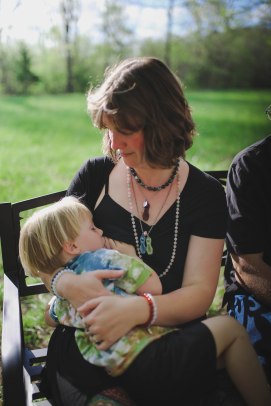 last night’s raindrops continuing to drip from the overfull gutters on the roof. The insistent stab of a single-note bird song in the air. His head nestles in the crook of my arm the way it has done every morning for three years. Blond hair against my nose, breathing in the slightly baby smell of him. “This is the last time,” I whisper softly. “We are all done after this. This is the last time we will have nonnies.”
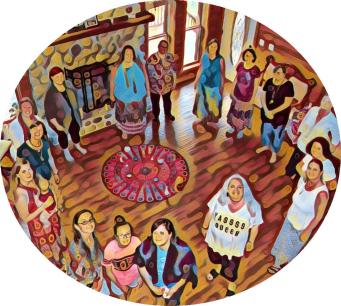 tapestries, their faces are turned towards me, waiting expectantly. We are here for our first overnight Red Tent Retreat, our women’s circle’s second only overnight ceremony in ten years. We are preparing to go on a pilgrimage. I tell them a synopsis version of Inanna’s descent into the underworld, her passage through seven gates and the requirement that at each gate she lie down something of herself, to give up or sacrifice something she holds dear, until she arrives naked and shaking in the depths of the underworld, with nothing left to offer, but her life.
 cultural dialog of birth to “positive” anticipation rather than fears, encouraging them to ask themselves questions like: “what if I give birth and it is one of the most powerful, thrilling moments of my life?” While I stand by this practice, I also think about the what ifs that crawl out of our dark places and lodge in our hearts. The what ifs that snake around the edges of our consciousness in the early hours of the morning. The what ifs we try to push down, down, down and away. The what ifs that stalk us. The what ifs so very awful that we fear in giving voice to them, we might give life to them as well.
