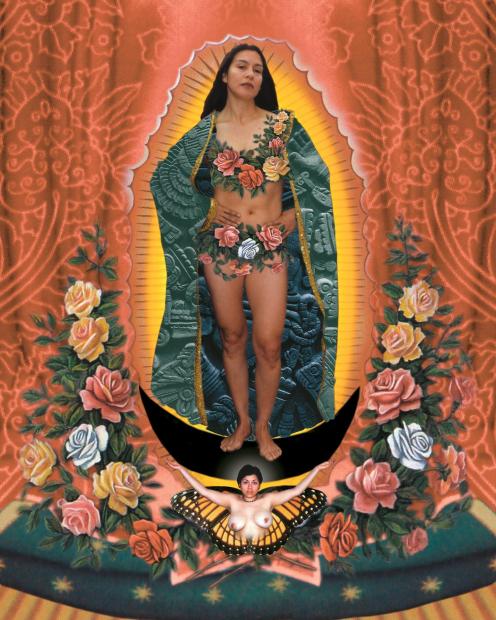
Some have said that all theology is autobiographical. Whether this is always the case or not, in my case, it is absolutely true. I came to the topic of religious mestizaje because of my own need to make sense of the fact that I fully identify as a Goddess loving person as well as a Christian-identified one. I have made reference to this before on this blog; I have admitted that even after my feminist awakening, even after coming to love and practice Goddess spirituality, even after reading all of Mary Daly’s books (some of them more than once), I have chosen to affiliate with Christianity all while also maintaining my Goddess devotion nonetheless. Therefore, Gloria Anzaldua’s understanding of mestijaze, and religious mestizaje in particular, has contributed to the ongoing revision of my religious identity.
The word mestiza or mestizo is born of the incarnation of hybridity and diversity.[1] Historically mestizaje is the new hybrid race, a reference to Mexicans who are the mixed people born of Indian and Spanish blood in the 16th century.[2] The Spanish invaded the land now called Mexico, and in partnership with rival tribes, conquered the Aztec people. Oscar Garcia-Johnson, in his book A Mestiza Community of the Spirit, states that mestizaje “represents a hub of dehumanizing stories and self-empowering templates.”[3] Thus, there is an inherent violence implied in mestizaje as the word originated, and this violence is also implied in my Goddess Loving Christian mestizaje. Christianity has been the cause of much harm and dehumanizing violence, especially in its relationship to women, and really is in need of transformation and self-empowering templates. The origin of mestizaje implies the violence of one tradition or people dominating and suppressing another and the reality that new life, a new people and tradition, find a way nonetheless; I think this is part of what leads to my religious mestizaje. The new ‘way’ that I have found has taken form in a Goddess Loving Christian religious practice that reflects the concrete embodied reality of my experience – a religious practice that is always negotiated with a community of people. .