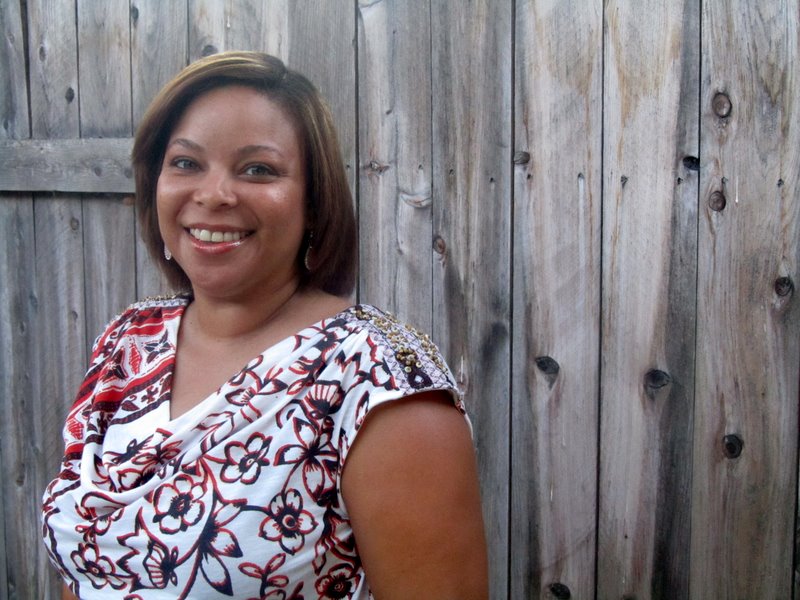
My Feminist Perspective of Authority – Part 2 by Elise M. Edwards

My understanding of authority differs from that of the academy in that I have defined for myself a sense of ultimate purpose that those in power in the institution do not have authority to deny. It also differs because I believe my authority is conditioned in particular ways. Yet I think that ultimately my conception of authority fits the paradigm of mentorship that the academy establishes, even though I may be more guarded about my work and my choice of mentors. My “her-story” gives me the courage to proceed, even as I protect myself and my work.

In a previous post, I discussed insights on power and authority from a student’s perspective that I shared at a workshop on Living Texts: Celebrating Feminist Perspective and Theo/alogy, Authority, and the Sacred in the Academy. The workshop was a gathering where women scholars in religion discussed the challenges and promises of our voices in the academy. The dialogue was so inspiring to me that I decided tocontinue it here. Today, I reflect on these two questions:

  • Does my understanding of authority differ from that of the academy?
  • How do you situate my “her-story” in light of a largely patriarchal perception of authority in the academy?

Previously, I asserted that there is a critical distinction between power and authority. Authority is a personal characteristic based on a relationship of trust between me and a text, a person, or their work. Power, on the other hand, is operative with or without trust. Therefore, the people who have authority in my academic work are those whose supportive words provide direction and assistance, and whose criticism I take seriously.

My understanding of authority differs from that of the academy in that I have defined for myself a sense of ultimate purpose that those in power in the institution do not have authority to deny. Continue reading “My Feminist Perspective of Authority – Part 2 by Elise M. Edwards”

The Need for a Positive Counter-Narrative of Religious Involvement in Feminism by Ivy Helman

I’ve admired JC for years.  That’s Joan Chittister, OSB the Benedictine nun of course.  I first saw her speak when I was in graduate school and she visited Yale.  I’ve also read a number of her books.    Her life is an example of how religious people support feminist ideals.    There is a story in Beyond Beijing: The Next Step for Women: A Personal Journal that I would like to share with you

Chittister began her historic journey on the Peace Train to the UN Conference on Women in Beijing in 1995.  As she  entered a conference room to register as a Peace Train participant, she was handed a large manila envelope.  To her surprise it was filled with condoms. At first, she thought that the woman who handed them to her meant to hand them to someone else.  However, Chittister was told (quite emphatically according to her) that she should distribute the condoms to the health workers she encounters while on the train and in the small towns she visits along the way to Beijing.  Eventually after much thought, Chittister decided to do just that and stuffs the manila envelope into her backpack.  Trying to find some humor in what she considered an awkward situation for a nun to be in she remarked, “Now all I have to do is to try not to die in front of some bishop with condoms in my backpack.”

My first reaction to this story is to laugh along with her.  I am also struck by her thoughtfulness to share the story publicly.  She could have been given the envelope, quietly distributed the condoms and then never told a soul.  But, no.  She includes the account of this feminist action she undertook in her book for the world to read.  What an amazing amount of courage and integrity this woman has! Continue reading “The Need for a Positive Counter-Narrative of Religious Involvement in Feminism by Ivy Helman”

The Power of Feminist Rituals by Grace Yia-Hei Kao

“These were very simple rituals and yet they were so powerful.”

Jeanette Stokes’ 25 Years in the Garden is on my bedside table. It’s a book I read several years ago with a small group of feminist Christians when I was living in Blacksburg, Virginia. The following passage from one of her essays got me to thinking back to the 2012 PANAAWTM conference (Pacific, Asian, and North American Asian Women in Theology and Ministry) I had attended just two weeks ago:

“Rituals are part of everyday lives: reading the newspaper, checking the weather, waiting for the mail to come, or talking with a family member at the end of the day. Rituals can also mark the extraordinary events in our lives: the birth of a child, the death of a loved one, a birthday, marriage, anniversary, or divorce” (Stokes, 2002, p. 37).

Continue reading “The Power of Feminist Rituals by Grace Yia-Hei Kao”

My Feminist Perspective of Authority – Part 1 by Elise M. Edwards

I make a distinction between power and authority.  Authority is a personal characteristic based on a relationship of trust between me and a text, a person, or their work.  Power, on the other hand, is operative with or without trust.

This past weekend, I had the honor of participating in a workshop on Living Texts: Celebrating Feminist Perspective and Theo/alogy, Authority, and the Sacred in the Academy.  The workshop was organized for the Women’s Caucus of WECSOR, a regional association of national organizations who study religion.  I was delighted to connect with new friends, mentors and sisters interested in feminism and religion, including some of my co-contributors on this site –Theresa Yugar, Sara Frykenberg, and Corinna Guerrero .  There were two panels that shared our reflections about authority from either student perspectives or diverse professional perspectives.  I shared my experiences as a student.  This workshop was a gathering where women scholars in religion could discuss the challenges and promises of our voices in the academy.  Because our dialogue was so inspiring to me, I thought I’d continue the discussion here. Continue reading “My Feminist Perspective of Authority – Part 1 by Elise M. Edwards”

My First Experience at a Women-Only Conference by Grace Yia-Hei Kao

“This ain’t your daddy’s conference!”

I knew that I was going to be attending a totally different type of conference than I had ever been to before when I received the following instructions on additional items to pack: (1) my own mug with which to drink coffee or tea (“we will go green in this conference as much as possible”), (2) 3 oz. of water “from a source of nature near your home” to be offered during “opening worship,” and (3) a small, modest, pre-owned, homemade, or inexpensive “earth-honoring gift for exchange.”

Continue reading “My First Experience at a Women-Only Conference by Grace Yia-Hei Kao”

Gender and Teaching in Higher Education by Margaret Miles

First thing to say is that your experience in teaching will be different than mine. Then was then (1978); now is now.

My first position (GTU doctorate in history; assistant professor, tenure track) was at the Harvard University Divinity School. My starting pay was 15k and I felt rich because I’d been a grad student! The first thing I needed to know – and didn’t – was that everyone at HDS, students and faculty alike was sure that he/she, but especially she, was an imposter, the one that the search committee or admissions committee had made a mistake in inviting them. I became the first tenured woman at HDS in 1985. At the end of the 80s, still the only tenured woman, with a lot of help from my friends, I initiated a doctoral concentration in Religion, Gender, and Culture.

With a degree and dissertation specializing on Augustine and 4th c. Mediterranean Cnty, I was hired to replace the illustrious (but alas, retired) George Hunston Williams teaching 1700 years of Christian history. I quickly learned not to present myself as an authority on these centuries. Of course I felt this as a terrible lack. But over almost 20 years of teaching at HDS I came to think of not posturing as an authority as a great pedagogical strategy. So even if I knew the answer to a question I learned to say, “Well, let’s see. Here’s how I would go about looking that up.” Then suggest that the student look it up. This helps the student both to get experience in scholarly research and to remember the answer! Continue reading “Gender and Teaching in Higher Education by Margaret Miles”

Feminist Theologies: Past, Present, and Future

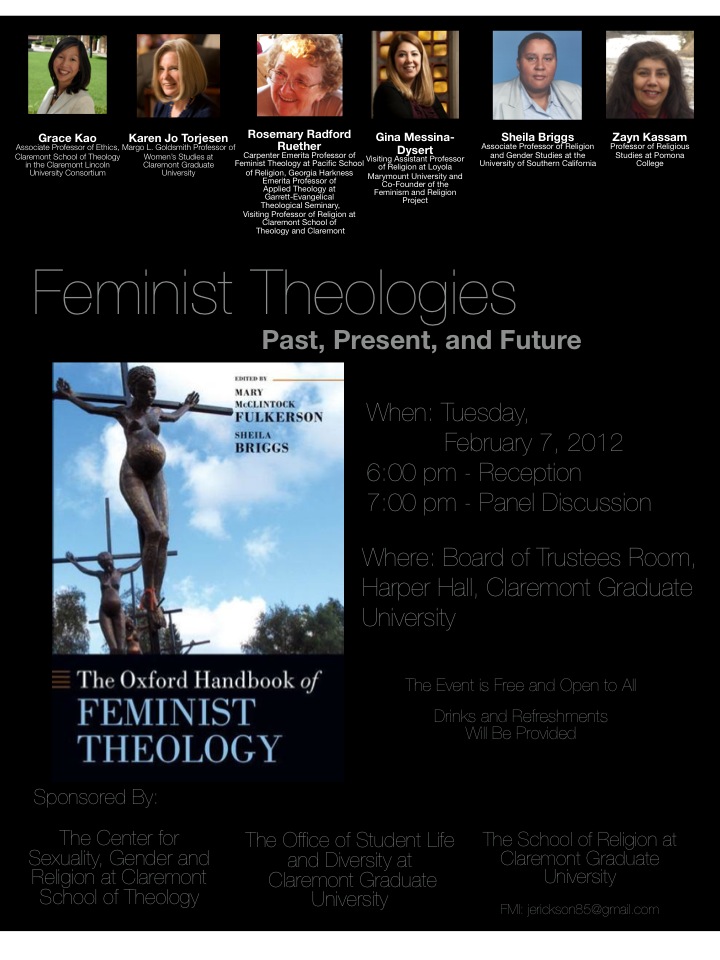
On February 7, 2012, a panel discussion focused on the past, present, and future of feminist theologies took place at Claremont Graduate University to celebrate the release of TheOxford Handbook on Feminist Theology.  The panel was organized by John Erickson, moderated by Grace Kao, and featured Karen Torjesen, Rosemary Radford Ruether, Gina Messina-Dysert, Zayne Kassam, and Sheila Briggs as presenters.  What resulted was a terrific discussion about women, religion, and feminist theologies.  Many were in attendance and participated in the panel; for those who were unable to attend, here is a video of the presentations from that evening.  We look forward to you sharing your thoughts and comments about the past, present, and future of feminist theologies.

Navigating the Academy with an Accent by Amanda Pumphrey

“Where are you from?” I wish I had a dollar for every time someone has asked me that question since moving to California. I would be able to make a substantial payment towards my student loan debt by now. No one knows I’m “different” here in SoCal until I open my mouth. My thick Southern accent happens to be my signifier.

Before I moved to Claremont to begin graduate school, I never considered my accent a problem. Despite the fact that when I moved outside of my hometown to college only two hours away, some of my friends teased me about my accent. Since I grew up in the very southwestern corner of Georgia, I lived right along the Alabama border. Some of my college friends from other regions of Georgia thought I sounded more Alabamian. Still, mostly everyone I went to college with had some form of a Southern accent and that was okay. It was safe. It was normative.  Continue reading “Navigating the Academy with an Accent by Amanda Pumphrey”

Motherhood: Still Women’s Most Valued Creative Contribution to Society? by Ivy Helman

I’m expecting…

The stork is delivering as we speak!  I hope you can join me in celebrating this joyous news  – although you should know, the stork is the United States Postal Service, and I am expecting my first book, not  my first baby!

It sounds somewhat crass (even to me whose book this is) to even try and pass off a book in the same way in which women announce they are expecting baby/babies.  Sadly, writing books, which is one use of a woman’s creative energy, does not seem to be as valued as a woman’s ability to procreate, another use of a woman’s creative energy.  Among the circle of friends I grew up with, children still seem to hold a more cherished place.  On facebook.com, my “friends” post weekly updates as to the progress of their babies, pictures of their “baby bumps” and pictures of their newborns.  Just through reading comments, the excitement is palpable. Continue reading “Motherhood: Still Women’s Most Valued Creative Contribution to Society? by Ivy Helman”

(Non-Human) Animals on the Agenda by Grace Yia-Hei Kao

“[E]thical interest in nonhuman animals is flourishing.”

To my delight, the New York Times recently chronicled the growing scholarly interest in human/non-human animal interactions in a story entitled “Animal Studies Cross Campus to Lecture Hall.” There are now more than 100 courses in colleges and universities in the burgeoning field of animal studies. At least 40 U.S. law schools now routinely offer courses in animal law. A growing number of formal academic programs, book series, journals, conferences, institutes, and fellowships are also dedicated to (re)examining human-animal relations from a variety of disciplinary perspectives—“art, literature, sociology, anthropology, film, theater, philosophy, [and] religion,” to name a few.

Continue reading “(Non-Human) Animals on the Agenda by Grace Yia-Hei Kao”