Get Your Laws off my Body! by Elise Edwards

After considering Virginia’s Transvaginal Utrasound Bill in light of the womanist critique, I wonder if religiously-motivated lawmakers considered that they alone do not have access to God’s intentions, but that the divine spirit is operative in a pregnant woman as well, would they be so willing to negate her moral agency?

On Tuesday, the senate in Virginia approved a law that would require women to get an external ultrasound before an abortion.  This is a scaled-back version of an original bill that mandated transvaginal ultrasounds prior to abortions. According to this Washington Post article, opponents like Sen. Janet D. Howell describe the measure as “state rape,” since it is the state, not the woman and her doctor who decides that she must undergo this procedure  requiring the insertion of a probe into the vagina.  Although proponents of the bill say that it is designed to give women more information about a fetus’ gestational age and development, most would agree that it is ultimately intended to discourage the women from having an abortion.  This is why bloggers like Kendra Hamilton believe that religion is the moti­va­tion behind this and the other 5 abortion-related bills introduced in the Virginia General Assembly connected to issues of women’s sovereignty over their bodies.  Yet, as I heard about these bills, another religious response came to mind – one that expresses horror and condemnation of coercive practices regarding women’s childbearing. Continue reading “Get Your Laws off my Body! by Elise Edwards”

Feminist Theologies: Past, Present, and Future

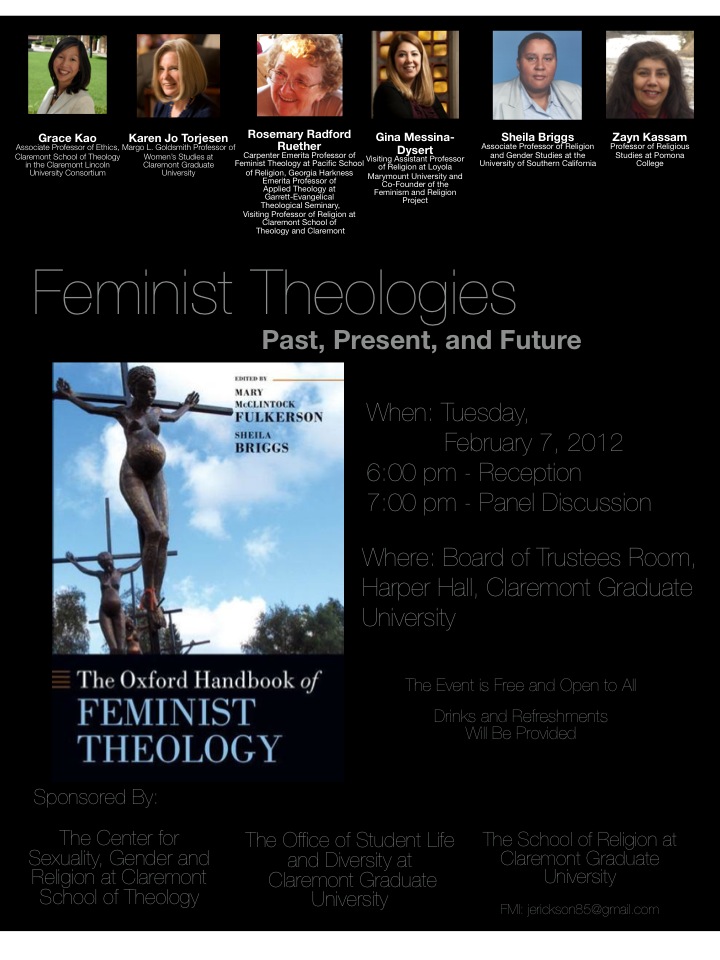
On February 7, 2012, a panel discussion focused on the past, present, and future of feminist theologies took place at Claremont Graduate University to celebrate the release of TheOxford Handbook on Feminist Theology.  The panel was organized by John Erickson, moderated by Grace Kao, and featured Karen Torjesen, Rosemary Radford Ruether, Gina Messina-Dysert, Zayne Kassam, and Sheila Briggs as presenters.  What resulted was a terrific discussion about women, religion, and feminist theologies.  Many were in attendance and participated in the panel; for those who were unable to attend, here is a video of the presentations from that evening.  We look forward to you sharing your thoughts and comments about the past, present, and future of feminist theologies.

Bareed Mista3jil: Negotiating Gender, Sexuality, and Religion in Lebanon by Amy Levin

It’s not often (enough) that I (have the time to) come across non-academic books that articulate and reflect some of the most complex intersections between religion, gender, and sexuality. Those that do are commonly produced in the Western hemisphere, often representing the voices of Euro-American cultures and religious traditions. That is why I want to give voice to Bareed Mista3jil, a book, or collection of “41 true (and personal) stories from lesbians, bisexuals, queer and questioning women, and transgender persons from all over Lebanon.” Bareed Mista3jil was published in 2009 by the organization Meem, a community of lesbian, bisexual, queer women and transgender persons (including male-to-female and female-to-male) in addition to women questioning their sexual orientation or gender identity in Lebanon. The purpose of the book is to give voice to those in Lebanon with non-conforming sexualities and identities in order to give hope to this under-represented, often silenced population. Here is a description from Meem on the origin of the book: Continue reading “Bareed Mista3jil: Negotiating Gender, Sexuality, and Religion in Lebanon by Amy Levin”

Catholicism, Contraception, and Conscience: Church Imposed Teaching, God’s Gift of Free Will, and Political Rhetoric by Michele Stopera Freyhauf

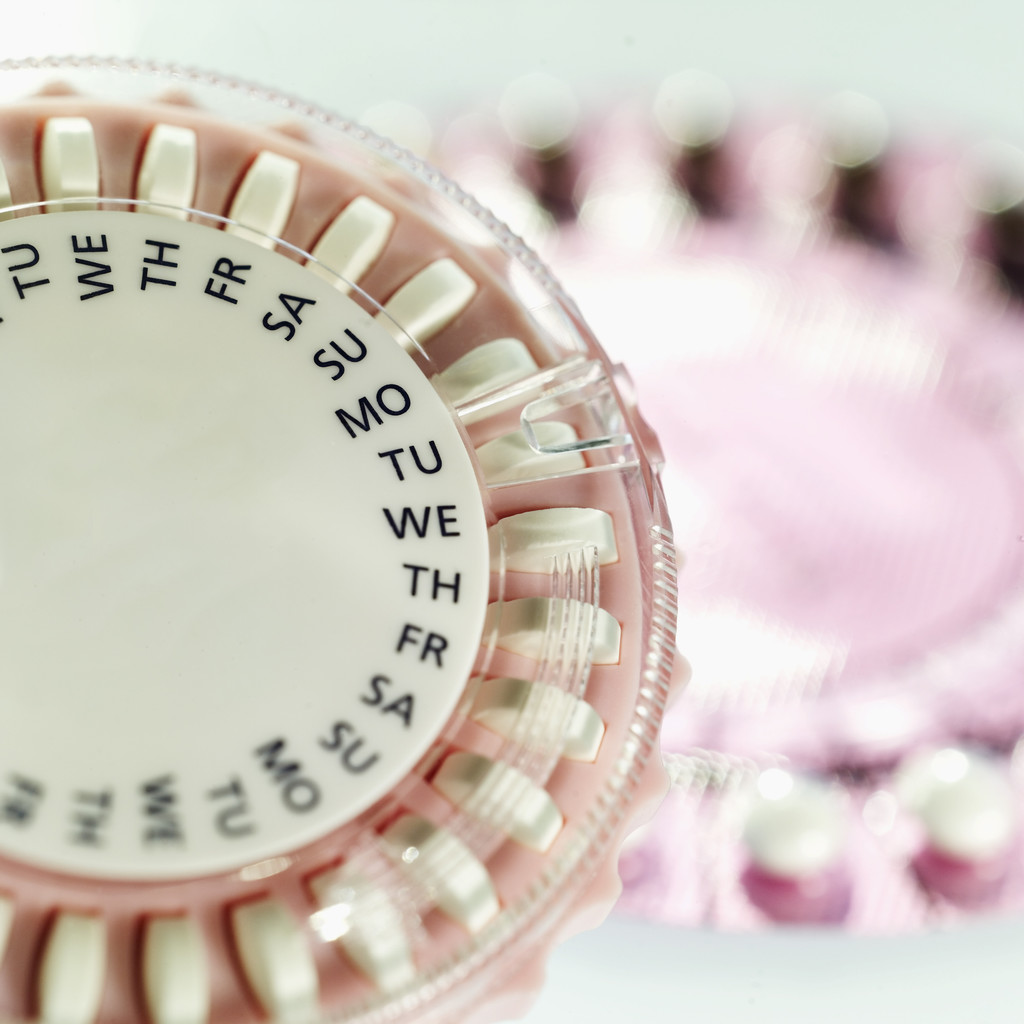
Certainly one cannot turn on the news without seeing a story about the feud over the Catholic Church’s stance on forbidding the use of contraception and Obama’s Patient Protection and Affordable Care Act (PPACA) that mandates free contraception to women.  In preparing this article, I took the time to review many articles from liberal and conservative news outlets, law professors who are experts on constitutional law, and statements from the USCCB and Bishops.  Before asking questions, I want to outline the following points:

  1. In the literature reviewed, only two women, Sr. Carol Keehan and Sr. Mary Ann Walsh, made a statement against this policy stating that the government is interfering with the working of the Church.  Most voices heard and shouting the loudest are members of the clergy.
  2. Hospitals considered “Catholic” hire people of all faiths and various beliefs.  They also treat patients of all faiths.  They are not exclusively “Catholic.”
  3. Catholic identified Colleges hire professors and staff that are not Catholic.  Moreover, their student body is not totally Catholic.
  4. Catholic Charities, once again, hire non-Catholics.
  5. Insurance plans currently in place often offer contraception prescriptions at a zero to low co-pay price.  These plans are in-force at many Catholic Institutions.
  6. Under HIPAA, healthcare of employees are protected and the Employer, even the Catholic Church cannot violate the privacy of the patient, even if it is an employee.
  7. Birth Control Pills are often prescribed for women with endometriosis or other “female” reproductive disorders and not birth control.
  8. Women pregnant, carrying a dead baby, cannot have surgery due to risks are given medication to induce abortion are given. Continue reading “Catholicism, Contraception, and Conscience: Church Imposed Teaching, God’s Gift of Free Will, and Political Rhetoric by Michele Stopera Freyhauf”

Why Should We Care About Birds? By Carol P. Christ

I believe that we should we care about birds because it is right to do so.  If we do not, we will contribute to extinction of species, and we will leave a diminished world to those who come after us. We must not give up hope that we can save the world for birds, for other wildlife, and for our children’s children.

On February 2, 2012, the International Day for Wetlands, the Greek government signed into law a Presidental Directive mandating protection of the small wetlands of the Greek islands.  There is no assurance that this law will be enforced.  There are still no measures in effect to protect most of the larger wetlands in Greece, even though this is required by the European law Natura 2000, which requires all of the countries in the European Union to protect bird and wildlife habitats.

When I became a birdwatcher, I could not have told you what a wetland is.  Now I know that wetlands are fragile bodies of water shallow enough for wading birds from flamingoes to sandpipers to stand in “without getting their bottoms wet” while feeding on shrimp, small fish, frogs, and other watery treats.  Wetlands often take the form of pools near the sea, but they also include the deltas at river mouths and seasonally flooded fields.  In the twentieth century and today many wetlands were designated “swamps” and drained. Continue reading “Why Should We Care About Birds? By Carol P. Christ”

Do We Need More “Ministerial Exceptions”? by Kile B. Jones

In a recent unanimous and precedent-setting Supreme Court ruling, a “ministerial exception” was given to Hosanna-Tabor Evangelical Lutheran Church and School regarding employment discrimination.  Cheryl Perich, a “called teacher” at Hosanna-Tabor, was fired after issues surrounding her narcolepsy developed.  As is well known in the United States, innumerable federal, state, and local laws exist to protect employees from discrimination based on race, sex, age, disability, and so forth.  Title VII of the Civil Rights Act (1964) prohibits employment discrimination based on race, color, sex, religion, or national origin.  In the Americans with Disabilities Act (ADA, signed in 1990), employers are also held liable for discrimination based on an employees’ disability.  The “ministerial exception” excludes religious institutions and ministers from the ADA.  It is important to note that the ADA protects employees hired by private companies as well as public ones.

In the slip opinion, the Supreme Court argues that, “The Establishment and Free Exercise Clauses of the First Amendment bar suits brought on behalf of ministers against their churches, claiming termination in violation of employment discrimination laws.”  The opinion sites other cases where it was ruled that religious institutions are their own arbiters of employment and termination and cannot be compelled by the State to comply with certain national laws (see Watson v. Jones, Kedroff v. Saint Nicholas Cathedral of Russian Orthodox Church in North America, and Serbian Eastern Orthodox Diocese for United States and Canada v. Milivojevich).  Justice Alito concurs by saying, “The “ministerial” exception gives concrete protection to the free “expression and dissemination of any religious doctrine.”  The Constitution leaves it to the collective conscience of each religious group to determine for itself who is qualified to serve as a teacher or messenger of its faith.” Continue reading “Do We Need More “Ministerial Exceptions”? by Kile B. Jones”

Hagar: A Portrait of a Victim of Domestic Violence and Rape

This week Twitter has been a flurry with information for victims of   domestic violence and rape.  This ranges from the U.S. redefinition of rape to include men to Nigeria’s first anti-rape toll free hotline for women.  There is even a male movement to stand against rape.  This problem is an ongoing issue, one that shows no sign of diminishing or going away.  According to Amnesty International, one in three women worldwide have been beaten, coerced into sex, or otherwise abused and their abuser is normally someone they know.  As I contemplate this very difficult issue, I am reminded of the Biblical Hagar in Genesis 16. The story of Hagar and Sarai is abundant

Men Can Stop Rape (http://www.mencanstoprape.org/)

in ethical situations that draw in the reader and presents complex issues that can be very troublesome.  If you take the text hermeneutically, through an ideological examination in its English translation, we have an Egyptian woman, who is also referred to as slave or concubine, forced to engage into sex with her owner’s husband for producing an heir.  Here the abuser is a woman with a docile and obedient husband portrayed by Abram.  What can we  glean from such a story for today’s battered women?  Hope or horrific defeat? Continue reading “Hagar: A Portrait of a Victim of Domestic Violence and Rape”

On Being a Gay Male Theologian During the War on Women by Dirk von der Horst

For some time, a prominent strand of gay and feminist theory and theology has taken it almost as axiomatic that gay men, lesbians, and straight women have a common stake in dismantling patriarchy.  While I have always understood my own work as a gay theologian in terms of that common struggle, recent developments point to a significant challenge to keeping that bond intact in the larger sphere of political activism.

At the end of last year, National Public Radio deemed 2011 an extraordinary year for gay rights.    Buzzfeed listed 40 reasons why it was the best year for gays ever, beginning with a Gallup poll showing that for the first time a majority of Americans supported same-sex marriage.  The list also included the repeal of Don’t Ask Don’t Tell and several firsts for openly gay elected officials.  Even the world of professional sports is becoming more accepting: in a recent tweet, Ravens’ linebacker Brendon Ayanbadejo equated support for same-sex marriage with playing in a Super Bowl when asked about his life’s greatest accomplishments.

Simultaneously, we saw a steady legislative assault on women’s reproductive freedom.   Continue reading “On Being a Gay Male Theologian During the War on Women by Dirk von der Horst”

The Land of the (Not Quite) Free: Women and Religion Behind Bars by Amy Levin

The sun was setting on an early Friday evening in October 2008 as I pulled into the parking lot of the Iowa Correctional Institute for Women, a maximum level security prison housing nearly 700 inmates. Though the serene drive on Iowa’s main highway lasted a mere 40 minutes from Grinnell to Mitchellville, my co-teacher and I felt worlds away from our tiny utopian bubble of books and booze. As we gathered our teaching materials for a course we designed called “Feminist Playwriting,” we made sure not to bring in any contraband, one of the many precautions given during our orientation for students participating in Grinnell Liberal Arts in Prison, a program created in 2003 that allows students to design liberal arts courses in either a men or women’s Iowa prison. My experience interacting with an incredible roomful of women, some who would suffer behind bars for the rest of their lives, was needless to say a life changing experience. That semester ignited a fire in me for prison rights, which recently has manifested in a concern for the nexus of religion and prison. Continue reading “The Land of the (Not Quite) Free: Women and Religion Behind Bars by Amy Levin”

What Do Kids’ Birthday Parties Actually Celebrate? Alternatives for Raising the Next Generation by Tallessyn Zawn Grenfell-Lee

I love birthdays. Maybe it’s partly because I’m a twin, so my parents always wanted to make sure that each of us felt adequately celebrated. For whatever reason, they’ve always been a big deal – your special day in the whole year, where you get to choose what’s for dinner and everyone is extra nice to you. So of course I’ve had even more fun now that I have kids of my own to celebrate. I love making crazy cakes and experimenting with fun party themes; and bring on the singing!  In our family, the traditional one verse birthday song was nowhere near celebratory enough – we added to it until it felt sufficiently festive, so ours goes on for a good five minutes. Continue reading “What Do Kids’ Birthday Parties Actually Celebrate? Alternatives for Raising the Next Generation by Tallessyn Zawn Grenfell-Lee”