Life in the Tenements by Carol P. Christ

carol-p-christ-photo-michael-bakasDuring my ancestor research, I have seen the word “tenement”—with the implication of poverty, filth, and disease–handwritten onto more than one death certificate. Last month, I visited the Lower East Side where my Irish 2x great-grandmother Annie Corliss lived in the tenements near the docks with her husband the Scottish seaman James Inglis and their nine children.

Though the tenements where they lived in the vicinity of Cherry Street a block from the East River have been torn down to build public housing, my newly discovered third cousin Hattie Murphy still lives in the area. She arranged for me to visit the “Irish Outsiders” house in the Tenement Museum on nearby Orchard Street in order to gain an understanding the conditions of life in the tenements in the middle of the nineteenth century.

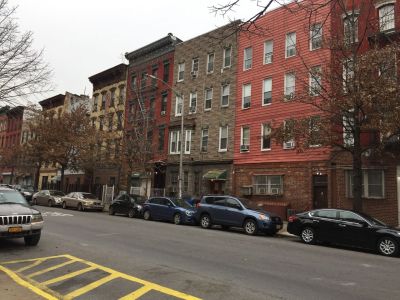
Tenement housing, which was a euphemism for apartment living in crowded and impoverished conditions, was often built on 25 x 100 foot lots that had been intended for single family homes. These several story buildings with four windows on the front of each floor were divided into small three-room apartments eight to a floor, each with one window facing the street or the back alley.
montrose-st-across-from-170
Buildings like this may look charming from the outside, until you imagine living your whole life in a small apartment set behind only one of these windows.

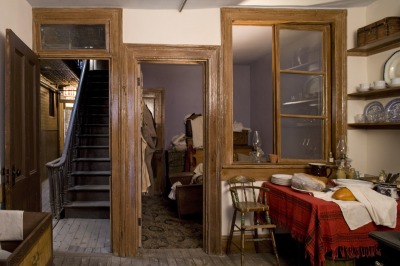
In the apartment we visited, the window was in the sitting room in the front, the bedroom was in the back, and the kitchen was in the center. The kitchen included a coal stove that was the only heating for the house. Laundry hung above the stove, and, as our guide explained, dirty diapers with only “number one” were simply pinned up to dry. Coal dust hung in the air and fell upon everything. Even in the summer when the windows were open, fresh air rarely reached to the kitchen, let alone to the bedroom in the back. Our guide remarked that the smells of cooking, coal, babies, and unwashed bodies would have been overpowering. Despite their poverty, the women purchased pretty dishes, often chipped, at second hand stores, and proudly displayed them.
tenement-museum-irish-house-kitchen-and-bedroom
This photo shows the communal staircase, the open door of the apartment, kitchen and bedroom. The window inside the apartment was added to improve air circulation due to health regulations. Blue Willow pattern dishes on display upper left.

Our visit began in the back “garden” where there were four toilets for twenty-two families. I shuddered to imagine trying to clean them or to run down to use them in the middle of the night. There was a pump for fresh water. The guide handed around a bucket filled with pebbles to give us an idea of the weight the housewives and their children had to lug up flights of stairs numerous times each day. No wonder baths were infrequent. I remember an older Greek friend telling me how they used to wash with a cloth from the waist up one day and from the waist down the next. Annie’s family may not even have managed that.
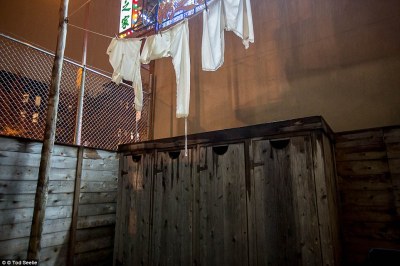
tenement-museum-toilets-outside
Outdoor toilets in the back “garden” serving twenty-two families.

Our tour included a description of a sick and dying baby and a funeral with the baby’s body laid out in the sitting room. My 2x great-grandmother gave birth to nine children of whom, unusually, the first eight lived to adulthood. Annie must have understood that hygiene is heath. Her days would have been spent fighting to keep her house and her children as clean as she could.
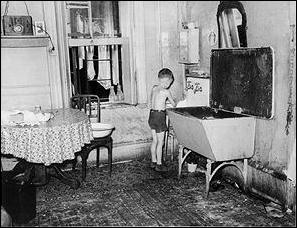
tenement-housing-boy-at-sink
Boy washing in tenement kitchen. The sink doubled as a work space.

The bedroom in the apartment we visited had a small double bed pushed up against two walls, with just enough room to walk past it to get to a small closet and a few trunks crammed in the space against the back wall. When James the seaman was home, this would have been the marital bed, but when he was gone, the younger children slept with their mother, while the older ones wrapped themselves in sheets and blankets near the stove or in the sitting room.
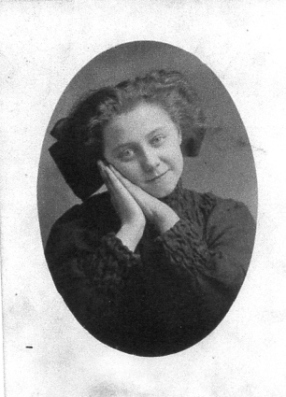
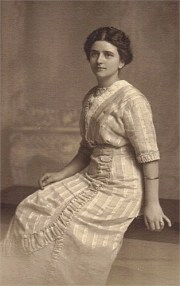
annie-corliss-young
Annie, at the time of her marriage

Anne, age 20, and James “Ingles,” mariner, age 25, husband and wife, living in the area of the docks, appear on the 1855 New York State census. In fact, Annie was perhaps 15, while James was 17. I suspected this was an unusually young age to marry, and research proved me right. The average age for Irish marriages at the time was 20 for the bride and 25 for the groom. Annie would have had every reason to lie about her age for reasons of propriety.

Documents I have only recently found show that Ann “Carless,” age 13 arrived in New York with her mother Mary on January 16, 1854. Her two younger brothers, one 7 and the other an infant, died on the ship. As I could not find Ann’s mother Mary after that, I assume she died soon after arriving, leaving her young daughter on her own.

Annie lived her whole life in America in tenements in the the unsavory area near the docks—filled with bars, drunken sailors, prostitution, and crime. She died at the age of forty-five of a stroke, leaving her husband and eight children. Because of her, I am here.

Also see “The Careless Spirit of Annie Corliss.”

***
a-serpentine-path-amazon-coverBe among the first to order A Serpentine Path, Carol P. Christ’s moving memoir of transformation. Carol’s other new book written with Judith Plaskow is Goddess and God in the World: Conversations in Embodied Theology. Carol also wrote the first Goddess feminist theology, Rebirth of the Goddess.

Join Carol on a Goddess Pilgrimage to Crete in 2017. Save $200.

Read two of the chapters in the book: Mysteries and Dionysian Rites.

Thanks to Judith Shaw for the cover art “Downward Serpent.”

 

Ancestor Connection in Williamsburg, Brooklyn by Carol P. Christ

carol-p-christ-photo-michael-bakasIn early December 2016 I visited central Williamsburg in Brooklyn, New York, where my 2x great-grandparents Thomas and Anna Maria Christ and their son George and his family, including my father’s father Irving John, lived for over fifty years. I had compiled a list of all the known addresses of the family in Williamsburg from census and death records. The family lived in a several block square area surrounding Most Holy Trinity Roman Catholic Church on Montrose Street for all that time.
Most of the buildings at the addresses where the family lived had been torn down and replaced with housing projects in the mid-twentieth century. Some of the remaining ones are being torn down today, as this area of Williamsburg is being gentrified. Still, enough of the old buildings remain to give a sense of what the neighborhood was like in the 1800s. Continue reading “Ancestor Connection in Williamsburg, Brooklyn by Carol P. Christ”

Down on the Farm by Carol P. Christ

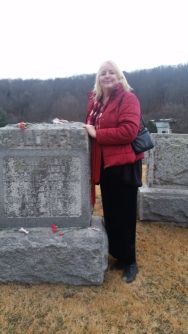
iloff-grave-with-carolIn the past week I visited Cherry Ridge, Honesdale, Wayne, Pennsylvania in the Pokonos, where I was welcomed by my third cousin Marcia Perry Gager whose family never left the place where our ancestors settled.  Marcia and I have been corresponding about our family’s history since Ancesty.com connected us about three years ago. During that time, together with another cousin, Debra Ball, we have managed to decipher the complicated history of Henry Iloff, his two wives, and their eighteen children.

My visit to Honesdale began at John’s Evangelical (formerly German) Lutheran Church.  Following a last-minute discovery that the baptism, marriage, and funeral  records of the church were not in the Wayne County Historical Musem archives as I had been led to believe, I made a call to the “emergency number” of Pastor Richard Mowery the day before our scheduled visit, not knowing how he would respond to this “not-really-emergency” invasion of his personal space. Continue reading “Down on the Farm by Carol P. Christ”

Mother Demdike, Ancestor of My Heart, Part 3 by Mary Sharratt

mary sharrattContinued from Part 1 and Part 2 When Bess was in her fifties, walking past the quarry at sunset—called daylight gate in her dialect—a beautiful young man emerged from the stone pit, his hair golden and shining, his coat half black, half brown. He introduced himself to her as Tibb and promised to be her familiar spirit, her otherworldly companion who would be the power behind her every spell.

Maureen Stopforth who runs the Witches Galore gift shop in Newchurch has warned visitors of a malign energy rising from the quarry but I sense nothing evil, merely a yearning that draws me in deeper until, near the back of the old stone pit, I find a man’s face carved in the rock—the handiwork of some fanciful Victorian who wished to pay tribute to Bess’s Tibb.

Attending a Halloween ghost walk, I bristle as the guide glibly describes Tibb as the “devil in disguise.” From my research, I learned that the devil, as such, appeared to be a minor figure in British witchcraft. Instead the familiar spirit took center stage—the cunning person’s spirit helper who could shape shift between human and animal form. Bess described how her Tibb could appear as a hare, a black cat, or a brown dog. In traditional English folk magic, it seemed that no cunning man or cunning woman could work magic without the aid of their familiar. Continue reading “Mother Demdike, Ancestor of My Heart, Part 3 by Mary Sharratt”

Mother Demdike, Ancestor of My Heart, Part 2 by Mary Sharratt

mary sharrattContinued from Part 1. As I sought to uncover the bones of the cunning woman Mother Demdike’s story, I was drawn into a new world of mystery and magic. It was as though Pendle Hill had opened up like an enchanted mountain to reveal the treasures hidden within. Every stereotype I’d held of historical witches and cunning folk was dashed to pieces. Continue reading “Mother Demdike, Ancestor of My Heart, Part 2 by Mary Sharratt”

Mother Demdike, Ancestor of My Heart, Part 1 by Mary Sharratt


beltaine-pendle-view

Pendle Hill, seen from the back of my house, in May.

mary sharrattThe Soul of Gaia is the numinous earth beneath my feet, her soil cradling the bones and the stories of the ancestors who have died into the land and become part of the ever-living spirit of the place.
An expat writer, my home is everywhere and nowhere. A wanderer, I have lived in many different places, from Minnesota, my birthplace, with its rustling marshes haunted by the cries of redwing blackbirds, to Bavaria with its dark forests and dazzling meadows and pure streams where otter still live. But I don’t know if any place has touched me as deeply as Lancashire, England, my home for the past fifteen years. Continue reading “Mother Demdike, Ancestor of My Heart, Part 1 by Mary Sharratt”

Weaving and Spinning Women: Witches and Pagans by Max Dashu: Reviewed by Carol P. Christ

carol p. christ photo michael bakasMax Dashu’s  Witches and Pagans: Women in European Folk Religion 700-1000 challenges the assumption that Europe was fully Christianized within a few short centuries as traditional historians tell us. Most of us were taught not only that Europe became Christian very rapidly, but also that Europeans were more than willing to adopt a new religion that was “superior” to “paganism” in every way. Careful readers of Dashu’s important new work will be challenged to revise their views. When the full 15 volumes of the projected series are in print, historians may be forced to hang their heads in shame. This of course assumes that scholars will read Dashu’s work. More likely they will ignore or dismiss it, but sooner or later–I dare to hope–the truth will out. Continue reading “Weaving and Spinning Women: Witches and Pagans by Max Dashu: Reviewed by Carol P. Christ”

In Search of Ancestral Wisdom by Max Dashu

Max 2011

 What is the preserving shrine? Níansa (not hard).
The preserving shrine is memory and what is preserved in it.
What is the preserving shrine? Níansa.

The preserving shrine is Nature and what is preserved in it.
Senchas Mór, Ireland

In a world in extremity, we are searching for the wellspring, the inexhaustible Source known to all our ancient kindreds. Many of us have been cut off from our deep roots, and especially from the ancient wisdom of women, and female spiritual leadership.

My long quest has been to discover the lost strands of my own roots, the old ethnic cultures of Europe, and to reweave those ripped webs. I have spent decades searching for authentic cultural testimony about women’s spiritual ways before Christianity, before the Roman empire, before men commandeered all positions of religious leadership. My book, Witches and Pagans: Women in European Folk Religion, brings together these ripped strands of the cultural web. Continue reading “In Search of Ancestral Wisdom by Max Dashu”

My Experience at Auschwitz by Ivy Helman

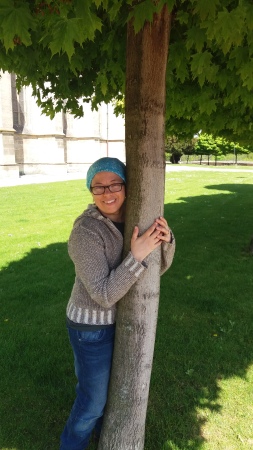
me hugging treeOn August 4th, I visited Auschwitz.  In the beginning, the reality of the experience did not match my surrealist expectations of it.  I expected to walk onto the grounds and get hit over the head with the heaviness of what happened there, to feel a sense of deep connection to the land covered in the ashes of my people, to have the opportunity to mourn the loss of the members of my family I never met and to be utterly speechless as to the twisted systematization and industrialization of murder that took place there.  That blow never came.  Why?

The day of my visit was out-of-this-world hot.  My guided tour, in Czech, started at 2pm.  I was early so I wandered among the crowd outside of the site.  There were families lounging on the lawns eating ice creams and drinking cokes.  There were tourists taking selfies.  There were lots of conversations and lots of laughter.  I was pretty convinced that I was the only Jew around.

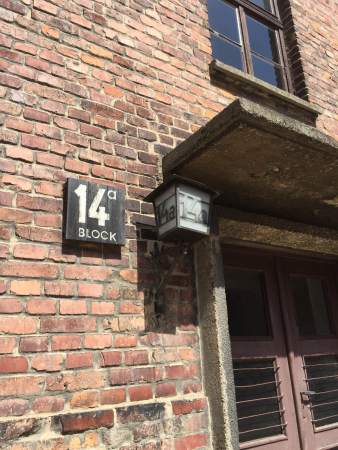
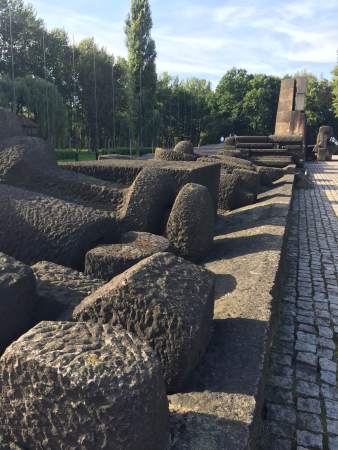
Upon entering the grounds, I was stunned by how green and lush it was.  There were many old brick buildings, seemingly orderly, with lanterns and building signs hanging outside the entrances.  Among it all, upwards of 500 people clustered in groups walked from place to place.auschwitz large stone memorial

The tour began with a basic history of the events of the Holocaust with “exhibits” contained within 3 or 4 different buildings. The guide seemed to me to have memorized a script in which we went from one building to another looking at the “exhibits,” most of which consisted of nothing more than one or two oversized pictures and maps.  Outwardly, I sensed no sentiment in the guide and no spirit in the exhibitions either.  Her voice was monotone, pronouncing the Czech in such a syllable-by-syllable fashion that it was nearly incomprehensible.  Most exhibition rooms were sparse, if they had any objects at all other than the black and white pictures and maps.  The tour and exhibitions portrayed such a distance from the events it was almost as if they didn’t happen there, in that place.

zyclon b
Zyklon B

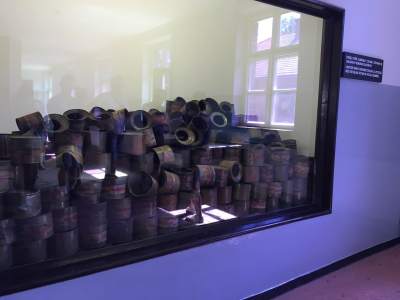
There were a few buildings with objects all hermetically sealed behind glass once again keeping us at a distance.  One room housed a display of used Zyklon B canisters and had an artist’s small scale all-white model of the “process of extermination,” meaning the “changing rooms,” “showers” and crematoriums – with tiny people crammed into the areas and bodies piled on the floors next to the ovens.  Two other buildings contained large displays, again behind glass and removed from their context, of what the exhibition called “evidence of the destruction:” piles of hair loosened from the burlaps sacks they had been founded in when the camp was liberated; shoes of the victims and a large (two-story) container filled with the pots and pans the victims had packed and brought with them but never used.

After we finished our tour of Auschwitz 1, we were given a 15 minute break and were instructed tolarge stone memorial reassemble by the bus that would take us to Auschwitz-Birkenau.  Once there, we rushed through the camp at such a pace that we were done in about 45 minutes.  In spite of the rush, I did manage to leave two stones on the pillars, which marked where the ashes of the victims were scattered (buried?).  We glanced at the memorial at the back of the camp as well as what was left of the bombed-out crematoriums.  Returning to the front of the camp, we ducked into a reconstructed dormitory and a reconstructed bathroom building.  The guide asked if we had any questions.  Silence.  The tour was done.

I stood there debating what to do.  Do I leave?  Do I stay?  I was pretty confident that it didn’t feel right to just go.  So, I headed back to the memorial.  The tour guide had said that each of the smaller stones creating the steps and floor commemorated one of the 1.1 million Jews killed in Auschwitz.  Yet, it was unclear as to the meaning of the large stones.  After circling the large stones and a futile attempt to make some meaning out of them, I went and sat on the stairs of the memorial and just looked out over the place and the people there.

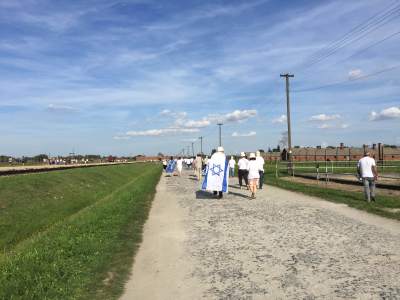
Jewish superherosStill puzzled but needing to catch the train, I made my way to the entrance.  In front of me was a group of Israeli Jews wrapped in Israeli flags, looking the Superhero part.  Something changed.  Maybe I didn’t need the sad, mournful, pit-of-the-stomach experience.  Maybe I’ve had it enough, learned about it enough, taught it enough and lived with it enough.  Maybe my pilgrimage there as a witness to the horrors was enough.

It was those Israeli Jews that I needed.  Walking into Auschwitz was one thing, but they were proud Jews walking out.  I followed them.  We, Jews, were the lucky ones who got to leave.  Isn’t that something!

Ivy Helman, Ph.D. is feminist scholar and faculty member at Charles University and Anglo-American University in Prague, Czech Republic where she teaches a variety of Jewish Studies and Ecofeminist courses.  She is an Associate of Merrimack College‘s Center for the Study of Jewish-Christian-Muslim Relations and spent many years there as an Adjunct Lecturer in the Religious and Theological Studies Department. 

A Tale of Two Sisters and a Daughter and Niece by Carol P. Christ

This continues the story I began last week. Catherina is my 2x great-grandmother; Agnes is my 2x great-aunt; Johanetta is my first cousin, 3x removed, and my step-2x great-grandmother; Henry is my 2x great-grandfather. It is true that Henry had eighteen children with two wives. It is also true that Henry and Johanetta married and had a child soon after Catherina’s death. Some of the other details came in waking trance as I allowed the ancestors to tell their stories through me.

Agnes Lattauer Sweitzer: I thought the day Catherina left for America would be the worst day of my life. I did not know I would see Catherina again. I did not know I would outlive my two little sisters and both of my brothers. I did not know what my daughter would do. I read Catherina’s letters from America through my tears. How I wanted to be with her on her wedding day. How I wished she had been with us when we buried our sister Johanetta. My heart nearly burst when Catherina wrote that she longed to take my hand when she gave birth to her first child. My mind contorted itself trying to envision her living in a big city, in a big building, climbing up and down stairs, her feet never touching the earth, her hands never working the soil. What kind of life was that?

Catherina Lattauer Iloff

Catherina Lattauer Iloff: I left home a girl. Because I was not yet engaged, Mother and Agnes never told me about married life. What to expect. What to do. I loved Heinrich, or Henry, as he wanted to be called after he became a citizen of the United States. I was not prepared. Henry was so insistent. I was soon pregnant. First Henry, named for Henry’s father Heinrich, then Elisabeth, named for Mother. I had to care for them on my own. Henry was busy with his work during the days. In the evenings he went to the German beer garden to meet his friends. Growing up with my mother and sisters, I had never been alone. There were other women around, but they were busy with their own lives. Some of them were kind, some of them were not, but nobody cared about me the way Mother and Agnes did. One night Henry came home and told me he had been talking with his friends. There was land available in a place called Cherry Ridge, Pennsylvania, a  day’s journey from New York City. He said it was his dream come true. We would build our own house. There was plenty of land to farm—not like back home where there were never enough fields to go around. I held my tongue. I did not tell him that I suspected I was pregnant again.

The Iloff farm house

Agnes Lattauer Sweitzer: Catherina and Henry have been to Cherry Ridge. Catherina says there is land for us there too. I don’t know what my Heinrich will say. Life is difficult for us here, but we have two young daughters, Elisabeth and Johanetta, and the baby, Peter. There is Mother to consider. Well, you could have blown me over with a feather. Heinrich said we should grab the opportunity before it is too late. Mother said she would come with us, because she wants to see Catherina and Rudolph again before she dies. She is an old lady. I wonder how she will manage the journey. But I couldn’t say no. The two of us cannot contain our joy. We will see our beloved Catherina again.

Catherina Lattauer Iloff: My life is complete. Mother and Agnes and the dear little children arrived. Mother immediately took Henry and Elisabeth in her arms. Agnes comforted me about the loss of Baby John. I could finally allow myself to cry, knowing that Mother and Agnes would be there to wipe away my tears.

Agnes Lattauer Sweitzer: Our first years in Cherry Ridge were difficult. There were houses to be built, fields to be plowed, cows to be bought and milked. I had two more children, Henry, who died as a boy, and John.  My little sister outdid me. She had nine children in all: Henry, Elisabeth, John who died, John who lived, George, Catherine, Mary, Frank, and Barbara. Giving birth to so many children took its toll on her. After the last one, she was never well. I think she may have been pregnant again several times, but she never spoke about it, not even to me. Finally, she took to her bed.

Catherina Lattauer Iloff: I had nine children. I never told anyone about the babies I lost before I began to show. Mother and Agnes worried that I was having too many children. But what could I do? I loved Henry, and I loved every one of my children. Mother died a few years after she came to Cherry Ridge. She always said she was so happy she had undertaken such a great adventure. She was pleased to know that Agnes and I were settled and happy. I miss her every day. Agnes is always by my side.  I was forty-two when Barbara, my last baby was born. I bled a lot. After that, I never carried another child to term. I was never myself again. Agnes is my rock. Johanetta helps with the little ones. Henry is still strong as an ox, busy in the fields or with the cattle. I see that Johanetta hangs on his every word. I dismiss such thoughts from my mind. I do not know how much longer I have.

Agnes Lattauer Sweitzer: Catherina died yesterday. She was only  forty-six (I am now fifty-six), and she had not been well for several years.  I told her to stay away from Henry, but she was powerless to do so. Sometimes I blame him for her death. I worry about Johanetta now. Wild horses will not keep her away from Henry. I see the way she looks at him, and I see the old goat looking right  back at her. She is twenty-six, a full grown woman.

hannah johanna nettie switzer
Johanetta displaying her engagement ring

Johanetta Sweitzer: I can’t believe it! Henry asked me to marry him. Mother is furious. Father says he should have whipped me a long time ago. But they can’t say no. I told them I am pregnant with Henry’s child. The older children are shocked that their cousin is marrying their father. The younger ones are thrilled. They have always viewed me as a second mother as well as an aunt. I have been looking after all of them these last years what with Aunt Catherina being so ill. I love those children.

Agnes Lattauer Sweitzer: I had to forgive Johanetta, but I will never forgive Henry. I smile when I see him to keep the peace, but my heart is cold. Peter was her first-born. After that she had Agnes and Emma, who died of some of those diseases children get. I could not help wondering if that was God’s punishment.

Johanetta Sweitzer Iloff: Henry and I were married  for twenty years. Except for losing Agnes and Emma, those were the happiest years of my life. In all, we had nine children: first Peter, Agnes, and Emma, and then, Anna, Lawrence, Charles, Robert, Otto, and Phillip. Henry was a good man. He worked hard all of his life to support his family. We lost the second John a few years ago, but there were fourteen living children to mourn Henry’s death. The little ones are still with me, some of the others are scattered to the winds, and quite a few are settled around here, raising families of their own. While he was still strong and able, Henry was elected Commissioner of Wayne County. He served his fellow countrymen proudly for years. I wish Mother had been alive to see that. Maybe then she would have understood what a wonderful man he was.

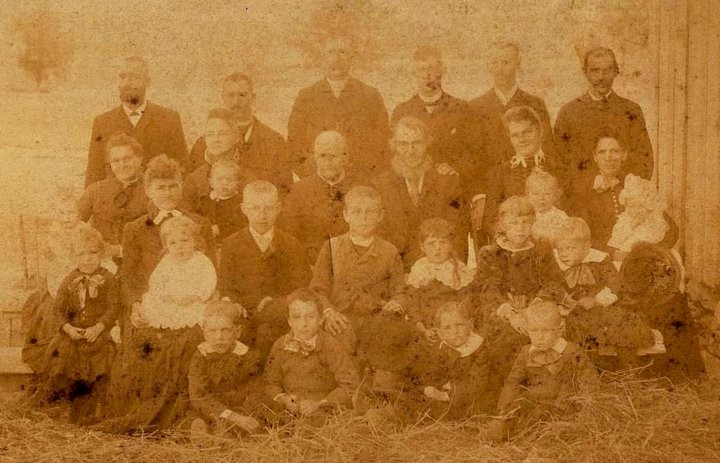
Henry and Johanetta, second row, center right, with some of Hnery's children and grandchildren
Henry and Johanetta, second row, center right with some of Henry’s children and grandchildren


Carol Molivos by Andrea Sarris 2Carol P. Christ is author or editor of eight books in Women and Religion and is one of the Foremothers of the Women’s Spirituality Movement. She leads the Goddess Pilgrimage to Crete in Spring and Fall: Sign up now for spring tour and save $100. Follow Carol on Twitter @CarolP.Christ, Facebook Goddess Pilgrimage, and Facebook Carol P. Christ.  Carol speaks in depth about the Goddess Pilgrimage to Crete in an illustrated interview with Kaalii Cargill. Photo of Carol by Andrea Sarris.

A Serpentine Path Cover with snakeskin backgroundA Serpentine Path: Mysteries of the GoddessGoddess and God in the World final cover design will be published by Far Press in 2016. A journey from despair to the joy of life.
Goddess and God in the World: Conversations in Embodied Theology with Judith Plaskow will be published by Fortress Press in August 2016. Exploring the connections of theology and autobiography and alternatives to the transcendent, omnipotent male God.