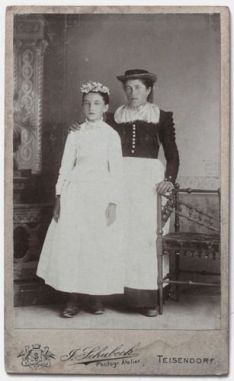
Continued from Part 1 and Part 2 When Bess was in her fifties, walking past the quarry at sunset—called daylight gate in her dialect—a beautiful young man emerged from the stone pit, his hair golden and shining, his coat half black, half brown. He introduced himself to her as Tibb and promised to be her familiar spirit, her otherworldly companion who would be the power behind her every spell.
Maureen Stopforth who runs the Witches Galore gift shop in Newchurch has warned visitors of a malign energy rising from the quarry but I sense nothing evil, merely a yearning that draws me in deeper until, near the back of the old stone pit, I find a man’s face carved in the rock—the handiwork of some fanciful Victorian who wished to pay tribute to Bess’s Tibb.
Attending a Halloween ghost walk, I bristle as the guide glibly describes Tibb as the “devil in disguise.” From my research, I learned that the devil, as such, appeared to be a minor figure in British witchcraft. Instead the familiar spirit took center stage—the cunning person’s spirit helper who could shape shift between human and animal form. Bess described how her Tibb could appear as a hare, a black cat, or a brown dog. In traditional English folk magic, it seemed that no cunning man or cunning woman could work magic without the aid of their familiar. Continue reading “Mother Demdike, Ancestor of My Heart, Part 3 by Mary Sharratt”
Continued from Part 1. As I sought to uncover the bones of the cunning woman Mother Demdike’s story, I was drawn into a new world of mystery and magic. It was as though Pendle Hill had opened up like an enchanted mountain to reveal the treasures hidden within. Every stereotype I’d held of historical witches and cunning folk was dashed to pieces. Continue reading “Mother Demdike, Ancestor of My Heart, Part 2 by Mary Sharratt”
Pendle Hill, seen from the back of my house, in May.
The Soul of Gaia is the numinous earth beneath my feet, her soil cradling the bones and the stories of the ancestors who have died into the land and become part of the ever-living spirit of the place.
An expat writer, my home is everywhere and nowhere. A wanderer, I have lived in many different places, from Minnesota, my birthplace, with its rustling marshes haunted by the cries of redwing blackbirds, to Bavaria with its dark forests and dazzling meadows and pure streams where otter still live. But I don’t know if any place has touched me as deeply as Lancashire, England, my home for the past fifteen years. Continue reading “Mother Demdike, Ancestor of My Heart, Part 1 by Mary Sharratt”
Max Dashu’s Witches and Pagans: Women in European Folk Religion 700-1000challenges the assumption that Europe was fully Christianized within a few short centuries as traditional historians tell us. Most of us were taught not only that Europe became Christian very rapidly, but also that Europeans were more than willing to adopt a new religion that was “superior” to “paganism” in every way. Careful readers of Dashu’s important new work will be challenged to revise their views. When the full 15 volumes of the projected series are in print, historians may be forced to hang their heads in shame. This of course assumes that scholars will read Dashu’s work. More likely they will ignore or dismiss it, but sooner or later–I dare to hope–the truth will out. Continue reading “Weaving and Spinning Women: Witches and Pagans by Max Dashu: Reviewed by Carol P. Christ”
What is the preserving shrine? Níansa (not hard).
The preserving shrine is memory and what is preserved in it.
What is the preserving shrine? Níansa. The preserving shrine is Nature and what is preserved in it.
—Senchas Mór, Ireland
In a world in extremity, we are searching for the wellspring, the inexhaustible Source known to all our ancient kindreds. Many of us have been cut off from our deep roots, and especially from the ancient wisdom of women, and female spiritual leadership.
My long quest has been to discover the lost strands of my own roots, the old ethnic cultures of Europe, and to reweave those ripped webs. I have spent decades searching for authentic cultural testimony about women’s spiritual ways before Christianity, before the Roman empire, before men commandeered all positions of religious leadership. My book, Witches and Pagans: Women in European Folk Religion, brings together these ripped strands of the cultural web. Continue reading “In Search of Ancestral Wisdom by Max Dashu”
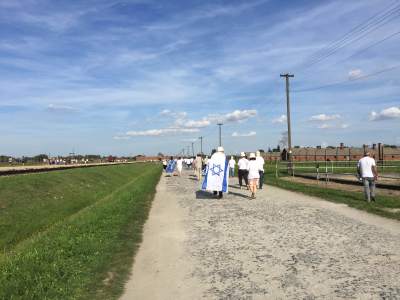
On August 4th, I visited Auschwitz. In the beginning, the reality of the experience did not match my surrealist expectations of it. I expected to walk onto the grounds and get hit over the head with the heaviness of what happened there, to feel a sense of deep connection to the land covered in the ashes of my people, to have the opportunity to mourn the loss of the members of my family I never met and to be utterly speechless as to the twisted systematization and industrialization of murder that took place there. That blow never came. Why?
The day of my visit was out-of-this-world hot. My guided tour, in Czech, started at 2pm. I was early so I wandered among the crowd outside of the site. There were families lounging on the lawns eating ice creams and drinking cokes. There were tourists taking selfies. There were lots of conversations and lots of laughter. I was pretty convinced that I was the only Jew around.
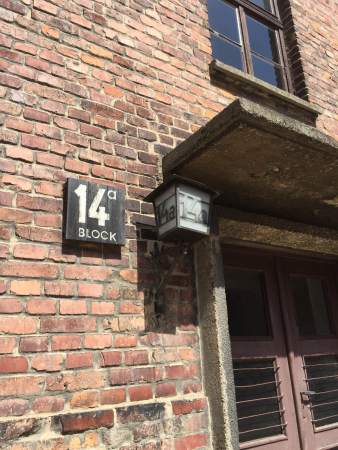
Upon entering the grounds, I was stunned by how green and lush it was. There were many old brick buildings, seemingly orderly, with lanterns and building signs hanging outside the entrances. Among it all, upwards of 500 people clustered in groups walked from place to place.
The tour began with a basic history of the events of the Holocaust with “exhibits” contained within 3 or 4 different buildings. The guide seemed to me to have memorized a script in which we went from one building to another looking at the “exhibits,” most of which consisted of nothing more than one or two oversized pictures and maps. Outwardly, I sensed no sentiment in the guide and no spirit in the exhibitions either. Her voice was monotone, pronouncing the Czech in such a syllable-by-syllable fashion that it was nearly incomprehensible. Most exhibition rooms were sparse, if they had any objects at all other than the black and white pictures and maps. The tour and exhibitions portrayed such a distance from the events it was almost as if they didn’t happen there, in that place.
Zyklon B
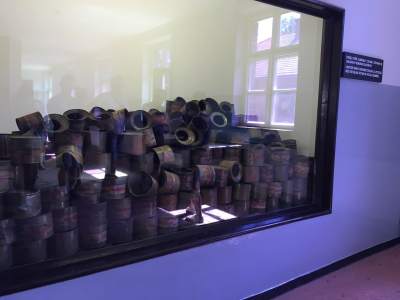
There were a few buildings with objects all hermetically sealed behind glass once again keeping us at a distance. One room housed a display of used Zyklon B canisters and had an artist’s small scale all-white model of the “process of extermination,” meaning the “changing rooms,” “showers” and crematoriums – with tiny people crammed into the areas and bodies piled on the floors next to the ovens. Two other buildings contained large displays, again behind glass and removed from their context, of what the exhibition called “evidence of the destruction:” piles of hair loosened from the burlaps sacks they had been founded in when the camp was liberated; shoes of the victims and a large (two-story) container filled with the pots and pans the victims had packed and brought with them but never used.
After we finished our tour of Auschwitz 1, we were given a 15 minute break and were instructed to reassemble by the bus that would take us to Auschwitz-Birkenau. Once there, we rushed through the camp at such a pace that we were done in about 45 minutes. In spite of the rush, I did manage to leave two stones on the pillars, which marked where the ashes of the victims were scattered (buried?). We glanced at the memorial at the back of the camp as well as what was left of the bombed-out crematoriums. Returning to the front of the camp, we ducked into a reconstructed dormitory and a reconstructed bathroom building. The guide asked if we had any questions. Silence. The tour was done.
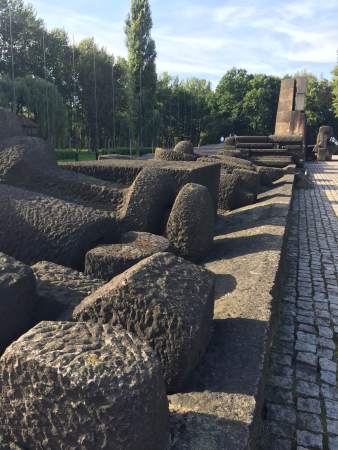
I stood there debating what to do. Do I leave? Do I stay? I was pretty confident that it didn’t feel right to just go. So, I headed back to the memorial. The tour guide had said that each of the smaller stones creating the steps and floor commemorated one of the 1.1 million Jews killed in Auschwitz. Yet, it was unclear as to the meaning of the large stones. After circling the large stones and a futile attempt to make some meaning out of them, I went and sat on the stairs of the memorial and just looked out over the place and the people there.
Still puzzled but needing to catch the train, I made my way to the entrance. In front of me was a group of Israeli Jews wrapped in Israeli flags, looking the Superhero part. Something changed. Maybe I didn’t need the sad, mournful, pit-of-the-stomach experience. Maybe I’ve had it enough, learned about it enough, taught it enough and lived with it enough. Maybe my pilgrimage there as a witness to the horrors was enough.
It was those Israeli Jews that I needed. Walking into Auschwitz was one thing, but they were proud Jews walking out. I followed them. We, Jews, were the lucky ones who got to leave. Isn’t that something!
Ivy Helman, Ph.D. is feminist scholar and faculty member at Charles University and Anglo-American University in Prague, Czech Republic where she teaches a variety of Jewish Studies and Ecofeminist courses. She is an Associate of Merrimack College‘s Center for the Study of Jewish-Christian-Muslim Relations and spent many years there as an Adjunct Lecturer in the Religious and Theological Studies Department.
This continues the story I began last week. Catherina is my 2x great-grandmother; Agnes is my 2x great-aunt; Johanetta is my first cousin, 3x removed, and my step-2x great-grandmother; Henry is my 2x great-grandfather. It is true that Henry had eighteen children with two wives. It is also true that Henry and Johanetta married and had a child soon after Catherina’s death. Some of the other details came in waking trance as I allowed the ancestors to tell their stories through me.
Agnes Lattauer Sweitzer: I thought the day Catherina left for America would be the worst day of my life. I did not know I would see Catherina again. I did not know I would outlive my two little sisters and both of my brothers. I did not know what my daughter would do. I read Catherina’s letters from America through my tears. How I wanted to be with her on her wedding day. How I wished she had been with us when we buried our sister Johanetta. My heart nearly burst when Catherina wrote that she longed to take my hand when she gave birth to her first child. My mind contorted itself trying to envision her living in a big city, in a big building, climbing up and down stairs, her feet never touching the earth, her hands never working the soil. What kind of life was that?
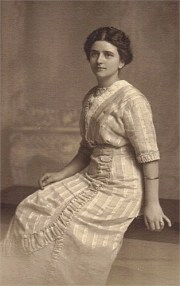
Catherina Lattauer Iloff
Catherina Lattauer Iloff: I left home a girl. Because I was not yet engaged, Mother and Agnes never told me about married life. What to expect. What to do. I loved Heinrich, or Henry, as he wanted to be called after he became a citizen of the United States. I was not prepared. Henry was so insistent. I was soon pregnant. First Henry, named for Henry’s father Heinrich, then Elisabeth, named for Mother. I had to care for them on my own. Henry was busy with his work during the days. In the evenings he went to the German beer garden to meet his friends. Growing up with my mother and sisters, I had never been alone. There were other women around, but they were busy with their own lives. Some of them were kind, some of them were not, but nobody cared about me the way Mother and Agnes did. One night Henry came home and told me he had been talking with his friends. There was land available in a place called Cherry Ridge, Pennsylvania, a day’s journey from New York City. He said it was his dream come true. We would build our own house. There was plenty of land to farm—not like back home where there were never enough fields to go around. I held my tongue. I did not tell him that I suspected I was pregnant again.
The Iloff farm house
Agnes Lattauer Sweitzer: Catherina and Henry have been to Cherry Ridge. Catherina says there is land for us there too. I don’t know what my Heinrich will say. Life is difficult for us here, but we have two young daughters, Elisabeth and Johanetta, and the baby, Peter. There is Mother to consider. Well, you could have blown me over with a feather. Heinrich said we should grab the opportunity before it is too late. Mother said she would come with us, because she wants to see Catherina and Rudolph again before she dies. She is an old lady. I wonder how she will manage the journey. But I couldn’t say no. The two of us cannot contain our joy. We will see our beloved Catherina again.
Catherina Lattauer Iloff: My life is complete. Mother and Agnes and the dear little children arrived. Mother immediately took Henry and Elisabeth in her arms. Agnes comforted me about the loss of Baby John. I could finally allow myself to cry, knowing that Mother and Agnes would be there to wipe away my tears.
Agnes Lattauer Sweitzer: Our first years in Cherry Ridge were difficult. There were houses to be built, fields to be plowed, cows to be bought and milked. I had two more children, Henry, who died as a boy, and John. My little sister outdid me. She had nine children in all: Henry, Elisabeth, John who died, John who lived, George, Catherine, Mary, Frank, and Barbara. Giving birth to so many children took its toll on her. After the last one, she was never well. I think she may have been pregnant again several times, but she never spoke about it, not even to me. Finally, she took to her bed.
Catherina Lattauer Iloff: I had nine children. I never told anyone about the babies I lost before I began to show. Mother and Agnes worried that I was having too many children. But what could I do? I loved Henry, and I loved every one of my children. Mother died a few years after she came to Cherry Ridge. She always said she was so happy she had undertaken such a great adventure. She was pleased to know that Agnes and I were settled and happy. I miss her every day. Agnes is always by my side. I was forty-two when Barbara, my last baby was born. I bled a lot. After that, I never carried another child to term. I was never myself again. Agnes is my rock. Johanetta helps with the little ones. Henry is still strong as an ox, busy in the fields or with the cattle. I see that Johanetta hangs on his every word. I dismiss such thoughts from my mind. I do not know how much longer I have.
Agnes Lattauer Sweitzer: Catherina died yesterday. She was only forty-six (I am now fifty-six), and she had not been well for several years. I told her to stay away from Henry, but she was powerless to do so. Sometimes I blame him for her death. I worry about Johanetta now. Wild horses will not keep her away from Henry. I see the way she looks at him, and I see the old goat looking right back at her. She is twenty-six, a full grown woman.
Johanetta displaying her engagement ring
Johanetta Sweitzer: I can’t believe it! Henry asked me to marry him. Mother is furious. Father says he should have whipped me a long time ago. But they can’t say no. I told them I am pregnant with Henry’s child. The older children are shocked that their cousin is marrying their father. The younger ones are thrilled. They have always viewed me as a second mother as well as an aunt. I have been looking after all of them these last years what with Aunt Catherina being so ill. I love those children.
Agnes Lattauer Sweitzer: I had to forgive Johanetta, but I will never forgive Henry. I smile when I see him to keep the peace, but my heart is cold. Peter was her first-born. After that she had Agnes and Emma, who died of some of those diseases children get. I could not help wondering if that was God’s punishment.
Johanetta Sweitzer Iloff: Henry and I were married for twenty years. Except for losing Agnes and Emma, those were the happiest years of my life. In all, we had nine children: first Peter, Agnes, and Emma, and then, Anna, Lawrence, Charles, Robert, Otto, and Phillip. Henry was a good man. He worked hard all of his life to support his family. We lost the second John a few years ago, but there were fourteen living children to mourn Henry’s death. The little ones are still with me, some of the others are scattered to the winds, and quite a few are settled around here, raising families of their own. While he was still strong and able, Henry was elected Commissioner of Wayne County. He served his fellow countrymen proudly for years. I wish Mother had been alive to see that. Maybe then she would have understood what a wonderful man he was.
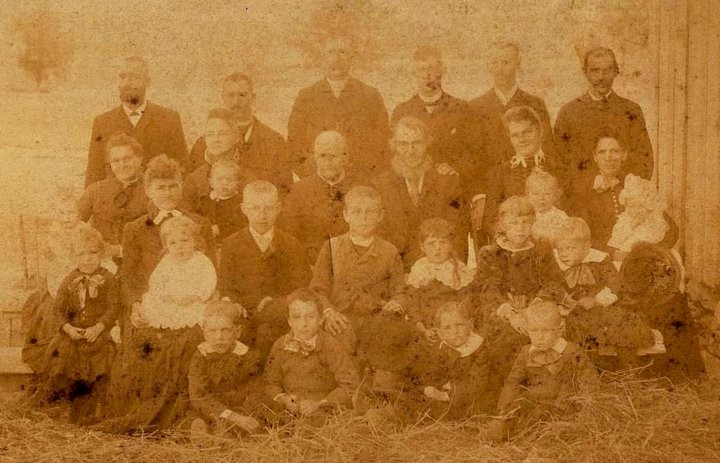
Henry and Johanetta, second row, center right with some of Henry’s children and grandchildren
When I first returned from my ancestor quest in Germany, I fell ill with a bad cold and cough and had little physical energy. For two weeks I lived in the dreamtime, communicating with the ancestors and trying to make sense of the information about their lives I had discovered. After I got better, I had difficulty returning to daily life. The ancestors wanted to speak through me. Their stories, based on facts, come to me in waking trance.
Feeding the ducks
Agnes Lattauer Sweitzer : I was born in Ober-Floerscheim (Hessen Darmstadt) on July 9, 1812. I was the first in a family of five children. Four years after me came Jakob, named after Father, and three years later, Rudolph. It was nice to have brothers, but my dream of a sister came true when Catherina was born a month and a day after my tenth birthday. My mother was busy with Jakob and Rudolph, so I became a second mother to Catherina. I could not nurse her, but I could sing to her and rock her to sleep. I changed her diapers and gave her a bath. It was so wonderful to have a baby to take care of. Three years later little Johanetta was born two days after my thirteenth birthday. Another baby for me and Mother bring up together. I was in heaven. I was both mother and sister to the little girls. When they got older, I took my little sisters to play by the stream, where they giggled and cooed as we fed the ducks and the geese. In the summer, Mother and I brought them with us to the fields where we hoed and planted, weeded and harvested. They tried to pull weeds with their little fingers. It was my job to keep them from pulling up the plants too. Continue reading “A Tale of Two Sisters by Carol P. Christ”
I am Carol Patrice Christ, born in Pasadena, California, daughter of Janet Claire Bergman, born in El Paso, Texas in 1919, daughter of Lena Marie Searing, born in Lyons, Michigan in 1891, daughter of Dora Sophia Bahlke, born in Lyons, Michigan in 1858, daughter of Maria Sophia Catherina Hundt, born in Parum, Mecklenburg in 1827, daughter of Catherina Sophia Elisabeth Schoppenhauer, born in Pogress, Mecklenburg in 1798, daughter of Anna Sophia Seehasse, born in Zulow, Mecklenburg in 1756 in the clan of Tara. I come from a long line of women, known and unknown, stretching back to Africa.
In our ritual on the Goddess Pilgrimage to Crete this May, I will have two new names to add to my mother line. The name Sophia was passed down through the maternal line for at least four generations. I am sorry it was not handed down to my grandmother, my mother, and me.
When I left for Germany a little over a month ago, I knew that Dora Sophia Bahlke was the mother of my grandmother Lena Marie Searing and that Dora Sophia’s parents were Anton Bahlke and Maria Hundt, immigrants from the small towns of Parum and Dummerhutte, in Mecklenburg, Germany. I did not have their parents’ correct names, and I had very little information about their lives in Germany. I have now put some flesh on the bones. Continue reading “An Illegitimate Child in Mecklenburg, 1850 by Carol P. Christ”
In the past month I have been on a spiritual journey seeking my German ancestors. Six of my 2x great-grandparents were born in Germany, which means I am 37 ½ percent German. Growing up, I was subjected to a form of patriarchal family disciple I came to identify as German, but I was told very little, positive or negative, about my German heritage.
Though I had been researching my family tree for five years when I began my trip to Germany, I had no clue about where in Bavaria the Thomas Christ-Anna Maria Hemmerlein branch of my family originated. While making final preparations before the trip, I learned that German church records are no longer kept in individual churches, but are grouped together in church archives. Some areas also have family records in state archives. Contrary to popular belief, the majority of German records were not destroyed in the two World Wars. However, many of the German records are not online. Continue reading “Finding Bavarian Ancestors by Carol P. Christ”


 Continued from Part 1 and Part 2 When Bess was in her fifties, walking past the quarry at sunset—called daylight gate in her dialect—a beautiful young man emerged from the stone pit, his hair golden and shining, his coat half black, half brown. He introduced himself to her as Tibb and promised to be her familiar spirit, her otherworldly companion who would be the power behind her every spell.

 The Soul of Gaia is the numinous earth beneath my feet, her soil cradling the bones and the stories of the ancestors who have died into the land and become part of the ever-living spirit of the place.
 Max Dashu’s


 Carol P. Christ is author or editor of
  A Serpentine Path: Mysteries of the Goddess

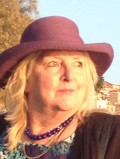 I am Carol Patrice Christ, born in Pasadena, California, daughter of Janet Claire Bergman, born in El Paso, Texas in 1919, daughter of Lena Marie Searing, born in Lyons, Michigan in 1891, daughter of Dora Sophia Bahlke, born in Lyons, Michigan in 1858, daughter of Maria Sophia Catherina Hundt, born in Parum, Mecklenburg in 1827, daughter of Catherina Sophia Elisabeth Schoppenhauer, born in Pogress, Mecklenburg in 1798, daughter of Anna Sophia Seehasse, born in Zulow, Mecklenburg in 1756