Seeing Death and Resurrection by Linn Marie Tonstad

Linn Marie TonstadYesterday, I visited the Capuchin catacombs in Palermo, Sicily. In a grotto about a mile or so from the center of the modern city are found the preserved remains of about 2,000 people who paid the monks to preserve their bodies after death, dress them in their finest clothing, and put them on display. Each of them is placed in its own niche along the wall, held up by iron bands, and has a tag around its neck with its name and date of death. The bodies are not displayed in random order: they are sorted (to some extent) by sex, profession, and familial status. In one large recess, a number of children’s skeletons are on display, many of them in heartbreakingly tiny coffins. In another corridor, friar after friar hangs in his robes, some with cords around their necks signifying their adherence to a Franciscan order. Almost indistinguishable from the cords are the braids still hanging from the heads of some of the women’s bodies. Some families are arranged together; in another corridor doctors and lawyers are segregated and in yet another female virgins are gathered together. The oldest body I saw dated from 1599 – high on a wall hangs the body of a monk whose name was almost illegible but who hailed from the Umbrian hill town of Gubbio.

Some of the skeletons presented death’s heads; others had skin dried to a leathery tightness over remaining bony protuberances. Some of their outfits are well preserved; others have disintegrated under the relentless assault of the years. The practice became illegal around 1880, but until then, people chose – or perhaps their relatives chose for them – to be preserved in this seemingly macabre manner. Continue reading “Seeing Death and Resurrection by Linn Marie Tonstad”

An Epic Woman: A Feminist Eulogy by Molly

editMollyNov 083There were some things about my grandmother that I didn’t find out until after she died. For example, in 1974, she co-organized a “Women’s Exchange”  in Fresno, California with the theme: Stop the World…We Want to Get On. How much I would have liked to talk to her about that! While I didn’t know about the fair, I do know that she was successful with her vision of getting on this brightly spinning world. My grandma was a woman who was hiking in the Channel Islands one month before receiving a diagnosis of aggressive pancreatic cancer. She was incredible.
After reading Grace Yia-Hei Kao’s recent post about giving a eulogy at her grandmother’s funeral, my thoughts turned to my grandmother’s memorial services this past spring. What, if any, are the components of a feminist eulogy? Grace wonders. In reading this, I reflected on the components of the services I prepared and participated in for my grandmother and I believe they fit the bill. In a pleasingly feminist move in itself, I was asked by my extended family to serve as the priestess at my grandmother’s “committal” service (in which her ashes were interred in the above-ground burial chamber that received my grandfather’s body in 1989).

It was deeply important to me to have multiple voices represented during the small, family-only, service and I enlisted all the grandchildren present, as well as her step-grandchildren, in an adapted responsive reading based on Walt Whitman’s “Song of the Open Road”. I chose it precisely because it spoke to the irrepressible, adventuresome spirit of my grandmother. It was a lot of pressure to be responsible for the family ceremony for the interment of her ashes. I wanted it to be perfect. I wanted it to be what she deserved. I wanted it to “speak” to every person there. I wanted it to be worthy of her. I hope it was enoughContinue reading “An Epic Woman: A Feminist Eulogy by Molly”

SACRED RHYTHMS OF THE OLIVE HARVEST by Carol P. Christ

carol-christOlives are being harvested in the fields outside my town these days.  We have been having the first rains of the season.  The roads are wet and muddy, and the trees are partially shrouded in mist.  The fields are spread with black plastic nets, and people are hard at work, the men hitting the trees to make the olives fall, and the women picking up the olives from the nets.  The harvest will continue throughout the winter.

The olive press is busy. Cars and trucks come and go, unloading heavy bags filled with olives.  These days the bags are white, made of sturdy woven plastic. In Crete this fall several of us bought canvas olive bags, hand-woven by women.  These, along with baskets hand-woven by men, were still in use only a few decades ago.

olive harvest in Lesbos early 20th century by Theofilos Hajimichael

A friend who died a few years ago told me that “in the old days” there were no nets. The women and the children had to pick the olives up from the ground, often cutting their hands on thorns and stones.  The nets are a Goddess-send.  Between harvests, the nets are simply folded up and placed in the crotch of the tree. Here no one steals them.

In the fields where I walk some of the trees have enormous trunks. Some of them have two trunks, growing like sisters.  Many of them are 300, some perhaps 500, years old.  A man emerges from a field that has some particularly old trees.  I ask him how old they are. “Older than I am,” he replies. “They were here before I was born.  They will be here after I die.” Continue reading “SACRED RHYTHMS OF THE OLIVE HARVEST by Carol P. Christ”

Inner and Outer Darkness in the Skoteino Cave by Coleen Clare

Coleen ClaireLast fall I undertook the Ariadne Goddess Pilgrimage to Crete and saw many wonders. Foremost for me was our descent into the Skoteino Cave, following in the footsteps of ancient Cretans who understood the cave to be the Source of Life, the womb of the Goddess, and a place of transformation. I ventured down tentatively taking very wary steps, protecting my two new hip replacements, determined to join our sacred ritual in the cave with my sisters. My hips called a stop to my descent half-way down. I perched perilously on a small rock ledge and there I confronted inner and outer darkness. It was indeed a profound transformation. Continue reading “Inner and Outer Darkness in the Skoteino Cave by Coleen Clare”

A Feminist Eulogy? By Grace Yia-Hei Kao

My grandmother, my last living grandparent, recently died. She was 84 years old. Because I’ve just come back from Taiwan where I participated in all of her funerary rites and delivered a eulogy therein, I’ve been thinking a lot about memorializing the dead.  Is there such a thing as a “feminist”  or feminist Christian way to remember the dead? What, if any, are the components of a feminist eulogy?

Continue reading “A Feminist Eulogy? By Grace Yia-Hei Kao”

IS THE SPIRIT OF GREAT GENEROSITY IN CRETE A SURVIVAL OF ANCIENT MATRIARCHAL VALUES? by Carol P. Christ

carol-christAt a coffee shop in Agios Thomas, Crete last month a perfect stranger offered to pay for the coffees and sodas of the 16 women on the Goddess Pilgrimage to Crete. This spirit of great generosity is rarely experienced in the United States or other parts of Europe, but it is still common in rural Crete and some parts of Greece.

 In fact our group was in Agios Thomas because our bus driver Babis, also in a spirit of great generosity, insisted on stopping to show us his village when we were passing nearby. He guided us to see Roman rock cut tombs and arranged for the early Byzantine church to be opened. At the end of the our pilgrimage, Babis stopped the bus at a wooded glen beside a small church where he offered us his own homemake raki, wine, and olives, accompanied by local sheep cheese he had purchased while we were climbing a mountain. After every meal that we ate in local tavernas, we were offered bottles of cold raki, fruit, and sweets.

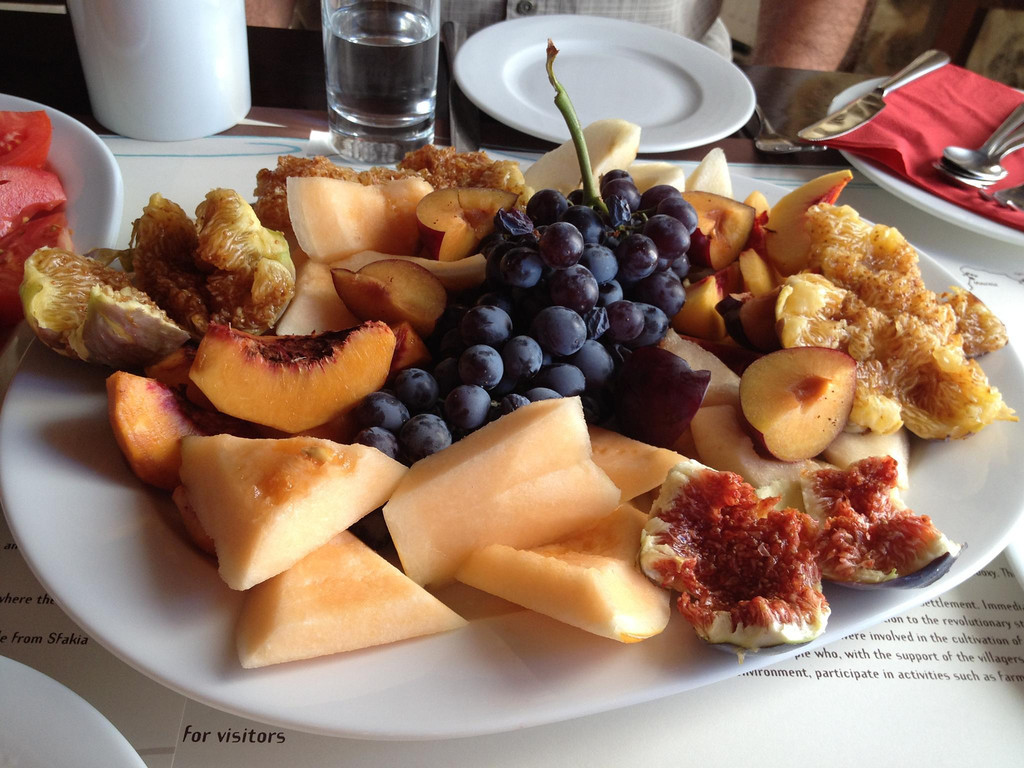
crete fruitsThis spirit of great generosity has long been commented on by travelers in Greece, who often speak of it as unexpected (for them) hospitality to the stranger or traveler. That it is, of course. Through the work of Heidi Goettner-Abendroth, I now understand that the famous Greek hospitality to the stranger has deep roots in matriarchal cultures. According to Goettner-Abendroth, equality of wealth is assured through the widely-practiced custom of gift-giving in matriarchal cultures. Continue reading “IS THE SPIRIT OF GREAT GENEROSITY IN CRETE A SURVIVAL OF ANCIENT MATRIARCHAL VALUES? by Carol P. Christ”

Feeding the Dead by Deanne Quarrie

Deanne QuarrieMost people really love this time of year and I share much of that.  Living in South Central Texas we actually only have two seasons, with a perhaps two to three weeks in between what we laughingly call spring and fall.  Because the winters are not harsh here, the step into spring feels different from those whose winters are frozen for months on end.  We do experience some relief when our temperatures finally drop a bit in October. Even then those drops are only teasers.  When we do finally get a briskness in the air in the wee, early morning hours of dawn but when the sun rises overhead, any memory of that coolness is forgotten.  This morning at 5:30 am, when I woke, it was 54 degrees. I stepped outside to smell and feel the air, so clean and cool.  And yet, now it is 85 degrees and rising, it once more feels like summer. We don’t have the sudden frosts that turn our trees to vibrant reds, yellows and browns.  Yes, the leaves eventually turn and fall to the ground, but we have no heavy freeze and so our colors are pale compared to those in the North and colder climates.

Many Texans think the emotional feel for our two seasons is backwards, believing that summer, with its blazing sun, is the time to withdraw.  Then in winter, when the weather is mostly mild, that’s the time to come out to play.  This is a reversal of pagan thinking about the seasons in North America. Continue reading “Feeding the Dead by Deanne Quarrie”

WOMEN ARTISTS AND RITUALISTS IN THE GREAT CAVES: THE BEGINNING OF THE END OF INDOLENT ASSUMPTIONS by Carol P. Christ

carol-christIn an earlier blog, I suggested that women might have blown red ocher around their hands to leave their marks in prehistoric caves.

At the time I thought this was a rather bold suggestion.

Had I been asked why I thought the images were made by women, I might have said that people have understood caves to be the womb of the Great Mother, the Source of All Life, from time immemorial. I might have added that those who performed rituals in the caves cannot have been performing simple “hunting magic,” but must also have been thanking the Source of Life for making life possible for them and for the great beasts they hunted.  Still I am not certain that I imagined women as the artists in the Paleolithic caves.

handprint peche merle cave

In recent days the news wires have been carrying a story titled “First Cave Artists May Have Been Women, New Study Suggests.”   According to retired anthropological archaeologist Dean Snow, the handprints made by Paleolithic ancestors 40,000-20,000 years ago may have been made primarily by women. Snow spent a decade gathering and analyzing photographs of the handprints left in caves. The scientific fact that women’s first and ring fingers are generally of the same length, while men’s ring fingers are generally longer their index fingers, led him to the conclusion that ¾ of the handprints in the caves were made by women! If women were painting their hands on the caves in larger numbers than men, then isn’t likely that they were also painting the images of the great beasts on the walls of the caves? Continue reading “WOMEN ARTISTS AND RITUALISTS IN THE GREAT CAVES: THE BEGINNING OF THE END OF INDOLENT ASSUMPTIONS by Carol P. Christ”

Birth Song, Life Song, Death Song by Molly

editMollyNov 083“A woman can spin a primal umbilical rope within her womb through which she passes life-energy to the future.” –Melissa Raphael

“In some indigenous cultures of the Americas there is the practice of finding one’s death song while alive. This song becomes the ally of the person throughout their lives, so that they become very acquainted with what the song means in their lifetime. Death then, is a companion of life, and is never forgotten. In the hour of death, these people would, if they were able to, sing their death song–exiting this world with song on their lips and no doubt feeling the power their ally-song had gathered by being with them in their life. I can see that a death song would provide a connection between the person and the cycles of life, guiding the dying person into the next world and helping to allay fear…” –Leslene della-Madre, Midwifing Death

I was introduced to blessingways, or mother blessing ceremonies, as a girl when my mother’s group of friends hosted them for each other during their pregnancies. I loved attending the ceremonies for my mom during her pregnancies with my younger brother and sister and witnessing the web of love, support, and commitment woven around her. They touched me deeply with their sacred, magical, and mysterious flavor. When I was twelve, the same group of friends had a coming of age blessingway ritual for the daughters of the group, ranging in age from 10-16. It was a mystical, beautiful experience. We wore wreaths of flowers in our hair and were blessed with wisdom and tokens from the wise women of our tribe. At 34 years old now, I still have my folder of prayers, quotes, and messages from that day. For years it smelled faintly of rose petals.

Continue reading “Birth Song, Life Song, Death Song by Molly”

Earth Connection & Healing the Bees by Jassy Watson

Jassy_Agora1-150x150

I’m an avid gardener. I must, need, long to have my hands in the soil. The sweet smell and feel of the earth connects me to something greater, to a sense of ‘other’; a source divine. I am interwoven, connected, at one and in reverence of a greater mystery.  When I think about my connection to the earth and its origins, I find it is a connection I have had my entire life. As a young girl I spent many hours, days, in fact years, exploring the Australian bush – it was my backyard. Some of my most prominent memories are the smell of Eucalypt and the crescendo of cicada song that would permeate my entire surroundings throughout summer. As a teen, time and time again, I bushwalked our families property that backed onto mountainous National forest. I often sensed the indigenous ancestral spirits of our land watching attentively.

It is this deep connection that I have to the earth that not only leaves me feeling exultant, it leaves me troubled. I am troubled by the continuing problems caused to the environment. I admit to feeling quite disturbed recently when I read a number of reports about the persisting problems with the Fukushima Nuclear plant – radiated water still leaking into the ocean. Birdlife and ocean animals found suffering from radiation burns. Should we even be eating fish from the pacific? I can’t begin to fathom the enormity of the repercussions from this disaster that will be seen for many generations to come. My inner activist wants to be out there on the frontline, riding the waves on the Rainbow Warrior, tied to an ancient tree in protest of lopping; but I know my place is here, nurturing my little ones. So what can I do with these troubled feelings, with the frustration and with the love I have for Mother earth and all her beings? Action starts from home. So I let it fuel my fire and I get creative. I paint, I write, I garden; with intention. My intention is to play a role, no matter how small, that aids in the healing of the planet. I hold hope that it inspires other to do the same. Continue reading “Earth Connection & Healing the Bees by Jassy Watson”