Reclaiming the Feminist Beginnings of America’s Thanksgiving by Michele Stopera Freyhauf

Freyhauf, Feminism, Religion, Durham, Old Testament, Blogger, Bible, Gender, Violence, Ursuline, John CarrollFor those who are unaware of my research focus and methodology, I try to use history to reconstruct or reclaim the feminine voice through more of an exegetical lens rather than an eisegetical or ideological lens. When it comes to Thanksgiving, I have yet another opportunity to restore credit to or at least bring visibility back to a woman who fought for Thanksgiving to be recognized as a national holiday on the last Thursday of November. Her works, though plentiful and sometimes known only by title, are largely forgotten to history; Sarah Josepha Buell Hale (1788-1879) is responsible for Thanksgiving becoming a national holiday in the United States.

Certainly, I do not have to go into the disparity that befell women during the 1800’s when it came to education and overall fundamental rights – that is a history with which we are all well familiar. Hale was educated through her brother, Horatio Gates Buell, who shared his education while attending Dartmouth College and “seemed very unwilling that [Hale] should be deprived of all his collegiate advantages,” and through her husband, David Hale, a lawyer who helped her cultivate her writing skills in the evenings. They even established a small literary club with their friends that allowed her to write. Hale was left a widow at a very young age with five children, the oldest age 7. Hale, like so many women during that time period, had to find a way to support herself and her family.

Sarah Josepha Buell Hale

After authoring a book of poems with her sister-in-law, The Genius of Oblivion and Other Original Poems, Hale, in 1827, published her first novel called Northwood – a book published the same year as Uncle Tom’s Cabin that also challenged slavery. From fame gained through this novel, Hale obtained a job as an editor of a women’s magazine, Ladies Book (later Godey’s Ladies Book then American Ladies Magazine), where she worked for about 40 years. She wrote about half of the material contained in the magazines, as a means of helping to educated women. Hale helped to discover and promote such authors as Edger Allen Poe, Nathaniel Hawthorne, Harriet Beecher Stowe, Lydia Maria Child, Catherine Sedgwick, Lucretia Mott, Emma Willard, Susan B. Anthony, Henry David Longfellow, Ralph Waldo Emerson, and Oliver Wendell Holmes.

She is credited for helping to establish Vassar College for women and wrote the familiar child’s poem “Mary had a Little Lamb” in 1830 (Poems for Our Children, republished in Juvenile Miscellany), Traits of American Life, which contained the story of “The Thanksgiving of the Heart:”

Continue reading “Reclaiming the Feminist Beginnings of America’s Thanksgiving by Michele Stopera Freyhauf”

Belonging to the Land by Carol P. Christ

Carol Christ in LesbosI believe that we can restore our hope in a world that transcends race by building communities where self-esteem comes from not feeling superior to any group, but from one’s relationship to the land, to the people, to the place, wherever that may be.—bell hooks

In these words from her poignant memoir-reflection-analysis Belonging, bell hooks suggests that rather than creating identity by comparing ourselves to others, whether in the academy, in communities, or in the larger society, we would do better to root our identity in the land.

Hooks “left home” in rural Appalachia in order to pursue “higher” (why do we call it that?) education including a Ph.D. which enabled her to teach at prestigious universities in the urban north. Despite her considerable success as an academic and a black feminist, hooks suffered persistent depression in the cities where she taught. Eventually she diagnosed her dis-ease as a longing for the home she had left behind, specifically as a need to connect with the traditions of her ancestors, the mountains, and the land that had sustained them since the end of slavery. Continue reading “Belonging to the Land by Carol P. Christ”

Death with Dignity by Carol P. Christ

Carol Christ in LesbosIn the summer of 1960 when I was 14 years old my much loved grandmother Mae Inglis Christ died of a cancer that affected her brain. The last time I saw my Nannie was shortly after her diagnosis in the early spring. While we were visiting, the cancer affected her back, and she took to her bed. In those days children were not allowed in hospitals. I never saw my grandmother alive again, but my mother told us that our grandmother was hooked up to tubes much longer than she should have been. Mother vowed, “This will never happen to me.” I was driven to the funeral in a limousine with my grandmother’s girlfriends. They spoke about my grandmother’s last days, describing how (because her mind was affected by cancer) my little grandmother had screamed and screamed at them for not visiting–even though they were with her every day. They found my grandmother’s outbursts so traumatic that they said they were relieved to see her looking so peaceful in her coffin. Continue reading “Death with Dignity by Carol P. Christ”

The Ancestors Live in Us by Carol P. Christ

Carol Christ in LesbosOn the recent Goddess Pilgrimage to Crete women had the option of riding up a winding road on a mountainside in the back of a farm truck singing “She’ll Be Comin’ ‘Round the Mountain” or could choose to go with the guard in his closed automobile.

That evening one of the older women who had chosen to ride in the car said, “I saw how much fun you were all having, but I have done that before. This time I was happy to let the rest of you do it.”

“That’s exactly how I feel about death,” I responded. “Some people want to live on after death, but I don’t. I am happy to let others do it. The only thing that would upset me would be if life did not go on after me.” Continue reading “The Ancestors Live in Us by Carol P. Christ”

Honoring Our Mothers, Honoring Our Selves by Safa Plenty


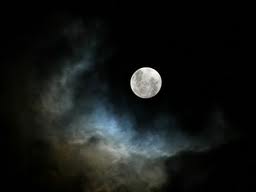
moon

“The moon has always been the primary symbol for female energy; its cycle around the earth takes approximately twenty-nine days, the same amount of time as the average woman’s menstrual cycle. It is often felt that as the pull of the moon affects the waters of the world, so does its motion affect the body of woman.” —Women’s Medicine Ways’ Cross-Cultural Rites of Passage by Marcia Starck 

Her full moon arose today,
sprinkling liquid stardust
onto her bathroom floor,
decorating her mattress
with vibrant hues of deep red,
staining her pajama pants
with artistic, circular symmetry.

For days, she had waited
for the completion of her moon,
while the sun shun
its luminous rays upon her,
the fall equinox bringing that
massive star into greater centrality.

And on a night, her moon had not set,
she sang to the four directions,
shattering myths of tainted womanhood,
tales of storks placing fragile care packages,
under willow trees.

Sang to Grandmother Moon,
Honoring the feminine Divine,
Celebrating her Sacred Waters,
Occupying her sanctified space
for the rejuvenation of Mother Earth,
honoring our Mothers,
honoring our selves.

wpid-wp-1409462860041.jpeg

Safa N. Plenty is currently pursing her Ph.D at Claremont Lincoln School of Theology in the area of Practical Theology, Spiritual Formation and Education. She holds a Masters of Social Work from Columbia University and an undergraduate degree in interdisciplinary studies with a minor in Africana Studies. For the past three years, she has worked as a K-12 education contractor and assistant counselor at a community college. Her research interests include Sufism, Attachment to God, indigenous cosmology, particularly Native American and Australian spirituality and somatic psychology. She is also interested in religious mysticism, mindfulness practice in Buddhism and the role of feminism and religion in cultivating a peacemaking capacity among young Muslim women. She is currently working to develop a faith based healthy relationships program for Mothers and Daughters. She enjoys writing poetry, research, and contemplative practice and tuning in with nature.

Casa Coatlicue by Erica Granados De La Rosa

Erica GDLR 2On a corner adjacent to a cantina, across the street from a home full of barefoot children running through open doorways, and a few houses down from a paleteria y fruteria in San Antonio, Texas, sits a bright white house dressed up in orange trimmings – Casa Coatlicue[1]. Before you walk through the gate you notice a raised bed of herbs, a garden, a large collection of potted succulents, and a metate[2] on the ground. Walking inside you can’t help but smell the sage, copal, and other herbs and incense that have left their smoky traces on the walls of the living room, the kitchen, and then the bedroom. As the house begins to introduce itself, you notice altars in corners and crevices of each room. Your curiosity begins to churn as you notice pictures and canvasses on the walls of ancient and present day cultural symbols, including one poster that reads “This land was Mexican once, and indigenous always,” and a large picture of Selena Quintanilla that captures her warm smile and beautiful black hair. As soon as you begin to take in the colors and ancient smells, the house is introduced to you by name, Casa Coatlicue, the home of four queer young healers, dreamers, lovers, artists, scholars, and spiritual activists who are reclaiming the life-giving traditions of their ancestors.
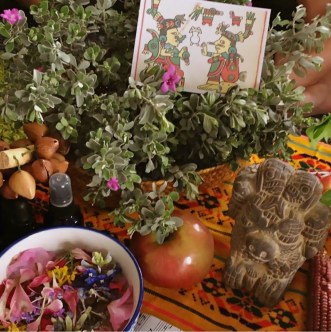
Community altar from  workshop
Community altar from workshop

Earlier this year, I was invited to a curanderismo workshop hosted at Casa Coatlicue. The word curanderismo had an air of secrecy, power, and nostalgia of home for me. I understood curanderismo as the medicine and magic of our grandmothers, and increasingly the forgotten inheritance of our communities. As I spoke with the residents of Casa Coatlicue, we began to identify the chronic erasure and appropriation of brown folks’ spiritual traditions, food, art, and customs by predominantly white, new age culture. Saddened by the loss and the historical disconnect of our people, we collectively affirmed the urgency and importance of relearning and reclaiming our own spiritual traditions not only to tap back into our cultural identity as native and mestizo people but also to tap into a powerful tool for the transformation of our current realities. In the midst of historic and present day manifestations of systemic violence against us – young brown bodies being gunned down in our streets, whole communities being persecuted, incarcerated, and displaced, as well as forced sterilization and assimilation- there is a critical need to tap into radical and sustainable ways to not only resist but to heal. Continue reading “Casa Coatlicue by Erica Granados De La Rosa”

Social Responsibility of the Artist by Jassy Watson

JassyAn artist’s place in society is ambiguous and one not often discussed. Artist’s often have difficulty claiming themselves as ‘artist’ for fear of criticism and rejection both inside and outside the art world and from within. Historically, artists have had their work labeled as narcissistic, sexist, racist, classist, elitist, indulgent, hermetic…and the list goes on.

I have been on the end of some harsh criticism. Comments made by the board of Queensland’s most prestigious art school have stayed with me for over 15 years. “Impressive folio” they said, however, using images of indigenous persons is ‘cultural appropriation’ and ‘unacceptable’. They were referring to a series of pieces I had been encouraged to create under the mentorship of a fine, accredited artist Wim De Vos. Continue reading “Social Responsibility of the Artist by Jassy Watson”

We Could Have Been Canadians and Other Thoughts about My New England Colonial Heritage by Carol P. Christ

carol mitzi sarahMy 2x great-grandparents Nathaniel Searing and Louisa Caroline Martin were pioneers who cleared the land and built a log cabin in Lyons, Michigan in 1840. They were descended from English Puritan Colonial settlers in New England. At least two of my ancestors are recognized by the Sons and Daughters of the American Revolutions. Other members of my family who were Quakers proudly refused to take part in the Revolutionary War.

My great-grandfather James Augustus married a woman of German descent, his daughter Lena Marie married a Swede, and my mother married a man who was German, Irish, and Scottish. As the descendants of Nathaniel Searing and Louisa Caroline Martin moved around the United States and married into the families of newer immigrants, the succeeding generations also lost touch with their history. Our family’s connections to the New England Colonists were not even mentioned at Thanksgiving! Continue reading “We Could Have Been Canadians and Other Thoughts about My New England Colonial Heritage by Carol P. Christ”

The Outraged Ancestral Mother by Molly


crop027During the fifth week of the Rise Up and Call Her Name curriculum by Elizabeth Fisher, “We honor the Outraged Ancestral Mother and the belief that the sacred and secular are one.” When I priestessed this session for my women’s circle, I was caught by the idea of the Outraged Ancestral Mother and we spent some time discussing her and the degree to which humanity has hurt our planet. The next morning while I was practicing yoga, snippets of a poem came floating to my mind. I had the distinct feeling that the Outraged Ancestral Mother was ready to speak to me. I went down to the woods to listen to what she had to say.

Continue reading “The Outraged Ancestral Mother by Molly”

A Message From My Mother by Mary Beth Mosèr

Recently I traveled to Texas to receive the Kore Award from the Association of Women in Mythology for my dissertation in Women’s Spirituality at the California Institute of Integral Studies, “The Everyday Spirituality of Women in the Italian Alps: A Trentino American Woman’s Search for Spiritual Agency, Folk Wisdom, and Ancestral Values.”

Shortly after I had arrived in San Antonio, and met my younger sister and her daughter who were in town, we received word that my Mother was not well.   Although Mom had been in precarious health throughout the last year, she had pulled through several times. That night in the hotel room, we hoped for the best.  The next morning as I lay in my dream state, I felt someone come and lay beside me in bed, compressing the covers, which I have come to understand as a visitation from my Mother. Then the phone rang with the news that Mom had died peacefully that morning.  It was comforting for me to be with my sister and niece, especially since we were away from home. Together, we made it through that long, rainy day.

Later that morning, my other siblings, who were gathered around my Mother’s kitchen table, called the hotel room where I was staying. They passed the phone around to each person, voicing their consensus that I should stay in Texas to attend the conference, give my presentation, and receive the award. There was nothing I could do in the next few days if I flew to Denver, they said.  All the arrangements had already been made; the funeral wasn’t until the next week. So, reluctantly, I surrendered to their decision. My heart wanted to be with them. However, I stayed, unsure. . . . Continue reading “A Message From My Mother by Mary Beth Mosèr”