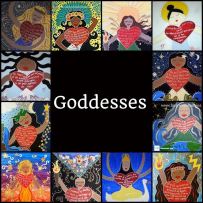
Holy Women Icons Online Retreats by Angela Yarber

I’ve shared before that the non-profit my wife and I created, the Holy Women Icons Project, is in the process of creating a small intersectionally ecofeminist retreat center on Hawai’i Island. The Holy Women Icons Project seeks to empower marginalized women by telling the stories of revolutionary holy women through art, writing, and special events.

Both the art and writing side of the project have been a monthly part of Feminism and Religion since 2012 as I feature the story of one of my holy women icons, along with the icon I’ve painted depicting them. As I paint revolutionary holy women from history, scripture, and myth, I also write about their lives; in addition to painting and writing, the bold witness of these women has inspired and grounded many of the retreats I lead in churches, seminaries, women’s and LGBTQ centers. Now the time has come for us to try and fulfill our dream of creating a home for this work, a little off-grid retreat center where people can come on retreat to create, sustain, and empower (by paying to attend or receiving scholarships from grants, but more on that later).

We were thrilled to film the first step of this process—building our family’s “tiny house”—with the television show Tiny House Nation. Since then, we’ve been working tirelessly to get our acre of land ready to build more housing for those on retreat, and to find funding sources to make it possible. Anyone who runs a non-profit or works in sustainable construction knows this is no easy (or affordable) task. We’re realizing that this far-flung dream may take longer than we’d envisioned due to lack of funding. We have some fabulous monthly patrons through Patreon, and we’d surely welcome more tax-deductible patronage or donations! Other than this, though, it’s the scrappy work of my wife and I to try and make this whole intersectionally-ecofeminist-off-grid-Hawai’i-retreat-thing a reality. Continue reading “Holy Women Icons Online Retreats by Angela Yarber”

Painting, Privilege, and “Going Tiny” in Hawai’i by Angela Yarber

Pelé by A. Yarber

It started with Pelé, the Hawai’ian Volcano Goddess who governs fire, lightning, volcanoes, and the flow of lava. When my little family set off on a big adventure in June 2015, I knew I’d research and paint her as a Holy Woman Icon, but I wanted to get to Hawai’i first so that I could experience her power firsthand. After three months volunteering without running water in Vermont, a month in southern Virginia’s finest fall foliage, and a holiday season traversing the country from east to west in a camper named Freya, we crossed the Pacific in search of Pelé.

The long-term goal of nearly two years of full-time travel was to discern next steps for our queer little family, and to find land to open an intersectionally ecofeminist retreat center. We always imagined returning to the southeast, likely buying land and creating the retreat center in the North Carolina mountains. Pelé had something else in store.

After three wild months volunteering on the Big Island, we fell in love, enlivened by this place we now call home: its beauty, the diversity of people, access to living off-grid, access to growing your own food, its rich culture and history, access to a vegan lifestyle, and the ability to live the majority of our life outside. In short, all of our plans were upended and recreated in the most beautiful and challenging ways because we knew Hawai’i must become our home. Continue reading “Painting, Privilege, and “Going Tiny” in Hawai’i by Angela Yarber”

Mulling over Movies: Moana, Pt. 1 by Elise M. Edwards

elise-edwardsI love going to outdoor movie screenings.  Sitting outdoors on a summer evening with good company brings me joy.  Last week, I went to an screening of Moana, the Disney movie about a teenager who goes on a quest through the Pacific Ocean with the demi-god Maui.  Moana goes on this journey to help her people.  The movie came out last year, but I didn’t see it.  I have to admit that I wasn’t even interested in it until Simone Biles performed a dance to one of Moana’s songs on Dancing with the Stars. It was then that I realized that the movie has an empowering message.  I asked my friend Natalie, who is also a feminist religion scholar, about Moana.  She has three young daughters, so I trusted her to be more current than I am.  Her enthusiastic response sold me, as did her remark, “There’s not even a love story in it!”

Ah, Disney princesses and their love stories!  I’m old enough that I didn’t grow up with the Disney culture that children in the past few decades have, but I haven’t been immune to the Disney princess phenomenon.  I childhood pre-dated DVDs and digital downloads, but I still knew and cherished the Disney characterizations of Snow White, Cinderella, and Sleeping Beauty. These young women were kind and virtuous and beautiful (according to Eurocentric standards), but their stories culminate with marriage to a charming prince.  It’s also problematic that so often, the villains in these movies were older women—wicked stepmothers or evil witches—who were motivated by jealousy and hate.

Continue reading “Mulling over Movies: Moana, Pt. 1 by Elise M. Edwards”

Painting Our Lady of Sorrows: Mother’s Day and Resurrection by Angela Yarber

The month of May finds those within the Christian tradition solidly within Easter season, reveling in the promise of resurrection, while simultaneously celebrating Mother’s Day. To be honest, I’d never seen much of a correlation between these two events in the past. But since my brother’s death in March, I’m viewing everything through the lens of grief, likely a new perspective that will color the way I see the world forever. Namely, until this year, I’d never really given much thought to what Jesus’ mother, Mary, was feeling in a post-resurrection world. Of course, the suffering, sorrow, and sadness of a mother who watched her child die is something that most Christian churches highlight during Holy Week, on Good Friday, or even on Easter Sunday. But then our liturgy shifts, as though Mary transitioned from weeping at the gruesome death of her child one day and then suddenly celebrates the reality of resurrection the next. At the risk of extreme blasphemy—a place where I consistently reside—when I place myself in Mary’s shoes as a mother, resurrection kinda sucks. Continue reading “Painting Our Lady of Sorrows: Mother’s Day and Resurrection by Angela Yarber”

Public Art and Personal Transformation by Jessica Bowman


Public Art Sculptures

Borrego Springs, CA

Artist: Ricardo Breceda

Photo: Jessica Bowman


Public Art displays like the image above, a dragon that appears to be moving through the sand dunes of Borrego Springs, California offer tremendous insight into the time and era of the society when it was created, the surrounding community, the patron of the work and of course, the artist. In the case of this artwork and several other similar sculptures found in the barren but beautiful landscape within the Anza-Borrego Desert State Park the subject matter supports the wildness of the region and invites the viewer to consider the area before the impacts of modern civilization.  In this case, it isn’t difficult to imagine such an untamed time as there are miles and miles of sandstone, treeless mountains and desert brush with very few people anywhere to be found. Also in this case, the artwork is absolutely appropriate for the environment in which it is placed.

“If private art suggests an intimate exchange, public art gathers a congregation.  While I have observed that all art is to some degree public, pubic art merits its name in virtue of the fact that the creation of a public is its point of departure.  Public art presupposes the public sphere and produces a public in relation to that concept.  Unlike popular or mass art, it does not assume a preexistent generic audience to be entertained or instructed but sets out to forge a specific public by means of an aesthetic interaction.” (Hein, pg. 49)

Continue reading “Public Art and Personal Transformation by Jessica Bowman”

The Nature of Communal Pondering by Elise M. Edwards

elise-edwardsLast week, I listened to an episode of Krista Tippett’s series On Being that featured an interview with poet Marilyn Nelson.  I am not very knowledgeable about the world of modern poetry, but I am familiar with Nelson’s work.  A couple years ago, I wrote about Fortune’s Bones: The Manumission Requiem, Nelson’s poetic composition about Fortune, an enslaved man whose owner rendered his body into a skeleton for medical training.  Fortune’s identity and history had been erased across centuries as his remains were displayed.  Community concerns eventually led to a multi-disciplinary academic, artistic, and community effort to honor the man and, in 2013, put his bones to rest.  Isaye M. Barnwell, a musician formerly of Sweet Honey in the Rock, developed a cantata and choral work for Fortune’s Bones. These developed into a series of artistic performances and community events that demonstrate the power of art to speak through and for those who are marginalized—even in death.  Disparate communities joined together to ponder Fortune’s life, and it was powerful.

In the On Being interview, Nelson spoke about “communal pondering,” and I’ve been repeating this phrase to myself since then.  It identifies a form of creative activity and a spiritual way of being that I am deeply committed to, and have not been able to name.  Communal pondering occurs when a group of people are listening together and are opening up new paths for discourse and action by the engaged reflection that takes place within that listening.

Continue reading “The Nature of Communal Pondering by Elise M. Edwards”

Painting a Goddess of Grief by Angela Yarber

In many ways, I’ve thought of the myriad Holy Women Icons I’ve painted as mediators, guides who accompany us, women who have shown us the way. Whether they enliven us to create, inspire us to sustain, or embolden us to empower, these holy women have taught me to rage, praise, hope, endure, persist, love, and laugh. Recently, though, I discovered that none of the Holy Women Icons I’ve researched, written about, or painted have helped me to grieve. Surely, many have experienced grief, or give us tools for coping with the grieving process, but no Goddesses of Grief filled my heart when I needed it most.
Last month, amidst my worries about walls and bans and words that exclude, grief came along and sucker punched me in such a way that I continue to grasp for mediators, guides, and ways to cope amidst tremendous sadness. On March 6, 2017 my little brother, Carl, died. An addict for much of his adulthood, his recent addiction began spiraling out of control over a year ago and he refused to go to rehab. My family worked hard to try and reach out to him, to open him up, to offer him support, but he refused to let anyone in, drowning his anguish in blackouts and overdoses. Though we filled his life with tremendous love, he also experienced pain—externally and internally—that he never shared with anyone. The drug of choice for the past year—duster—runs the risk of cutting off the oxygen to the brain every time it is used; in fact, there are instances of people dying the first time using duster. And this is precisely what happened when my mother found my brother. My beloved single-mom, Mary, became Our Lady of Sorrows, as she held the lifeless body of her 33 year-old son. Our lives will never be the same and the grief is overwhelming. Continue reading “Painting a Goddess of Grief by Angela Yarber”

Coming in the Back Door by Jessica Bowman

“I’m not ready to make nice
I’m not ready to back down
I’m still mad as hell, and I don’t have time
To go ’round and ’round and ’round
It’s too late to make it right
I probably wouldn’t if I could
‘Cause I’m mad as hell
Can’t bring myself to do what it is
You think I should”

(Dixie Chicks, 2009)

The quote listed above is the lyrical reaction of the music group the Dixie Chicks in response to the backlash of lead singer Natalie Maines public criticism of then US president George Bush and US military involvement in the Middle East during a music concert in the UK. Because the concert was televised, her criticism reached millions of people. As a result of her words, the band experienced extreme repercussion which included death threats and all of their songs being banned from the major radio networks in the US for an extended period of time. These song lyrics are a prime example of art being used as political activism and its effectiveness to make the point using peaceful means.  Women have learned that if they are not allowed to enter through the same door, the front door, as the one intended for men they will find another way. Continue reading “Coming in the Back Door by Jessica Bowman”

Join the Rebellion by Jessica Bowman

Like many other thousands of Americans, I watched the newest offering from the Star Wars legacy last autumn and was re-inspired to be an active part of the rebellion against oppression. Viewing the movie through my feminist lens I was cheered on by the choice of actors and actresses in lead roles and was reminded of Margaret Mead’s famous quote, “Never doubt that a small group of thoughtful, committed, citizens can change the world. Indeed, it is the only thing that ever has.”

It may be easy to compare the new president to Lord Vader because he is an easy target who encourages mockery and ridicule. However, tyranny, violence, and power trips have long been a part of world societies, for centuries.  It is as evident as ever that we must continue to stand against such debilitating realities. We must stand together.

And, like millions of other people across the world, I had the privilege to participate in a Sister March to the Women’s March on Washington; shoulder to shoulder with passionate and caring people determined to make a difference. The experience generated feelings of elation, hope, and unity. I was most impressed by the kindness radiating from every person I came in contact with.  Even though spaces were packed with people the overall atmosphere was conscientious, polite, and caring. Peaceful activism is critical to progress.  

I also listened intently to the speeches made at the marches; especially by the women well known in popular culture. Gloria Steinem, a cornerstone of the modern feminist movement, spoke words that I believe reflect the change in values that I visualize in the form of a river current. “God may be in the details, but the Goddess is in connections. We are at one with each other, we are looking at each other, not up.” Women’s work is the creation of the web; the tapestry of connections between us all and the building of momentum in the stream bed. Continue reading “Join the Rebellion by Jessica Bowman”

Painting the Mother of Exiles by Angela Yarber

angelaLast month, my column focused on the importance of intersectionality within the feminist movement by highlighting the revolutionary work of Sojourner Truth, an escaped slave, abolitionist, and women’s rights activist. I’d like to continue to press the importance of intersectionality, particularly given our current political state. Of late, I’ve received a little criticism that some of my recent Holy Women Icons are too political, particularly with reference to Mothers of Black Lives Matter, Dolores Huerta, and the Midwives of Standing Rock. As a woman artist, and particularly a queer woman artist, the personal is always political. Feminists taught us this decades ago. Since the lives, loves, and bodies of LGBTQs, women, refugees, immigrants, people of color, Muslims, Jews, those who are differently abled, and the poor continue to be legislated, violated, excluded, and oppressed, I’d contend that writing about, painting about, and working for liberation for all of these intersectional identities is paramount, especially for those who profess faith in a homeless refugee liberator from the Middle East (that would be Jesus, of course). Needless to say, I believe these recent works in the Holy Women Icons Project fit in quite nicely with the over seventy revolutionaries—political and otherwise—that I’ve painted and written about in the past.

These critiques combined with the current climate of the United States, new legislation passed, proposed, and promised that attacks the lives of the aforementioned marginalized groups. So, I took to canvas and, for the first time, I did not pen the poetry scrawled across the holy woman’s heart. Instead, I relied on the words of Jewish American poet, Emma Lazarus (1849-1877). Most famous for the portion of her sonnet, “The New Colossus,” that graces the pedestal of the Statue of Liberty, I wanted Lady Liberty and Lazarus’ timely words to become my newest Holy Woman Icon. In its entirety, “The New Colossus” reads: Continue reading “Painting the Mother of Exiles by Angela Yarber”