
I went to the lake this morning . . . by Beth Bartlett

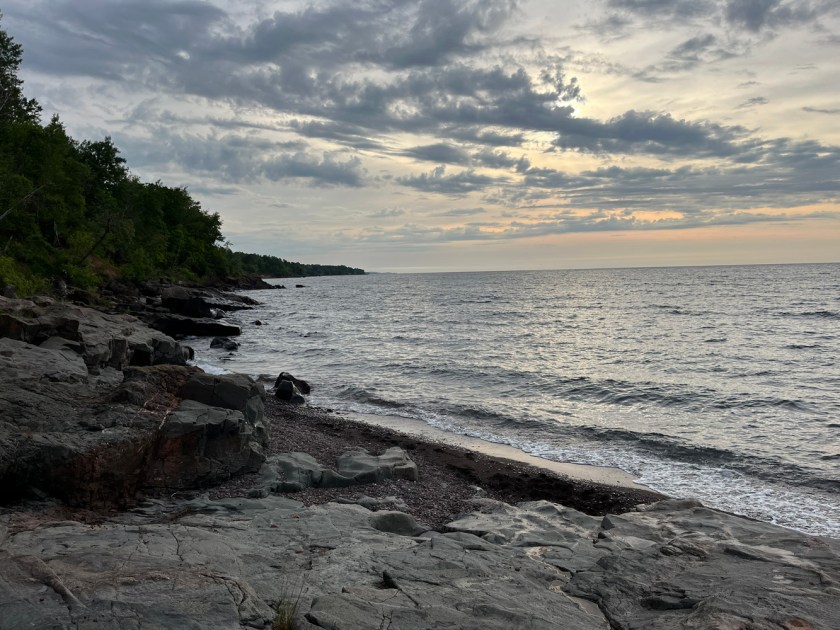
I went to the lake this morning, seeking the peace, sustenance, and perspective it so often provides. I had been particularly distressed and distraught the day before after watching the documentary on Christian Nationalism, “Bad Faith.” It was chilling to say the least.  Among other things, the film demonstrates the longevity of Christian Nationalism in this country, dating back at least to the Ku Klux Klan, founded in 1865.  However, the central theme of the documentary is the staggering influence of conservative political operative Paul Weyrich, who orchestrated the merger of conservative Evangelical Christians with the Republican Party in the 1980s.  He founded the Moral Majority with Jerry Falwell, the Heritage Foundation which authored Project 2025, the American Legislative Exchange Council, and the Council for National Policy – all of which seek to undermine democracy in order to bring about what these organizations and their followers call a “Christian nation,” by force if necessary.  But as former Republican strategist Steve Schmidt states in the film, there is nothing “Christian” about this movement.  It is pure nationalism, a striving for power requiring the dismantling of the institutions of democratic government as we know them. These extremist Republican strategists found a powerful base of voters by tapping into Evangelical Christians and manipulating the messages they received to fill them with fear, and found just the puppet they needed in the charismatic and amoral figure of Donald Trump.  As we’ve seen in recent years, they have been quite successful in the destruction of government.  After filling the Supreme Court with their chosen nominees during Trump’s first term, getting Christian Nationalist Mike Johnson installed as Speaker of the House, and getting Trump elected a second time despite the January 6th insurrection, or perhaps because of it, they are now successfully dismantling or otherwise destroying the Departments of Education, Health and Human Services, Energy, Defense, Agriculture, Justice and more along with the Environmental Protection Agency, the Food and Drug Administration, the Social Security Administration, the Federal Regulatory Agency. . . the list goes on. It’s all part of the plan to fulfill the “Seven Mountain Mandate” of dominionism[i], which seeks to impose its beliefs in seven spheres of influence: religion, family, education, government, media, arts and entertainment, and business. As one of the Christian Nationalists interviewed in the film proudly said, “It’s the Christian Taliban.”

Continue reading “I went to the lake this morning . . . by Beth Bartlett”
Thanksgiving by Beth Bartlett

When I offered to write the FAR post for Thanksgiving a month ago, I had no idea how difficult I would find that task to be. I suppose I had a different vision of what these days would be like.  I had no idea how heartsick and wordless I would become in the wake of a second and even more bizarre and dangerous Trump presidency.  It hardly feels like a time for celebrating a national holiday. 

Thanksgiving in the United States and the colonies before has gone through several iterations – from the mythologized feast of the Puritan colonists in Plymouth, Massachusetts with the indigenous Wampanoag following the successful corn harvest – corn the Wampanoag had taught the Puritans how to plant after half of them had starved to death the previous winter; to George Washington’s Thanksgiving proclamation giving thanks for the successful ratification of the US Constitution; to Abraham Lincoln in 1863 acceding to Sarah Josepha Hale’s 36-year quest to establish Thanksgiving  as a national holiday — “to heal the wounds of the nation.” Goddess knows we could use that now, but it seems farther out of reach than ever.

Lesser known is the proclamation of a day of thanksgiving by the Massachusetts Bay Company to celebrate their defeat of the Pequot nation following the Pequot Wars of 1636-1638 in which most of the Pequot peoples were killed or enslaved, giving rise to many indigenous peoples observing Thanksgiving as a National Day of Mourning.

Continue reading “Thanksgiving by Beth Bartlett”

TRUMP AS MESSIAH by Esther Nelson

Once upon a time long, long ago, I identified as an evangelical Christian. The term “evangelical” has evolved over time, however, evangelicals can probably be found in every branch of Protestant Christianity. Wherever you find them, they emphasize the authority/ inerrancy of the Bible, a “born-again” experience into the Kingdom of God, and a personal relationship with Jesus Christ. Generally, evangelicals are socially conservative and rarely does their thinking go beyond the borders of their insulated theology.

It comes as no surprise to me that many (most?) evangelicals embrace Trump with a fervor akin to their enthusiasm for Jesus. Trump supporters, especially those who identify with the Religious Right may love Jesus, but Jesus is not the Messiah they yearn for.

Continue reading “TRUMP AS MESSIAH by Esther Nelson”

The People Who Have Always Had Questions by Liz Cooledge Jenkins

A few weeks back, author and historian Jemar Tisby tweeted that an acquaintance of his “described their general experience with white evangelicals as ‘people who don’t have any questions.’ I immediately knew what they meant.” The tweet gained some traction, with 62.1k “likes” at the time I’m writing this. The next week, Tisby followed up with a thoughtful reflection piece, expanding on his own experience with white evangelicals needing to have answers to every question, from “How old is the earth?” to “How should Christians vote?” Tisby unpacks the dangers of this kind of arrogant certainty, inviting Christians instead to embrace mystery, curiosity, and learning.

I resonate with many of Tisby’s observations and reflections. From my experience (including thirteen years in evangelical churches and a Master of Divinity degree from an evangelical seminary), I wouldn’t say these things are true of every single white evangelical—but they’re definitely true enough of the movement as a whole that they are very much worth naming, engaging, and challenging. I appreciate Tisby’s work.

Continue reading “The People Who Have Always Had Questions by Liz Cooledge Jenkins”

Can I get an “Amen” up in here? by Laura Montoya 

I am a great evangelist. I used to evangelize in Pentecostal settings until I was 22. Then, I left my church to evangelize about feminist issues to every woman that crossed my path. Rhetoric is a gift I received when I was a kid and that I inherited from my grandpa and my dad. But during the COVID lockdowns, it was hard to socialize, and my evangelization skills turned toward making my friends and family join the privileged fan base of Ru Paul’s Drag Race. One by one, I convinced my sister, cousins, neighbors, and best friends to watch the reality show, and they did with astonishing devotion. Every week, two or three of us gather in someone’s living room wearing masks to watch episode after episode after episode. Our debates about the queens in the show could last all night long. Who had the best performance? Did you like their lip-synching? “That elimination was so fair/unfair!” 

Continue reading “Can I get an “Amen” up in here? by Laura Montoya “

From the Archives: Politicians Make Dangerous Theologians by Katey Zeh

This was originally posted November 21, 2017

ben-white-181034

Accounts and allegations of sexual harassment, assault, and abuse perpetrated by mostly straight white men in power have flooded the U.S. news cycle for months. Each new revelation confirms that sexual violence is an epidemic fueled by systems of unchecked power and authority, including patriarchy, white supremacy, and Christian supremacy.

After The Washington Post published the story of Leigh Corfman who recounted the sexual abuse she suffered as a teenager at the hands of Roy Moore, Alabama State Auditor Jim Zeigler came to his defense and argued that this would have no political impact since Moore “never had sexual intercourse with any of these girls.”

We all ought know by now that such allegations of sexual abuse, even when the perpetrator admits to them, bear little weight on the electability of white male politicians (see: November 8, 2016). Even so, I was stunned by a poll that revealed that 29% of Alabama voters answered that they are now more likely to vote for Roy Moore since allegations were made against him.  

Continue reading “From the Archives: Politicians Make Dangerous Theologians by Katey Zeh”

Talking about Death with my Daughter & Remembering Carol Christ

Recently, facing the reality that I do not have definitive or perhaps, static “answers” for my little one when she asks me about death, I find comfort in Carol’s words—in the idea that I don’t have to “answer” my daughter with one, forever “truth.” Because I have to ability to give her “enough,” at least for now.

As I sit down to write, I am reminded of a post I wrote many years ago entitled “Where Do Cat’s Go,” about my mother’s cat, Mimi, who passed away at the age of twenty-four. At that time, I was struggling with what death meant outside of an Evangelical Christian ideology. I had rejected the doctrine of heaven (and hell) itself; but doubt lingered. Fear still held sway over my emotions. I wanted to “believe in,” something else. Whether to regain control or simply for comfort, I hoped for new belief.

Carol Christ, who has touched so many of us, who was my teacher and whom I miss, replied to that post (paraphrasing here), “Why does [Mimi] have to go anywhere? Isn’t it enough that she is a loved and remembered part of life?”

At the time it was not enough. But recently, facing the reality that I do not have definitive or perhaps, static “answers” for my little one when she asks me about death, I find comfort in Carol’s words—in the idea that I don’t have to “answer” my daughter with one, forever “truth.” Because I have to ability to give her “enough,” at least for now.

 As a feminist mom, I frequently think about what will give my daughter strength and a sense of her value outside of hetero-patriarchal standards. I am also an ex-vangelical agnostic married to an atheist. He and I want our daughter to have choice in her spirituality and freedom to explore her own directions. I think this is a good commitment, though it is frequently a little more difficult in practice. My partner wants to protect our daughter from all religion and Christianity in particular. I tend to take an educational approach, answering her questions about spiritual matters with, “well, people believe all sorts of things about that,” then listing several beliefs or mythologies that might give her some information on the matter.

Continue reading “Talking about Death with my Daughter & Remembering Carol Christ”

All We Have is Our Heart by Esther Nelson

One of my former students recommended UNFOLLOW to me, a memoir written by Megan Phelps-Roper, granddaughter of Fred Phelps (1929 – 2014), the (in)famous pastor of Westboro Baptist Church, Topeka, Kansas.

Some people may not be aware that Fred Phelps began his career as a civil rights attorney—someone who, in the 1960s, took on racial discrimination cases no other lawyer would touch.  Today, he is best remembered as a preacher who vociferously opposed homosexuality, spreading his message “God Hates Fags” both in the pulpit and while picketing in public spaces.  He and his followers also picketed the funerals of fallen soldiers with signs that read “Thank God for Dead Soldiers.” Phelps believed soldiers’ deaths (as well as natural disasters) to be God’s punishment for the country’s “bankrupt values,” especially the “sin” of homosexuality.  Hence, God unleashes calamity and catastrophe on the United States, a nation in dire need of repentance.

Continue reading “All We Have is Our Heart by Esther Nelson”

Is Authoritarianism a Christian Value? by Esther Nelson


Many Americans described the recent (January 6, 2021) attack on the Capitol in Washington DC as shocking.  I believe the event reflected one of the many times we’ve reaped the fruit of what we’ve sown throughout the course of American history.  Thomas Edsall, in a New York Times article (1/28/21), wrote an excellent piece titled, “The Capitol Insurrection is as Christian Nationalist as it Gets.”  He quotes a variety of experts on religion and other disciplines while contextualizing the incident within a religious narrative—something that is sorely lacking from our news outlets.

I think many people think of religion as something inherently good or at least as a neutral phenomenon belonging for the most part to an unearthly, apolitical realm.  Charles Kimball writes in his book When Religion Becomes Evil: “History clearly shows that religion has often been linked directly to the worst examples of human behavior… more wars have been waged, more people killed…in the name of religion than by any other institutional force in human history.” Continue reading “Is Authoritarianism a Christian Value? by Esther Nelson”

“This World Is Not My Home” by Esther Nelson

I’ve been puzzled for a long time why people, especially conservative Christian people who seem to be decent human beings, enthusiastically support Donald Trump, our current president.  My thinking stems from my own experience of being brought up in an evangelical, fundamentalist space.

I grew up with ultra-conservative, missionary parents in a small community of believers who thought they were the only people who understood “life” properly.  Especially relevant to the theme of this essay is their understanding that political leaders are in power because God willed it.  “Let every soul be subject unto the higher powers. For there is no power but of God: the powers that be are ordained of God” (Romans 13:1).  Nothing happens in the political arena (or anywhere else) outside of God’s will which is perfect even though we may not always understand God’s strategies. Continue reading ““This World Is Not My Home” by Esther Nelson”