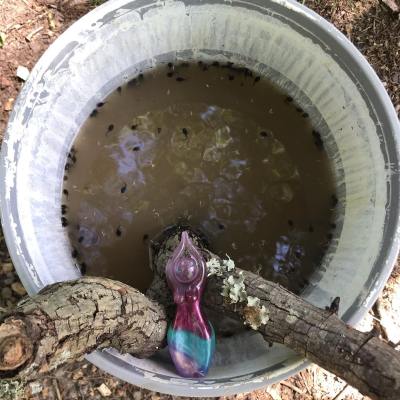
Rescue tadpoles from the evaporating puddle
in the driveway.
Look for pink roses in the field.
Look for wild strawberries
along the road.
Listen to the crows in
the compost pile
and try to identify them
by their different voices.
Plant basil and calendula
and a few more rows of lettuce.
Examine the buds beginning
on the elderberries
and check blackberry canes
to see if the berries have set.
Watch the yellow swallowtail butterflies dance.
Wonder about action and apathy
and what bridges gaps.
Refuse to surrender belief in joy.
Listen for faint echoes of hope.
Feel the tender beat of humanity
pulsing in the world.
Feel the sun on your face
and water seeping
into your jeans.
Remember that even if you have to
move one tadpole at a time,
change is always possible.
It is easy to become exhausted and overwhelmed by the volume of things there are to say, the things there are to think about, to care about, to put energy into, to love, to be outraged about. I want to invite you, at the moment of this reading, to breathe it out, to let yourself come into your body right where you are this second, and put one hand on your heart and one hand on your belly. Remind yourself that you’re whole right here, right now. There is suffering and there is fear and there is pain and there is joy and there is beauty and there is life, and we can hold it all. Let yourself settle and feel, present in this moment, in this unfolding. And, with whatever you feel, whether you feel hopeless or joyful or angry or happy or thrilled or enthusiastic or creative or drained, whatever it is, with your hand on your heart, accept those feelings as okay right now: how you feel, is how you feel; where you are, is where you are; who you are, is who you are. Continue reading “Nourishing Wholeness in a Fractured World, by Molly Remer”
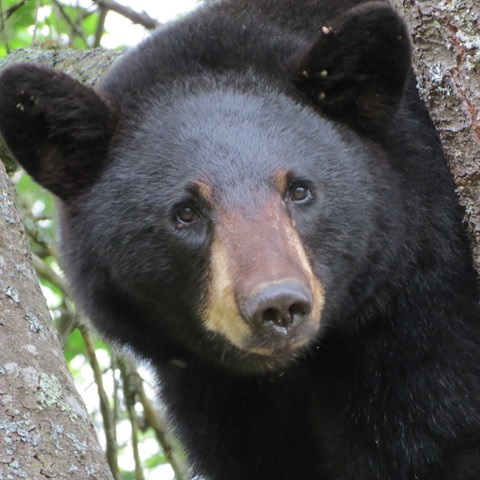
It is overcast and a few drops of rain are falling. I have been out talking to Tree Bear (TB), a yearling who has brightened my life in these dark soul days. Tree Bear comes up the mossy pine strewn path to the clearing and peeks at me from behind his white pine intermittently as he snacks.
There are so many old felled trees full of tasty grubs and ants now that the spring grasses have matured and gone by; soon the berries will ripen and Tree Bear will begin to put on weight. Acorns will be the choice of food for fall. Few people know that Black Bears are 93 percent vegetarian.
The other night I watched TB in the cherry tree, sitting in the branches like a monkey calmly combing out his thick under fur as he munched on cherry leaves and hard green cherries. He is a healthy looking and very beautiful yearling with brown eyebrows and a bump in his nose that is only visible from some angles. He probably weighs 50 – 60 lbs and has some brownish fur in places.
I don’t do well being cooped up (staying at home) all day and every day. Thankfully the state of Virginia, where I currently live, has kept their parks open during the COVID-19 pandemic. For two months, I intentionally scheduled a “green space” time into my daily routine. Usually I’d hike. Sometimes I’d just sit in the car and look at the natural scenery in front of me.
The James River at Pony Pasture Rapids was my “go-to” place during the pandemic lockdown. In addition to refreshing themselves by the river, people use Pony Pasture as their launching point for a variety of floatation devices, but mostly kayaks, to paddle around the river.
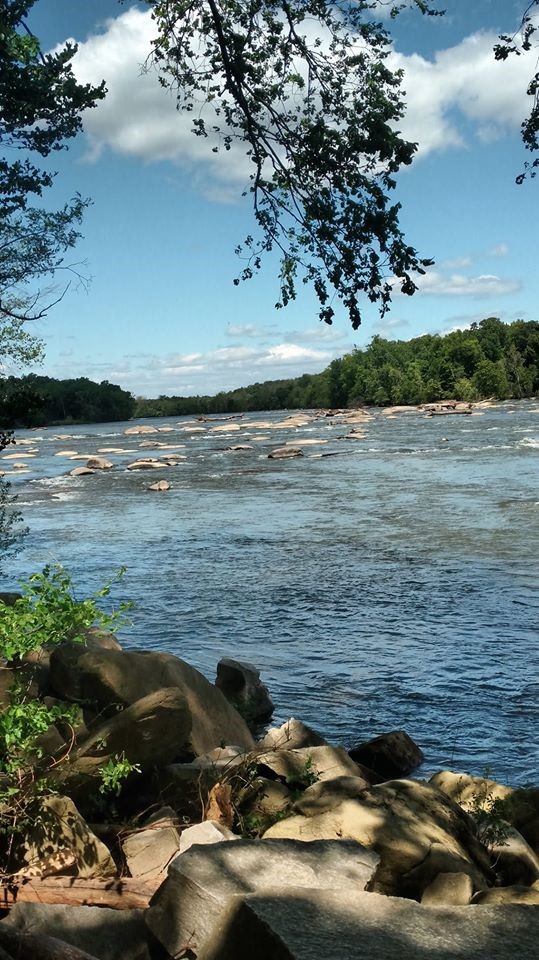
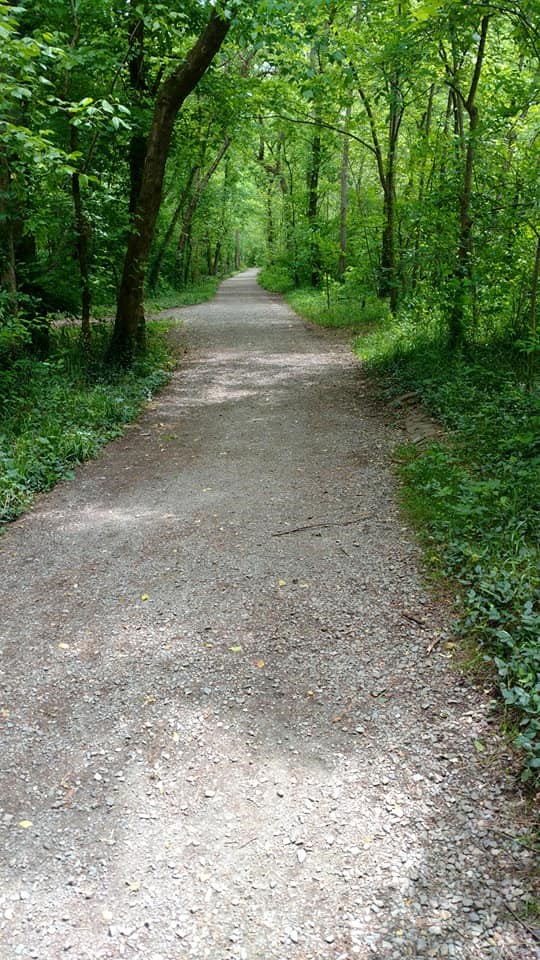
Pleasant Creek Trail is one among many paths along the James River at Pony Pasture. After meandering a half mile or so, I came upon this view. I call this scene “Entering the Emerald Forest.”
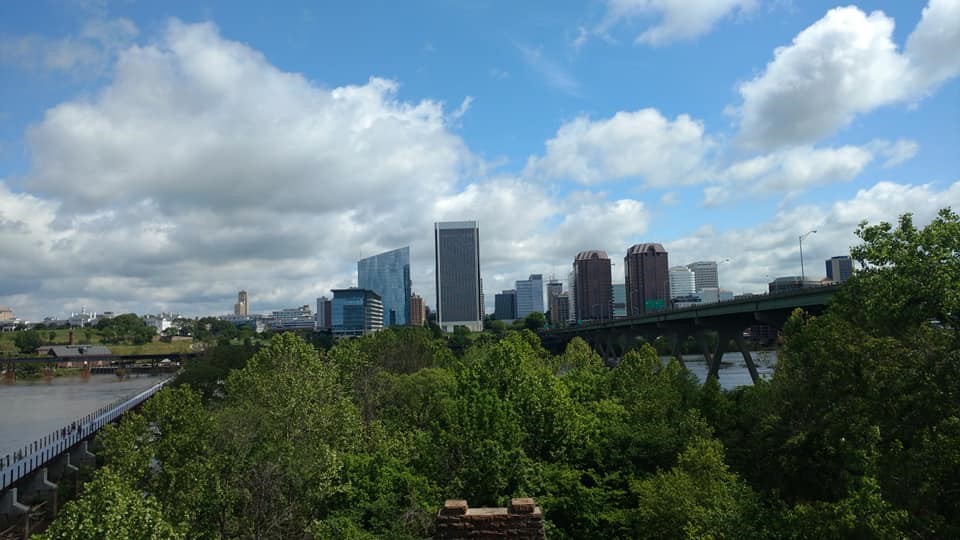
Showcasing Richmond, Virginia, in an attractive cityscape. I walked along the floodwall to capture this Richmond skyline.
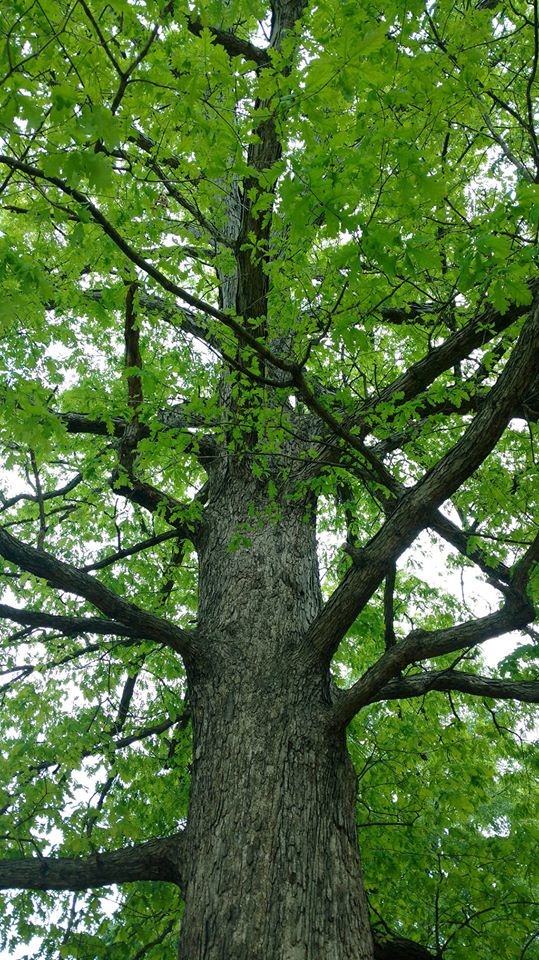
One day, I went to a local park (Maymont) and stared up at this tree like infants do with their mobiles hanging over their cribs.
Straight, sturdy tree trunk
Spreading its leafy branches
Green shelter in place
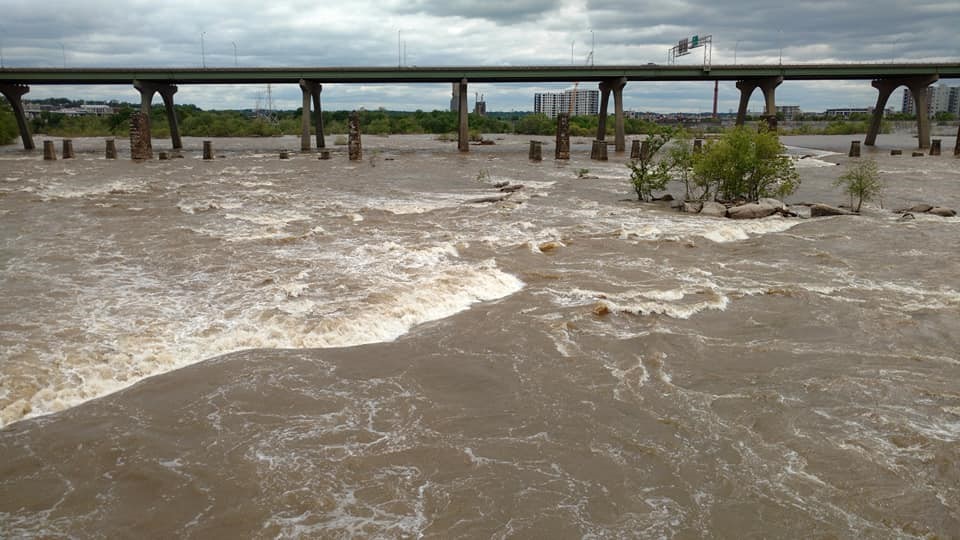
Richmond has had a goodly amount of rain this spring. This is the James River after several inches of rain throughout the state.
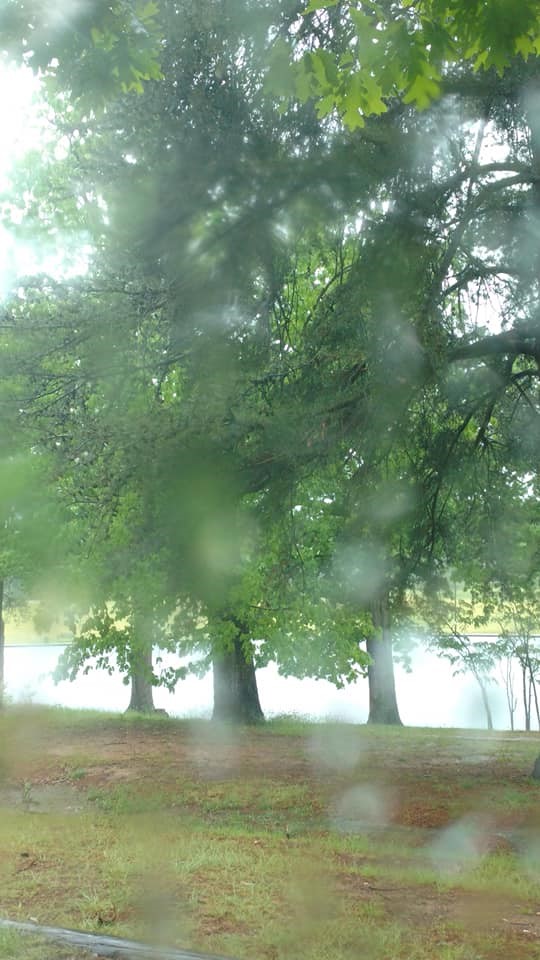
Even when the rain came, I made it a point to get out of the house, sit in my car, dream a bit, and read from my Kindle for two or three hours.
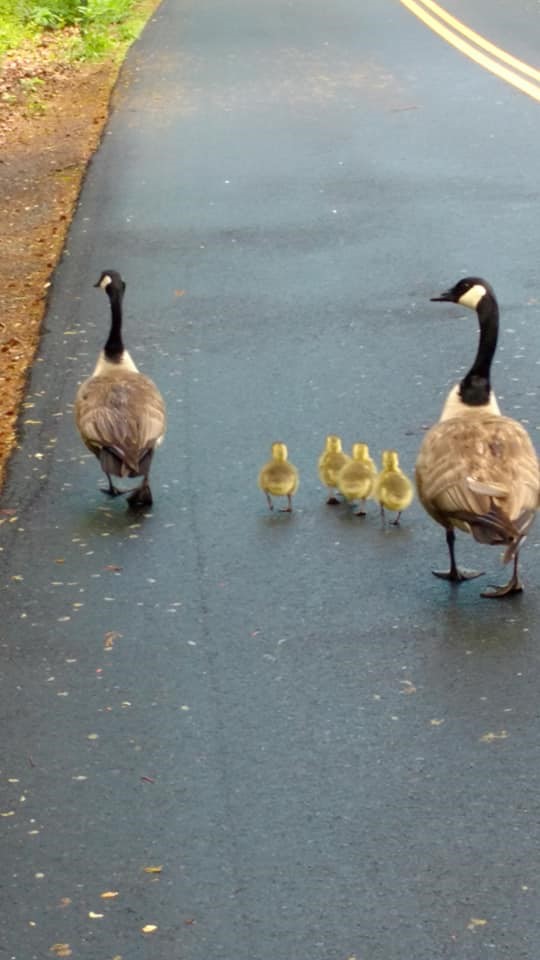
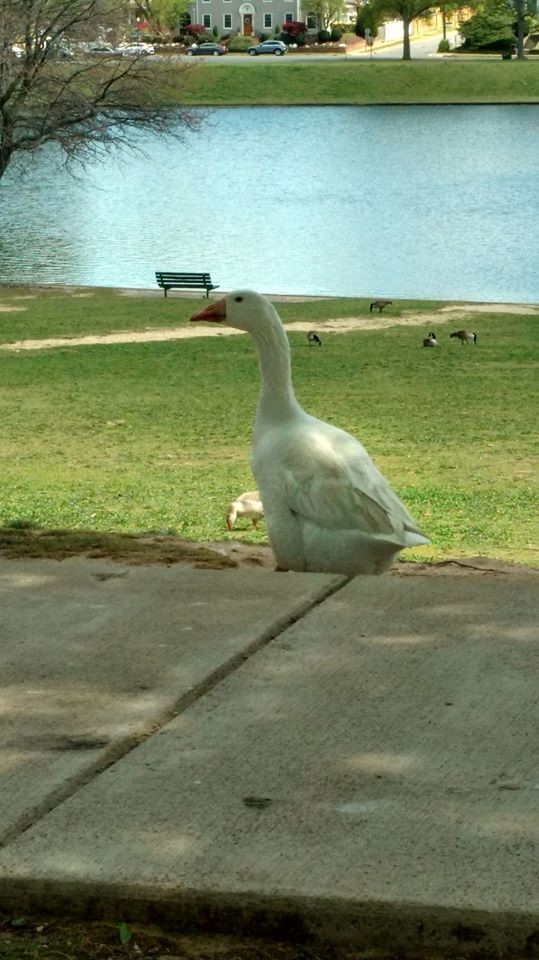
Had a visitor one day while enjoying the sunshine and breathing in fresh air at Byrd park.
Bench-sitting alone
Cold winds blowing through the trees
Mother Goose visits
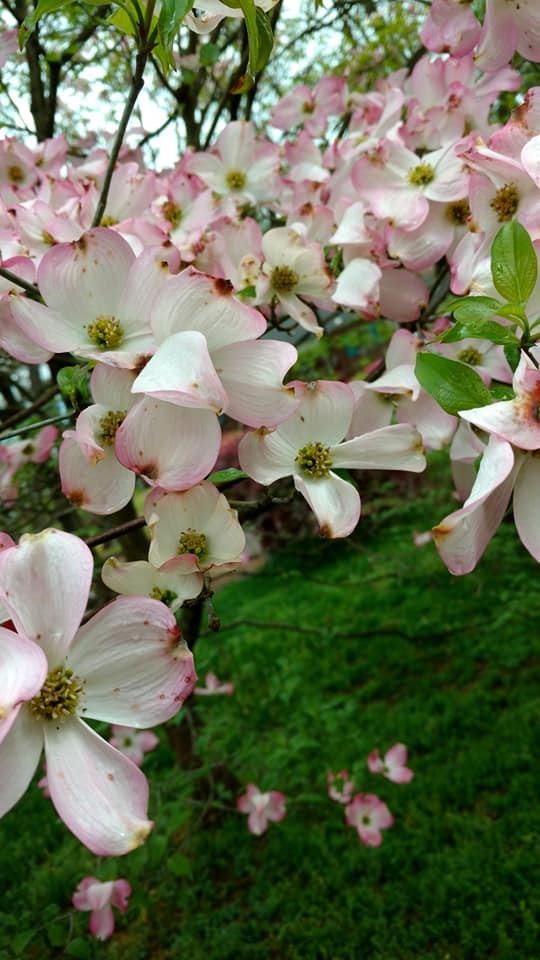
Earlier in the spring, I watched the dogwood tree bloom in my front yard.
Amidst clouds and chill
Nature still blooms pink and white
In my damp front yard
One of my favorite days at Pony Pasture Rapids put me in touch with this family.
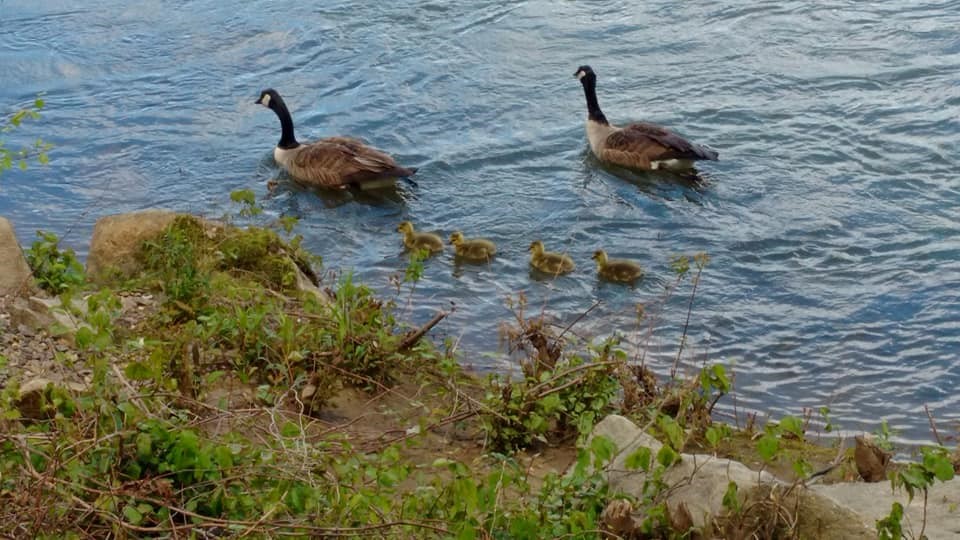
Blessed be!
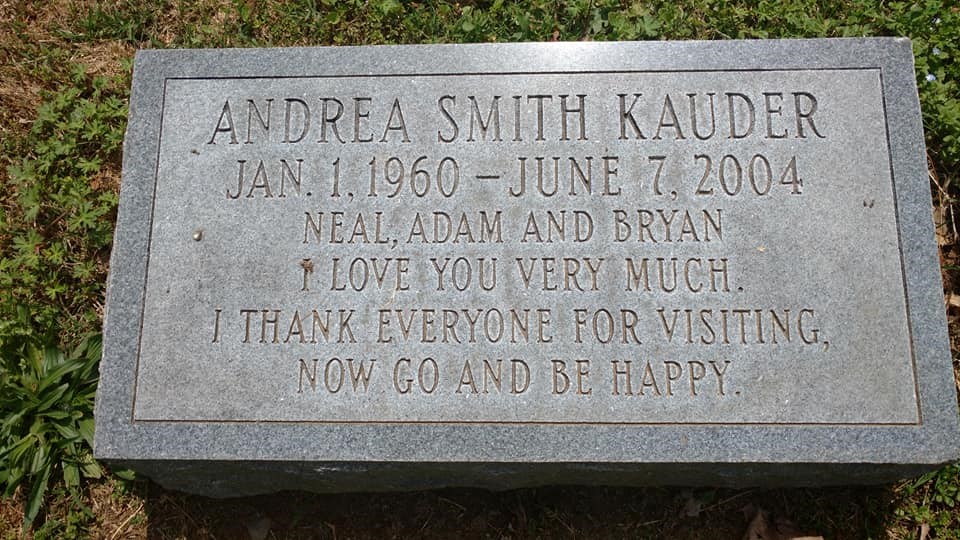
In sunnier weather, I’d visit beautiful, old Hollywood Cemetery in Richmond. From the web: “Hollywood Cemetery was designed in 1847 as a “rural” style garden cemetery to escape the grid-like monotony of city cemeteries. Landscape architect, John Notman, specifically left trees and other plants untouched when designing the cemetery’s landscape in order to create a peaceful haven for Richmonders. Today, our 135 acres of valleys and hills are covered with heritage roses, stately trees, and other blooms that live up to the name of a garden cemetery. In 2017, Hollywood Cemetery was named a recognized arboretum with the ArbNet Arboretum Accreditation Program.”
One day I went hunting (and I did have to hunt!) for inscriptions that made me take notice. There’s such a paucity of creative, interesting text on tombstones. Of those I’ve seen so far, Andrea Smith Kauder’s is my favorite. “Neal, Adam and Bryan–I love you very much. I thank everyone for visiting. Now go and be happy.” Andrea died as a relatively young woman—44 years old. I think I would have enjoyed knowing her.
And, I’m moving again! Going to a condominium just three miles down the road from my current address in Richmond, Virginia. Wonder where in the world I will eventually land. I can’t seem to settle down in any one spot. Here I am scrubbing the floor of my new condo in preparation for move-in. My only green space on this day was the green gloves I used to protect my hands during the onerous chore.
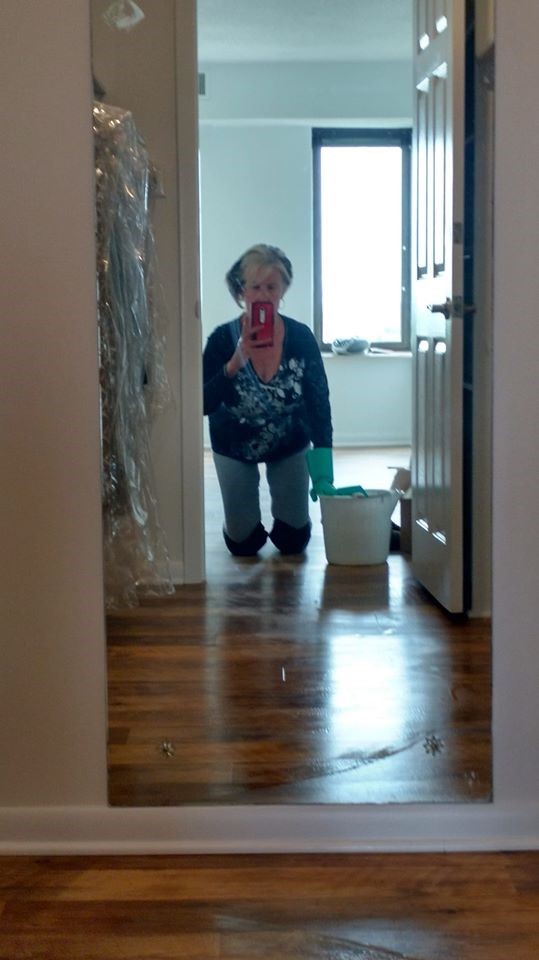
My grandmother, Jessie, often told me, “Only way to clean a floor, honey, is to get on your hands and knees and scrub.” Jessie was right. Perhaps a fitting text on my tombstone might reflect the necessity of women’s domestic labor to keep the wheels of society moving.
She cleaned like a fiend
Hoping…yes, always hoping
For a little dirt.
Esther Nelson is an adjunct professor at Virginia Commonwealth University, Richmond, Va. She has taught courses on Human Spirituality, Global Ethics, Christian-Muslim Relations, and Religions of the World, but focuses on her favorite course, Women in Islam. She is the co-author (with Nasr Abu Zaid) of Voice of an Exile: Reflections on Islam and the co-author (with Kristen Swenson) of What is Religious Studies? : A Journey of Inquiry.

Brother Francesco, known to the world as Saint Francis of Assisi, left us many sweet and lovely poems and songs. In “The Canticle of the Sun,” he wrote about the gifts of nature. Brother Sun, his light and radiance.Sister Moon and Stars for their beauty.Brothers Wind and Air, through fair skies or storms. Sister Water for her humility, purity, and usefulness. Brother Fire, who lights the night, is playful and strong. And Sister Death, whom no one living can escape. And, of course, he included:
Praised be You my Lord through our Sister, Mother Earth who sustains and governs us, producing varied fruits with coloured flowers and herbs.
Mother Earth. We live on her, we eat what she provides, we use what wondrous supply she shares with us, and….
We are not the kindest of children. We are not always so Grateful for what our Mother so generously lends to us. Because it is a loan. Do not be mistaken. Mother Earth is not a bottomless well of giving. She is a Mother with expectations; a Mother who gives and then wants to see us give back.
I recently returned to Maine after what can only be called a harrowing journey from the Southwest. Grateful to feel beloved earth under my feet, I walk along the pine strewn woodland paths to keep myself sane. My animals have been ill, my neighbor was hospitalized briefly, other neighbors deliberately destroyed my garden wall crushing a baby balsam, and used this property as their personal ski slope, the threat of the C/virus looms – there are no words to describe this kind of exhaustion. As a PTSD survivor all my senses are on permanent scream. The simplest task has become monumental. And I am only one of so many…
Each day I attempt to feel gratitude for what is good in my life.
Momentary peace is found in the Dark Green Religion of Hope that I experience walking under every balsam, lichen, wet leaf, deciduous tree, listening to chickadees, phoebes, juncos, and finches, meandering along the swollen brook – Just to see clear mountain waters rushing to the sea reminds me that Nature’s rhythms are my own, and that most of the time I am not breathing with her – unless I take these walks. Somewhere along the way over these last weeks I have lost access to my body (PTSD). Continue reading “La Llorona and the Dark Green Religion of Hope by Sara Wright”
My previous post on this site, Trauma Healing through Communal Dance, on February 1, told of a traumatic event and its lingering effects, including insomnia, brain fog, nightmares, tearfulness, migraines, anxiety, and fear. Now I’m hearing reports of similar symptoms from virtually all of my friends who are affected by the trauma of the coronavirus pandemic.
Three months ago, Greek communal dance helped me recover from my traumatised state. Now, nobody has access to communal practices like circle dance to help us get through it.
So how do we heal when we all need healing? When we don’t have access to the things which would normally help us heal?
Circle Dance with Laura Shannon, Germany 2008 (photo: Beate Frey)
There is a lot of talk right now about strategies, small and large, which can keep us sane in this crazy time. Many speak of the ‘silver linings’ we can find in this enforced retreat, and I have found a few myself. But I have also heard from people who aren’t in a safe place, or who just aren’t coping well.
Even if you are blessed with a peaceful home, access to nature, and continuing income, not everyone is made for isolation. The lockdown can be particularly hard on extroverts. And many people may find that high stress levels in this time of separation, loss, and uncertainty awaken old ghosts of unhealed trauma.
My earlier blog named some of the therapeutic aspects of communal circle dance, including connection with others, shared movement synchrony, realignment with ‘my self, my body, my place between heaven and earth, and my home in the human community.’
Armenian Candle Dance with Laura Shannon, Findhorn 2015 (photo: Hugo Klip)
As I wrote in Medusa and Athena: Ancient Allies in Healing Women’s Trauma, “Past trauma can be transformed through ‘physical experiences that directly contradict the helplessness, rage and collapse that are part of trauma’ and which foster a renewed sense of self-mastery. Because trauma tends to be experienced in ‘isolated fragments’, treatment particularly needs to engage the entire organism, ‘body, mind, and brain’.”
So, dancing is perfect. Circle dance, particularly, is my ideal method of trauma healing. But how can we dance without a circle?
A lot of us are dancing on platforms including Skype and Zoom, but the slight time lag with this technology means that true synchrony is impossible; everyone’s movement appears slightly off the beat. Nevertheless, I love seeing cherished faces, talking together, and dancing despite the distance.
My favourite way to dance ‘in circle’ is without any online technology, simply connecting in heart and spirit. Since the start of the lockdown, my network of dance students, friends, and colleagues in different countries have been ‘meeting’ at set times twice daily, and it is deeply moving to join together in this way. We light a candle for loved ones, health workers, key workers, and anyone who is unwell or needs extra support at this difficult time. Then we each dance the same sequence of circle dances, plus our personal favourites. Knowing that my friends are all dancing in their own homes, and that we are all thinking of each other at the same time, is very precious.
Candle (photo: Laura Shannon)
If you too are separated from your loved ones, you can choose a time every day to stop what you are doing so you can think of one another, with no need for online technology. You don’t have to dance; just put on your favourite music and know you are connected.
Doing things you love can also provide an antidote to trauma – cooking favourite foods, lovingly repotting houseplants, or embarking on a fun creative project – anything you enjoy can connect you to your own power and experience of mastery as a source of healing. With my housemates here in Canterbury, we created a beautiful Easter feast – twice, first for Western and then for Orthodox Easter – with photos of our missing loved ones on the table. It was such a simple act, but nourishing on so many levels.
Time in nature connects us with the flow of life force which is in each of us. As we walk outdoors, feeling the earth below and the sky above, we can remember when we have come through challenges in the past, and let those memories reassure us that we will come through this now too. It was the same earth under our feet then, and it’s the same sky around us now and so it will be in the future when all of this is behind us.
Trees (photo: public domain)
Sometimes a larger crisis, like this pandemic, can put things in perspective, and bring us closer to forgiveness and healing. To support this inner process, I have found the Hawaiian indigenous practice of ho’oponopono to be very powerful. Hawaiian scholar and educator Mary Kawena Pukui describes it as a practice of forgiveness and reconciliation, for family members to ‘make right’ broken relations and prevent problems from erupting.
What can we do to foster forgiveness, move beyond blame, and focus on what we have in common? One recent story on the Karuna website tells how rival gangs in South Africa are now cooperating to deliver food to the vulnerable in their community. Amazing!
There is always something we can do, for ourselves and for others. And let’s not forget the larger context: life as we knew it has hit the pause button, and we have a chance to make some different choices in preparation for when we once again press ‘play’. Maybe we will find that all of us – and all of humanity – are suddenly dancing to a more beautiful tune.
Laura Shannon has been researching and teaching traditional women’s ritual dances since 1987, and is considered one of the ‘grandmothers’ of the worldwide Sacred / Circle Dance movement. She trained in Intercultural Studies (1986) and Dance Movement Therapy (1990), and is currently pursuing postgraduate studies in Myth, Cosmology, and the Sacred at Canterbury Christ Church University in England. Her primary research in Balkan and Greek villages seeks out songs, dances, rituals and textile patterns which descend from the Goddess cultures of Neolithic Old Europe, and which embody an ancient worldview of sustainability, community, and reverence for the earth. In 2018 Laura was chosen as an Honorary Lifetime Member of the Sacred Dance Guild in recognition of her ‘significant and lasting contribution to dance as a sacred art’. Her articles and essays on women’s ritual dances have appeared in numerous publications, including Re-Enchanting the Academy, Dancing on the Earth: Women’s Stories of Healing Through Dance, She Rises! Vol. 2, Inanna’s Ascent, Revisioning Medusa, and Spiritual Herstories – Call of the Soul in Dance Research. Laura is also Founding Director of the non-profit Athena Institute for Women’s Dance and Culture. She lives in Canterbury, Greece, and the Findhorn community in Scotland.
Medusa and Athena: Ancient Allies in Healing Women’s Trauma in Revisioning Medusa: from Monster to Divine Wisdom, edited by Glenys Livingstone, Trista Hendren and Pat Daly. Girl God Press, 2017, 206-222. www.thegirlgod.com. This excerpt cites Bessel Van der Kolk, The Body Keeps the Score (2014), pp 4, 40, 53.
Mary Kawena Pukui Karuna website: This site collects positive stories in the time of coronavirus. ‘Karuna’ is a Sanksrit word meaning compassion. Their site motto: ‘Karuna spreads faster than corona.’
I awakened this morning to frozen raindrops hanging from trees – jeweled beads, snow capped hills, and a cacophony of spring songs – I was serenaded by robins, chickadees, phoebes, goldfinches, and nuthatch tweets as I walked out the door into the early morning sun. I listened for the cardinals, who for the moment were absent. It was cold! 28 degrees at the end of April speaks to anomalies, or more realistically, Climate Change.
Yesterday we had rain, and working in the still damp air is literally a healing experience. The fragrance is a combination of chemicals released by soil-dwelling bacteria, oils released from plants during dry spells and ozone created when lightning splits oxygen and nitrogen molecules that then turn into nitric oxide.
I dug in baby trees that I had rescued from the side of the road the day before. Salt kills tender cedar seedlings if the road crew misses slaughtering them. Around Maine trees are worthless except as an economically viable product, a heartbreaking reality for someone like me. Continue reading “Earth Day Reflection by Sara Wright”
Over the past few weeks of lockdown in Greece, I have asked myself numerous times: if we can shut down the world economy because of a virus, why don’t we shut everything down until we end war or find real solutions to global climate change? In my mind the horrors of war are much worse than the horrors of disease and dying and the threat and reality of global extinctions pose a much greater threat to humanity (not to mention nature) than the Coronavirus.
Why is it that we are willing to take extreme measures to defeat the Coronavirus but we are not willing to take extreme measures to end war or to stop global climate change? A thought keeps creeping into the back of my mind: the fight against disease and death is (understood to be) a fight against Mother Nature and (sadly) we are well used to fighting against Her. If we recognized that human beings have brought the Coronavirus upon ourselves, we would have to face up to our responsibility for it. Continue reading “Coronavirus: The Villain Is Not Mother Nature: It Is Ourselves by Carol P. Christ”
In 2016, Zlinszky (Zlinszky/Molnar/Barfod) and his team released another study demonstrating that birch trees go to sleep at night (now we know that all trees – at least all the trees that have been studied so far – do sleep at night).
Trees follow circadian cycles responding primarily to light and darkness on a daily cycle. The researchers believe the dropping of birch branches before dawn is caused by a decrease in the tree’s internal water pressure while the trees rest. With no photosynthesis at night to drive the conversion of sunlight into simple sugars, trees are conserving energy by relaxing branches that would otherwise be angled towards the sun. Trees increase their transpiration during the morning, decreasing it during the afternoon and into the night. There is a change in the diameter of the trunk or stem that produces a slow pulse. During the evening and the night tree water use is declining, while at the same time, the stem begins to expand again as it refills with water.
When trees drop their branches and leaves its because they’re sleeping. They enter their own type of circadian rhythm known as circadian leaf movement, following their own internal tree clock. Continue reading “Trees Sleep? by Sara Wright”