When I was a child in the 1950s we often played cowboys and Indians. There is a photograph of my brother and me in no doubt inauthentic costume complete with feathered headdress. In kindergarten I named myself Morning Star. (I just googled and see that I must have gotten the name from the 50s television series Brave Eagle, the first with an indigenous main character. Morning Star is the female lead.)
When I was a teenager, my aunt came across a privately printed book The Gentleman on the Plains about second sons of English aristocracy hunting buffalo in western Iowa. My great grandfather accompanied them as their clergyman. I wish I could find that book now to see how this enterprise was presented. In my adolescent mind these “gentlemen” looked like the local foxhunters in full regalia. On opening morning of foxhunt season an Episcopal clergyman (like my father) was on hand in ecclesiastical dress to bless the hunt and then invited to a boozy breakfast. Continue reading “Forgive Me My Ancestor(s) by Elizabeth Cunningham”
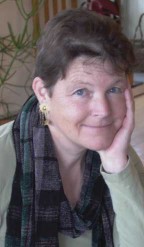
For almost 35 years nature has been my sacred place. As an 8-year old, I started to pray to Mother Earth even though the protestant tradition in which I grew up only recognised ‘God the Father’. I went outside in my inflatable rowing boat to seek solitude (as an only child in a quiet family!) on a small island in the lake of our local park. I practised rowing and walking quietly to not break the sacred silence. I collected herbs to brew infusions in my little thermos flask with boiled water brought from home. I sung to the moon, and danced my love for all creation back through my moving body. Over the last 15 or so years, I spent many days and nights at Neolithic monuments, dreaming in ancestral burial mounds, time traveling in stone circles in Cornwall, Wales, Scotland, England, Ireland and Brittany. This nature-based practice evolved naturally, and later incorporated my training with the Scandinavian Centre for Shamanic Studies and the School of Movement Medicine. Nature is where I reconnect most easily with the Sacred, and listen to the whispers on the great web of life in which all of nature is a great teacher. Nature, for me, is a strong place of prayer, solace, awe, reverence, gratitude, joy, guidance, reconnection, healing and transformation.
Rowing contemplation Image credits Henk Kieft
Yet I am confused. I am confused because although this way of connecting to the mystery feels the most natural and innocent thing in the world to me, my practice is criticised as “playing Indian” because I did not happen to be born into one of the indigenous traditions that kept nature-based (“shamanic”, for want of a better word) practices alive. Critique includes cultural appropriation in relation to colonialism and white privilege, as well as that any form of spirituality outside the five major religions is considered as empty, eclectic, post-modern consumerist product that lacks meaning and substance because of its diluted, selective ‘picking’ of traditions from other times and contemporary contexts. Continue reading “Who Owns the Sacred? A Personal Search beyond (European) Indigenous Knowledge by Eline Kieft”
When I walked into the space a bolt of light shot across the room and struck me so forcibly that it felt like it shattered the cells beneath my skin. Did this occur before I glimpsed her bronzed moon shaped face? I will never know. I sat down almost in front of her, sizzling with the uncomfortable buzz that seizes my nervous system when what I call, the Powers of Nature, have taken over my body/mind. I gazed at her in a dazed sort of way. She wore silver and white, and the two sharply contrasting hues shone so brilliantly my eyes ached…
As she began to speak about the Navajo Blessingway, I drifted effortlessly into a light trance in spite of the static. Honeyed words poured out of her mouth as she slipped from her Native Dine’ language into English and back again; creating a profound musical intonation that made it difficult for me to concentrate on the stories. Initially. All that music. Layers upon layers. I had entered the Forest of Enchantment. Continue reading “The Storyteller by Sara Wright”
On Holy Ground is a collection of icons for this age of climate change. The collection of iconography opens with an image of Mary of Swords inspired by the number seven. This sacred number is associated with intuition, mysticism, inner wisdom, and a deep inward knowing. The ancient church speaks of seven deadly sins and seven holy attributes, and seven sacraments. The composition places the planet Earth beside Mary as she bows her head having been told, “ a sword will pierce Your own Soul ”
Mary of Sorrows or in this case, Mary the softener of Evil Hearts tilts her head lovingly towards our planet Earth. Seven swords pierce her heart; indicating the fullness and boundless sorrow, pain and “sickness of heart” that would have been experienced by Mary the Mother of Jesus at His crucifixion.
Muslimspilgrims circle the Kaaba in Mecca sevens times, and Egyptians had seven gods.
In the precious hour before dawn I walk down to a river that no longer empties into the sea – the circle of life has been broken – the earth’s veins and arteries are hopelessly clogged by human interference (stupidity) – the birds and animals that used to be able to rely on the river waters for food and resting places can no longer do so because dams control the water flow and westerners “own” the water. This morning black stone sculptures appeared overnight because the water level has been dropped another foot. And yet, acknowledging the flowing waters in their death throws seems like an important thing to do. For now, at least, the river turns crimson, reflecting the raging beauty of a pre dawn sky, and I am soothed by water rippling quietly over round stone.
I open the rusty gate to enter the Bosque, a place of refuge, for the cottonwoods and for me. Now I am surrounded by desert scrub and graceful matriarchs arc over my head. As I traverse the well – trodden path I enter a meditative state without effort. Soon I am walking in circle after circle passing through the same trees and desert scrub hearing voices.
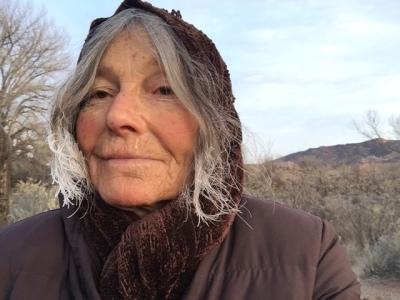
This morning the sky was on fire before dawn even as I approached the river whose ripples reflected a purple so deep it was almost inked in charcoal – In the Bosque I noticed that one mule deer had used a juniper to scrape his antlers. Otherwise the Earth emanated precious predawn stillness except for the sound of receding river waters slipping over cobbled stones. It was mild; I thought today might be the day…
The greens I had tipped in prayer and gratitude on ‘the mountain where bears live’ were waiting to be woven into wreaths, and by afternoon the temperature was warm enough for me to sit on the porch under a milky December sun with my clippers and bag of greens.
The sweet scent of pinion wafted through the air as I began to weave my circle of life with pinion, fir, and spruce. I wove carefully cutting smaller fronds without thinking about what I was doing, but beneath my quiet mind an intention was being set to weave a new kind of wholeness back into the trees, back into our broken Earth; S/he who is crying out to be heard through each raging fire, crackling drought, mud ridden flood. My greatest fear is that no one is listening.
She came on the wings of the Owl flew out of the crack of our imagining, swooped low over the underground forest hooing, hooing, hooing screeching and clacking – Haunting the night with her song.
I almost didn’t recognize her inside the feathery brown cape with bars.
On Starry nights while the white moon sleeps the cloak falls away and behold! She steps out in all her Firebird splendor. Burning, crimson, gold, she crackles — turns blue white light torching the fire turned star. Beaming second sight she rises out of Earthen ashesContinue reading “Firebird’s Song by Sara Wright”
“The classroom remains the most radical space of possibility in the academy.”-bell hooks
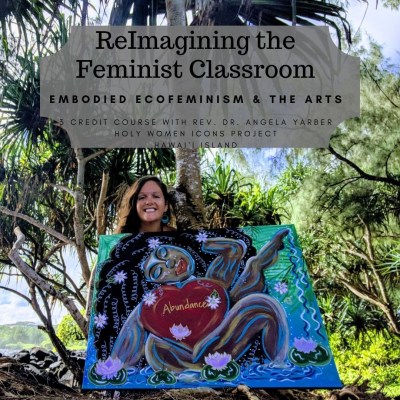
Like many academics, my “in the box” dream was to be a professor. The full-time, tenured kind. Like many queer feminist academics, I know that such dreams are rarely reality. When you’re also an artist and activist with a strong penchant for wanderlust, these dreams are simply unattainable fairytales. Never one for “in the box” living, I left the traditional academy and traditional church years ago, wandering over the garden’s walls with Lilith as my intrepid guide. I’ve told the story before. My wife and I left our jobs, sold our home, traveled full-time with our toddler, and turned the Holy Women Icons Project into a non-profit while building an off-grid tiny house on the television show Tiny House Nation in Hawai’i. It’s become old news. But since we’ve been doing this for several years now, those faraway dreams are finally starting to become reality. The academic classroom, the activist’s platform, the artist’s studio, the feminist’s megaphone, and the farmer’s orchard are fusing into one creative, life-giving, empowering space for teaching. The Holy Women Icons Project’s first academic course, “Embodied Ecofeminism and the Arts,” is actually happening. Seminarians and doctoral students from Berkeley join us in January. They’re soon followed by undergraduates from New York and seminarians from Atlanta. And I’m reaching out to more and more schools interested in creatively, subversively, and sustainably decolonizing the classroom with us for one week on the Big Island.
I was one of millions inspired by Greta Thunberg’s speech to the United Nations. In her usual courageous fashion, she spoke plain truths all adults need to hear about our failure to assure a future for generations of all creatures. Yet you all come to us young people for hope? How dare you? she rebuked us. How dare you?
The beginning of her speech actually struck me the most. This is all wrong, she said. I shouldn’t be up here. I should be back in school, on the other side of the ocean. Her words echoed the words of the small, simple hobbit Samwise in Lord of the Rings, as he and Frodo journey into the terrifying, almost certain death of Mordor. In the film, Sam says: It’s all wrong. By rights we shouldn’t even be here.Continue reading “From the Biblical ‘Woman on Fire’ to Female Kurdish Fighters: The Women Who Mama Up by Tallessyn Zawn Grenfell-Lee”
Yesterday I gave a poetry reading at a local library beginning and ending with thoughts about how Climate Change is affecting all living things. I am a naturalist who holds the radical belief that all living things are sentient. I also argue that we must not equate animal intelligence with that of humans.
Almost every poem I read was about my intimate relationship with some aspect of the natural world, for example, the changing seasons, my friendship with sagebrush lizards, steadfast trees, Sandhill cranes, beloved Black bears. Intimacy and inter –relationship are part of every experience I have with nature and by sharing these poems I hoped might draw others in to new ways of perceiving the earth and her creatures.
The whole point of my focusing on non – human species was to raise awareness that these animals and plants desperately need our help. Perhaps I wasn’t clear enough about how critical it is to bring animals, plants, trees, mushrooms into the picture in this age of the Anthropocene, that is, the period in which we live where a few men with power rule. Today, it is not an exaggeration to say that humans control every aspect of our fragile planet.
I repeat: Perhaps I wasn’t clear enough or perhaps almost no one was capable of listening? Maybe both. As soon as I concluded my reading one woman did actually bring up an incident involving a very difficult child who became attached to a lizard, so she at least, was on the track I hoped I had laid….


 For almost 35 years nature has been my sacred place. As an 8-year old, I started to pray to Mother Earth even though the protestant tradition in which I grew up only recognised ‘God the Father’. I went outside in my inflatable rowing boat to seek solitude (as an only child in a quiet family!) on a small island in the lake of our local park. I practised rowing and walking quietly to not break the sacred silence. I collected herbs to brew infusions in my little thermos flask with boiled water brought from home. I sung to the moon, and danced my love for all creation back through my moving body. Over the last 15 or so years, I spent many days and nights at Neolithic monuments, dreaming in ancestral burial mounds, time traveling in stone circles in Cornwall, Wales, Scotland, England, Ireland and Brittany. This nature-based practice evolved naturally, and later incorporated my training with the Scandinavian Centre for Shamanic Studies and the School of Movement Medicine. Nature is where I reconnect most easily with the Sacred, and listen to the whispers on the great web of life in which all of nature is a great teacher. Nature, for me, is a strong place of prayer, solace, awe, reverence, gratitude, joy, guidance, reconnection, healing and transformation.
 When I walked into the space a bolt of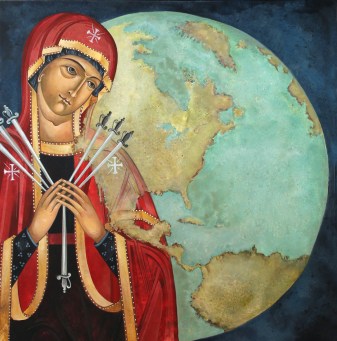
 This morning the sky was on fire before dawn even as I approached the river whose ripples reflected a purple so deep it was almost inked in charcoal – In the Bosque I noticed that one mule deer had used a juniper to scrape his antlers. Otherwise the Earth emanated precious predawn stillness except for the sound of receding river waters slipping over cobbled stones. It was mild; I thought today might be the day…
 I was one of millions inspired by Greta Thunberg’s
 Feminism and Religion